Example code
A phosphorylation network's steady concentrations do not determine whether disturbances decay or develop into oscillations. This example retains the enzyme–substrate complexes that temporarily hold kinase and phosphatase. Changing a matched binding–dissociation pair preserves the equilibrium, productive fluxes and static reduction, yet changes stability.
The reference three-site model has a freshly certified supercritical Hopf point at r ≈ 1.43323: the equilibrium loses stability and nearby attracting oscillations emerge. At r = 1, numerical shooting finds a cycle with period 39.5907 and a free fully phosphorylated substrate swing of about 3.349. Eliminating every complex removes this instability; eliminating just the fast C2 complex preserves a nearby Hopf point when its induced cubic term is retained.
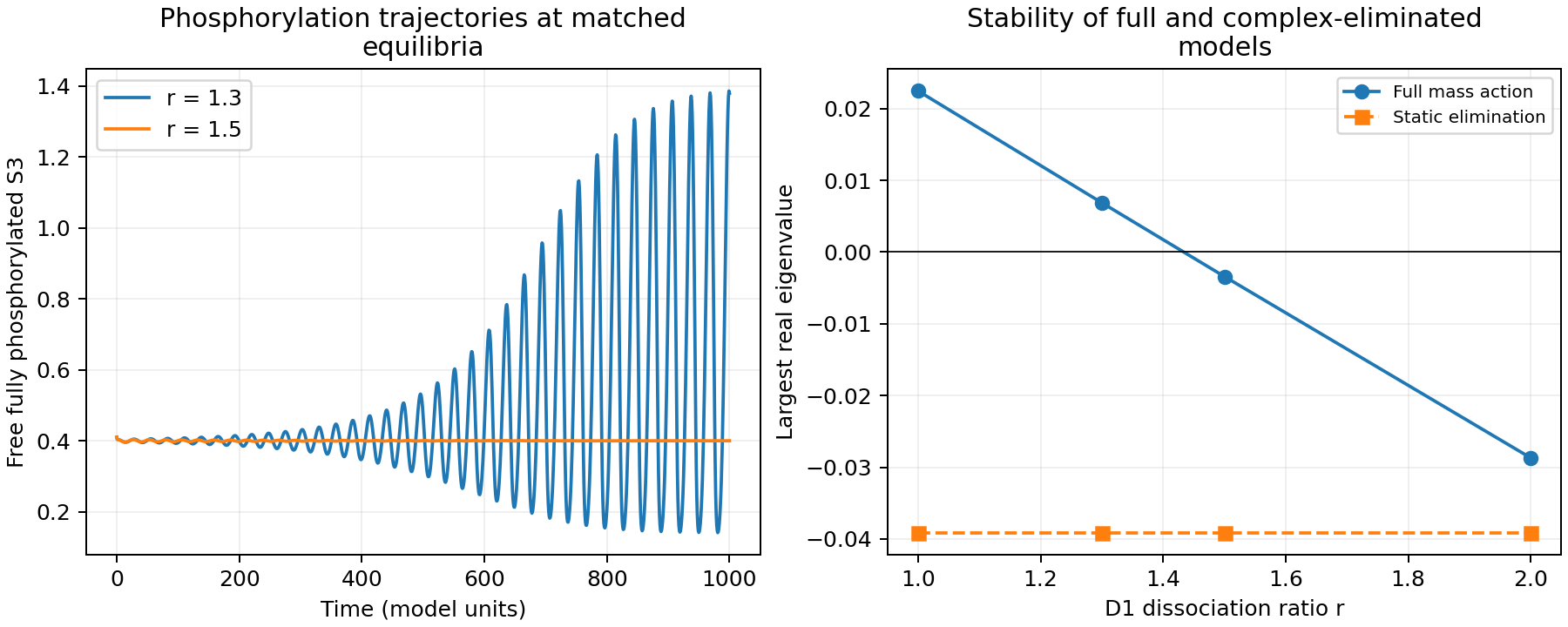
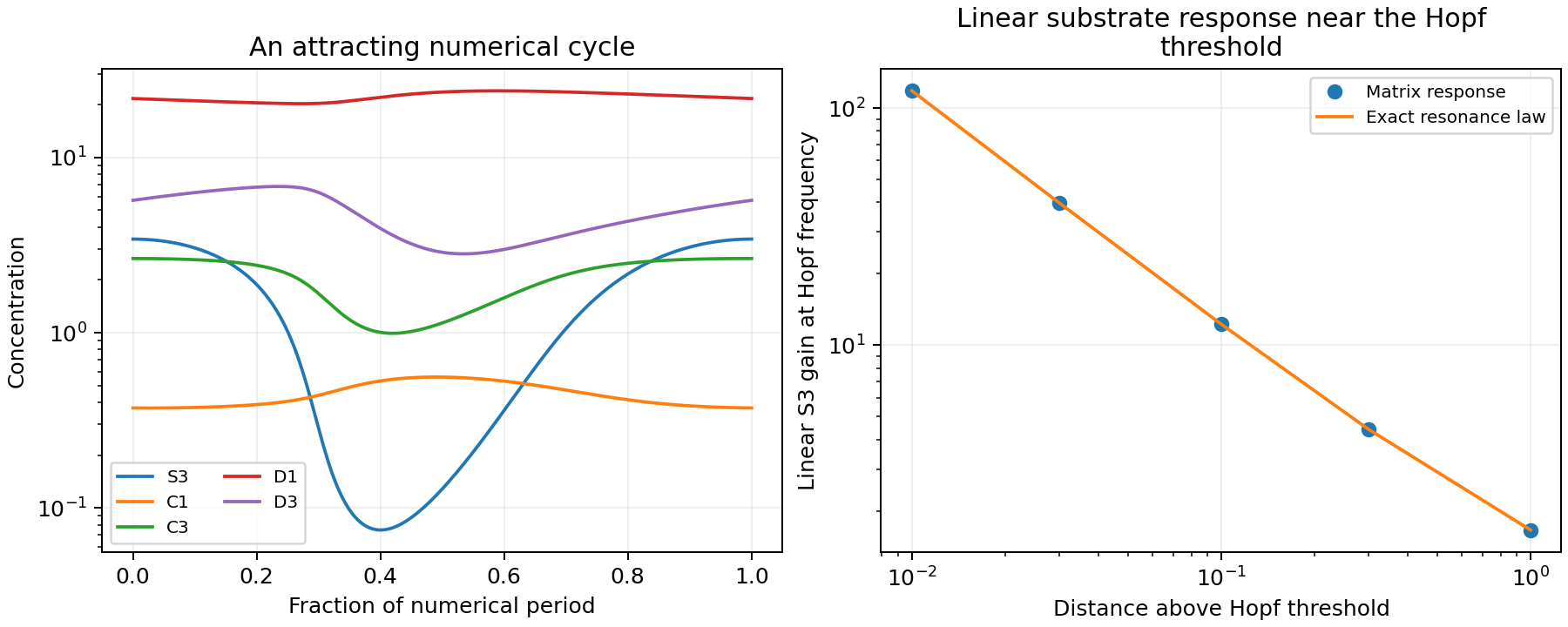
Editable equilibrium concentrations, productive fluxes and reverse ratios feed reusable design and reactor classes. The package supports arbitrary site count, new rate arrays, enzyme buffering, complex relaxation, reversible catalytic currents and binding protocols. Saved trajectories, flux ledgers and dynamic-readout comparisons make those components inspectable and reusable.
The attributed manuscript kernel replays exact polynomial isolation and rational interval calculations for the attracting and subcritical witnesses, a buffered-kinase case, an added site and the C2 reduction. Numerical simulations, shooting and Floquet spectra are labeled separately. The paper's finite-amplitude interval orbit proofs, uncertain pulse proof and Lean development are not rerun.
The optional dimensional reading is illustrative, not calibrated biology. The driven reversible construction changes designed chemical potentials together with the driving parameter; it does not establish a finite-fuel oscillator or a numerical threshold for persistence.
Python source
"""Full multisite phosphorylation: identical static behavior, different dynamics.

Run python example.py. Inputs below are dimensionless paper witnesses, not fitted
biochemistry. Output JSON distinguishes freshly certified facts from numerics.
"""
# ------------------------- EDITABLE INPUTS -------------------------
SUBSTRATE=('2','12','1/5','2/5')
FREE_KINASE='23/10'
FREE_PHOSPHATASE='2/5'
KINASE_COMPLEXES=('23/50','3/10','17/10')
PHOSPHATASE_COMPLEXES=('23','9/50','4')
PRODUCTIVE_FLUX=('1/10','32/5','6/5')
KINASE_REVERSE=('1/100',)*3
PHOSPHATASE_REVERSE=('1','1/100','1/100')
REVERSE_PARAMETER_SWEEP=(1.,1.3,1.5,2.)
TRANSIENT_TIME=1000.
ORBIT_PARAMETER=1.
ORBIT_PERIOD_GUESS=39.59
ADDED_SITE_LOADS=('1/100',)
REVERSIBLE_DRIVE=20.
CONCENTRATION_UNIT_MICROMOLAR=.1
TIME_UNIT_SECONDS=100.
OUTPUT_DIRECTORY='outputs'
# Certificate reference cases A, H, C2 reduction and site addition are fixed
# paper reproductions; edits above change the separate exploration model.
# ------------------------------------------------------------------
import argparse,csv,hashlib,json,platform
from pathlib import Path
import numpy as np
import sympy as sp
from scipy.signal import find_peaks
import phos
from reactor import EquilibriumDesign,MassActionReactor,ConstantBinding

MANUSCRIPT_SHA256='7a0bbd174ad9a01c8765e169ed4dc1541cb7680dd3fd18d8f4529569f52c87d9'


def design():
    return EquilibriumDesign(SUBSTRATE,FREE_KINASE,FREE_PHOSPHATASE,KINASE_COMPLEXES,PHOSPHATASE_COMPLEXES,PRODUCTIVE_FLUX,KINASE_REVERSE,PHOSPHATASE_REVERSE)


def certificate_record(c):
    keys=('t','r','omega','crossing','l1','eps_derivative')
    return dict(evidence='Fresh exact polynomial isolation and outward-rounded rational arithmetic, using the attributed manuscript kernel; not Lean.',
        **{k:phos.bounds(c[k]) for k in keys if k in c},routh_first_column=[phos.bounds(v) for v in c['routh']],
        p0=[str(v) for v in c['p0']],p1=[str(v) for v in c['p1']],
        right_eigenvector=[phos.bounds(v) for v in c['right']],left_eigenvector=[phos.bounds(v) for v in c['left']],
        constant_coefficient_positive=c['const_coeff_positive'])


def certify_references():
    results={};raw={}
    for name,builder in [('A',lambda r:phos.witness('A',r)),('H',lambda r:phos.witness('H',r)),('A_kinase_clamped',lambda r:phos.witness('A',r,clampE=True)),('A_added_site',lambda r:phos.extended('A',r,list(ADDED_SITE_LOADS)))]:
        m=builder(sp.Rational(1,2));norm=2*m.n+2 if name=='A_added_site' else None
        c=phos.certify_hopf(builder,norm_index=norm);raw[name]=c;results[name]=certificate_record(c)
    reduced=phos.certify_reduced(lambda r:phos.witness('A',r),fast=4,norm_index=8)
    results['A_C2_eliminated']=certificate_record(reduced)
    results['A_C2_eliminated']['scope']='Local algebraic reduction with induced quadratic AND cubic terms; not a trajectory-error guarantee.'
    assert raw['A']['l1'].b<0 and raw['H']['l1'].a>0 and raw['A_added_site']['l1'].b<0
    assert raw['A_kinase_clamped']['l1'].a>0 and reduced['l1'].b<0
    c=raw['A'];m=phos.witness('A',sp.Rational(1,2));L,M,A=m.blocks();Jstatic=L*A.inv()*M
    cp=Jstatic.charpoly().all_coeffs()
    assert all(v>0 for v in cp) and cp[1]*cp[2]>cp[3]
    other=phos.witness('A',sp.Rational(7,3));L2,M2,A2=other.blocks();assert Jstatic==L2*A2.inv()*M2
    sensors={'S3':[0,0,1,0,0,0,0,0,-1],'S3+D3':[0,0,1,0,0,0,0,0,0]}
    gains,identity=phos.gain_constants(lambda r:phos.witness('A',r),c,sensors)
    from interval_arithmetic import I,C,dot
    a=-c['crossing'].re;scale=(a/(-c['omega']*c['l1'])).sqrt();amplitudes={}
    for name,v in sensors.items():
        z=dot([C(x) for x in v],c['right']);amplitudes[name]=phos.bounds(4*(z.re*z.re+z.im*z.im).sqrt()*scale)
    results['mechanism']=dict(static_characteristic=[str(v) for v in cp],static_independence='Exact at two distinct family values; row-factor cancellation proves the full static field independence.',
        resonance_constants={k:phos.bounds(v) for k,v in gains.items()},rank_one_identity=phos.bounds(identity*C(c['r'])),
        amplitude_prefactors=amplitudes,radial_recovery_prefactor=phos.bounds(2*a),
        all_n_scope='The positive-load site-addition theorem is imported; this run freshly certifies the configured finite extension. n<=2 means no Hopf, not no periodic orbit.',
        finite_amplitude_scope='Manuscript interval orbit proofs and validated pulse proof are not rerun here. Simulations, shooting, Floquet spectra and pulse trajectories below are numerical only.')
    return results,raw


def encoded(v):
    if isinstance(v,np.ndarray):return v.tolist()
    if isinstance(v,np.generic):return v.item()
    if isinstance(v,complex):return dict(real=v.real,imag=v.imag)
    raise TypeError(type(v).__name__)


def main():
    parser=argparse.ArgumentParser(description=__doc__);parser.add_argument('--output',default=OUTPUT_DIRECTORY)
    out=Path(parser.parse_args().output);out.mkdir(exist_ok=True)
    def dump(name,data):(out/name).write_text(json.dumps(data,indent=2,default=encoded)+'\n',encoding='utf-8')
    def table(name,header,rows):
        with (out/name).open('w',newline='',encoding='utf-8') as f:w=csv.writer(f);w.writerow(header);w.writerows(rows)
    reference,raw=certify_references();dump('hopf_certificates.json',reference)
    print('Fresh rational Hopf certificates: A attracting, H subcritical, kinase clamp subcritical, site addition attracting.',flush=True)
    d=design();base=MassActionReactor(d.exact());n=base.n
    if n!=3:raise ValueError('The teaching plots use a three-site starting design; the reactor classes accept arbitrary site count.')
    rows=[];trajectories={};static_fields=[]
    y0=np.zeros(base.dim);y0[2]=.01
    for r in REVERSE_PARAMETER_SWEEP:
        model=MassActionReactor(d.with_reverse(r).exact());J=model.jacobian(0,np.zeros(model.dim));eig=np.linalg.eigvals(J)
        sol,X=model.integrate(y0,TRANSIENT_TIME)
        z,uf=model.static_complexes(np.array([.001,-.001,.001]));static_fields.append(uf)
        rows.append(dict(r=r,equilibrium_residual=float(max(abs(model.field(0,np.zeros(model.dim))))),leading_real=float(max(eig.real)),
            static_leading_real=float(max(np.linalg.eigvals(model.static_jacobian()).real)),static_local_field=uf,
            minimum_concentration=float(X.min()),conservation_drift=float(np.max(abs(model.conservation@X-([email protected])[:,None])))))
        trajectories[str(r)]=(sol,X)
        table(f'trajectory_r_{r}.csv',['time',*model.labels],zip(sol.t,*X))
    assert np.max(np.ptp(np.array(static_fields),axis=0))<1e-10
    dump('static_and_dynamic.json',dict(evidence='Exact reference static comparison above; editable sweep and nonlinear implicit solves are numerical.',sweep=rows))
    # Locate a repeated maximum after a long transient, then solve the return map.
    orbitmodel=MassActionReactor(d.with_reverse(ORBIT_PARAMETER).exact())
    settled,X=orbitmodel.integrate(y0,TRANSIENT_TIME,6001)
    peaks,_=find_peaks(X[3]);peaks=peaks[settled.t[peaks]>.6*TRANSIENT_TIME]
    if len(peaks)<2:raise RuntimeError('No repeated oscillation detected. Adjust the parameter, transient or disable this experiment in your own driver.')
    seed=settled.y[:,peaks[-1]];periodguess=settled.t[peaks[-1]]-settled.t[peaks[-2]]
    anchor,T,multipliers,residual=orbitmodel.periodic_orbit(seed,periodguess if periodguess>0 else ORBIT_PERIOD_GUESS)
    cyc,CX=orbitmodel.integrate(anchor,T,1601,ledger=True);led=cyc.y[orbitmodel.dim:,-1]
    trivial=int(np.argmin(abs(multipliers-1)));nontrivial=np.delete(multipliers,trivial)
    orbit=dict(evidence='Numerical shooting and variational integration, NOT a validated orbit or minimal-period proof.',r=ORBIT_PARAMETER,period=T,
        shooting_residual=residual,multipliers=multipliers,largest_nontrivial_modulus=float(max(abs(nontrivial))),
        minimum_concentration=float(CX.min()),S3_peak_to_peak=float(np.ptp(CX[3])),
        kinase_turnovers=led[:n],phosphatase_turnovers=led[n:],paired_flux_difference=led[:n]-led[n:],
        total_forward_ATP_turnover=float(sum(led[:n])),turnover_per_substrate=float(sum(led[:n])/([email protected])[2]))
    table('periodic_orbit.csv',['time',*orbitmodel.labels,*[f'integral_{s}' for s in ['C1','C2','C3','D1','D2','D3']]],zip(cyc.t,*CX,*cyc.y[orbitmodel.dim:]))
    dump('periodic_orbit.json',orbit)
    # Uniform slowing preserves equilibrium and static behavior; clamping changes
    # the physical conservation contract by replacing enzyme pools with buffers.
    interventions=[]
    for label,model in [('both_free_enzymes_buffered',MassActionReactor(d.with_reverse('1').exact(True,True))),
        ('complexes_faster',MassActionReactor(d.with_reverse('1').exact(),relaxation=.5)),
        ('driven_reversible',MassActionReactor(d.with_reverse('1').exact(),drive=REVERSIBLE_DRIVE))]:
        sol,X=model.integrate(y0,TRANSIENT_TIME)
        interventions.append(dict(name=label,terminal_peak_to_peak=float(np.ptp(X[3,-301:])),minimum_concentration=float(X.min()),
            equilibrium_residual_at_original_design=float(max(abs(model.field(0,np.zeros(model.dim)))))))
        trajectories[label]=(sol,X)
    # Detailed-balance construction: potentials vary with M; not fixed chemistry
    # under changing ATP concentration. Reverse currents keep the three totals.
    rm=MassActionReactor(d.with_reverse('1').exact(),drive=REVERSIBLE_DRIVE);mm=rm.model
    mu=np.zeros(len(rm.xstar));mu[:n+1]=np.arange(n+1)*REVERSIBLE_DRIVE
    mu[rm.cpx]=mu[rm.lev]-np.log(rm.kon/rm.koff)
    binding_error=np.log(rm.kon/rm.koff)-(mu[rm.lev]+mu[rm.enz]-mu[rm.cpx])
    cat_potential=mu[rm.cpx]-mu[rm.out]-mu[rm.enz];cat_potential[:n]+=2*REVERSIBLE_DRIVE
    catalysis_error=np.log(rm.kcat/rm.reverse)-cat_potential
    revsol,revX=rm.integrate(anchor,TRANSIENT_TIME,1201,ledger=True)
    # No period proof here: accumulated net fuel is reported over a finite window.
    net=float(sum(revsol.y[rm.dim:rm.dim+n,-1]))
    dump('interventions.json',dict(experiments=interventions,thermodynamics=dict(driving_M=REVERSIBLE_DRIVE,
        local_detailed_balance_residual=float(max(np.max(abs(binding_error)),np.max(abs(catalysis_error)))),
        finite_window_net_ATP=net,cycle_affinity=2*REVERSIBLE_DRIVE,
        scope='Finite-time net consumption is not an entropy-production identity away from a closed periodic orbit. The theorem gives no numerical M0. Potentials are redesigned together with M; ATP/ADP/Pi remain chemostatted.')))
    c=raw['A'];rc=phos.mid(c['r']);omega=phos.mid(c['omega']);sensor=np.array([0,0,1,0,0,0,0,0,-1]);resonance=[]
    for delta in [.01,.03,.1,.3,1.]:
        m=MassActionReactor(phos.witness('A',str(rc+delta)));J=m.jacobian(0,np.zeros(9));b=np.zeros(9);b[6]=(1+rc+delta)*.1
        gain=abs([email protected](1j*omega*np.eye(9)-J,b))
        bounds=reference['mechanism']['resonance_constants']['S3'];K=float((sp.Rational(bounds[0])+sp.Rational(bounds[1]))/2)
        exactlaw=(1+rc+delta)*K/delta
        resonance.append(dict(delta=delta,direct_gain=gain,rank_one_law=exactlaw,relative_residual=abs(gain/exactlaw-1)))
    pulses=[]
    for r in ['13/10','3/2']:
        pm=MassActionReactor(phos.witness('A',r),ConstantBinding(1.5));ps,PX=pm.integrate(np.zeros(9),.05,51)
        pulses.append(dict(r=r,D1_terminal=float(PX[9,-1]),scope='Nominal numerical pulse only; no preparation/actuator uncertainty enclosure.'))
    dump('dynamic_readouts.json',dict(resonance=resonance,nominal_pulses=pulses,scope='The resonance law is exact for the linearized response at the certified frequency. Finite forcing, measurement error and experiment feasibility require separate analysis.'))
    dump('units.json',dict(calibrated=False,concentration_unit_micromolar=CONCENTRATION_UNIT_MICROMOLAR,time_unit_seconds=TIME_UNIT_SECONDS,
        totals_micromolar=([email protected])*CONCENTRATION_UNIT_MICROMOLAR,period_minutes=T*TIME_UNIT_SECONDS/60,
        free_phosphatase_molecules_per_femtoliter=float(base.xstar[base.model.iF]*CONCENTRATION_UNIT_MICROMOLAR*602.214076),
        caveat='Illustrative scale only; heavy enzyme loading, broad catalytic rates and low molecule numbers can invalidate a biological or deterministic interpretation.'))
    plot(out,trajectories,cyc,CX,rows,resonance)
    print(f'Numerical r={ORBIT_PARAMETER:g} orbit: period {T:.9f}; S3 swing {orbit["S3_peak_to_peak"]:.6f}; largest nontrivial multiplier {max(abs(nontrivial)):.6f}.',flush=True)
    print('Static fields agree while the full stability changes. Reverse catalysis, buffering, fuel and dynamic readouts evaluated.',flush=True)
    here=Path(__file__).parent;digest=lambda p:hashlib.sha256(p.read_bytes()).hexdigest()
    dump('run_metadata.json',dict(manuscript_sha256=MANUSCRIPT_SHA256,source_sha256=digest(Path(__file__)),python=platform.python_version(),
        module_sha256={p.name:digest(p) for p in sorted(here.glob('*.py')) if p.name not in ['example.py','test_example.py']},
        output_sha256={p.name:digest(p) for p in sorted(out.iterdir()) if p.is_file() and p.name!='run_metadata.json'}))


def plot(out,trajectories,cyc,X,rows,resonance):
    import matplotlib
    matplotlib.use('Agg')
    import matplotlib.pyplot as plt
    fig,axs=plt.subplots(1,2,figsize=(10,4),layout='constrained')
    for key in [str(REVERSE_PARAMETER_SWEEP[1]),str(REVERSE_PARAMETER_SWEEP[2])]:
        sol,Z=trajectories[key];axs[0].plot(sol.t,Z[3],label='r = '+key)
    axs[0].set(xlabel='Time (model units)',ylabel='Free fully phosphorylated S3',title='Phosphorylation trajectories at matched\nequilibria');axs[0].legend()
    axs[1].plot([r['r'] for r in rows],[r['leading_real'] for r in rows],'o-',label='Full mass action')
    axs[1].plot([r['r'] for r in rows],[r['static_leading_real'] for r in rows],'s--',label='Static elimination')
    axs[1].axhline(0,color='black',lw=.7);axs[1].set(xlabel='D1 dissociation ratio r',ylabel='Largest real eigenvalue',title='Stability of full and complex-eliminated\nmodels');axs[1].legend(fontsize=8)
    for ax in axs:ax.grid(alpha=.2)
    fig.savefig(out/'mechanism.png',dpi=180);fig.savefig(out/'mechanism.svg');plt.close(fig)
    fig,axs=plt.subplots(1,2,figsize=(10,4),layout='constrained')
    for i in [3,6,8,9,11]:axs[0].semilogy(cyc.t/cyc.t[-1],X[i],label=['S0','S1','S2','S3','E','F','C1','C2','C3','D1','D2','D3'][i])
    axs[0].set(xlabel='Fraction of numerical period',ylabel='Concentration',title='An attracting numerical cycle');axs[0].legend(fontsize=8,ncol=2)
    axs[1].loglog([r['delta'] for r in resonance],[r['direct_gain'] for r in resonance],'o',label='Matrix response')
    axs[1].loglog([r['delta'] for r in resonance],[r['rank_one_law'] for r in resonance],label='Exact resonance law')
    axs[1].set(xlabel='Distance above Hopf threshold',ylabel='Linear S3 gain at Hopf frequency',title='Linear substrate response near the Hopf\nthreshold');axs[1].legend(fontsize=8)
    for ax in axs:ax.grid(alpha=.2)
    fig.savefig(out/'cycle_and_readout.png',dpi=180);fig.savefig(out/'cycle_and_readout.svg');plt.close(fig)


if __name__=='__main__':main()
Run output
Fresh rational Hopf certificates: A attracting, H subcritical, kinase clamp subcritical, site addition attracting.
Numerical r=1 orbit: period 39.590676906; S3 swing 3.348682; largest nontrivial multiplier 0.237083.
Static fields agree while the full stability changes. Reverse catalysis, buffering, fuel and dynamic readouts evaluated.