Example code
After deleting a reaction, which part of an autocatalytic network can still obtain its reactants and catalysts? A checked record of reaction dependencies identifies a region to recompute while leaving the rest intact. This example implements that process and shows why a large affected region can still contain reactions that survive.
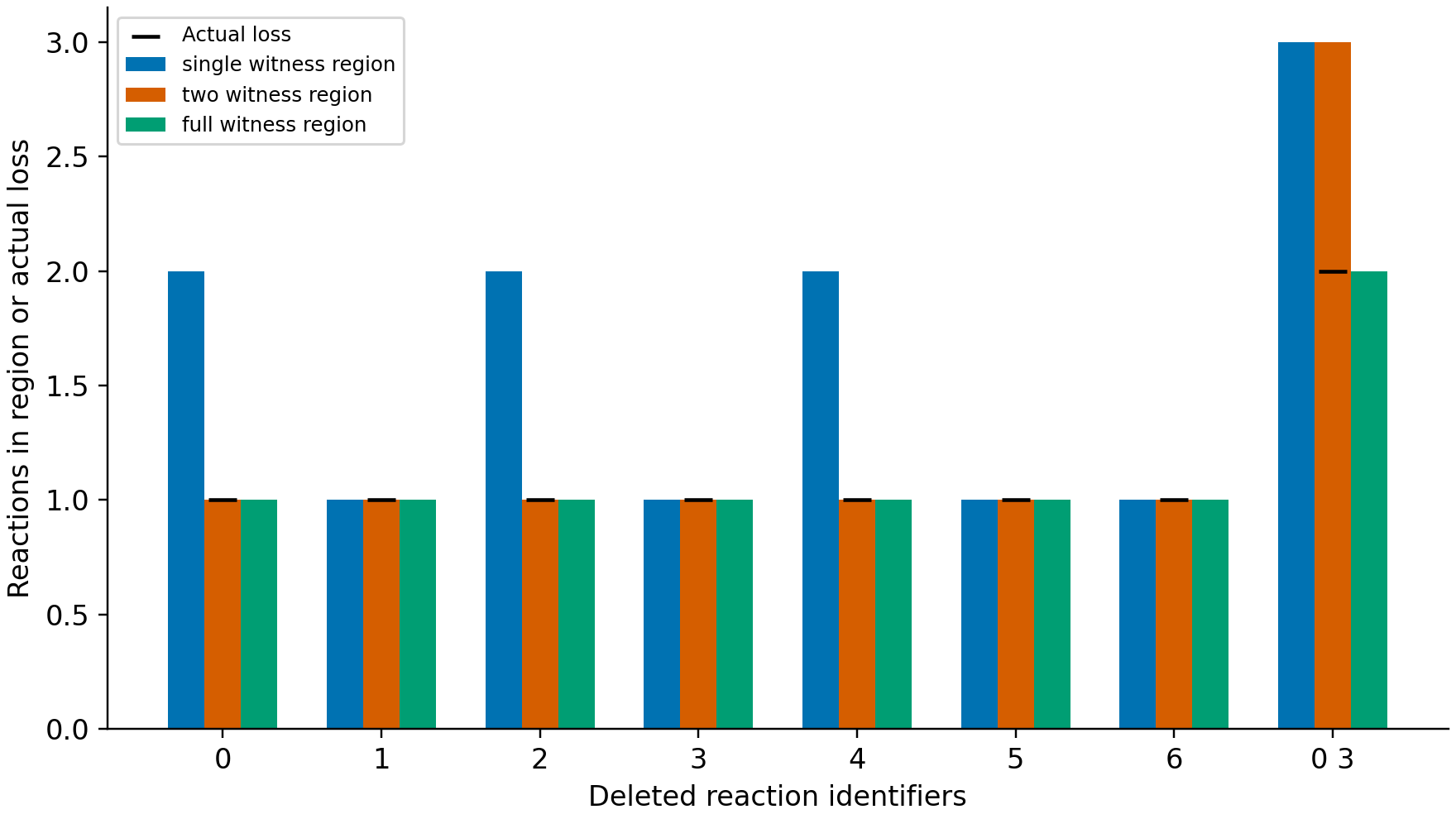
A ranked support witness records which reactions supply each reaction's reactants and catalysts. Reactant producers must have lower ranks; catalyst producers may have any rank, preserving ordinary RAF semantics. Following those dependencies from a deletion gives an affected region, or cone, containing every actual loss. Outside that cone, the retained reactions still form a RAF or empty set.
The engine adds retained products to the food set and recomputes only the remaining region. It then checks a closure-and-pruning schedule before accepting the result. A malformed schedule triggers a fresh exact calculation. Multiple witnesses can shrink the region by intersecting their cones, while the residual solve preserves exact answers even when that intersection still overestimates loss.
The worked source has three pairs of alternative producers, numbered 0/1, 2/3 and 4/5, plus consumer 6 requiring all three products. Two complementary witnesses give exact regions for every single deletion. Deleting 0 and 3 together, however, puts consumer 6 in both cones even though it survives through the alternatives. The residual computation rescues it. Across all 128 deletion sets, one witness overestimates the region on 19 queries, two on 12, and all eight on none; every returned answer is exact.
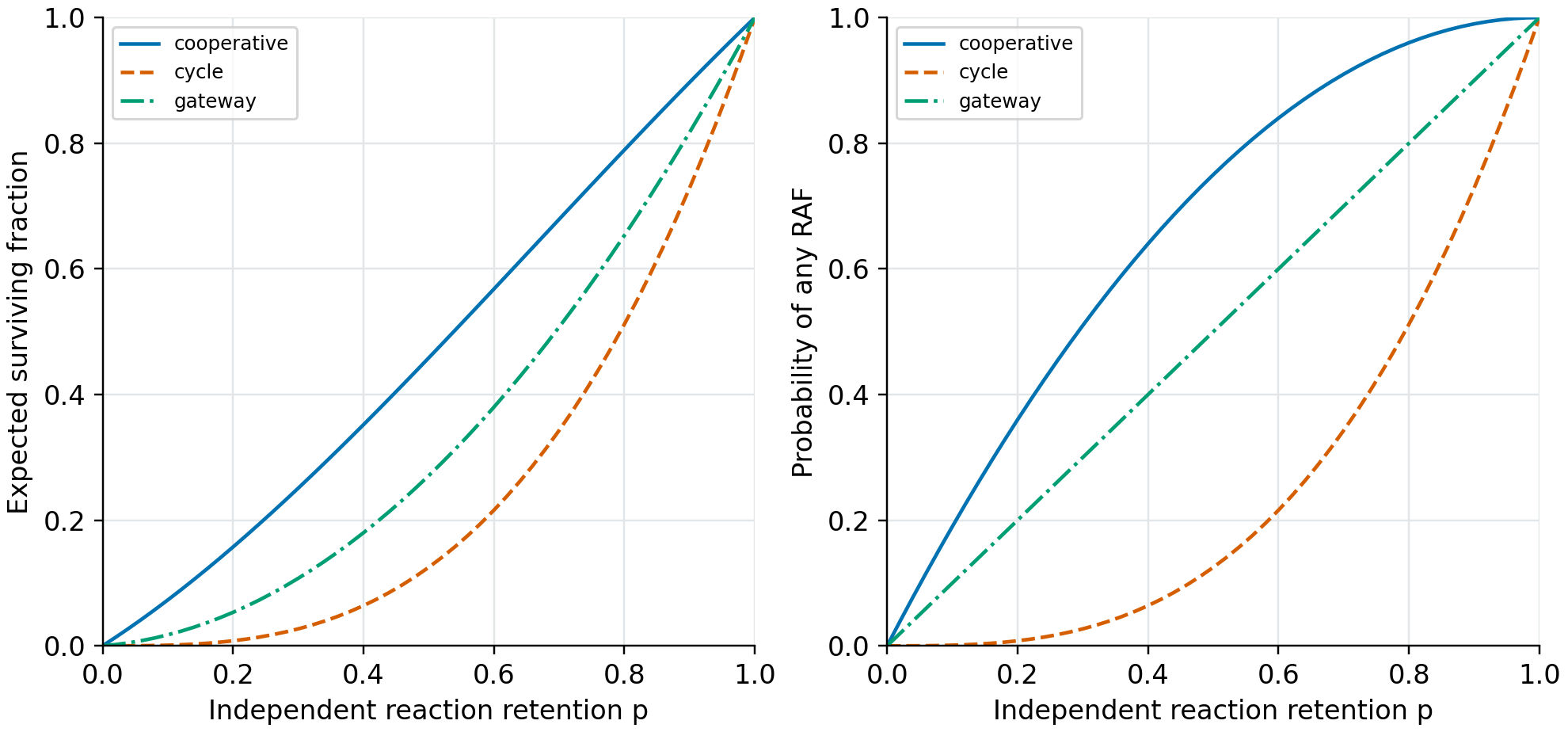
The robustness portion asks a separate question: retain each reaction independently with probability , then measure the surviving RAF. For two interchangeable producers and one consumer, expected surviving size is , with curvature at full retention. A three-reaction catalytic cycle has expectation and curvature . The signs distinguish pairs whose joint deletion causes extra loss from pairs whose individual losses overlap. A shared gateway also shows why expected surviving size and the probability of any survivor are different quantities.
For food-consuming reactions with private products and one catalytic parent, forward parent orbits give exact exposure sets. Allowing a second catalyst at one reaction gives two such sets; a target survives if either is entirely available. The package computes exact survival gains, minimal external cuts and the best single catalyst addition in a candidate list. Two controls with identical exposure-size distributions have mean but variances and , revealing the effect of shared exposure.
Download the package, install requirements.txt, run python example.py --output outputs, and check it with python -m unittest -v. Editable inputs appear first. Import ReactionSystem, RankedWitness and DeletionEngine for other sources; use RobustnessPolynomial for small general networks and FunctionalSource for the stated orbit-based source class. JSON files expose source chemistry, witnesses, query certificates and exposure sets.
Tests compare with an independent exhaustive RAF oracle, check corrupted-certificate fallback, audit all 343 elementary three-reaction catalyst graphs, and exhaust functional maps and one-site additions. Queries are independent deletions from a fixed baseline. The example makes no kinetic-persistence claim and does not reproduce the manuscript's charge-model or wall-clock speedup results; plotted region sizes are not runtimes.
Python source
"""Checked ranked witnesses, local deletion queries, portfolios and robustness.

All queries are independent deletions from a fixed baseline. No kinetics implied.
"""
from __future__ import annotations
import argparse
import csv
from dataclasses import dataclass
from fractions import Fraction as F
from itertools import combinations,product
import hashlib
import json
from math import comb
from pathlib import Path
import platform
import time

# USER INPUTS ---------------------------------------------------------------
PAIR_COUNT = 3                   # two alternative producers per required input
DELETION = (0,3)                  # mixed deletion defeats complementary witnesses
GREEDY_PORTFOLIO_BUDGET = 2        # trained on every singleton, queried on any deletion
RETENTION_GRID = tuple(F(i,50) for i in range(51))
GATEWAY_SIZE = 12
FUNCTIONAL_PARENTS = (0,0,1,2,3)
CATALYST_ADDITION = (2,2)          # add producer 2 as catalyst of reaction 2
ADDITION_RETENTION = F(4,5)
EXHAUSTIVE_REACTION_CAP = 14
WITNESS_POOL_CAP = 4096
PAPER_SHA256 = '6482ca887a9fa90c1a44bf1950c6a89d08f45b2390bfc7ed0ed7b726fc9a2999'
# Inputs are structural incidence choices and independent availability probabilities.
# --------------------------------------------------------------------------


def subsets(values):
    values=tuple(values)
    for size in range(len(values)+1):
        for s in combinations(values,size): yield frozenset(s)


@dataclass(frozen=True)
class Reaction:
    identifier: int
    reactants: frozenset[str]
    products: frozenset[str]
    catalysts: frozenset[str]

    def __post_init__(self):
        for name in ('reactants','products','catalysts'): object.__setattr__(self,name,frozenset(getattr(self,name)))


class ReactionSystem:
    def __init__(self,reactions,food=('f',)):
        reactions=tuple(reactions);self.reactions={r.identifier:r for r in reactions};self.food=frozenset(food)
        if len(self.reactions)!=len(reactions): raise ValueError('Reaction identifiers must be distinct.')
        if any(not isinstance(r.identifier,int) for r in reactions): raise ValueError('Reaction identifiers must be integers.')
        self.identifiers=frozenset(self.reactions)

    def selected(self,ids):
        ids=frozenset(ids)
        if not ids<=self.identifiers: raise ValueError('Unknown reaction identifier.')
        return ids

    def closure(self,ids,food=None):
        ids=self.selected(ids);pool=set(self.food if food is None else food);schedule=[];pending=set(ids)
        while True:
            enabled=sorted(r for r in pending if self.reactions[r].reactants<=pool)
            if not enabled: return frozenset(pool),tuple(schedule)
            for r in enabled: pool.update(self.reactions[r].products);pending.remove(r);schedule.append(r)

    def prune(self,ids,pool):
        return frozenset(r for r in ids if self.reactions[r].reactants<=pool and self.reactions[r].catalysts&pool)

    def maximum(self,ids=None,food=None):
        ids=self.identifiers if ids is None else self.selected(ids)
        while True:
            pool,_=self.closure(ids,food);kept=self.prune(ids,pool)
            if kept==ids: return ids
            ids=kept

    def is_raf(self,ids):
        ids=self.selected(ids);pool,_=self.closure(ids)
        return bool(ids) and self.prune(ids,pool)==ids

    def pruning_certificate(self,ids,food):
        ids=self.selected(ids);rounds=[]
        while True:
            pool,schedule=self.closure(ids,food);rounds.append(dict(available=sorted(ids),schedule=list(schedule)))
            kept=self.prune(ids,pool)
            if kept==ids: return rounds
            ids=kept

    def check_certificate(self,ids,food,rounds):
        ids=self.selected(ids)
        for index,round_data in enumerate(rounds):
            if set(round_data['available'])!=ids: raise ValueError('Pruning round availability mismatch.')
            pool=set(food)
            for r in round_data['schedule']:
                if r not in ids or not self.reactions[r].reactants<=pool: raise ValueError('Invalid closure schedule.')
                pool.update(self.reactions[r].products)
            if any(self.reactions[r].reactants<=pool and not self.reactions[r].products<=pool for r in ids):
                raise ValueError('Proposed closure is not closed under the available reactions.')
            kept=self.prune(ids,pool)
            if kept==ids:
                if index!=len(rounds)-1: raise ValueError('Extra certificate rounds after fixed point.')
                return kept
            ids=kept
        raise ValueError('Certificate has no terminal fixed point.')


class RankedWitness:
    def __init__(self,baseline,parents,ranks):
        self.baseline=frozenset(baseline);self.parents={r:frozenset(p) for r,p in parents.items()};self.ranks=dict(ranks)

    def validate(self,system):
        s=self.baseline
        if not s<=system.identifiers or set(self.parents)!=s or set(self.ranks)!=s: raise ValueError('Witness domain mismatch.')
        for r in s:
            if not isinstance(self.ranks[r],int) or self.ranks[r]<0 or not self.parents[r]<=s: raise ValueError('Invalid rank or parent.')
            reaction=system.reactions[r]
            for x in reaction.reactants-system.food:
                if not any(x in system.reactions[t].products and self.ranks[t]<self.ranks[r] for t in self.parents[r]):
                    raise ValueError('Nonfood reactant lacks a lower-ranked producer.')
            if not reaction.catalysts&system.food and not any(reaction.catalysts&system.reactions[t].products for t in self.parents[r]):
                raise ValueError('Reaction lacks a food or selected product catalyst.')
        return True

    @classmethod
    def build(cls,system,baseline=None,retain_first=()):
        s=system.maximum() if baseline is None else system.selected(baseline);retained=frozenset(retain_first)
        if not retained<=s or system.maximum(retained)!=retained or system.maximum(s)!=s:
            raise ValueError('Construction requires fixed baseline and retained sets.')
        pool=set(system.food);order=[]
        for block in (retained,s-retained):
            pending=set(block)
            while pending:
                enabled=sorted(r for r in pending if system.reactions[r].reactants<=pool)
                if not enabled: raise ValueError('Selected set cannot be generated from food.')
                for r in enabled: order.append(r);pool.update(system.reactions[r].products);pending.remove(r)
        ranks={r:i for i,r in enumerate(order)};parents={r:set() for r in s}
        for r in s:
            eligible=retained if r in retained else s
            for x in sorted(system.reactions[r].reactants-system.food):
                candidates=[t for t in eligible if ranks[t]<ranks[r] and x in system.reactions[t].products]
                parents[r].add(min(candidates))
            if not system.reactions[r].catalysts&system.food:
                candidates=[t for t in eligible if system.reactions[r].catalysts&system.reactions[t].products]
                parents[r].add(min(candidates))
        witness=cls(s,parents,ranks);witness.validate(system);return witness

    def cone(self,deletions):
        reached=set(deletions)&self.baseline;pending=list(reached);children={r:set() for r in self.baseline}
        for r,parents in self.parents.items():
            for p in parents: children[p].add(r)
        while pending:
            r=pending.pop()
            for child in children[r]-reached: reached.add(child);pending.append(child)
        return frozenset(reached)

    def record(self): return dict(parents={str(r):sorted(p) for r,p in self.parents.items()},ranks=self.ranks)


class DeletionEngine:
    def __init__(self,system,witnesses=(),availability=None):
        self.system=system;self.baseline=system.maximum(availability)
        self.witnesses=tuple(RankedWitness(w.baseline,w.parents,w.ranks) for w in witnesses)
        for witness in self.witnesses:
            if witness.baseline!=self.baseline: raise ValueError('Witness baseline does not match engine baseline.')
            witness.validate(system)

    def query(self,deletions,proposed_certificate=None):
        deleted=self.system.selected(deletions)&self.baseline;region=self.baseline
        for witness in self.witnesses: region&=witness.cone(deleted)
        retained=self.baseline-region;local=region-deleted;fallback=False;certificate=[]
        if region==deleted: surviving=retained;route='closed seed'
        else:
            food=self.system.food.union(*(self.system.reactions[r].products for r in retained))
            certificate=self.system.pruning_certificate(local,food) if proposed_certificate is None else proposed_certificate
            try:
                surviving=retained|self.system.check_certificate(local,food,certificate);route='checked residual'
            except (ValueError,KeyError,TypeError):
                surviving=self.system.maximum(self.baseline-deleted);fallback=True;route='fresh fallback'
        return dict(deleted=sorted(deleted),region=sorted(region),retained=sorted(retained),surviving=sorted(surviving),
            loss=sorted(self.baseline-surviving),excess=len(region-(self.baseline-surviving)),route=route,fallback=fallback,certificate=certificate)


def greedy_portfolio(pool,queries,budget):
    if not pool or not isinstance(budget,int) or budget<1: raise ValueError('Nonempty witness pool and positive budget required.')
    queries=tuple(frozenset(k) for k in queries);events=[{(i,r) for i,k in enumerate(queries) for r in w.baseline-w.cone(k)} for w in pool]
    selected=[];covered=set()
    for _ in range(min(budget,len(pool))):
        i=max((i for i in range(len(pool)) if i not in selected),key=lambda i:len(events[i]-covered))
        selected.append(i);covered|=events[i]
    return tuple(pool[i] for i in selected),dict(pool_indices=selected,rescued_training_events=len(covered))


def paired_source(k):
    if not isinstance(k,int) or k<1 or 2**k>WITNESS_POOL_CAP: raise ValueError('Pair count is positive and must fit the complete witness budget.')
    reactions=[Reaction(2*i+j,{'f'},{f'x{i}',f'private{2*i+j}'},{'f'}) for i in range(k) for j in (0,1)]
    reactions.append(Reaction(2*k,{f'x{i}' for i in range(k)},{'z'},{'f'}));system=ReactionSystem(reactions);pool=[]
    for choice in product((0,1),repeat=k):
        parents={r:set() for r in system.identifiers};parents[2*k]={2*i+choice[i] for i in range(k)}
        witness=RankedWitness(system.identifiers,parents,{r:int(r==2*k) for r in system.identifiers});witness.validate(system);pool.append(witness)
    return system,tuple(pool)


class RobustnessPolynomial:
    """Exact availability enumeration; coefficient order is ascending powers of p."""
    def __init__(self,system):
        self.system=system;self.baseline=system.maximum();n=len(self.baseline)
        if n>EXHAUSTIVE_REACTION_CAP: raise ValueError('Availability enumeration budget exceeded.')
        self.mean=[0]*(n+1);self.second=[0]*(n+1);self.nonempty=[0]*(n+1)
        for available in subsets(sorted(self.baseline)):
            size=len(system.maximum(available));k=len(available)
            for j in range(n-k+1):
                coefficient=(-1)**j*comb(n-k,j)
                self.mean[k+j]+=size*coefficient;self.second[k+j]+=size*size*coefficient;self.nonempty[k+j]+=bool(size)*coefficient

    @staticmethod
    def evaluate(coefficients,p):
        p=F(p);result=F(0)
        for coefficient in reversed(coefficients): result=result*p+coefficient
        return result

    def moments(self,p):
        p=F(p)
        if not 0<=p<=1: raise ValueError('Retention probability must be between zero and one.')
        mean=self.evaluate(self.mean,p)
        return dict(mean=mean,nonempty=self.evaluate(self.nonempty,p),variance=self.evaluate(self.second,p)-mean*mean)

    def sensitivity(self):
        s=self.baseline;losses={r:s-self.system.maximum(s-{r}) for r in s};pairs=[]
        for i,j in combinations(sorted(s),2):
            joint=s-self.system.maximum(s-{i,j});overlap=losses[i]&losses[j];cooperative=joint-(losses[i]|losses[j])
            pairs.append(dict(first=i,second=j,overlap=len(overlap),cooperative=len(cooperative)))
        first=sum(map(len,losses.values()));second=2*sum(r['overlap']-r['cooperative'] for r in pairs)
        if first!=sum(i*c for i,c in enumerate(self.mean)) or second!=sum(i*(i-1)*c for i,c in enumerate(self.mean)):
            raise ArithmeticError('Loss-derived derivatives differ from the independent polynomial.')
        return dict(first_derivative=first,second_derivative=second,singleton_losses={str(r):sorted(v) for r,v in losses.items()},pair_terms=pairs)


class FunctionalSource:
    def __init__(self,parents):
        self.parents=tuple(parents);n=len(parents)
        if n<1 or any(not isinstance(r,int) or not 0<=r<n for r in parents): raise ValueError('Parent map must stay in a nonempty reaction set.')
        self.exposures=tuple(self.orbit(r) for r in range(n))

    def orbit(self,r):
        visited=set()
        while r not in visited: visited.add(r);r=self.parents[r]
        return frozenset(visited)

    def network(self,alternative=None):
        if alternative is not None and len(alternative.parents)!=len(self.parents): raise ValueError('Alternative map has wrong size.')
        return ReactionSystem(Reaction(r,{'f'},{f'x{r}'},{f'x{self.parents[r]}'}|({f'x{alternative.parents[r]}'} if alternative else set())) for r in range(len(self.parents)))

    def moments(self,p):
        p=F(p)
        if not 0<=p<=1: raise ValueError('Retention probability must be between zero and one.')
        exposures=self.exposures;mean=sum((p**len(e) for e in exposures),F(0))
        variance=sum((p**len(e|g)-p**(len(e)+len(g)) for e in exposures for g in exposures),F(0))
        return dict(mean=mean,variance=variance)

    def addition(self,site,parent):
        if not 0<=site<len(self.parents) or not 0<=parent<len(self.parents): raise ValueError('Invalid catalyst-addition index.')
        other=list(self.parents);other[site]=parent;return OneSiteExposure(self,FunctionalSource(other))


class OneSiteExposure:
    def __init__(self,original,alternative):
        if len(original.parents)!=len(alternative.parents) or sum(a!=b for a,b in zip(original.parents,alternative.parents))>1:
            raise ValueError('Two-exposure law requires maps differing at at most one site.')
        self.original,self.alternative=original,alternative

    def surviving(self,available):
        available=frozenset(available)
        if not available<=set(range(len(self.original.parents))): raise ValueError('Unknown available reaction.')
        return frozenset(r for r,(e,g) in enumerate(zip(self.original.exposures,self.alternative.exposures)) if e<=available or g<=available)

    def probability(self,target,p):
        p=F(p)
        if not isinstance(target,int) or not 0<=target<len(self.original.parents): raise ValueError('Unknown target reaction.')
        if not 0<=p<=1: raise ValueError('Retention probability must be between zero and one.')
        e,g=self.original.exposures[target],self.alternative.exposures[target]
        return p**len(e)+p**len(g)-p**len(e|g)

    def gain(self,target,p):
        return self.probability(target,p)-F(p)**len(self.original.exposures[target])

    def cuts(self,target):
        if not isinstance(target,int) or not 0<=target<len(self.original.parents): raise ValueError('Unknown target reaction.')
        e,g=self.original.exposures[target],self.alternative.exposures[target]
        return frozenset([*(frozenset({r}) for r in (e&g)-{target}),*(frozenset({r,s}) for r in e-g for s in g-e)])


def catalyst_candidates(source,p):
    rows=[]
    for site in range(len(source.parents)):
        for parent in range(len(source.parents)):
            addition=source.addition(site,parent)
            rows.append(dict(site=site,parent=parent,total_gain=str(sum((addition.gain(r,p) for r in range(len(source.parents))),F(0)))))
    return sorted(rows,key=lambda r:(-F(r['total_gain']),r['site'],r['parent']))


def write_csv(path,rows):
    with path.open('w',newline='',encoding='utf-8') as f:
        writer=csv.DictWriter(f,fieldnames=list(rows[0]));writer.writeheader();writer.writerows(rows)


def plot(profiles,curves,output):
    import matplotlib
    matplotlib.use('Agg')
    import matplotlib.pyplot as plt
    import numpy as np
    with plt.rc_context({'font.size':11,'figure.facecolor':'white','savefig.facecolor':'white','svg.fonttype':'none'}):
        keys=list(dict.fromkeys(r['deleted'] for r in profiles));x=np.arange(len(keys));fig,ax=plt.subplots(figsize=(8,4.5),layout='constrained')
        for i,(strategy,color) in enumerate([('single','#0072B2'),('two','#D55E00'),('full','#009E73')]):
            rows=[r for r in profiles if r['strategy']==strategy]
            ax.bar(x+(i-1)*.23,[r['region_size'] for r in rows],width=.23,label=f'{strategy} witness region',color=color)
        rows=[r for r in profiles if r['strategy']=='single'];ax.scatter(x,[r['loss_size'] for r in rows],marker='_',s=130,color='black',label='Actual loss')
        ax.set_xticks(x,keys);ax.set(xlabel='Deleted reaction identifiers',ylabel='Reactions in region or actual loss')
        ax.legend(fontsize=8);ax.spines[['top','right']].set_visible(False)
        fig.savefig(output/'regions.png',dpi=220);fig.savefig(output/'regions.svg');plt.close(fig)
        fig,axes=plt.subplots(1,2,figsize=(9,4.2),layout='constrained')
        for name,color,style in [('cooperative','#0072B2','-'),('cycle','#D55E00','--'),('gateway','#009E73','-.')]:
            rows=[r for r in curves if r['source']==name];p=[float(F(r['p'])) for r in rows]
            axes[0].plot(p,[float(F(r['mean_fraction'])) for r in rows],style,color=color,label=name)
            axes[1].plot(p,[float(F(r['nonempty'])) for r in rows],style,color=color,label=name)
        for ax in axes:
            ax.set(xlabel='Independent reaction retention p',xlim=(0,1),ylim=(0,1));ax.spines[['top','right']].set_visible(False);ax.grid(color='#e3e6e8');ax.legend(fontsize=8)
        axes[0].set_ylabel('Expected surviving fraction');axes[1].set_ylabel('Probability of any RAF')
        fig.savefig(output/'robustness.png',dpi=220);fig.savefig(output/'robustness.svg');plt.close(fig)


def main():
    parser=argparse.ArgumentParser(description=__doc__);parser.add_argument('--output',type=Path,default=Path('outputs'))
    args=parser.parse_args();args.output.mkdir(parents=True,exist_ok=True);start=time.perf_counter()
    inputs=dict(pair_count=PAIR_COUNT,deletion=DELETION,greedy_budget=GREEDY_PORTFOLIO_BUDGET,retention_grid=list(map(str,RETENTION_GRID)),
        gateway_size=GATEWAY_SIZE,functional_parents=FUNCTIONAL_PARENTS,catalyst_addition=CATALYST_ADDITION,
        addition_retention=str(ADDITION_RETENTION),exhaustive_reaction_cap=EXHAUSTIVE_REACTION_CAP,witness_pool_cap=WITNESS_POOL_CAP)
    intro='Resolved inputs: '+json.dumps(inputs);print(intro,flush=True)
    system,pool=paired_source(PAIR_COUNT);s=system.identifiers
    if len(s)>EXHAUSTIVE_REACTION_CAP: raise ValueError('Default complete query audit exceeds reaction budget.')
    queries=[{r} for r in sorted(s)]+[set(DELETION)];strategies={'single':pool[:1],'two':(pool[0],pool[-1]),'full':pool}
    selected,selection=greedy_portfolio(pool,({r} for r in sorted(s)),GREEDY_PORTFOLIO_BUDGET)
    profiles=[];audits=[];query_receipts={}
    for name,witnesses in strategies.items():
        engine=DeletionEngine(system,witnesses);excess_count=0
        for deleted in subsets(sorted(s)):
            result=engine.query(deleted);fresh=system.maximum(s-deleted)
            if set(result['surviving'])!=fresh: raise ArithmeticError('Localized result differs from fresh maximum RAF.')
            excess_count+=bool(result['excess'])
        audits.append(dict(strategy=name,queries=2**len(s),inexact_regions=excess_count,all_answers_exact=True))
        for deleted in queries:
            result=engine.query(deleted);profiles.append(dict(strategy=name,deleted=' '.join(map(str,sorted(deleted))),region_size=len(result['region']),loss_size=len(result['loss']),excess=result['excess']))
        query_receipts[name]=engine.query(DELETION)
    write_csv(args.output/'regions.csv',profiles)
    (args.output/'query_certificates.json').write_text(json.dumps(query_receipts,indent=2)+'\n',encoding='utf-8')
    (args.output/'witnesses.json').write_text(json.dumps([w.record() for w in pool],indent=2)+'\n',encoding='utf-8')
    (args.output/'model.json').write_text(json.dumps(dict(food=sorted(system.food),reactions=[dict(id=r.identifier,reactants=sorted(r.reactants),products=sorted(r.products),catalysts=sorted(r.catalysts)) for r in system.reactions.values()]),indent=2)+'\n',encoding='utf-8')
    cooperative,_=paired_source(1);cycle=FunctionalSource((1,2,0));gateway=FunctionalSource((0,)*GATEWAY_SIZE)
    polynomials={'cooperative':RobustnessPolynomial(cooperative),'cycle':RobustnessPolynomial(cycle.network())}
    sensitivities={name:poly.sensitivity() for name,poly in polynomials.items()};curves=[]
    for p in RETENTION_GRID:
        for name,poly in polynomials.items():
            moments=poly.moments(p);curves.append(dict(source=name,p=str(p),mean_fraction=str(moments['mean']/len(poly.baseline)),nonempty=str(moments['nonempty']),variance=str(moments['variance'])))
        gm=gateway.moments(p);curves.append(dict(source='gateway',p=str(p),mean_fraction=str(gm['mean']/GATEWAY_SIZE),nonempty=str(p),variance=str(gm['variance'])))
    write_csv(args.output/'robustness.csv',curves)
    source=FunctionalSource(FUNCTIONAL_PARENTS);addition=source.addition(*CATALYST_ADDITION);network=source.network(addition.alternative);n=len(source.parents)
    if n>EXHAUSTIVE_REACTION_CAP: raise ValueError('Exposure audit exceeds availability enumeration budget.')
    for available in subsets(range(n)):
        if addition.surviving(available)!=network.maximum(available): raise ArithmeticError('Two-exposure law differs from literal RAF evaluation.')
    exposures=[dict(target=r,original=sorted(source.exposures[r]),alternative=sorted(addition.alternative.exposures[r]),
        probability=str(addition.probability(r,ADDITION_RETENTION)),gain=str(addition.gain(r,ADDITION_RETENTION)),
        external_cuts=[sorted(c) for c in sorted(addition.cuts(r),key=lambda s:(len(s),sorted(s)))]) for r in range(n)]
    candidates=catalyst_candidates(source,ADDITION_RETENTION);write_csv(args.output/'catalyst_candidates.csv',candidates)
    (args.output/'exposures.json').write_text(json.dumps(exposures,indent=2)+'\n',encoding='utf-8')
    controls=[]
    for parents in ((0,2,0,4,0),(0,2,1,1,1)):
        control=FunctionalSource(parents);moments=control.moments(F(1,2));literal=RobustnessPolynomial(control.network()).moments(F(1,2))
        if any(moments[k]!=literal[k] for k in moments): raise ArithmeticError('Exposure moment formula failed.')
        controls.append(dict(parents=parents,orbit_sizes=sorted(map(len,control.exposures)),mean=str(moments['mean']),variance=str(moments['variance'])))
    plot(profiles,curves,args.output)
    summary=dict(inputs=inputs,localization_audits=audits,greedy_selection=selection,greedy_query=DeletionEngine(system,selected).query(DELETION),
        robustness_coefficients={name:dict(mean=p.mean,nonempty=p.nonempty,second_moment=p.second) for name,p in polynomials.items()},
        sensitivities=sensitivities,overlap_controls=controls,best_single_catalyst_addition=candidates[0],exposure_queries_checked=2**n,
        evidence='Exact finite sets, checked closure/pruning schedules, rational availability laws. No Lean compilation, biological calibration, kinetic-persistence claim, or replay of the paper charge-model/runtime theorem.')
    transcript=json.dumps(summary,indent=2)
    (args.output/'summary.json').write_text(transcript+'\n',encoding='utf-8');(args.output/'console.txt').write_text(intro+'\n'+transcript+'\n',encoding='utf-8')
    import matplotlib
    metadata=dict(paper_sha256=PAPER_SHA256,source_sha256=hashlib.sha256(Path(__file__).read_bytes()).hexdigest(),python=platform.python_version(),
        matplotlib=matplotlib.__version__,platform=platform.platform(),elapsed_seconds=time.perf_counter()-start,command='python example.py --output outputs',seed_policy='No random sampling.',
        output_sha256={p.name:hashlib.sha256(p.read_bytes()).hexdigest() for p in sorted(args.output.iterdir()) if p.is_file() and p.name!='run_metadata.json'})
    (args.output/'run_metadata.json').write_text(json.dumps(metadata,indent=2)+'\n',encoding='utf-8');print(transcript)


if __name__=='__main__': main()
Run output
Resolved inputs: {"pair_count": 3, "deletion": [0, 3], "greedy_budget": 2, "retention_grid": ["0", "1/50", "1/25", "3/50", "2/25", "1/10", "3/25", "7/50", "4/25", "9/50", "1/5", "11/50", "6/25", "13/50", "7/25", "3/10", "8/25", "17/50", "9/25", "19/50", "2/5", "21/50", "11/25", "23/50", "12/25", "1/2", "13/25", "27/50", "14/25", "29/50", "3/5", "31/50", "16/25", "33/50", "17/25", "7/10", "18/25", "37/50", "19/25", "39/50", "4/5", "41/50", "21/25", "43/50", "22/25", "9/10", "23/25", "47/50", "24/25", "49/50", "1"], "gateway_size": 12, "functional_parents": [0, 0, 1, 2, 3], "catalyst_addition": [2, 2], "addition_retention": "4/5", "exhaustive_reaction_cap": 14, "witness_pool_cap": 4096}
{
  "inputs": {
    "pair_count": 3,
    "deletion": [
      0,
      3
    ],
    "greedy_budget": 2,
    "retention_grid": [
      "0",
      "1/50",
      "1/25",
      "3/50",
      "2/25",
      "1/10",
      "3/25",
      "7/50",
      "4/25",
      "9/50",
      "1/5",
      "11/50",
      "6/25",
      "13/50",
      "7/25",
      "3/10",
      "8/25",
      "17/50",
      "9/25",
      "19/50",
      "2/5",
      "21/50",
      "11/25",
      "23/50",
      "12/25",
      "1/2",
      "13/25",
      "27/50",
      "14/25",
      "29/50",
      "3/5",
      "31/50",
      "16/25",
      "33/50",
      "17/25",
      "7/10",
      "18/25",
      "37/50",
      "19/25",
      "39/50",
      "4/5",
      "41/50",
      "21/25",
      "43/50",
      "22/25",
      "9/10",
      "23/25",
      "47/50",
      "24/25",
      "49/50",
      "1"
    ],
    "gateway_size": 12,
    "functional_parents": [
      0,
      0,
      1,
      2,
      3
    ],
    "catalyst_addition": [
      2,
      2
    ],
    "addition_retention": "4/5",
    "exhaustive_reaction_cap": 14,
    "witness_pool_cap": 4096
  },
  "localization_audits": [
    {
      "strategy": "single",
      "queries": 128,
      "inexact_regions": 19,
      "all_answers_exact": true
    },
    {
      "strategy": "two",
      "queries": 128,
      "inexact_regions": 12,
      "all_answers_exact": true
    },
    {
      "strategy": "full",
      "queries": 128,
      "inexact_regions": 0,
      "all_answers_exact": true
    }
  ],
  "greedy_selection": {
    "pool_indices": [
      0,
      7
    ],
    "rescued_training_events": 42
  },
  "greedy_query": {
    "deleted": [
      0,
      3
    ],
    "region": [
      0,
      3,
      6
    ],
    "retained": [
      1,
      2,
      4,
      5
    ],
    "surviving": [
      1,
      2,
      4,
      5,
      6
    ],
    "loss": [
      0,
      3
    ],
    "excess": 1,
    "route": "checked residual",
    "fallback": false,
    "certificate": [
      {
        "available": [
          6
        ],
        "schedule": [
          6
        ]
      }
    ]
  },
  "robustness_coefficients": {
    "cooperative": {
      "mean": [
        0,
        2,
        2,
        -1
      ],
      "nonempty": [
        0,
        2,
        -1,
        0
      ],
      "second_moment": [
        0,
        2,
        8,
        -1
      ]
    },
    "cycle": {
      "mean": [
        0,
        0,
        0,
        3
      ],
      "nonempty": [
        0,
        0,
        0,
        1
      ],
      "second_moment": [
        0,
        0,
        0,
        9
      ]
    }
  },
  "sensitivities": {
    "cooperative": {
      "first_derivative": 3,
      "second_derivative": -2,
      "singleton_losses": {
        "0": [
          0
        ],
        "1": [
          1
        ],
        "2": [
          2
        ]
      },
      "pair_terms": [
        {
          "first": 0,
          "second": 1,
          "overlap": 0,
          "cooperative": 1
        },
        {
          "first": 0,
          "second": 2,
          "overlap": 0,
          "cooperative": 0
        },
        {
          "first": 1,
          "second": 2,
          "overlap": 0,
          "cooperative": 0
        }
      ]
    },
    "cycle": {
      "first_derivative": 9,
      "second_derivative": 18,
      "singleton_losses": {
        "0": [
          0,
          1,
          2
        ],
        "1": [
          0,
          1,
          2
        ],
        "2": [
          0,
          1,
          2
        ]
      },
      "pair_terms": [
        {
          "first": 0,
          "second": 1,
          "overlap": 3,
          "cooperative": 0
        },
        {
          "first": 0,
          "second": 2,
          "overlap": 3,
          "cooperative": 0
        },
        {
          "first": 1,
          "second": 2,
          "overlap": 3,
          "cooperative": 0
        }
      ]
    }
  },
  "overlap_controls": [
    {
      "parents": [
        0,
        2,
        0,
        4,
        0
      ],
      "orbit_sizes": [
        1,
        2,
        2,
        3,
        3
      ],
      "mean": "5/4",
      "variance": "9/4"
    },
    {
      "parents": [
        0,
        2,
        1,
        1,
        1
      ],
      "orbit_sizes": [
        1,
        2,
        2,
        3,
        3
      ],
      "mean": "5/4",
      "variance": "33/16"
    }
  ],
  "best_single_catalyst_addition": {
    "site": 2,
    "parent": 2,
    "total_gain": "2196/3125"
  },
  "exposure_queries_checked": 32,
  "evidence": "Exact finite sets, checked closure/pruning schedules, rational availability laws. No Lean compilation, biological calibration, kinetic-persistence claim, or replay of the paper charge-model/runtime theorem."
}