Example code
A stable chemical composition can encode a heritable state even while material is extracted. When the same chemistry supports a consumer community, identical species proportions can correspond to different total abundances and production rates. This example implements the paper's two arrangements of one four-species resident chemistry: a finite-cell growth–division–transfer protocol, and a reservoir coupled to self-limited consumers.
Their connection is exact but limited: feedback replaces the imposed extraction coefficient by reservoir concentration times total consumer abundance. That resident-field identity does not transfer an inheritance guarantee to the consumer community.
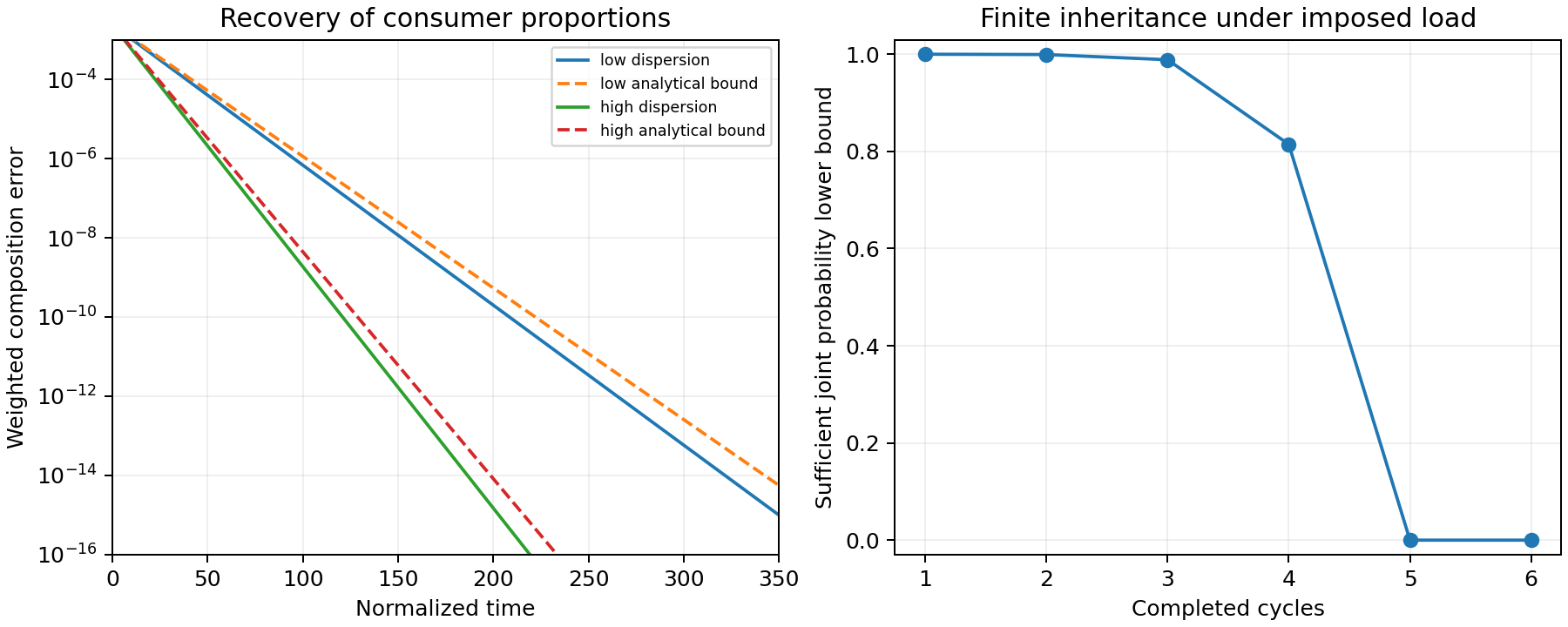
For the stated imposed-extraction witness, the two-cycle success lower bound is 0.9993009388. On the common event, both ancestries survive, retained cells recover, the high-ancestry fraction exceeds about 69.30%, and each batch exports more than five times its initial size. The code recomputes the full error budget and distinguishes finite repetition from indefinite inheritance.
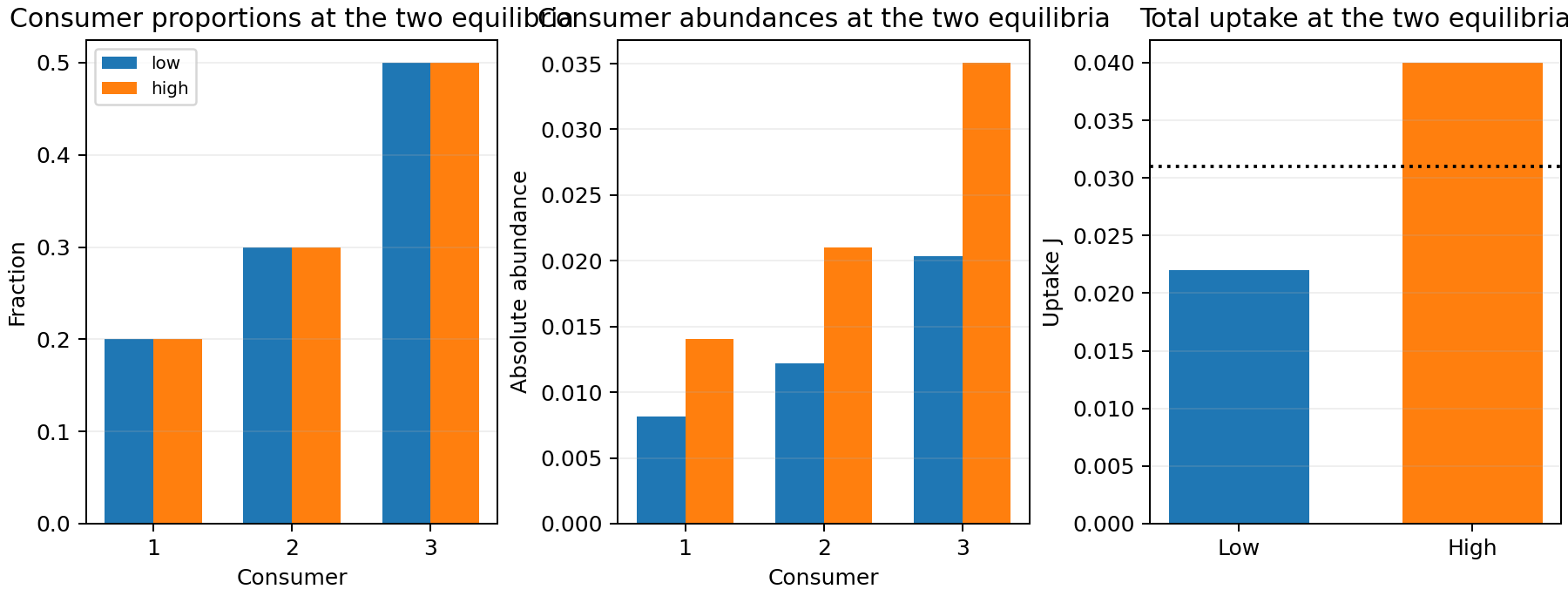
The feedback model has two attracting operating states with exactly the same consumer proportions, yet uptake differs by a factor greater than 1.8186. Absolute abundance reveals this stationary difference. During transients, interpreting the readout also requires changes in total abundance and differences among consumer abundances relative to their target proportions—or a reservoir balance. A reusable window calculator propagates declared errors and returns unresolved when its calibration, recovery, or two-alternative assumptions are missing.
The runnable package includes all fourteen resident channels, falling-factorial molecular propensities, complementary daughter partitioning, neutral intact-cell transfer, extraction-active recovery, full consumer dynamics, and physical output ledgers. Editable inputs sit at the top of the example; separate classes support parameter exploration and new measurement traces. Optional small molecular runs retain unfinished outcomes and do not claim to simulate the enormous theorem witness.
Fresh rational and symbolic checks verify stationary brackets, the high-state exclusion certificate, the sharper stationary feedback-load cap, and the displayed confidence arithmetic. The theorem's compartment and population scales are conservative mathematical witnesses, not a calibrated laboratory design. Lean is not rerun, and numerical feedback trajectories are kept separate from the imported local-attraction proof.
Python source
"""Productive inheritance under imposed load; hidden operating states under feedback."""
# EDITABLE INPUTS: paper parameters and separately labelled small diagnostics.
EXTRACTION='1/100'               # theorem interval [9999/10^6,1/100]
NEWBORN_SIZE=65536*10**18
RETAINED_CELLS=4*10**9
GROWTH_COUPLING='1/100000000000'
COMPOSITION=(.2,.3,.5)
RENEWAL=.05
MORTALITY=.5
RECOVERY_HORIZON=1000.
ABUNDANCE_PERTURBATION=(1.08,.94,1.004)  # not assumed inside the tiny certified energy sublevel
SMALL_SIZE=10
SMALL_CELLS=4
SMALL_GROWTH='2'                 # accelerated exploration, outside theorem scope
SMALL_RECOVERY=.05               # theorem recovery is 5376
EVENT_BUDGET=30000
SEED=52092026
WINDOW=100
S_MAX='0.08'
ABUNDANCE_ERROR='0.001'
DISPERSION_ERROR='0.0001'
RESERVOIR_ERROR='0.005'
AVERAGE_QUADRATURE_ERROR='0.00001'
ADMITTED_DYNAMIC_ERROR='0.001'    # synthetic classifier assumption, not inferred from the trajectory
CONCENTRATION_MOLAR='1/1000'
TIME_UNIT_SECONDS=1.

import argparse
from fractions import Fraction as F
import csv
import hashlib
import json
import math
from pathlib import Path
import platform
import numpy as np
from mpmath import mp,iv
import sympy as sp
from scipy.integrate import solve_ivp
from resident import ResidentChemistry,Cell,reconstruction,residual,rational_root,ENERGY
from feedback import Community,WindowReadout,S_BOUNDS,stationary,stationary_residual,uptake,load
from protocol import PopulationSource,SerialProtocol,UniformTransfer

mp.dps=70;iv.dps=70
MANUSCRIPT_SHA256='41f71eaed3040751568bf085391b5021bde099b27d14335de005729d33233d1a'


def val(ctx,q):
    q=F(q);return ctx.mpf(q.numerator)/q.denominator


class InheritanceCertificate:
    """Fresh complete error budget; scope is the paper's fixed constructive witness."""
    def __init__(self,rho=EXTRACTION,N=NEWBORN_SIZE,M=RETAINED_CELLS,gamma=GROWTH_COUPLING):
        self.rho=F(rho);self.N=N;self.M=M;self.gamma=F(gamma)
        if not F(9999,10**6)<=self.rho<=F(1,100):raise ValueError('Extraction outside certified interval')
        if N!=65536*10**18 or M!=4*10**9 or self.gamma!=F(1,10**11):raise ValueError('Published certificate requires the declared N, M and gamma; new scales need a new source audit')
    def logs(self,ctx):
        N=ctx.mpf(self.N);M=ctx.mpf(self.M);T=8/val(ctx,self.gamma);u=N/(10**12*512000000);ln=ctx.log
        return dict(outer_initial=ln(M)-7*u,daughter_initial=ln(14*M)-4*u,
            outer_drift=ln(M*T*u/60)-15*u/2,spatial_initial=ln(M)-u,spatial_drift=ln(M*T*u/60)-3*u/2,
            bad_partition=ln(56*M)-N/(35*10**12),deadline=-N/2500,size_odds=-19*N/500000,
            low_output=-N*M,collection=ln(ctx.mpf(1)/10**6),batch_service=ln(ctx.mpf(1)/10**6),recovery_and_service=ln(2*M/10**18))
    def evaluate(self):
        logs=self.logs(mp);ilog=self.logs(iv);nontransfer=sum(iv.exp(v) for v in ilog.values())
        if nontransfer.b>val(iv,F(3,10**6)).a:raise ArithmeticError('Nontransfer bound failed')
        p0=F(1,2);p1=F(49,1600);D=lambda p:F(32)/(F(1,50)**2*p*self.M)
        lower=1-D(p0)-D(p1)-F(6,10**6)
        assert lower==F(24482873,24500000)
        b=mp.mpf(3)/5*mp.log(4)-mp.mpf(19)/500;ell=mp.log(mp.mpf(51)/49)
        gain=2*(b-ell)-mp.log(2)
        repeats=[]
        for k in range(1,7):
            failure=sum(F(1,25000)*F(800,49)**j for j in range(k))+F(3*k,10**6)
            g=k*(b-ell)-mp.log(2)
            repeats.append(dict(cycles=k,probability_lower=max(F(0),1-failure),count_fraction_lower_numerical=float(1/(1+mp.exp(-g)))))
        return dict(joint_two_cycle_lower=lower,nontransfer_upper=math.nextafter(float(nontransfer.b),math.inf),transfer_first=D(p0),transfer_second=D(p1),
            log_error_terms={k:mp.nstr(v,32) for k,v in logs.items()},count_log_odds_gain_numerical=float(gain),
            high_fraction_lower_numerical=float(1/(1+mp.exp(-gain))),batch_output_strictly_greater_than=5*self.N*self.M,
            prepared_precursor_at_most=12*self.N*self.M,growth_consumption_at_most=9*self.N*self.M,
            finite_repetition=repeats,scope='Imported source-kernel theorem; fresh error arithmetic. Repetitions beyond two are conventional corollaries, not rerun Lean roots.')


def exact_audit():
    z,rho=sp.symbols('z rho',positive=True);a,b,zz,h=reconstruction(z,rho);e=sp.Rational(1,100000)
    field=(6-2*a+b*z+2*e*(b-a*a),27+a-(1+z)*b-e*(b-a*a),a-b*z-16*z-4*z*z+3*h-rho*z,16*z+2*z*z-sp.Rational(20001,10000)*h)
    rr=residual(z,rho)
    assert all(sp.simplify(v)==0 for v in (field[0]+2*rr,field[1]-rr,field[2],field[3]))
    # Uniform bracket signs follow from monotonicity in rho, checked at both endpoints.
    brackets={}
    for tag,lo,hi in [('L','0.98172','0.98174'),('H','2.89014','2.89017')]:
        signs=[(residual(F(lo),r),residual(F(hi),r)) for r in [F(9999,10**6),F(1,100)]]
        assert all(a<0<b for a,b in signs)
        P=sp.Matrix(ENERGY[tag].tolist())/10**6
        assert all((P-sp.eye(4)/200)[:k,:k].det()>0 and (60*sp.eye(4)-P)[:k,:k].det()>0 for k in range(1,5))
        brackets[tag]=dict(z=[lo,hi],endpoint_signs=[['negative','positive']]*2,energy_spectral_sandwich=True)
    y=sp.Symbol('y',real=True)
    q=sp.Rational(2646507285317916225,16)-sp.Rational(373906577279071365,2)*y+sp.Rational(34457435637128464441,2)*y*y
    certificate=q+26834156547533132606*(y+sp.Rational(1,2))*y*y+4448524228728822329*y**4+136356292472000*(y+sp.Rational(1,2))*y**4+44462224000000*y**6
    numerator=sp.cancel(residual(z,sp.Rational(31,1000))*4444888900000000000*(z+2)**2)
    assert sp.expand(numerator.subs(z,y+sp.Rational(5,2))-certificate)==0
    assert sp.discriminant(q,y)<0 and q.coeff(y,2)>0
    s=sp.Symbol('s',nonnegative=True);aa=sp.Rational(11,250);bb=sp.Rational(12,3125);U=sp.Rational(2239911,97656250)
    assert sp.expand(U-load(s)-10*(s-aa-bb/20)**2-20*(s+2*aa)*(s-aa)**2)==0
    feedback=[]
    for lo,hi in S_BOUNDS:
        a,b=F(lo),F(hi);fa,fb=stationary_residual(a),stationary_residual(b)
        assert fa*fb<0
        feedback.append(dict(S=[a,b],J=[uptake(a),uptake(b)],load=sorted([load(a),load(b)])))
    gap=feedback[1]['J'][0]-feedback[0]['J'][1];threshold=(feedback[1]['J'][0]+feedback[0]['J'][1])/2
    assert feedback[1]['J'][0]/feedback[0]['J'][1]>F('1.8186')
    # Count drift is evaluated at symbols, with exact falling factorials.
    A,B,Z,H,m=sp.symbols('A B Z H m',positive=True);chem=ResidentChemistry();symbols=(A,B,Z,H)
    rate=[sp.Rational(ch.coefficient.numerator,ch.coefficient.denominator)*m**(1-sum(ch.inputs))*sp.prod(sp.prod(m*x-k for k in range(order)) for x,order in zip(symbols,ch.inputs)) for ch in chem.channels]
    countdrift=[sp.expand(sum(r*(ch.outputs[i]-ch.inputs[i])/m for r,ch in zip(rate,chem.channels))) for i in range(4)]
    expected=[6-2*A+B*Z+2*e*(B-A*A),27+A-(1+Z)*B-e*(B-A*A),A-B*Z-16*Z-4*Z*Z+3*H-Z/100,16*Z+2*Z*Z-sp.Rational(20001,10000)*H]
    corrections=[sp.simplify(a-b) for a,b in zip(countdrift,expected)]
    assert corrections==[2*e*A/m,-e*A/m,4*Z/m,-2*Z/m]
    return dict(stationary_reconstruction=True,imposed_brackets=brackets,stationary_exclusion_polynomial=True,
        quadratic_discriminant=str(sp.discriminant(q,y)),load_cap=F(2239911,97656250),feedback_intervals=feedback,
        uptake_gap=gap,uptake_threshold=threshold,half_gap=gap/2,uptake_ratio_lower=feedback[1]['J'][0]/feedback[0]['J'][1],
        count_correction=[str(v) for v in corrections],scope='Exact identities and enclosures; full uniform nonlinear energy and stochastic generator inequalities remain imported theorem premises')


def small_protocol():
    chemistry=ResidentChemistry(EXTRACTION);centers=chemistry.centers()
    if len(centers)<3:raise ValueError('Small diagnostic expects low and high centers')
    cells=tuple(Cell(tag,SMALL_SIZE,tuple(max(0,math.floor(float(v)*SMALL_SIZE)) for v in centers[0 if tag=='L' else -1])) for tag in ['L']*(SMALL_CELLS//2)+['H']*(SMALL_CELLS-SMALL_CELLS//2))
    source=PopulationSource(SMALL_SIZE,SMALL_GROWTH,chemistry)
    result=SerialProtocol(source,SMALL_CELLS,SMALL_RECOVERY).run(cells,2,SEED,EVENT_BUDGET)
    # Account actual completed/partial histories. Only complete runs telescope over all stages here.
    if result['complete']:
        initial=sum(c.counts[2] for c in cells);final=sum(c['counts'][2] for c in result['population']['cells'])
        extraction=sum(h[k]['extracted'] for h in result['history'] for k in ('batch','recovery'))
        production=sum(h[k]['signed_internal_formation'] for h in result['history'] for k in ('batch','recovery'))
        growth=sum(h['batch']['growth_consumed'] for h in result['history']);discard=sum(h['discarded_z'] for h in result['history'])
        error=production-(final-initial+extraction+growth+discard)
        if error:raise ArithmeticError('Actual intracellular-z telescope failed')
        result['physical_z_ledger']=dict(initial=initial,final=final,extracted=extraction,growth=growth,discarded=discard,signed_internal=production,residual=error)
    result['scope']='Accelerated small physical direct-method diagnostic, not the finite stopped law or its theorem-success event'
    return result


def main():
    parser=argparse.ArgumentParser(description=__doc__);parser.add_argument('--output',default='outputs');parser.add_argument('--simulate',action='store_true');args=parser.parse_args()
    out=Path(args.output);out.mkdir(parents=True,exist_ok=True)
    exact=exact_audit();inheritance=InheritanceCertificate().evaluate();community=Community(COMPOSITION,RENEWAL,MORTALITY)
    equilibria=community.equilibria();traces=[];operating=[]
    for name,eq in zip(('low','high'),equilibria):
        obs=community.observables(eq);initial=eq.copy()
        perturb=np.asarray(ABUNDANCE_PERTURBATION)
        if len(perturb)!=len(COMPOSITION):raise ValueError('One abundance perturbation per consumer')
        initial[5:]*=perturb
        run=community.integrate(initial,RECOVERY_HORIZON);traces.append((name,run));o0=community.observables(initial)
        a0=float(min(o0['p']/community.q));records=[];maxreadout=maxcomposition=0.
        for t,state,ints in zip(run['times'],run['states'],run['integrals']):
            o=community.observables(state);d=community.field(state);co=community.composition(state)
            maxreadout=max(maxreadout,abs(o['J']-(sum(d[5:])+community.mu*o['S']+o['S']**2+o['W'])))
            actualp=(d[5:]*o['S']-state[5:]*sum(d[5:]))/o['S']**2
            maxcomposition=max(maxcomposition,float(max(abs(actualp-co['pdot']))))
            inferred=float(co['v']@co['pdot']/(co['v']@co['v'])) if co['derivative_condition']<1e10 else None
            records.append([t,o['S'],o['J'],o['load'],o['W'],o['chi'],o0['chi']*math.exp(-2*a0*ints[1]),inferred,co['derivative_condition'],*o['p']])
        run['records']=records
        operating.append(dict(name=name,state=eq,observables=obs,residual=float(max(abs(community.field(eq)))),
            largest_eigen_real=float(max(np.linalg.eigvals(community.jacobian(eq)).real)),
            balance_error_abundance=run['abundance_balance_error'],balance_error_reservoir=run['reservoir_balance_error'],
            instantaneous_readout_residual=maxreadout,composition_identity_residual=maxcomposition,
            final_state_distance=float(max(abs(run['states'][-1]-eq)))))
    window=WindowReadout(F(WINDOW),F(S_MAX),F(ABUNDANCE_ERROR),F(DISPERSION_ERROR),F(RESERVOIR_ERROR),F(AVERAGE_QUADRATURE_ERROR),F(AVERAGE_QUADRATURE_ERROR))
    assumptions=dict(calibrated=True,two_alternatives=True,recovery_bound=ADMITTED_DYNAMIC_ERROR)
    synthetic=[window.classify('0.0224','0.0222',**assumptions),window.classify('0.0402','0.0401',**assumptions),
        window.classify('0.0224','0.0222'),window.classify('0.0224','0.0401',**assumptions),window.classify('0.031','0.031',**assumptions)]
    # Imposed extraction has its own stationary roots; no feedback inheritance is inferred.
    resident=ResidentChemistry(EXTRACTION);centers=resident.centers();imposed=[]
    for tag,center in [('L',centers[0]),('H',centers[-1])]:
        lo,hi=rational_root(EXTRACTION,tag)
        imposed.append(dict(tag=tag,center=center,z_exact_enclosure=[lo,hi]))
    result=dict(exact=exact,inheritance=inheritance,imposed_states=imposed,feedback=operating,synthetic_readouts=synthetic,
        units=dict(newborn_volume_liters=float(F(NEWBORN_SIZE)/(F('6.02214076e23')*F(CONCENTRATION_MOLAR))),
            initial_population_liters=float(F(NEWBORN_SIZE*RETAINED_CELLS)/(F('6.02214076e23')*F(CONCENTRATION_MOLAR))),
            two_deadlines_and_recoveries_seconds=(16/float(F(GROWTH_COUPLING))+10752)*TIME_UNIT_SECONDS),
        inputs=dict(extraction=EXTRACTION,composition=COMPOSITION,renewal=RENEWAL,mortality=MORTALITY))
    if args.simulate:result['small_protocol']=small_protocol()
    dump=lambda name,obj:(out/name).write_text(json.dumps(obj,indent=2,default=lambda v:v.tolist() if isinstance(v,np.ndarray) else str(v) if isinstance(v,F) else float(v))+'\n',encoding='utf-8')
    dump('results.json',result)
    def table(name,header,rows):
        with (out/name).open('w',newline='') as f:w=csv.writer(f);w.writerow(header);w.writerows(rows)
    for name,run in traces:
        table(name+'_recovery.csv',['time','S','uptake','load','dispersion','chi_squared','chi_bound','S_from_exact_p_derivative','derivative_error_amplification',*[f'p{i+1}' for i in range(len(COMPOSITION))]],run['records'])
        table(name+'_states.csv',['time','A','B','z','H','R',*[f'X{i+1}' for i in range(len(COMPOSITION))]],np.c_[run['times'],run['states']])
    table('finite_repetition.csv',['cycles','probability_lower_exact','high_fraction_lower_numerical'],[(r['cycles'],str(r['probability_lower']),r['count_fraction_lower_numerical']) for r in inheritance['finite_repetition']])
    lines=[f'Two-cycle imposed-extraction success lower bound: {inheritance["joint_two_cycle_lower"]} = {float(inheritance["joint_two_cycle_lower"]):.12f}.',
        f'Final high-ancestry fraction lower bound (numerical evaluation): {inheritance["high_fraction_lower_numerical"]:.10f}.',
        'Same consumer proportions; uptake '+', '.join(f'{r["observables"]["J"]:.12f}' for r in operating)+'.',
        f'Exact stationary feedback-load cap: {exact["load_cap"]}; uptake separation margin: {float(exact["half_gap"]):.12f}.',
        'Synthetic readouts: '+', '.join(r['outcome'] for r in synthetic)+'.',
        'Feedback and imposed extraction share the resident field, not an inheritance theorem. Lean is not rerun.']
    (out/'console.txt').write_text('\n'.join(lines)+'\n');print('\n'.join(lines));plot(out,operating,traces,inheritance,window,exact)
    digest=lambda p:hashlib.sha256(p.read_bytes()).hexdigest()
    dump('run_metadata.json',dict(manuscript_sha256=MANUSCRIPT_SHA256,python=platform.python_version(),source_sha256=digest(Path(__file__)),
        module_sha256={p.name:digest(p) for p in Path(__file__).parent.glob('*.py')},output_sha256={p.name:digest(p) for p in sorted(out.iterdir()) if p.is_file() and p.name!='run_metadata.json'}))


def plot(out,operating,traces,inheritance,window,exact):
    import matplotlib
    matplotlib.use('Agg')
    import matplotlib.pyplot as plt
    fig,axs=plt.subplots(1,3,figsize=(10,3.8),layout='constrained');x=np.arange(len(COMPOSITION))
    for k,r in enumerate(operating):
        axs[0].bar(x+(k-.5)*.35,r['observables']['p'],.35,label=r['name'])
        axs[1].bar(x+(k-.5)*.35,r['state'][5:],.35)
        axs[2].bar(k,r['observables']['J'],.6)
    axs[0].set(title='Consumer proportions at the two equilibria',xlabel='Consumer',ylabel='Fraction');axs[0].legend(fontsize=8)
    axs[1].set(title='Consumer abundances at the two equilibria',xlabel='Consumer',ylabel='Absolute abundance')
    for ax in axs[:2]:ax.set_xticks(x,[str(i+1) for i in x])
    axs[2].set(title='Total uptake at the two equilibria',ylabel='Uptake J');axs[2].set_xticks([0,1],['Low','High']);axs[2].axhline(float(exact['uptake_threshold']),color='k',ls=':')
    for ax in axs:ax.grid(axis='y',alpha=.2)
    fig.savefig(out/'hidden_states.png',dpi=180);fig.savefig(out/'hidden_states.svg');plt.close(fig)
    fig,axs=plt.subplots(1,2,figsize=(10,4),layout='constrained')
    for name,run in traces:
        a=np.array([row[:7] for row in run['records']],float);axs[0].semilogy(a[:,0],np.maximum(a[:,5],1e-30),label=name+' dispersion')
        axs[0].semilogy(a[:,0],np.maximum(a[:,6],1e-30),'--',label=name+' analytical bound')
    axs[0].set(title='Recovery of consumer proportions',xlabel='Normalized time',ylabel='Weighted composition error',ylim=(1e-16,.001),xlim=(0,min(350,RECOVERY_HORIZON)));axs[0].legend(fontsize=7)
    data=inheritance['finite_repetition'];axs[1].plot([r['cycles'] for r in data],[float(r['probability_lower']) for r in data],'o-')
    axs[1].set(title='Finite inheritance under imposed load',xlabel='Completed cycles',ylabel='Sufficient joint probability lower bound',ylim=(-.03,1.03))
    for ax in axs:ax.grid(alpha=.2)
    fig.savefig(out/'operational_limits.png',dpi=180);fig.savefig(out/'operational_limits.svg');plt.close(fig)


if __name__=='__main__':main()
Run output
Two-cycle imposed-extraction success lower bound: 24482873/24500000 = 0.999300938776.
Final high-ancestry fraction lower bound (numerical evaluation): 0.6930453422.
Same consumer proportions; uptake 0.021991433513, 0.039995584124.
Exact stationary feedback-load cap: 2239911/97656250; uptake separation margin: 0.009002065126.
Synthetic readouts: low, high, unresolved, unresolved, unresolved.
Feedback and imposed extraction share the resident field, not an inheritance theorem. Lean is not rerun.