Example code
Autocatalytic reaction cores can each produce a surplus when tested separately, yet have no shared operating state. Their common species must have consistent chemical activities (effective concentrations). This example constructs the cores and checks that shared-state requirement, which simpler tests can miss.
For a two-reaction core and , the currents are and . Both species have positive production exactly when . Equivalently, the target activity lies between and .
Two productive steps force the target below , which is strictly below on . A shortcut between those endpoints requires the opposite inequality. The default four-core family therefore has no common physical state, even though every single deletion is productive and both simplified tests—consistent reaction directions and independently chosen complex activities—pass. Increasing the path length produces larger minimal conflicts without changing the two-reaction building block.
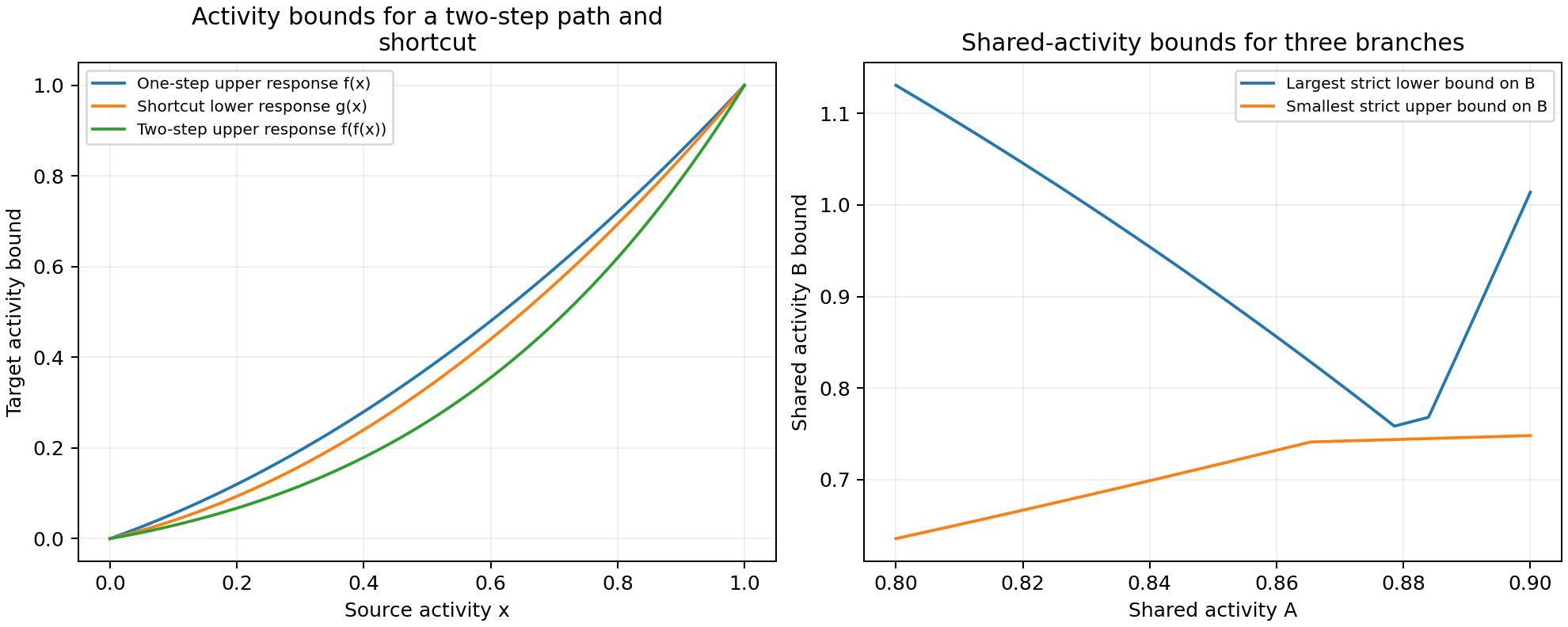
The second model is a fan of triangles sharing . Each branch has a private species and returns to . Eliminating the private species gives lower and upper bounds on the same shared activity , expressed in the remaining variable . The solver uses exact intervals on which the relevant polynomials have fixed signs over the entire activity box and reconstructs a full physical state whenever the bounds overlap. All seven proper subfamilies of the default three-branch fan are compatible; the full family is not.
A separate rational certificate verifies the paper's robustness margins: the incompatibility, deletion witnesses, and relaxation witnesses persist when every kinetic factor and box endpoint changes independently by at most . This is a uniform inequality bound, not a parameter-grid estimate.
Download the complete package for editable inputs at the top, reusable
PairCore, PairAssembly, Branch, and Fan classes, seven scientific test
groups, and all saved results. The README includes a kinetic-factor sweep.
Subfamily selection retains every activity box and the common reaction.
These are static production constraints, not a dynamic reactor or a claim
of sustained growth. Rational calculations and positive-state audits are
exact; the negative fan decision trusts SymPy's root-isolation implementation,
which is not formally verified here. A computation exceeding the polynomial
degree limit returns not_computed. Failure to find a grading certificate
also does not establish general incompatibility.
Python source
"""Exact, composable activity models for collective core incompatibility.

Activities and kinetic factors are dimensionless; these are instantaneous
production constraints, not a steady-state or time-dependent reactor model.
"""
from __future__ import annotations

from dataclasses import dataclass
from fractions import Fraction as Q
from pathlib import Path
import argparse
import hashlib
import itertools
import json
import platform

# EDITABLE INPUTS: exact decimal strings or rational numbers, never binary floats.
PATH_LENGTH = 3                 # L >= 2; conflict order is L + 1
SHARED_FACTOR = Q(1)
SHARED_A_BOX = (Q('0.1'), Q('0.9'))
SHARED_B_BOX = (Q('0.1'), Q('0.9'))
# gain, B<->C factor, C<->mA factor, closed C activity box
BRANCH_INPUTS = ((3, Q(4), Q(2), (Q('.65'), Q('.71'))),
                 (4, Q('0.5'), Q(1), (Q('.65'), Q('.76'))),
                 (3, Q(1), Q(1), (Q('.65'), Q('.76'))))
MAX_ROOT_PRODUCT_DEGREE = 400   # exceeding this returns not_computed
MANUSCRIPT_SHA256 = '6b1d307cee4aa5f7cb65edbbc36b3071e2a62851bedd27741451321209cba972'


@dataclass(frozen=True)
class Box:
    lower: Q
    upper: Q

    def __post_init__(self):
        if not 0 < self.lower <= self.upper:
            raise ValueError('A positive, nonempty closed box is required.')

    def contains(self, value):
        return self.lower <= value <= self.upper

    def intersect_open(self, lower, upper):
        if not (lower < upper and self.lower < upper and lower < self.upper):
            return None
        return max(self.lower, min(self.upper, (lower + upper) / 2))


@dataclass(frozen=True)
class PairCore:
    source: int
    target: int

    def currents(self, activities, doubled=None):
        x, y = activities[self.source], activities[self.target]
        t = x*x if doubled is None else doubled[self.source]
        return x-y, y-t

    def residuals(self, activities, doubled=None):
        p, q = self.currents(activities, doubled)
        return 2*q-p, p-q


@dataclass(frozen=True)
class PairAssembly:
    species_count: int
    cores: tuple[PairCore, ...]

    def __post_init__(self):
        if self.species_count < 1 or any(not 0 <= v < self.species_count
                for e in self.cores for v in (e.source, e.target)):
            raise ValueError('Invalid species index.')

    def graded_state(self):
        """Return an exact constructive witness, or None (NOT infeasibility)."""
        adjacency = [[] for _ in range(self.species_count)]
        for edge in self.cores:
            adjacency[edge.source].append((edge.target, 1))
            adjacency[edge.target].append((edge.source, -1))
        ranks = {}
        for start in range(self.species_count):
            if start in ranks:
                continue
            ranks[start] = 0
            component, queue = [start], [start]
            while queue:
                u = queue.pop()
                for v, delta in adjacency[u]:
                    if v in ranks:
                        if ranks[v] != ranks[u] + delta:
                            return None
                    else:
                        ranks[v] = ranks[u] + delta
                        component.append(v)
                        queue.append(v)
            shift = min(ranks[v] for v in component)
            for v in component:
                ranks[v] -= shift
        height = max(ranks.values())
        state = tuple(1-Q(1,20)*Q(5,8)**(height-ranks[v])
                      for v in range(self.species_count))
        assert all(min(e.residuals(state)) > 0 for e in self.cores)
        return state


class ShortcutFamily:
    def __init__(self, length):
        if not isinstance(length, int) or length < 2:
            raise ValueError('Path length must be an integer >= 2.')
        self.length = length
        self.assembly = PairAssembly(length+1, tuple(
            [PairCore(i, i+1) for i in range(length)] + [PairCore(0, length)]))

    def report(self):
        L = self.length
        delta = Q(1,1000*(L-1))
        a = (Q(19,20),) + tuple(Q(941,1000)-(i-1)*delta for i in range(1,L+1))
        doubled = (Q(467,500),) + tuple(a[i]-Q(7,4)*delta for i in range(1,L+1))
        deletion = []
        for omitted in range(L+1):
            cores = self.assembly.cores[:omitted]+self.assembly.cores[omitted+1:]
            state = PairAssembly(L+1, cores).graded_state()
            deletion.append({'omitted': omitted, 'state': state,
                             'minimum_production': min(r for e in cores for r in e.residuals(state))})
        return {'order': L+1, 'physical_status': 'incompatible',
                'certificate': 'f(f(x))-g(x)=x*(x-1)*(3*x*x+9*x+2)/24 < 0 on (0,1)',
                'single_deletions': deletion, 'direction_state': a,
                'minimum_forward_current': min(j for e in self.assembly.cores for j in e.currents(a)),
                'independent_doubled_complexes': doubled,
                'minimum_relaxed_production': min(r for e in self.assembly.cores for r in e.residuals(a,doubled))}


@dataclass(frozen=True)
class Branch:
    gain: int
    forward_factor: Q
    return_factor: Q
    box: Box

    def __post_init__(self):
        if not isinstance(self.gain, int) or self.gain < 2 or min(self.forward_factor,self.return_factor) <= 0:
            raise ValueError('Integer gain >= 2 and positive factors required.')

    def responses(self, a, shared_factor):
        m, x, y, b0 = self.gain, self.forward_factor, self.return_factor, shared_factor
        t, ell, u = a**m, self.box.lower, self.box.upper
        lower = (((x+y)*b0*a+m*x*y*t)/(m*x*y+(x+y)*b0),
                 ((x+y)*ell-y*t)/x, (b0*a+m*y*(t-u))/b0)
        upper = (((x+y)*b0*a+x*y*t)/(x*y+(x+y)*b0), (x*u+b0*a)/(x+b0))
        return lower, upper

    def private_state(self, a, b, shared_factor):
        j, t = shared_factor*(a-b), a**self.gain
        lo = max(b-j/self.forward_factor, t+j/(self.gain*self.return_factor))
        hi = (self.forward_factor*b+self.return_factor*t)/(self.forward_factor+self.return_factor)
        return self.box.intersect_open(lo, hi)

    def residuals(self, a, b, c, shared_factor, monomial=None):
        j = shared_factor*(a-b)
        p = self.forward_factor*(b-c)
        q = self.return_factor*(c-(a**self.gain if monomial is None else monomial))
        return self.gain*q-j, j-p, p-q


@dataclass(frozen=True)
class Fan:
    shared_factor: Q
    a_box: Box
    b_box: Box
    branches: tuple[Branch, ...]

    def __post_init__(self):
        if self.shared_factor <= 0 or not self.branches:
            raise ValueError('Positive shared factor and at least one branch required.')

    def selected(self, selected):
        indices = tuple(range(len(self.branches))) if selected is None else tuple(selected)
        if len(set(indices)) != len(indices) or any(i < 0 or i >= len(self.branches) for i in indices):
            raise ValueError('Invalid or duplicate branch index.')
        return indices

    def witness_at(self, a, selected=None):
        indices = self.selected(selected)
        if not self.a_box.contains(a):
            return None
        if indices:
            responses = [self.branches[i].responses(a,self.shared_factor) for i in indices]
            b = self.b_box.intersect_open(max(v for lo,_ in responses for v in lo),
                                         min(v for _,hi in responses for v in hi))
            if b is None:
                return None
        else:
            b = (self.b_box.lower+self.b_box.upper)/2
        cs = tuple(self.branches[i].private_state(a,b,self.shared_factor) if i in indices
                   else (self.branches[i].box.lower+self.branches[i].box.upper)/2
                   for i in range(len(self.branches)))
        if any(c is None for c in cs):
            raise ArithmeticError('Response reconstruction failed.')
        state = (a,b,*cs)
        if not self.audit(state,indices):
            raise ArithmeticError('Reconstructed state failed independent physical audit.')
        return state

    def audit(self, state, selected=None):
        indices = self.selected(selected)
        if len(state) != len(self.branches)+2:
            return False
        a,b,*cs = state
        return (self.a_box.contains(a) and self.b_box.contains(b)
                and all(branch.box.contains(c) for branch,c in zip(self.branches,cs))
                and all(min(self.branches[i].residuals(a,b,cs[i],self.shared_factor)) > 0 for i in indices))

    def decide(self, selected=None, max_degree=MAX_ROOT_PRODUCT_DEGREE):
        """Exact rational sign-cell decision using SymPy real-root isolation.

        Resource guard returns not_computed. Root-isolation implementation is
        trusted, not formally verified. Every positive answer is audited again.
        """
        import sympy as sp
        indices = self.selected(selected)
        for a in (self.a_box.lower,self.a_box.upper):
            witness = self.witness_at(a,indices)
            if witness is not None:
                return {'status':'compatible','state':witness,'method':'box_endpoint'}
        if self.a_box.lower == self.a_box.upper:
            return {'status':'incompatible','method':'singleton_A_box'}
        a = sp.Symbol('a')
        responses = [self.branches[i].responses(a,self.shared_factor) for i in indices]
        lowers = [v for lo,_ in responses for v in lo]
        uppers = [v for _,hi in responses for v in hi]
        expressions = [u-l for l in lowers for u in uppers]
        expressions += [u-self.b_box.lower for u in uppers]
        expressions += [self.b_box.upper-l for l in lowers]
        polys = []
        for expression in expressions:
            p = sp.Poly(expression,a,domain=sp.QQ)
            if p.degree() <= 0:
                if p.eval(0) <= 0:
                    return {'status':'incompatible','method':'nonpositive_constant'}
            else:
                polys.append(p)
        # Include box endpoints so every in-domain sign cell is bounded.
        product = sp.Poly((a-self.a_box.lower)*(a-self.a_box.upper),a,domain=sp.QQ)
        for p in polys:
            product = sp.lcm(product,p)
            if product.degree() > max_degree:
                return {'status':'not_computed','method':'degree_limit','degree':product.degree()}
        roots = product.sqf_part().intervals(eps=sp.Rational(1,10**12))
        samples = []
        for ((_,left),_),((right,_),_) in zip(roots,roots[1:]):
            sample = Q((left+right)/2)
            if self.a_box.lower < sample < self.a_box.upper:
                samples.append(sample)
                witness = self.witness_at(sample,indices)
                if witness is not None:
                    return {'status':'compatible','state':witness,'method':'exact_sign_cells',
                            'degree':product.degree(),'cells_checked':len(samples)}
        return {'status':'incompatible','method':'exact_sign_cells',
                'degree':product.degree(),'cells_checked':len(samples)}


def reference_fan():
    return Fan(SHARED_FACTOR,Box(*SHARED_A_BOX),Box(*SHARED_B_BOX),
               tuple(Branch(m,x,y,Box(*box)) for m,x,y,box in BRANCH_INPUTS))


def robustness_certificate(rho=Q(1,10**6)):
    """Fixed reference theorem, separate from editable fan inputs.

    Certifies a whole cube of independent factor/endpoint perturbations through
    uniform inequalities, not through sampling its corners.
    """
    if not 0 <= rho <= Q(1,10**6):
        return {'status':'not_certified','reason':'outside implemented theorem radius'}
    fan = Fan(Q(1),Box(Q(1,10),Q(9,10)),Box(Q(1,10),Q(9,10)),(
        Branch(3,Q(4),Q(2),Box(Q(13,20),Q(71,100))),
        Branch(4,Q(1,2),Q(1),Box(Q(13,20),Q(19,25))),
        Branch(3,Q(1),Q(1),Box(Q(13,20),Q(19,25)))))
    eta = Q(1,10**5)
    states = (((0,1),(Q(141,160),Q(93,125),Q(71,100)-eta,Q(13,20)+eta,Q(7,10))),
              ((0,2),(Q(169,200),Q(88,125),Q(67,100),Q(7,10),Q(653,1000))),
              ((1,2),(Q(22,25),Q(157,200),Q(7,10),Q(13,20)+eta,Q(18,25))))
    margins = []
    boxes = (fan.a_box,fan.b_box,*(b.box for b in fan.branches))
    for selected,state in states:
        assert fan.audit(state,selected)
        assert min(min(v-box.lower,box.upper-v) for v,box in zip(state,boxes)) >= eta
        margins.append(min(r for i in selected for r in
            fan.branches[i].residuals(state[0],state[1],state[i+2],fan.shared_factor)))
    a, u, ell = Q(7,8),Q(89,125),Q(81,125)
    split_bounds = ((a+4*u+10*a**4-15*ell)/11,(4*u-a-3*a**3)/6)
    assert max(split_bounds) < -Q(3,500)
    relaxed = (Q(9,10)-eta,Q(37,50),Q(701,1000),Q(651,1000),Q(341,500))
    complexes = {3:Q(157,250),4:Q(61,100)}
    relaxed_margin = min(r for i,b in enumerate(fan.branches) for r in
        b.residuals(relaxed[0],relaxed[1],relaxed[i+2],Q(1),complexes[b.gain]))
    assert all((Q(1,10)+rho)**m < t < (Q(9,10)-rho)**m for m,t in complexes.items())
    assert min(min(v-box.lower,box.upper-v) for v,box in zip(relaxed,boxes)) > rho
    assert min(margins)-5*rho > 0 and relaxed_margin-5*rho > 0
    return {'status':'certified','radius':rho,'negative_split_bounds':split_bounds,
            'full_family_production_upper_bound':-Q(3,500)+5*rho,
            'deletion_reference_margins':margins,
            'deletion_uniform_lower_bound':min(margins)-5*rho,
            'independent_complex_reference_margin':relaxed_margin,
            'independent_complex_uniform_lower_bound':relaxed_margin-5*rho}


def rational_json(value):
    if isinstance(value,Q):
        return str(value)
    if isinstance(value,dict):
        return {k:rational_json(v) for k,v in value.items()}
    if isinstance(value,(list,tuple)):
        return [rational_json(v) for v in value]
    return value


def main():
    parser = argparse.ArgumentParser(description=__doc__)
    parser.add_argument('--output',type=Path,default=Path('outputs'))
    args = parser.parse_args()
    args.output.mkdir(parents=True,exist_ok=True)
    shortcut, fan = ShortcutFamily(PATH_LENGTH).report(), reference_fan()
    subsets = [{'selected':selected,**fan.decide(selected)}
               for k in range(len(fan.branches)+1)
               for selected in itertools.combinations(range(len(fan.branches)),k)]
    result = {'shortcut':shortcut,'fan_subfamilies':subsets,
              'fixed_reference_robustness':robustness_certificate()}
    (args.output/'results.json').write_text(json.dumps(rational_json(result),indent=2)+'\n')
    lines = [f'Path with shortcut: {shortcut["order"]} cores; full family incompatible.',
             'All single deletions have exact productive witnesses.',
             f'Minimum direction current: {shortcut["minimum_forward_current"]}',
             f'Minimum independent-complex production: {shortcut["minimum_relaxed_production"]}']
    lines += [f'Fan branches {r["selected"]}: {r["status"]} ({r["method"]})' for r in subsets]
    (args.output/'console.txt').write_text('\n'.join(lines)+'\n')
    print('\n'.join(lines))
    import matplotlib
    matplotlib.use('Agg')
    import matplotlib.pyplot as plt
    xs = [i/500 for i in range(501)]
    f = lambda x:(x+x*x)/2
    g = lambda x:(x+2*x*x)/3
    fig,axes = plt.subplots(1,2,figsize=(11,4.4),layout='constrained')
    axes[0].plot(xs,[f(x) for x in xs],label='One-step upper response f(x)')
    axes[0].plot(xs,[g(x) for x in xs],label='Shortcut lower response g(x)')
    axes[0].plot(xs,[f(f(x)) for x in xs],label='Two-step upper response f(f(x))')
    axes[0].set(xlabel='Source activity x',ylabel='Target activity bound',title='Activity bounds for a two-step path and\nshortcut')
    axes[0].legend(fontsize=8)
    aa = [Q(80,100)+Q(i,10000) for i in range(1001)]
    lower,upper = [],[]
    for a in aa:
        rr = [b.responses(a,fan.shared_factor) for b in fan.branches]
        lower.append(float(max(v for lo,_ in rr for v in lo)))
        upper.append(float(min(v for _,hi in rr for v in hi)))
    axes[1].plot([float(a) for a in aa],lower,label='Largest strict lower bound on B')
    axes[1].plot([float(a) for a in aa],upper,label='Smallest strict upper bound on B')
    axes[1].set(xlabel='Shared activity A',ylabel='Shared activity B bound',title='Shared-activity bounds for three branches')
    axes[1].legend(fontsize=8)
    for ax in axes:
        ax.grid(alpha=.2)
    fig.savefig(args.output/'compatibility.png',dpi=180)
    fig.savefig(args.output/'compatibility.svg')
    plt.close(fig)
    digest = lambda p:hashlib.sha256(p.read_bytes()).hexdigest()
    metadata = {'manuscript_sha256':MANUSCRIPT_SHA256,'source_sha256':digest(Path(__file__)),
                'python':platform.python_version(),'output_sha256':{
                    p.name:digest(p) for p in sorted(args.output.iterdir())
                    if p.is_file() and p.name != 'run_metadata.json'}}
    (args.output/'run_metadata.json').write_text(json.dumps(metadata,indent=2)+'\n')


if __name__ == '__main__':
    main()
Run output
Path with shortcut: 4 cores; full family incompatible.
All single deletions have exact productive witnesses.
Minimum direction current: 1/2000
Minimum independent-complex production: 1/8000
Fan branches (): compatible (box_endpoint)
Fan branches (0,): compatible (exact_sign_cells)
Fan branches (1,): compatible (box_endpoint)
Fan branches (2,): compatible (box_endpoint)
Fan branches (0, 1): compatible (exact_sign_cells)
Fan branches (0, 2): compatible (exact_sign_cells)
Fan branches (1, 2): compatible (box_endpoint)
Fan branches (0, 1, 2): incompatible (exact_sign_cells)