Example code
Listing all minimal self-supporting reaction sets (irreducible RAFs) can be difficult even when few exist. This example uses a Boolean satisfiability (SAT) solver to find them and tests a network construction with one known core per variable plus one core per satisfying truth assignment. It makes both the new outputs and the completion decision inspectable.
SupportedTraceCNF expresses the food-generation and catalyst-support requirements as Boolean clauses. Variables select reactions, record supported molecules at successive food-closure stages, and record supported firings. A molecule may appear in a claimed row only through earlier support. The trace may omit reachable molecules, but it cannot invent them. Selected reactions must have their reactants and a catalyst in the final supported row.
One exclusion clause per known irreducible RAF requires at least one of its reactions to be omitted. The solver therefore searches for an avoiding RAF. ModelEnumerator checks the returned reaction set independently, minimizes inside that witness using maxRAF deletions, verifies irreducibility, and blocks its supersets. Blocking reaction sets rather than individual SAT assignments prevents rediscovering the same chemistry through different support histories.
A completed run with cores and supplied cores makes exactly solver calls, including the final UNSAT response, which says no allowed solution remains. This is a call count, not a runtime guarantee. Formula-size, call or conflict limits leave the result incomplete; finding several valid cores never silently becomes a completeness claim. Positive outputs are checked independently in Python, while completeness explicitly trusts the SAT backend's UNSAT result.
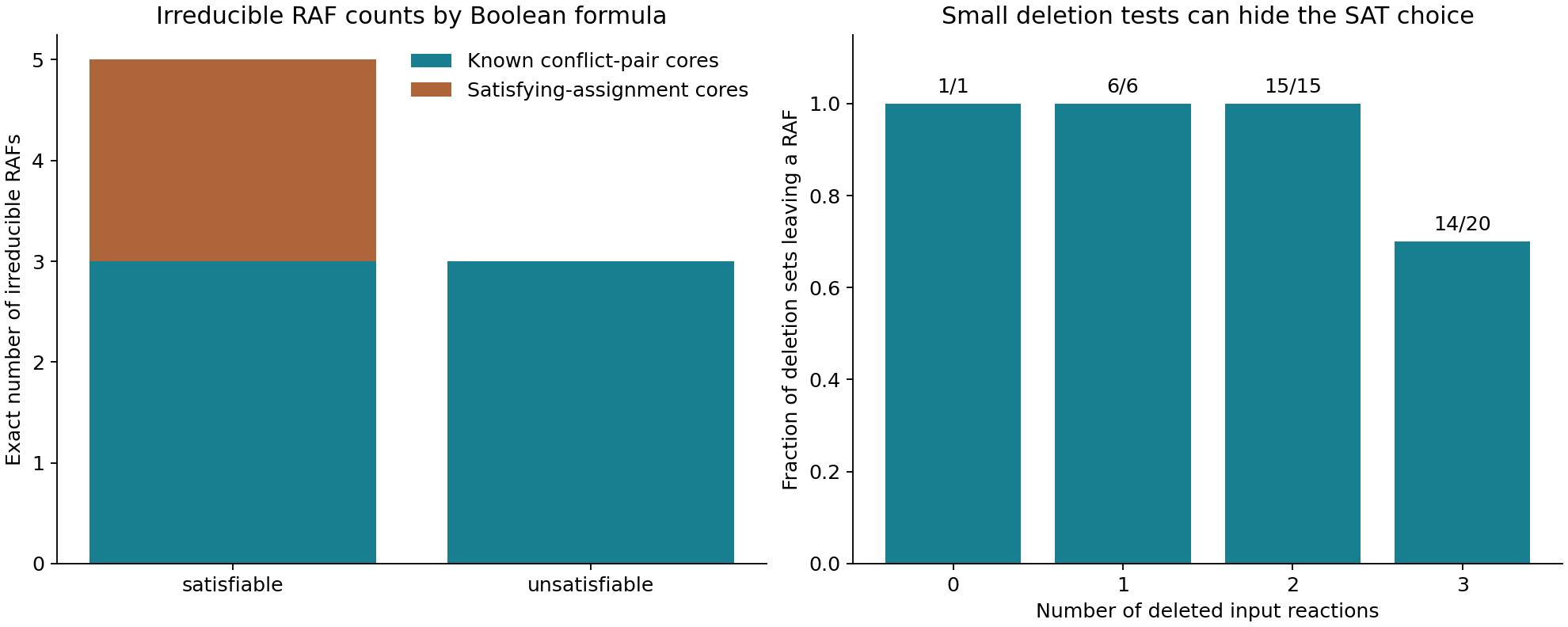
The paper's whole-family source uses reactions representing true/false choices, rules propagating their signals, a mandatory catalytic cycle and a reset. The cycle forces every auxiliary reaction into every RAF. The reset produces all wires only after the output wire exists, so it cannot supply its own first prerequisite. Consequently, the irreducible family is exactly the conflict pairs plus the satisfying assignments; the count is .
Both worked sources have three declared variables, two clauses, 36 molecules and 29 reactions. For , the three known size-25 cores are complete. For , two size-26 assignment cores are missing. Starting from the three known cores, the enumerator finishes in one and three SAT calls respectively. The count-first output lengths are exactly 91 and 151 bits, matching the manuscript.
The lower-bound insight is the known small output on unsatisfiable inputs. A hypothetical uniform output-polynomial algorithm would have a computable polynomial deadline for that output, allowing SAT to be decided. This code displays the source and counts; it does not treat a practical solver timeout as such a proof or assume a polynomial runtime for SAT.
Low-order deletion tests can hide the distinction. Deleting fewer than three input reactions from either worked source leaves a conflict pair. At order three, choices leaving a full assignment distinguish SAT from UNSAT. essential_reactions also computes universally required reactions with maxRAF queries, without enumerating the family. Structural survival is separate from kinetic persistence or thermodynamic feasibility.
Download the package, install requirements.txt, run python example.py --output outputs, then python -m unittest -v. Editable CNFs and limits appear first. For a new chemistry, edit the emitted JSON and run python example.py --input outputs/model_input.json --output custom_run. The chemistry, supported-trace compiler, solver adapter and enumerator are independently reusable; DIMACS queries and output masks are included.
Seven test groups check tiny-source SAT correspondence, all containers of a three-core source, 512 two-variable CNFs and every choice set, exact worked counts, duplicate reaction identities, resource limits, unknown responses and invalid models. This implementation uses pinned PySAT/Glucose3 and independently validates every emitted core. It does not reproduce the paper's Lean machine proof or claim a general efficient enumeration algorithm.
Python source
"""Supported-trace SAT enumeration and the paper's exact SAT-to-RAF family source."""
# EDITABLE INPUTS -------------------------------------------------------------
DECLARED_VARIABLES = 3
SATISFIABLE_CLAUSES = ((1,), (2,))
UNSATISFIABLE_CLAUSES = ((1,), (-1,))
SOLVER_NAME = "g3"                 # installed PySAT Glucose3 backend
MAX_SOLVER_CALLS = 1000            # includes the final UNSAT completion call
CONFLICT_BUDGET_PER_CALL = 100000  # exhausted solve returns unknown, not complete
MAX_FORMULA_LITERALS = 2000000     # guard compilation before allocating clauses
MAX_TRUTH_TABLE_ASSIGNMENTS = 4096 # independent source-check limit, not an SAT-solver limit
# ---------------------------------------------------------------------------

import argparse
from dataclasses import dataclass
import hashlib
from itertools import combinations, product
import json
import math
from pathlib import Path
import platform
import importlib.metadata

@dataclass(frozen=True)
class Reaction:
    name: str
    reactants: frozenset[str]
    products: frozenset[str]
    catalysts: frozenset[str]

    def __post_init__(self):
        for field in ("reactants", "products", "catalysts"):
            object.__setattr__(self, field, frozenset(getattr(self, field)))


@dataclass(frozen=True)
class ReactionSystem:
    food: frozenset[str]
    reactions: tuple[Reaction, ...]

    def __post_init__(self):
        object.__setattr__(self, "food", frozenset(self.food))
        object.__setattr__(self, "reactions", tuple(self.reactions))
        if len(self.ids) != len(self.reactions):
            raise ValueError("Reaction identifiers must be unique")

    @property
    def ids(self):
        return frozenset(r.name for r in self.reactions)

    def select(self, allowed):
        allowed = frozenset(allowed)
        if not allowed <= self.ids:
            raise ValueError("Unknown reaction identifier")
        return tuple(r for r in self.reactions if r.name in allowed)

    def closure_stages(self, allowed):
        selected = self.select(allowed)
        stages = [self.food]
        while True:
            next_state = stages[-1] | frozenset(x for r in selected if r.reactants <= stages[-1] for x in r.products)
            if next_state == stages[-1]:
                return tuple(stages)
            stages.append(next_state)

    def is_raf(self, allowed):
        selected = self.select(allowed)
        closure = self.closure_stages(allowed)[-1]
        return bool(selected) and all(r.reactants <= closure and r.catalysts & closure for r in selected)

    def to_dict(self):
        return {"food": sorted(self.food), "reactions": [{"name": r.name,
                "reactants": sorted(r.reactants), "products": sorted(r.products),
                "catalysts": sorted(r.catalysts)} for r in self.reactions]}

    @classmethod
    def from_dict(cls, data):
        return cls(frozenset(data["food"]), tuple(Reaction(**row) for row in data["reactions"]))


class RAFOracle:
    def __init__(self, system):
        self.system = system
        self.calls = 0

    def maximum(self, allowed=None):
        self.calls += 1
        remaining = self.system.ids if allowed is None else frozenset(allowed)
        self.system.select(remaining)
        while remaining:
            closure = self.system.closure_stages(remaining)[-1]
            keep = frozenset(r.name for r in self.system.select(remaining)
                             if r.reactants <= closure and r.catalysts & closure)
            if keep == remaining:
                break
            remaining = keep
        return remaining

    def irreducible(self, allowed):
        allowed = frozenset(allowed)
        return self.system.is_raf(allowed) and all(not self.maximum(allowed-{r}) for r in sorted(allowed))

    def extract(self, allowed):
        """One inclusion-minimal RAF; no minimum-cardinality claim."""
        current = self.maximum(allowed)
        for r in sorted(current):
            if r in current:
                smaller = self.maximum(current-{r})
                if smaller:
                    current = smaller
        return current


class FormulaLimit(RuntimeError):
    pass


class SupportedTraceCNF:
    """Literal one-way support formula from the paper, without stronger axioms."""
    def __init__(self, system, known=(), container=None, max_literals=None):
        self.system = system
        self.reactions = tuple(r.name for r in system.reactions)
        self.species = tuple(sorted(system.food.union(*(r.reactants | r.products | r.catalysts for r in system.reactions))))
        self.d, self.r = len(self.species),len(self.reactions)
        self.container = system.ids if container is None else frozenset(container)
        system.select(self.container)
        self.known = tuple(map(frozenset,known))
        if any(not member <= system.ids for member in self.known):
            raise ValueError("Unknown identifier in avoidance family")
        self.variable_count = self.r+self.d*(self.d+1)+self.d*self.r
        self.expected_counts = self.counts()
        if max_literals is not None and self.expected_counts["literals"] > max_literals:
            raise FormulaLimit("Supported-trace formula exceeds the configured literal limit")
        self.species_index = {x:i for i,x in enumerate(self.species)}
        self.reaction_index = {x:i for i,x in enumerate(self.reactions)}
        clauses = [tuple(self.selection(a) for a in range(self.r))]
        clauses += [(-self.selection(a),) for a,name in enumerate(self.reactions) if name not in self.container]
        clauses += [(-self.row(0,x),) for x,name in enumerate(self.species) if name not in system.food]
        for i in range(self.d):
            for a,reaction in enumerate(system.reactions):
                clauses.append((-self.firing(i,a),self.selection(a)))
                clauses += [(-self.firing(i,a),self.row(i,self.species_index[x])) for x in sorted(reaction.reactants)]
            for x,name in enumerate(self.species):
                producers = tuple(self.firing(i,a) for a,reaction in enumerate(system.reactions) if name in reaction.products)
                clauses.append((-self.row(i+1,x),self.row(i,x))+producers)
        for a,reaction in enumerate(system.reactions):
            clauses += [(-self.selection(a),self.row(self.d,self.species_index[x])) for x in sorted(reaction.reactants)]
            clauses.append((-self.selection(a),)+tuple(self.row(self.d,self.species_index[x]) for x in sorted(reaction.catalysts)))
        clauses += [self.block(member) for member in self.known]
        self.clauses = tuple(clauses)
        if len(clauses) != self.expected_counts["clauses"] or sum(map(len,clauses)) != self.expected_counts["literals"]:
            raise ArithmeticError("Compiler clause accounting differs from the paper")

    def selection(self,a):
        return a+1

    def row(self,i,x):
        return self.r+i*self.d+x+1

    def firing(self,i,a):
        return self.r+self.d*(self.d+1)+i*self.r+a+1

    def block(self,member):
        return tuple(-self.selection(self.reaction_index[a]) for a in sorted(member))

    def counts(self):
        d,r = self.d,self.r
        ar = sum(len(a.reactants) for a in self.system.reactions)
        ap = sum(len(a.products) for a in self.system.reactions)
        ac = sum(len(a.catalysts) for a in self.system.reactions)
        h,t = len(self.system.food),len(self.system.ids-self.container)
        g,hg = len(self.known),sum(map(len,self.known))
        return {"variables":r+d*(d+1)+d*r,
                "clauses":1+t+(d-h)+d*r+d*ar+d*d+ar+r+g,
                "literals":2*r+t+(d-h)+2*d*r+2*(d+1)*ar+2*d*d+d*ap+ac+hg}

    def dimacs(self,extra=()):
        clauses = self.clauses+tuple(extra)
        return f"p cnf {self.variable_count} {len(clauses)}\n"+"".join(" ".join(map(str,c))+" 0\n" for c in clauses)

    def witness(self,selected):
        """Canonical satisfying assignment from a RAF's actual staged closure."""
        selected = frozenset(selected)
        stages = self.system.closure_stages(selected)
        rows = [stages[min(i,len(stages)-1)] for i in range(self.d+1)]
        true = {self.selection(a) for a,name in enumerate(self.reactions) if name in selected}
        true |= {self.row(i,x) for i in range(self.d+1) for x,name in enumerate(self.species) if name in rows[i]}
        true |= {self.firing(i,a) for i in range(self.d) for a,reaction in enumerate(self.system.reactions)
                 if reaction.name in selected and reaction.reactants <= rows[i]}
        return tuple(v if v in true else -v for v in range(1,self.variable_count+1))

    def check_model(self,model,extra=()):
        true = frozenset(v for v in model if v > 0)
        if not all(any((literal > 0) == (abs(literal) in true) for literal in clause)
                   for clause in self.clauses+tuple(extra)):
            raise ValueError("SAT model fails a compiled clause")
        selected = frozenset(name for a,name in enumerate(self.reactions) if self.selection(a) in true)
        if not self.system.is_raf(selected) or not selected <= self.container:
            raise ValueError("Selected reactions fail independent RAF validation")
        if any(member <= selected for member in self.known):
            raise ValueError("Model failed known-family avoidance")
        # Check the soundness invariant, allowing supported rows to omit molecules.
        stages = self.system.closure_stages(selected)
        for i in range(self.d+1):
            supported = {name for x,name in enumerate(self.species) if self.row(i,x) in true}
            if not supported <= stages[min(i,len(stages)-1)]:
                raise ValueError("Unsupported molecule in the SAT trace")
        return selected


class PySATBackend:
    """Incremental solver adapter. UNSAT trusts the backend, not a Lean certificate."""
    def __init__(self,clauses,name=SOLVER_NAME,conflict_budget=CONFLICT_BUDGET_PER_CALL):
        from pysat.solvers import Solver
        self.solver = Solver(name=name,bootstrap_with=clauses)
        self.conflict_budget = conflict_budget

    def add_clause(self,clause):
        self.solver.add_clause(list(clause))

    def solve(self):
        if self.conflict_budget is None:
            status = self.solver.solve()
        else:
            self.solver.conf_budget(self.conflict_budget)
            status = self.solver.solve_limited()
        if status is None:
            return "unknown",None
        return ("sat",self.solver.get_model()) if status else ("unsat",None)

    def close(self):
        self.solver.delete()


class ModelEnumerator:
    def __init__(self,system,backend_factory=PySATBackend):
        self.system,self.backend_factory = system,backend_factory

    def run(self,known=(),max_calls=MAX_SOLVER_CALLS,max_literals=MAX_FORMULA_LITERALS):
        family = list(sorted(set(map(frozenset,known)),key=lambda s:tuple(sorted(s))))
        initial = len(family)
        validator = RAFOracle(self.system)
        if any(not validator.irreducible(i) for i in family):
            raise ValueError("Every initial member must be an irrRAF")
        try:
            formula = SupportedTraceCNF(self.system,family,max_literals=max_literals)
        except FormulaLimit as error:
            return {"status":"incomplete","reason":str(error),"family":[sorted(i) for i in family],"solver_calls":0}
        backend = self.backend_factory(formula.clauses)
        events,blocks,calls,min_calls = [],[],0,0
        status,reason = "incomplete","Solver-call limit reached before a final UNSAT result"
        try:
            while max_calls is None or calls < max_calls:
                verdict,model = backend.solve()
                calls += 1
                if verdict == "unknown":
                    reason = "Solver returned unknown or reached its resource limit"
                    break
                if verdict == "unsat":
                    status,reason = "complete","Final supported-trace query is UNSAT"
                    break
                if verdict != "sat" or model is None:
                    raise ValueError("Invalid solver response")
                selected = formula.check_model(model,blocks)
                if any(i <= selected for i in family):
                    raise ValueError("Backend returned a blocked reaction set")
                oracle = RAFOracle(self.system)
                current = selected
                # The whole sweep stays inside the avoiding SAT witness.
                for reaction in self.system.reactions:
                    if reaction.name in current:
                        smaller = oracle.maximum(current-{reaction.name})
                        if smaller:
                            current = smaller
                min_calls += oracle.calls
                if current in family or not validator.irreducible(current):
                    raise ArithmeticError("Emitted set is not a new irreducible RAF")
                family.append(current)
                clause = formula.block(current)
                blocks.append(clause)
                backend.add_clause(clause)
                events.append({"selected":sorted(selected),"emitted":sorted(current),"minimization_calls":oracle.calls})
        finally:
            backend.close()
        if status == "complete" and calls != len(family)-initial+1:
            raise ArithmeticError("Completed solver-call identity failed")
        return {"status":status,"reason":reason,"initial_members":initial,"family":[sorted(i) for i in family],
                "solver_calls":calls,"minimization_maxraf_calls":min_calls,"events":events,
                "base_formula":formula.expected_counts,"final_blocking_clauses":len(family)}


@dataclass(frozen=True)
class BooleanFormula:
    variables: int
    clauses: tuple[tuple[int,...],...]

    def __post_init__(self):
        if self.variables < 2:
            raise ValueError("Declare at least two variables; padding changes the model count")
        if any(v == 0 or abs(v) > self.variables for c in self.clauses for v in c):
            raise ValueError("Literals must use signed one-based variable indices")

    def evaluate(self,assignment):
        return all(any(bool(assignment[abs(v)-1]) == (v > 0) for v in c) for c in self.clauses)

    def satisfying_assignments(self):
        if 2**self.variables > MAX_TRUTH_TABLE_ASSIGNMENTS:
            raise ValueError("Source truth-table audit exceeds its limit; use ModelEnumerator on your network or explicitly raise the audit limit")
        return tuple(a for a in product((False,True),repeat=self.variables) if self.evaluate(a))

    def accepts_choices(self,choices):
        choices = frozenset(choices)
        conflict = any({(i,False),(i,True)} <= choices for i in range(self.variables))
        coverage = all((i,False) in choices or (i,True) in choices for i in range(self.variables))
        hits = all(any((abs(v)-1,v>0) in choices for v in c) for c in self.clauses)
        return conflict or (coverage and hits)


class SATFamilySource:
    """Whole-family source: mandatory auxiliary cycle plus reset and literal inputs."""
    def __init__(self,formula):
        self.formula = formula
        n,m = formula.variables,len(formula.clauses)
        def literal(i,b): return f"literal:{i}:{int(b)}"
        wires = {literal(i,b) for i in range(n) for b in (False,True)}
        wires |= {f"covered:{i}" for i in range(n)}|{f"clause:{j}" for j in range(m)}|{"out"}
        rules = []
        for i in range(n):
            rules.append(({literal(i,False),literal(i,True)},{"out"}))
        for i,b in product(range(n),(False,True)):
            rules.append(({literal(i,b)},{f"covered:{i}"}))
        for j,clause in enumerate(formula.clauses):
            for i,b in product(range(n),(False,True)):
                signed = i+1 if b else -(i+1)
                rules.append(({literal(i,b)},{f"clause:{j}"} if signed in clause else set()))
        rules.append(({f"covered:{i}" for i in range(n)}|{f"clause:{j}" for j in range(m)},{"out"}))
        q = len(rules)
        self.auxiliary = frozenset(f"aux:{j}" for j in range(q+1))
        self.inputs = {(i,b):f"input:{i}:{int(b)}" for i,b in product(range(n),(False,True))}
        reactions = [Reaction(name,{"food"},{literal(i,b)},{f"marker:{q}"}) for (i,b),name in self.inputs.items()]
        reactions += [Reaction(f"aux:{j}",required,produced|{f"marker:{j}"},{f"marker:{j+1}"}) for j,(required,produced) in enumerate(rules)]
        reactions.append(Reaction(f"aux:{q}",{"out"},wires|{f"marker:{q}"},{"marker:0"}))
        self.system = ReactionSystem({"food"},tuple(reactions))
        self.reset = f"aux:{q}"
        self.baseline = tuple(self.canonical(((i,False),(i,True))) for i in range(n))

    def canonical(self,choices):
        return self.auxiliary|frozenset(self.inputs[c] for c in choices)

    def predicted_family(self):
        return frozenset(self.baseline)|frozenset(self.canonical(enumerate(a)) for a in self.formula.satisfying_assignments())

    def dimensions(self):
        n,m = self.formula.variables,len(self.formula.clauses)
        d,r = 6*n+2*n*m+m+4,5*n+2*n*m+2
        return {"molecules":d,"reactions":r,"input_bits":2*d+r+2+3*d*r,"baseline_output_bits":(r+1)*n+1}


def output_bits(reaction_order,family):
    family = tuple(map(frozenset,family))
    if len(set(family)) != len(family) or any(not s <= set(reaction_order) for s in family):
        raise ValueError("Count-first output requires distinct valid reaction masks")
    return "1"*len(family)+"0"+"".join("1" if r in member else "0" for member in family for r in reaction_order)


def essential_reactions(system):
    oracle = RAFOracle(system)
    if not oracle.maximum():
        return {"status":"no RAF","reactions":[]}
    return {"status":"RAF exists","reactions":sorted(r for r in system.ids if not oracle.maximum(system.ids-{r}))}


def main():
    parser = argparse.ArgumentParser(description=__doc__)
    parser.add_argument("--output",type=Path,default=Path("outputs"))
    parser.add_argument("--input",type=Path,help="JSON source with food, reactions and optional known_family")
    args = parser.parse_args()
    args.output.mkdir(parents=True,exist_ok=True)
    if args.input:
        data = json.loads(args.input.read_text())
        report = ModelEnumerator(ReactionSystem.from_dict(data)).run(data.get("known_family",()))
        (args.output/"enumeration.json").write_text(json.dumps(report,indent=2)+"\n")
        print(report["status"],len(report["family"]))
        return
    cases = {"satisfiable":BooleanFormula(DECLARED_VARIABLES,SATISFIABLE_CLAUSES),
             "unsatisfiable":BooleanFormula(DECLARED_VARIABLES,UNSATISFIABLE_CLAUSES)}
    for boolean in cases.values():
        boolean.satisfying_assignments()  # check the small-source audit limit before solver work
    results = {}
    for name,boolean in cases.items():
        source = SATFamilySource(boolean)
        report = ModelEnumerator(source.system).run(source.baseline)
        expected = source.predicted_family()
        found = frozenset(map(frozenset,report["family"]))
        if not found <= expected or (report["status"] == "complete" and found != expected):
            raise ArithmeticError("Enumerated family differs from the source correspondence")
        order = tuple(r.name for r in source.system.reactions)
        encoded = output_bits(order,report["family"])
        results[name] = {"dimensions":source.dimensions(),"satisfying_assignment_count":len(boolean.satisfying_assignments()),
                         "predicted_family_count":len(expected),"enumeration":report,"output_bits":len(encoded),
                         "output_sizes":sorted(map(len,found)),"essential":essential_reactions(source.system)}
        (args.output/f"{name}_masks.txt").write_text(encoded+"\n")
        query = SupportedTraceCNF(source.system,source.baseline)
        # .txt suffix permits a standalone DIMACS artifact in the site's schema.
        (args.output/f"{name}_completion_dimacs.txt").write_text(query.dimacs())
        if name == "satisfiable":
            source_data = {**source.system.to_dict(),"known_family":[sorted(i) for i in source.baseline]}
            (args.output/"model_input.json").write_text(json.dumps(source_data,indent=2)+"\n")
            # Low-order input deletions leave a conflict pair; at order n the
            # surviving assignment exposes the SAT distinction.
            by_order = []
            oracle = RAFOracle(source.system)
            for size in range(DECLARED_VARIABLES+1):
                deletions = tuple(combinations(source.inputs.values(),size))
                alive = sum(bool(oracle.maximum(source.system.ids-set(d))) for d in deletions)
                by_order.append({"deleted_inputs":size,"survivors":alive,"total":len(deletions)})
            results[name]["input_deletion_profile"] = by_order
    (args.output/"results.json").write_text(json.dumps(results,indent=2)+"\n")
    import matplotlib
    matplotlib.use("Agg")
    import matplotlib.pyplot as plt
    plt.rcParams.update({"font.size":11,"axes.spines.top":False,"axes.spines.right":False,"svg.hashsalt":"sat-enumeration-v1"})
    fig,axes = plt.subplots(1,2,figsize=(12,4.8),layout="constrained")
    names = tuple(results)
    baseline = [DECLARED_VARIABLES]*len(names)
    assignments = [results[n]["satisfying_assignment_count"] for n in names]
    axes[0].bar(names,baseline,label="Known conflict-pair cores",color="#187f91")
    axes[0].bar(names,assignments,bottom=baseline,label="Satisfying-assignment cores",color="#ae6539")
    axes[0].set(ylabel="Exact number of irreducible RAFs",title="Irreducible RAF counts by Boolean formula")
    axes[0].legend(frameon=False)
    profile = results["satisfiable"]["input_deletion_profile"]
    axes[1].bar([r["deleted_inputs"] for r in profile],[r["survivors"]/r["total"] for r in profile],color="#187f91")
    axes[1].set(xlabel="Number of deleted input reactions",ylabel="Fraction of deletion sets leaving a RAF",
                ylim=(0,1.15),xticks=[r["deleted_inputs"] for r in profile],title="Small deletion tests can hide the SAT choice")
    for row in profile:
        axes[1].text(row["deleted_inputs"],row["survivors"]/row["total"]+.025,f"{row['survivors']}/{row['total']}",ha="center")
    for ext in ("png","svg"):
        fig.savefig(args.output/f"families.{ext}",dpi=165)
    plt.close(fig)
    console = "\n".join(["Supported-trace SAT enumeration; all emitted RAFs independently checked"]+
        [f"{name}: {r['enumeration']['status']}, {len(r['enumeration']['family'])} cores, {r['enumeration']['solver_calls']} SAT calls from {DECLARED_VARIABLES} known cores, output {r['output_bits']} bits" for name,r in results.items()]+
        ["Completion trusts the PySAT backend's UNSAT answer. Solver-call count is not a runtime guarantee."])
    print(console)
    (args.output/"console.txt").write_text(console+"\n")
    metadata = {"paper_sha256":"d3f3798ee1f02275a8ecbd97805982690d1d0f793ba8eb90a028fbc51d5d9004",
                "source_sha256":hashlib.sha256(Path(__file__).read_bytes()).hexdigest(),"python":platform.python_version(),
                "python-sat":importlib.metadata.version("python-sat"),"matplotlib":matplotlib.__version__,
                "inputs":{"variables":DECLARED_VARIABLES,"satisfiable_clauses":SATISFIABLE_CLAUSES,
                          "unsatisfiable_clauses":UNSATISFIABLE_CLAUSES,"solver":SOLVER_NAME,"max_calls":MAX_SOLVER_CALLS,
                          "conflict_budget":CONFLICT_BUDGET_PER_CALL,"formula_literal_limit":MAX_FORMULA_LITERALS,
                          "truth_table_assignment_limit":MAX_TRUTH_TABLE_ASSIGNMENTS},
                "output_sha256":{p.name:hashlib.sha256(p.read_bytes()).hexdigest() for p in sorted(args.output.iterdir())
                                  if p.is_file() and p.name != "run_metadata.json"}}
    (args.output/"run_metadata.json").write_text(json.dumps(metadata,indent=2)+"\n")


if __name__ == "__main__":
    main()
Run output
Supported-trace SAT enumeration; all emitted RAFs independently checked
satisfiable: complete, 5 cores, 3 SAT calls from 3 known cores, output 151 bits
unsatisfiable: complete, 3 cores, 1 SAT calls from 3 known cores, output 91 bits
Completion trusts the PySAT backend's UNSAT answer. Solver-call count is not a runtime guarantee.