Example code
A network of autocatalytic reactors exchanges material while each reactor recovers from harvesting. This example runs the paper's full six-species chemistry at every node, with different local rates, actual transport, and repeated withdrawal, loss and food refill. It also exposes the production floors and resource budgets as reusable calculations.
The key condition is simple: every species moves with the same exchange rates, conserving total material across nodes. Any fixed weighted sum of species inventories then follows the same transport rule. Exchange cannot decrease its value at the node where it is smallest, and it cancels from the network's total inventory. This lets the local recovery argument survive arbitrary finite symmetric coupling, including disconnected graphs.
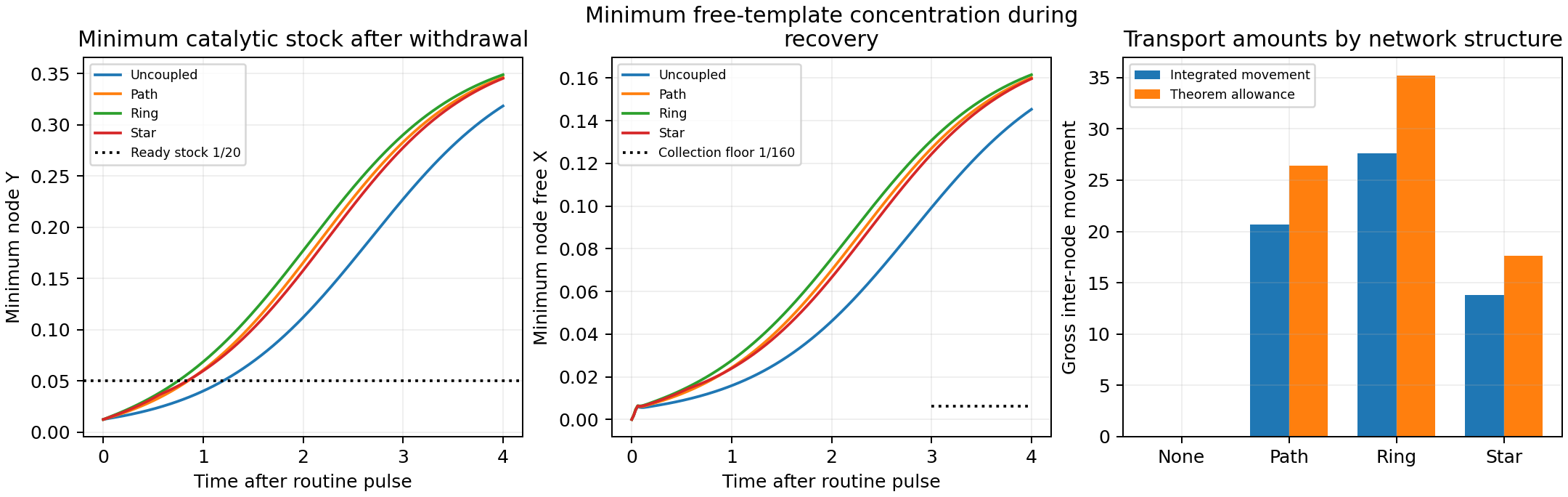
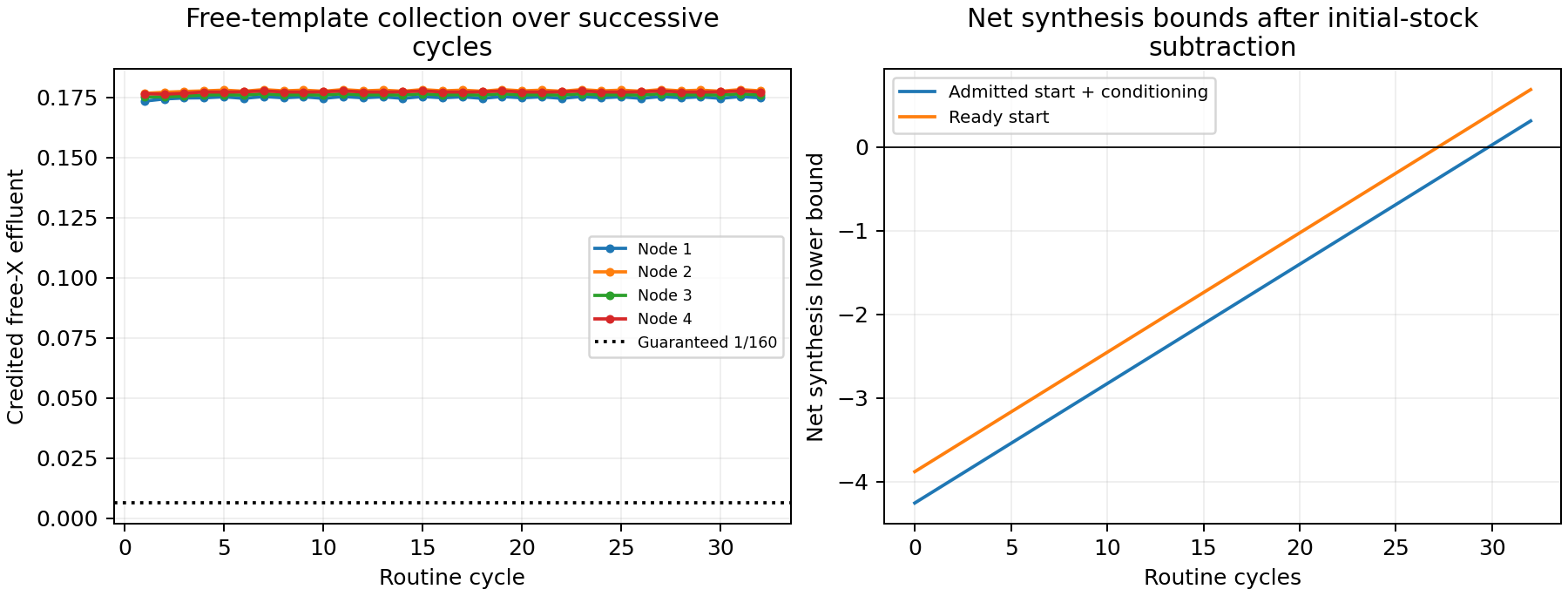
Catalytic stock can sit in several complexes, so recovering stock does not immediately guarantee free product. The code constructs the paper's nonnegative backward weights, which follow how those complexes release free . Fresh rational checks recover the collection floors: at least template equivalents and free per node per routine cycle. Free is already included in the template total; the two outputs overlap.
The runnable model composes local chemistry, graph exchange, synchronized pulses, a history-dependent policy and separate accounting. It reproduces the four one-cycle paper diagnostics, runs 32 cycles from actual previous endpoints, and sweeps exchange strength. Independent numerical solvers and the exact material solution check the computed trajectories. Those curves illustrate the theorem; they do not prove it or identify an optimal graph.
The inventory ledger subtracts the entire initial stock and includes all effluent, withdrawn material and losses. Its guaranteed net synthesis becomes positive after 30 routine cycles with conditioning, or 28 from a ready start. Transport has a separate handling cost even though the production floor does not depend on graph strength.
For an illustrative four-node system of 1 mL reactors at a 1 mM concentration scale, the worked demand needs 11 cycles plus conditioning: 56 minutes, at least micromoles of template equivalents and micromoles of free . The food and service budgets fund 12 cycles. These are transparent dimensional placeholders, not measured laboratory performance.
An exact two-node example also shows the boundary of the argument: selectively moving only makes the catalytic observable decrease at a shared minimum. This invalidates the common-transport reasoning there; it does not establish extinction. The guarantee assumes equal volumes, fixed admissible kinetics, maintained reservoirs and instantaneous synchronized pulses. It does not certify finite-molecule reliability, asynchronous handling or finite-bath autonomy, and the package does not rerun Lean.
Python source
"""Common conservative transport, pulsed recovery, and honest production accounts.

Run python example.py --output outputs. Normalized deterministic concentrations;
the network theorem is imported, while its algebra and constants are checked here.
"""
from __future__ import annotations
import argparse
import csv
from dataclasses import dataclass
from fractions import Fraction as Q
import hashlib
import json
import math
from pathlib import Path
import platform
import numpy as np
from scipy.integrate import solve_ivp
from scipy.linalg import expm
import sympy as sp

# EDITABLE INPUTS -----------------------------------------------------------
TOPOLOGY = 'path'                       # uncoupled, path, ring, star (four nodes)
EXCHANGE_SCALE = 1.0                    # common to ALL species; no theorem upper cap
RELEASE = (19., 21., 19., 21.)          # fixed node rates, each in [19,21]
CLEAVAGE = (.04, .02, .02, .04)         # each in [.02,.04]
INITIAL_STATE = (
    (151/160,151/160,1/20,0,0,0),
    (1303/1440,1367/1440,0,2/45,0,0),
    (1033/1120,1033/1120,0,0,1/28,0),
    (1351/1440,1351/1440,0,0,0,1/36),
)
ROUTINE_CYCLES = 32                     # conditioning pulse + 12, then pulse + 4
BASE_RETENTION = (.25, .75, .4, .6)
SURVIVAL = (.98, 1., .98, 1., .99, 1.)
FOOD_ERROR = (-.005, -.005)
CONCENTRATION_MOLAR = .001              # illustrative, not fitted chemistry
NODE_VOLUME_LITERS = .001
TIME_SECONDS = 60.
DEMAND_I, DEMAND_X = '3/2', '1/5'       # normalized network amounts; overlapping outputs
AVAILABLE_TIME = 64
FOOD_U_BUDGET, FOOD_W_BUDGET, SERVICE_BUDGET = 300, 280, 12
RTOL, ATOL = 1e-9, 1e-12
MANUSCRIPT_SHA256 = 'c8b16eaf2abf49162495bbfb0ea0e69908a3a28d5e34968d60dcd399daf6518f'
# --------------------------------------------------------------------------
SPECIES = ('U','W','X','C1','C2','Z')
A = np.array([1,0,1,2,2,2.]); B = np.array([0,1,1,1,2,2.])
Y = np.array([0,0,1,9/8,7/5,9/5]); I = np.array([0,0,1,1,1,2.])
WEIGHTS = np.array([A,B,Y,I])
STOICH = np.array([[-1,-1,0,0,0,1],[-1,0,-1,0,0,1],
    [1,-1,0,0,2,-1],[0,1,-1,0,0,0],[0,0,1,-1,0,0],[0,0,0,1,-1,0]])
EPS, ETA = Q(1,500000000), Q(1,8000000000)


class LocalChemistry:
    """Six reversible pairs at each node; vectorized mass action, unit flow."""
    def __init__(self, release=RELEASE, cleavage=CLEAVAGE):
        self.r=np.asarray(release,float).copy(); self.d=np.asarray(cleavage,float).copy()
        if self.r.ndim!=1 or self.r.shape!=self.d.shape or not len(self.r) or not np.all(np.isfinite([self.r,self.d])) or np.any(self.r<0) or np.any(self.d<0):
            raise ValueError('Equal nonempty vectors of finite nonnegative node rates required.')

    @property
    def certified(self): return bool(np.all((self.r>=19)&(self.r<=21)&(self.d>=.02)&(self.d<=.04)))

    def fluxes(self,c):
        u,w,x,c1,c2,z=c.T
        return np.array([float(EPS)*(u*w-x/10),20*(x*u-c1),20*(c1*w-c2),
                         20*c2-2*z,self.r*(z-x*x),self.d*(x-float(ETA)*u*w)]).T

    def field(self,c): return np.array([1,1,0,0,0,0])-c+self.fluxes(c)@STOICH.T

    def service(self,c): return self.d*(c[:,2]+float(ETA)*c[:,0]*c[:,1])


class CommonExchange:
    """Equal-volume symmetric exchange; arbitrary finite graph, same D for all species."""
    def __init__(self, weights):
        k=np.asarray(weights,float).copy()
        if k.ndim!=2 or not len(k) or k.shape[0]!=k.shape[1] or not np.all(np.isfinite(k)) or np.any(k<0) or np.any(np.diag(k)!=0) or not np.array_equal(k,k.T):
            raise ValueError('Finite symmetric nonnegative zero-diagonal matrix required.')
        self.k=k; self.D=k-np.diag(k.sum(axis=1)); self.n=len(k)

    def field(self,c): return self.D@c
    def gross_handling(self,c): return float(self.k.sum(axis=1)@c.sum(axis=1))
    def handling_bound(self,duration): return 11/5*duration*self.k.sum()
    def directed_labels(self):
        return [(i,j,s,float(self.k[i,j])) for i in range(self.n) for j in range(self.n)
                if self.k[i,j]>0 for s in SPECIES]

    @classmethod
    def four_nodes(cls,name,scale=1.):
        if not np.isfinite(scale) or scale<0: raise ValueError('Nonnegative finite scale required.')
        edges={'uncoupled':[], 'path':[(0,1),(1,2),(2,3)],
               'ring':[(0,1),(1,2),(2,3),(3,0)],'star':[(0,1),(0,2),(0,3)]}[name]
        k=np.zeros((4,4))
        for i,j in edges:k[i,j]=k[j,i]=scale*(1/3 if name=='star' else .5)
        return cls(k)


@dataclass(frozen=True)
class Pulse:
    retained: tuple
    survival: tuple = SURVIVAL
    food_error: tuple = FOOD_ERROR

    def arrays(self,n):
        q=np.asarray(self.retained,float); ell=np.asarray(self.survival,float)
        e=np.asarray(self.food_error,float)
        if q.shape!=(n,) or ell.shape not in ((6,),(n,6)) or e.shape not in ((2,),(n,2)):
            raise ValueError('One retention per node; survival/refill may be common or node-specific.')
        if not all(np.all(np.isfinite(v)) for v in (q,ell,e)) or np.any((q<.25)|(q>.75)) or np.any((ell<.98)|(ell>1)) or np.any(abs(e)>.005):
            raise ValueError('Pulse outside paper bounds.')
        return q[:,None],np.broadcast_to(ell,(n,6)),np.broadcast_to(e,(n,2))

    def apply(self,c):
        q,ell,e=self.arrays(len(c)); after=q*ell*c; food=1-q+e
        after[:,:2]+=food
        return after,(1-q)*c,q*(1-ell)*c,food


class HistoryPolicy:
    """Example admissible feedback: preserve more after a relatively small last output.

    Receives snapshots of completed cycles and current state; never changes kinetics.
    Replace choose() to investigate another synchronized policy.
    """
    def choose(self,c,history):
        q=np.roll(np.asarray(BASE_RETENTION),len(history)).copy()
        if history:
            last=np.array(history[-1]['collection_I']); q[last<np.median(last)]=.75
        return Pulse(tuple(q))


class ReactorNetwork:
    def __init__(self,chemistry,exchange):
        if len(chemistry.r)!=exchange.n: raise ValueError('Rate and graph node counts differ.')
        self.chemistry=chemistry; self.exchange=exchange; self.n=exchange.n

    def validate_state(self,c):
        c=np.asarray(c,float).copy()
        if c.shape!=(self.n,6) or not np.all(np.isfinite(c)) or np.any(c<0): raise ValueError('Nonnegative finite N by 6 state required.')
        return c

    def in_region(self,c,ready=False):
        obs=np.asarray(c)@WEIGHTS.T; lo,hi=(159/160,161/160) if ready else (.9,1.1)
        return bool(np.all((obs[:,:2]>=lo-1e-14)&(obs[:,:2]<=hi+1e-14)) and np.all(obs[:,2]>=(.05 if ready else .0002)-1e-14))

    def rhs(self,t,v):
        c=v[:6*self.n].reshape(self.n,6); j=self.chemistry.fluxes(c)
        counters=np.column_stack((c@I,c[:,2],self.chemistry.service(c),j[:,0]+j[:,3]-j[:,5]))
        return np.r_[(self.chemistry.field(c)+self.exchange.field(c)).ravel(),counters.ravel(),self.exchange.gross_handling(c)]

    def evolve(self,initial,duration,method='Radau'):
        c=self.validate_state(initial)
        if not np.isfinite(duration) or duration<=0: raise ValueError('Positive duration required.')
        sol=solve_ivp(self.rhs,(0,duration),np.r_[c.ravel(),np.zeros(4*self.n+1)],
                      method=method,rtol=RTOL,atol=ATOL,dense_output=True)
        if not sol.success: raise RuntimeError(sol.message)
        time=np.linspace(0,duration,round(duration*50)+1)
        samples=sol.sol(time)[:6*self.n].T.reshape(-1,self.n,6)
        if samples.min()<-1e-9: raise RuntimeError('Negative numerical concentration; no clipping applied.')
        final=samples[-1]; totals=sol.y[6*self.n:-1,-1].reshape(self.n,4)
        collection=(sol.sol(duration)-sol.sol(duration-1))[6*self.n:-1].reshape(self.n,4) if duration>=1 else None
        material=np.stack([1+expm((self.exchange.D-np.eye(self.n))*t)@(c@WEIGHTS[:2].T-1) for t in time])
        residual=float(np.max(abs(samples@WEIGHTS[:2].T-material)))
        inventory=float(abs((final@I).sum()-(c@I).sum()+totals[:,0].sum()-totals[:,3].sum()))
        return dict(end=final,time=time,samples=samples,totals=totals,collection=collection,
                    handling=float(sol.y[-1,-1]),material_error=residual,inventory_error=inventory)


class HarvestMission:
    """Actual endpoint feeds the next pulse; all effluent and losses stay in the ledger."""
    def __init__(self,network,policy):self.network=network; self.policy=policy

    def run(self,initial,cycles,conditioning=True,method='Radau'):
        if not isinstance(cycles,int) or isinstance(cycles,bool) or cycles<0:raise ValueError('Nonnegative integer cycle count required.')
        c=self.network.validate_state(initial)
        if not self.network.chemistry.certified or not self.network.in_region(c,ready=not conditioning):
            raise ValueError('Mission certificate requires paper rates and admitted/ready initial state.')
        first=float((c@I).sum()); history=[]; traces=[]; all_totals=np.zeros((self.network.n,4))
        food=np.zeros(2); withdraw=loss=handling=0.; elapsed=0.; max_material=max_inventory=0.
        import copy
        for stage in range(-int(conditioning),cycles):
            pulse=self.policy.choose(c.copy(),copy.deepcopy(history)); after,removed,waste,added=pulse.apply(c)
            withdraw+=float((removed@I).sum()); loss+=float((waste@I).sum()); food+=added.sum(axis=0)
            duration=12 if stage<0 else 4
            part=self.network.evolve(after,duration,method); c=part['end']; food+=duration*self.network.n
            all_totals+=part['totals']; handling+=part['handling']
            max_material=max(max_material,part['material_error']); max_inventory=max(max_inventory,part['inventory_error'])
            traces.extend((elapsed+t,stage,i,*row) for t,cs in zip(part['time'],part['samples']) for i,row in enumerate(cs))
            elapsed+=duration
            if stage>=0:history.append(dict(cycle=stage+1,retained=list(pulse.retained),collection_I=part['collection'][:,0].tolist(),
                collection_X=part['collection'][:,1].tolist(),endpoint_Y=(c@Y).tolist()))
        net=float(all_totals[:,3].sum()); wash=float(all_totals[:,0].sum()); final=float((c@I).sum())
        return dict(history=history,trace=traces,end=c.tolist(),food=food.tolist(),gross_service=float(all_totals[:,2].sum()),
            gross_handling=handling,initial_I=first,final_I=final,all_effluent_I=wash,withdrawn_I=withdraw,lost_I=loss,
            net_synthesis=net,inventory_residual=abs(net-(final-first+wash+withdraw+loss)),
            material_error=max_material,flow_inventory_error=max_inventory,duration=elapsed)


class MissionCertificate:
    """Exact arithmetic on the imported deterministic theorem, not an ODE proof."""
    def __init__(self,n):
        if not isinstance(n,int) or isinstance(n,bool) or n<1:raise ValueError('Positive integer node count required.')
        self.n=n

    def bounds(self,m,conditioning=True):
        if not isinstance(m,int) or isinstance(m,bool) or m<0:raise ValueError('Nonnegative integer cycle count required.')
        n=self.n; start=Q(11,10) if conditioning else Q(161,160)
        return dict(cycles=m,time=12*int(conditioning)+4*m,collection_I=Q(n*m,28),collection_X=Q(n*m,160),
            each_food=Q(n*(2551*int(conditioning)+951*m),200),gross_service=Q(n*(27*int(conditioning)+9*m),50),
            net_synthesis= n*(Q(m+1,28)-start))

    def size(self,demand_I,demand_X,time,food_U,food_W,service):
        vals=list(map(Q,(demand_I,demand_X,time,food_U,food_W,service)))
        if min(vals)<0:raise ValueError('Nonnegative demands and budgets required.')
        di,dx,t,bu,bw,bg=vals;n=self.n
        available=min((t-12)/4,(200*bu/n-2551)/951,(200*bw/n-2551)/951,(50*bg/n-27)/9)
        if available<0:raise ValueError('Conditioning is not funded; zero routine cycles is not a feasible mission.')
        required=math.ceil(max(28*di/n,160*dx/n)); funded=math.floor(available)
        return dict(required_cycles=required,funded_cycles=funded,feasible=required<=funded,required_bounds=self.bounds(required))


class PhaseCertificate:
    """Lower-system weights convert total catalytic stock into free X locally.

    This Metzler lower matrix is not the reactor Jacobian. Nonnegative truncated
    exponential rows provide exact reusable weight certificates at rational lags.
    """
    M=sp.Matrix([[-48,20,0,38],[0,-43,20,0],[0,0,-41,2],[0,0,20,-24]])
    weights=sp.Matrix([[1,sp.Rational(9,8),sp.Rational(7,5),sp.Rational(9,5)]])

    def polynomial(self,degree=4):
        if not isinstance(degree,int) or degree<0:raise ValueError('Nonnegative degree required.')
        h=sp.Symbol('h',nonnegative=True); K=self.M+48*sp.eye(4); e=sp.Matrix([[1,0,0,0]])
        p=sum((h**k/sp.factorial(k)*e*K**k for k in range(degree+1)),sp.zeros(1,4))
        return h,p,sp.simplify(p*K-p.diff(h))

    def exact_floor(self):
        h,p,residual=self.polynomial(); ratios=[Q(v)/Q(w) for v,w in zip(p.subs(h,sp.Rational(1,28)),self.weights)]
        z=Q(6,7); upper=sum(z**k/math.factorial(k) for k in range(8))+z**8*Q(9,8)/math.factorial(8)
        floor=min(ratios)/20/upper**2
        assert floor>Q(1,160) and all(sp.Poly(v,h).is_zero or all(c>=0 for c in sp.Poly(v,h).all_coeffs()) for v in residual)
        return dict(polynomial=[str(v) for v in p],residual=[str(v) for v in residual],lag='1/28',
            ratios=list(map(str,ratios)),exp_6_over_7_upper=str(upper),certified_floor=str(floor),reported_floor='1/160')


def algebra_checks():
    """Fresh symbolic identities and rational comparisons; no stored verdicts loaded."""
    u,w,x,c1,c2,z,r,d=sp.symbols('u w x c1 c2 z r d'); c=sp.Matrix([u,w,x,c1,c2,z])
    eps,eta=map(sp.Rational,(EPS,ETA)); j=sp.Matrix([eps*(u*w-x/10),20*(x*u-c1),20*(c1*w-c2),20*c2-2*z,r*(z-x*x),d*(x-eta*u*w)])
    f=sp.Matrix([1,1,0,0,0,0])-c+sp.Matrix(STOICH)*j
    a,b,yy,ii=[sp.Matrix(list(map(lambda v:sp.Rational(str(v)),row))) for row in [A,B,[0,0,1,Q(9,8),Q(7,5),Q(9,5)],I]]
    assert sp.expand(a.dot(f)-1+a.dot(c))==sp.expand(b.dot(f)-1+b.dot(c))==0
    assert sp.expand(ii.dot(f)+ii.dot(c)-j[0]-j[3]+j[5])==0
    # Guard Y<=1/20, A,B>=.9: nonnegative slack products prove local growth.
    drift=sp.expand(yy.dot(f)); lower=(eps+d*eta)*u*w+(sp.Rational(1,9)-eps/10)*x+sp.Rational(51,280)*c1+c2/6+(r-19)*z/5
    aa,bb,ee,rho,sigma=sp.symbols('a b e rho sigma',nonnegative=True)
    gap=sp.expand(drift-sp.Rational(2,3)*yy.dot(c)-lower).subs({u:sp.Rational(73,90)+aa,w:sp.Rational(29,35)+bb,d:sp.Rational(1,25)-ee})
    gap=sp.expand(gap+r*x*x/5-sp.Rational(21,5)*(x/20-sigma)+rho*x*x/5)
    assert all(v>=0 for v in sp.Poly(gap,aa,bb,ee,rho,sigma,x,c1,c2,z).coeffs())
    # Shared thermochemistry includes the driven F/P pair; transport changes location only.
    full=sp.Matrix(STOICH).col_join(sp.Matrix([[0,0,0,0,0,-1],[0,0,0,0,0,1]]))
    composition=sp.Matrix([[1,0,1,2,2,2,0,0],[0,1,1,1,2,2,0,0],[0,0,0,0,0,0,1,1]])
    boltz=[sp.Integer(v) for v in [1,1,10,10,10,100]]+[sp.Rational(1,80000000000),sp.Integer(1)]
    assert composition*full==sp.zeros(3,6)
    ratios=[sp.prod(boltz[s]**full[s,jj] for s in range(8)) for jj in range(6)]
    assert ratios==[10,1,1,10,1,8000000000]
    # Exact boundary witness: only X moves; both nodes start at the SAME minimum Y.
    local=drift.subs({u:sp.Rational(151,160),w:sp.Rational(151,160),x:sp.Rational(1,20),c1:0,c2:0,z:0,r:21,d:sp.Rational(1,25)})
    selective=local-sp.Rational(1,10)
    assert selective==sp.Rational(-227999990907999,5120000000000000)<0<local
    taylor=lambda t,n:sum(Q(t)**k/math.factorial(k) for k in range(n+1))
    assert taylor(3,4)>=16 and taylor(Q(36,5),10)>=Q(50000,49) and taylor(Q(3,2),4)>=Q(200,49)
    lo=min(q*Q(49,50)*Q(9,10)+1-q-Q(1,200) for q in [Q(1,4),Q(3,4)])
    hi=max(q*Q(11,10)+1-q+Q(1,200) for q in [Q(1,4),Q(3,4)])
    assert (lo,hi)==(Q(1813,2000),Q(27,25))
    return dict(material_and_inventory='exact symbolic identities',guard_slack=str(gap),
        thermochemical_rate_ratios=list(map(str,ratios)),pulse_material_interval=[str(lo),str(hi)],
        selective=dict(local_Y_drift=str(local),X_only_exchange='-1/10',coupled_Y_drift=str(selective),
                       scope='Failure of the common-minimum argument; not proof of extinction.'),phase=PhaseCertificate().exact_floor())


def pilot(name,scale=1.,method='Radau'):
    network=ReactorNetwork(LocalChemistry(),CommonExchange.four_nodes(name,scale))
    c=network.validate_state(INITIAL_STATE); post=Pulse(BASE_RETENTION).apply(c)[0]
    p=network.evolve(post,4,method)
    result=dict(topology=name,scale=scale,collection_I_min=float(p['collection'][:,0].min()),collection_X_min=float(p['collection'][:,1].min()),
        final_Y_min=float((p['end']@Y).min()),final_material_deviation=float(abs(p['end']@WEIGHTS[:2].T-1).max()),
        handling=p['handling'],handling_bound=network.exchange.handling_bound(4),material_error=p['material_error'],inventory_error=p['inventory_error'])
    return result,p


def main():
    parser=argparse.ArgumentParser(description=__doc__);parser.add_argument('--output',type=Path,default=Path('outputs'));args=parser.parse_args();out=args.output;out.mkdir(parents=True,exist_ok=True)
    algebra=algebra_checks(); net=ReactorNetwork(LocalChemistry(),CommonExchange.four_nodes(TOPOLOGY,EXCHANGE_SCALE))
    mission=HarvestMission(net,HistoryPolicy()).run(INITIAL_STATE,ROUTINE_CYCLES)
    cert=MissionCertificate(net.n); bounds=cert.bounds(ROUTINE_CYCLES)
    pilots=[]; curves=[]
    for name in ('uncoupled','path','ring','star'):
        result,part=pilot(name);pilots.append(result)
        curves.extend((name,t,i,*row) for t,cs in zip(part['time'],part['samples']) for i,row in enumerate(cs))
    _,independent=pilot('path',method='BDF');_,reference=pilot('path')
    disagreement=float(np.max(abs(independent['samples']-reference['samples'])))
    assert disagreement<1e-7 and mission['inventory_residual']<1e-7 and mission['material_error']<1e-7
    for h in mission['history']:
        assert min(h['collection_I'])>=1/28 and min(h['collection_X'])>=1/160
    assert max(mission['food'])<=float(bounds['each_food']) and mission['gross_service']<=float(bounds['gross_service'])
    assert mission['net_synthesis']>=float(bounds['net_synthesis'])
    traces=mission.pop('trace');scale=CONCENTRATION_MOLAR*NODE_VOLUME_LITERS*1e6
    physical=dict(amount_per_normalized_unit_umol=scale,seconds_per_time_unit=TIME_SECONDS,
        node_volume_mL=1000*NODE_VOLUME_LITERS,eleven_cycles={k:float(v)*scale for k,v in cert.bounds(11).items() if k not in ('cycles','time')},
        eleven_cycles_minutes=56*TIME_SECONDS/60,scope='Illustrative unit conversion; no measured chemistry, pumping energy, or finite reservoir depletion model.')
    result=dict(manuscript_sha256=MANUSCRIPT_SHA256,algebra=algebra,pilots=pilots,independent_solver_max_difference=disagreement,
        mission=mission,certificate=bounds,mission_sizing=cert.size(DEMAND_I,DEMAND_X,AVAILABLE_TIME,FOOD_U_BUDGET,FOOD_W_BUDGET,SERVICE_BUDGET),
        physical=physical,exchange_labels=net.exchange.directed_labels(),scope='Deterministic synchronized equal-volume network. The global theorem is imported; exact algebra and numerical diagnostics are freshly run. No Lean replay or stochastic claim.')
    def dump(name,data):(out/name).write_text(json.dumps(data,indent=2,default=str)+'\n')
    def table(name,header,rows):
        with (out/name).open('w',newline='') as f:w=csv.writer(f);w.writerow(header);w.writerows(rows)
    dump('results.json',result);table('mission.csv',['time','cycle_index','node',*SPECIES],traces);table('pilots.csv',['topology','time','node',*SPECIES],curves)
    sweep=[]
    for strength in (0.,.05,.2,1.,5.,20.):
        p,_=pilot('path',strength);sweep.append([strength,p['collection_I_min'],p['collection_X_min'],p['handling'],p['handling_bound']])
    table('exchange_sweep.csv',['scale','min_collection_I','min_collection_X','handling','handling_bound'],sweep)
    lines=[f'Exact material, inventory, guarded-growth, thermochemical and backward-weight identities passed.',
        f'Each node, each routine cycle: I output >= 1/28 and free X >= 1/160; these outputs overlap.',
        f'{ROUTINE_CYCLES} cycles plus conditioning: actual net synthesis {mission["net_synthesis"]:.6g}; theorem lower bound {bounds["net_synthesis"]}.',
        f'Global inventory residual {mission["inventory_residual"]:.3g}; independent solver difference {disagreement:.3g}.',
        f'Worked mission requires {result["mission_sizing"]["required_cycles"]} cycles; budgets fund {result["mission_sizing"]["funded_cycles"]}.',
        'Selective-X witness has negative Y drift at a shared minimum; no extinction conclusion follows.']
    (out/'console.txt').write_text('\n'.join(lines)+'\n');print('\n'.join(lines))
    import matplotlib
    matplotlib.use('Agg')
    import matplotlib.pyplot as plt
    fig,axs=plt.subplots(1,3,figsize=(12,3.8),layout='constrained')
    for name in ('uncoupled','path','ring','star'):
        data=np.array([r[1:] for r in curves if r[0]==name]);states=data[:,2:].reshape(-1,4,6);t=data[::4,0]
        axs[0].plot(t,(states@Y).min(axis=1),label=name.title());axs[1].plot(t,states[:,:,2].min(axis=1),label=name.title())
    axs[0].axhline(.05,color='k',ls=':',label='Ready stock 1/20');axs[1].hlines(1/160,3,4,color='k',linestyle=':',label='Collection floor 1/160')
    axs[0].set(xlabel='Time after routine pulse',ylabel='Minimum node Y',title='Minimum catalytic stock after withdrawal');axs[1].set(xlabel='Time after routine pulse',ylabel='Minimum node free X',title='Minimum free-template concentration during\nrecovery');axs[0].legend(fontsize=7);axs[1].legend(fontsize=7)
    xs=np.arange(4);axs[2].bar(xs-.18,[p['handling'] for p in pilots],.36,label='Integrated movement');axs[2].bar(xs+.18,[p['handling_bound'] for p in pilots],.36,label='Theorem allowance');axs[2].set_xticks(xs,['None','Path','Ring','Star']);axs[2].set(ylabel='Gross inter-node movement',title='Transport amounts by network structure');axs[2].legend(fontsize=7)
    for ax in axs:ax.grid(alpha=.2)
    fig.savefig(out/'networks.png',dpi=180);fig.savefig(out/'networks.svg');plt.close(fig)
    fig,axs=plt.subplots(1,2,figsize=(10,3.8),layout='constrained');h=mission['history'];cy=[v['cycle'] for v in h]
    for i in range(net.n):axs[0].plot(cy,[v['collection_X'][i] for v in h],'.-',label=f'Node {i+1}')
    axs[0].axhline(1/160,color='k',ls=':',label='Guaranteed 1/160');axs[0].set(xlabel='Routine cycle',ylabel='Credited free-X effluent',title='Free-template collection over successive\ncycles');axs[0].legend(fontsize=7)
    m=np.arange(0,max(33,ROUTINE_CYCLES+1));axs[1].plot(m,[float(cert.bounds(int(k))['net_synthesis']) for k in m],label='Admitted start + conditioning');axs[1].plot(m,[float(cert.bounds(int(k),False)['net_synthesis']) for k in m],label='Ready start');axs[1].axhline(0,color='k',lw=.7);axs[1].set(xlabel='Routine cycles',ylabel='Net synthesis lower bound',title='Net synthesis bounds after initial-stock\nsubtraction');axs[1].legend(fontsize=8)
    for ax in axs:ax.grid(alpha=.2)
    fig.savefig(out/'mission.png',dpi=180);fig.savefig(out/'mission.svg');plt.close(fig)
    digest=lambda p:hashlib.sha256(p.read_bytes()).hexdigest()
    dump('run_metadata.json',dict(manuscript_sha256=MANUSCRIPT_SHA256,source_sha256=digest(Path(__file__)),python=platform.python_version(),output_sha256={p.name:digest(p) for p in sorted(out.iterdir()) if p.is_file() and p.name!='run_metadata.json'}))


if __name__=='__main__':main()
Run output
Exact material, inventory, guarded-growth, thermochemical and backward-weight identities passed.
Each node, each routine cycle: I output >= 1/28 and free X >= 1/160; these outputs overlap.
32 cycles plus conditioning: actual net synthesis 203.871; theorem lower bound 11/35.
Global inventory residual 0; independent solver difference 1.13e-09.
Worked mission requires 11 cycles; budgets fund 12.
Selective-X witness has negative Y drift at a shared minimum; no extinction conclusion follows.