Example code
Measurements of one daughter at a time can miss correlations between sisters that affect the survival of their whole population. Complementary allocation conserves the mother's molecular marks across her two daughters. An independent comparator gives each daughter the same distribution of individual states but loses the relationship between sisters. Their expected populations agree, yet their extinction and regrowth risks differ.
This example supplies a finite-type branching model with interchangeable sister laws, step or smooth death readouts, molecular transition rates, multistage (Erlang) division-time distributions and independent capture. Editable inputs sit at the top of the driver. Exact source-specific certificates are rebuilt separately from numerical explorations.
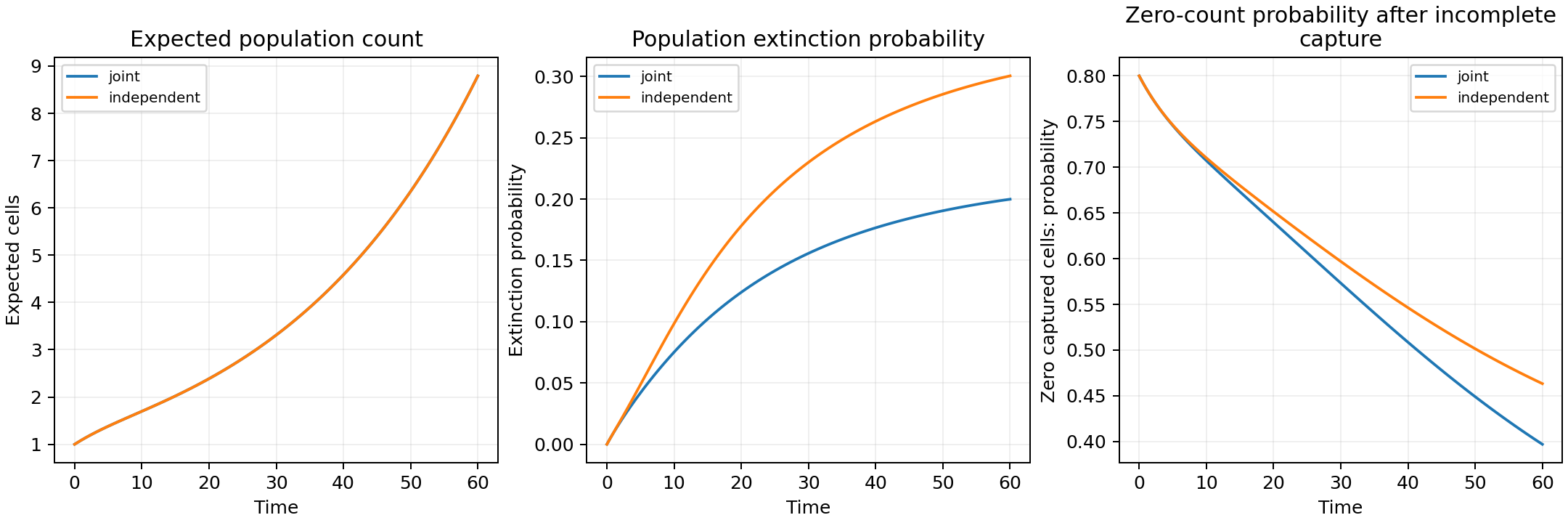
For one two-site AA founder, the exact eventual extinction intervals are approximately 0.220722–0.220725 with complementary allocation and 0.335145–0.335150 with independent allocation. Fresh validated generating functions give a probability above 0.765 of reaching 300 cells by time 300 in the complementary model; the independent model's eventual probability is below 0.681.
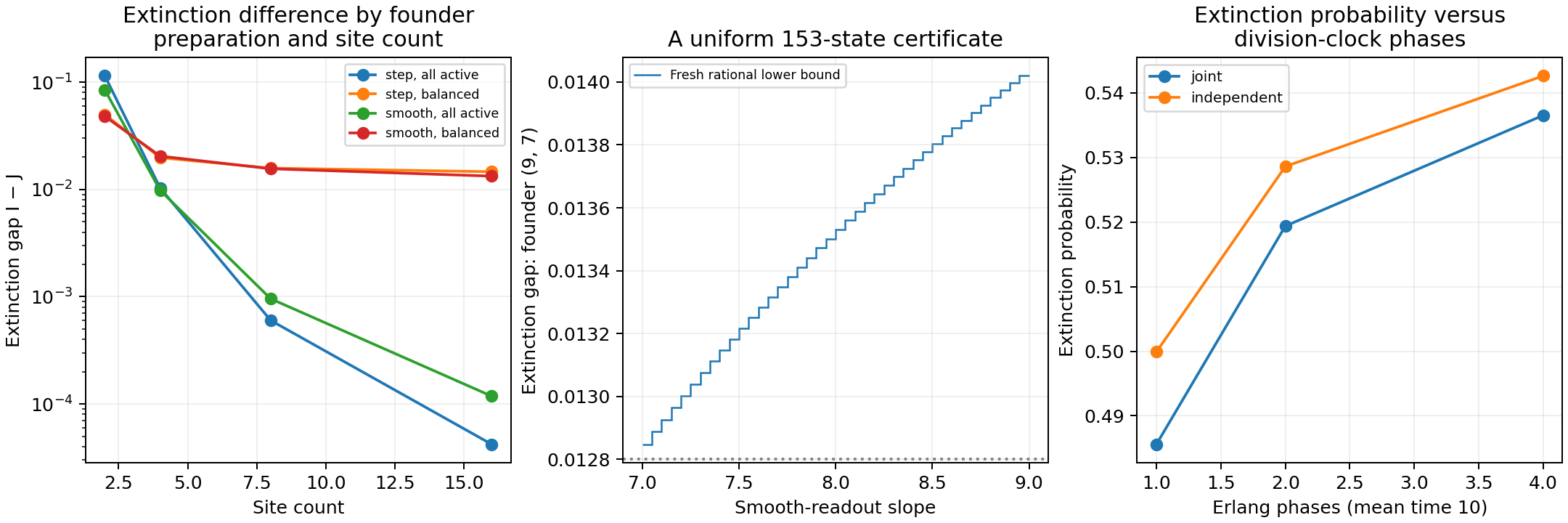
Exact bounds over forty slope intervals reproduce the 16-site preparation effect: the near-balanced founder retains an extinction gap above 0.0128 throughout slopes 7–9. Changing the division clock or founder preparation changes the magnitude. Conditional sister-clone covariance and incomplete capture illustrate which observations can reveal the difference.
The ordering theorem needs the paper's monotone hazard and molecular order, with a state-independent division clock. Equal means do not imply arbitrary first-passage ordering. The numerical sweeps are diagnostics; exact bounds cover their declared sources. These illustrative rates and cell thresholds are not clinically calibrated. Lean is not rerun.
Python source
"""Same daughter marginal and mean growth, different population risks. Run: python example.py"""
# EDITABLE EXPLORATION INPUTS. Rates are illustrative per time unit, not clinical calibration.
SITES = 2
FOUNDER = (2, 0)                 # (active, repressive); inactive = SITES - sum(FOUNDER)
READOUT = 'step'                # 'step' or 'smooth'
SMOOTH_SLOPE = 8.
WRITING = .01
RECRUITMENT = 1.
ERASURE = .01
ANTAGONISM = .5
DIVISION_RATE = .1              # mean interdivision time = 1 / DIVISION_RATE
ERLANG_PHASES = 1               # state-independent clock; 1, 2, 4 are paper examples
PROTECTED_DEATH = .01
EXPOSED_DEATH = .3
HORIZON = 60.
CAPTURE_PROBABILITY = .2         # independent cell capture
REGROWTH_THRESHOLD = 300        # fixed two-site certificate, separate from edited model
OBSERVED_PAIR_COVARIANCE = -.025
INDEPENDENT_ENROLLED_PAIRS = 100000
MOTHER_MEAN_RANGE = .1
MISCLASSIFICATION = .0001
MISSING_FRACTION = .0001
CONFIDENCE_ALPHA = .05

from pathlib import Path
from fractions import Fraction as F
from math import comb
import argparse,csv,hashlib,json,platform,sys
import numpy as np
from branching import (MolecularSource,StepHazard,SmoothHazard,Complementary,Independent,
                       BranchingPopulation,IndependentCapture,PairedCloneObservation,balanced_survival_bound)
from certificates import TwoSiteCertificate,SmoothSlopeCertificate,DeadlineCertificate

MANUSCRIPT_SHA256='2ae028e1227c6f80f7da47df7a035ea41fd4c68508e68112f623ae0b923cdc4b'


def serialize(value):
    if isinstance(value,F):return str(value)
    if isinstance(value,np.ndarray):return value.tolist()
    if isinstance(value,np.generic):return value.item()
    raise TypeError(type(value).__name__)


def main():
    sys.set_int_max_str_digits(0)  # Serialize our own exact threshold powers (not untrusted input).
    ap=argparse.ArgumentParser(description=__doc__);ap.add_argument('--output',default='outputs');args=ap.parse_args()
    out=Path(args.output);out.mkdir(parents=True,exist_ok=True)
    def dump(name,value):(out/name).write_text(json.dumps(value,indent=2,default=serialize)+'\n',encoding='utf-8')
    def table(name,headers,rows):
        with (out/name).open('w',newline='',encoding='utf-8') as f:
            w=csv.writer(f);w.writerow(headers);w.writerows(rows)
    print('Rebuilding the two-site rational risk and covariance-response boxes...',flush=True)
    two=TwoSiteCertificate();exact=two.calculate();dump('two_site_certificate.json',exact)
    regrowth=two.regrowth(REGROWTH_THRESHOLD);dump('eventual_regrowth.json',regrowth)
    print('Rebuilding 41 smooth-readout slope cells, with full 153-state witnesses...',flush=True)
    smooth=SmoothSlopeCertificate();narrow=smooth.calculate(F(7999,1000),F(8001,1000),1)
    dump('smooth_narrow_certificate.json',narrow)
    wide=smooth.calculate();dump('smooth_wide_certificate.json',wide)
    assert narrow['gap_lower']>F(1427,100000) and wide['gap_lower']>F(128,10000)
    assert narrow['all_active_gap_upper']<F(122,1000000) and wide['regrowth_2000_gap_lower']>F(122,10000)
    print('Reintegrating both 300-time-unit PGFs with outward integer Taylor arithmetic...',flush=True)
    finite=DeadlineCertificate().calculate();finite['gap_against_independent_eventual_upper']=finite['joint_hit_by_deadline_lower']-two.regrowth(300)['independent_eventual_upper']
    assert finite['gap_against_independent_eventual_upper']>F(84,1000)
    dump('deadline_certificate.json',finite)
    # Edited model: no automatic transfer of the fixed source certificates.
    source=MolecularSource(SITES,WRITING,RECRUITMENT,ERASURE,ANTAGONISM)
    if FOUNDER not in source.index:raise ValueError('founder must be a state of the configured source')
    if HORIZON<=0 or not np.isfinite(HORIZON):raise ValueError('horizon must be positive and finite')
    if READOUT not in ['step','smooth']:raise ValueError('choose step or smooth readout')
    hazard=StepHazard(PROTECTED_DEATH,EXPOSED_DEATH) if READOUT=='step' else SmoothHazard(SMOOTH_SLOPE,PROTECTED_DEATH,EXPOSED_DEATH)
    times=np.linspace(0,HORIZON,121);k=source.index[FOUNDER];results={};capture=IndependentCapture(CAPTURE_PROBABILITY)
    for name,law in [('joint',Complementary()),('independent',Independent())]:
        population=BranchingPopulation(source,hazard,law,DIVISION_RATE,ERLANG_PHASES)
        q,it=population.extinction();pgf=population.pgf(times);mean,var=population.moments(times);zero=capture.nondetection(population,times);cm,cv=capture.moments(mean,var)
        results[name]=dict(q=q,pgf=pgf,mean=mean,var=var,zero=zero,capture_mean=cm,capture_variance=cv,iterations=it)
        table(name+'_time_course.csv',['time','extinction','mean','variance','capture_nondetection','capture_mean','capture_variance'],zip(times,pgf[:,k],mean[:,k],var[:,k],zero[:,k],cm[:,k],cv[:,k]))
        table(name+'_eventual_risk.csv',['active','repressive','extinction_numerical'],[(a,r,q[i]) for i,(a,r) in enumerate(source.states)])
    mean_error=float(np.max(abs(results['joint']['mean']-results['independent']['mean'])/np.maximum(1,results['joint']['mean'])))
    applicable=(SITES==2 and READOUT=='step' and (WRITING,RECRUITMENT,ERASURE,ANTAGONISM,DIVISION_RATE,ERLANG_PHASES,PROTECTED_DEATH,EXPOSED_DEATH)==(.01,1.,.01,.5,.1,1,.01,.3))
    dump('configured_model.json',dict(sites=SITES,founder=FOUNDER,readout=READOUT,division_phases=ERLANG_PHASES,horizon=HORIZON,capture=CAPTURE_PROBABILITY,fixed_two_site_certificate_applicable=applicable,
        eventual_risks={name:float(r['q'][k]) for name,r in results.items()},relative_common_mean_residual=mean_error,
        scope='Floating-point least-fixed-point and ODE diagnostics. Mean and single-daughter kernel agree by construction. No finite-threshold probability is inferred from mean or variance; no arbitrary first-passage ordering is claimed.'))
    # Preparation and clock are distinct axes, explored with the full 153-state model.
    prep=[];clock=[]
    for N in [2,4,8,16]:
        src=MolecularSource(N)
        for readout,h in [('step',StepHazard()),('smooth',SmoothHazard())]:
            q=[BranchingPopulation(src,h,law).extinction()[0] for law in [Complementary(),Independent()]]
            for label,st in [('all active',(N,0)),('balanced',(N//2,N//2))]:
                j=src.index[st];prep.append((N,readout,label,float(q[0][j]),float(q[1][j]),float(q[1][j]-q[0][j])))
    src=MolecularSource(16);j=src.index[9,7]
    for m in [1,2,4]:
        q=[BranchingPopulation(src,SmoothHazard(),law,phases=m).extinction()[0][j] for law in [Complementary(),Independent()]]
        clock.append((m,*q))
    table('preparation_sweep.csv',['sites','readout','preparation','joint_extinction','independent_extinction','gap'],prep)
    table('division_clock.csv',['phases','joint_extinction','independent_extinction'],clock)
    # Exact observable counterexamples and conservative observation uncertainty.
    pooled=F(7,64);aa=F(-1,16);nonmonotone=F(1,4)
    assert pooled==F(1,4)-F(3,8)**2 and aa==F(1,2)-F(3,4)**2
    observation=PairedCloneObservation(MOTHER_MEAN_RANGE,MISCLASSIFICATION,MISSING_FRACTION)
    obs=observation.interval(OBSERVED_PAIR_COVARIANCE,INDEPENDENT_ENROLLED_PAIRS,CONFIDENCE_ALPHA)
    sister=Complementary();within=[]
    src2=MolecularSource(2);pop2=BranchingPopulation(src2,StepHazard(),sister);f=pop2.pgf([60.])[0];cov=sister.product(src2,f,f)-(src2.D@f)**2
    for i,st in enumerate(src2.states):within.append((*st,float(cov[i])))
    table('conditional_sister_clone_covariance.csv',['mother_active','mother_repressive','covariance_at_60'],within)
    dump('observation_accounts.json',dict(exact_newborn_indicator_covariance_AA=aa,exact_equal_AA_RR_mixture_covariance=pooled,nonmonotone_continuation_counterexample=nonmonotone,
        configured_sensitivity_and_sampling_interval=obs,negative_within_mother_covariance_supported=obs[1]<0,confidence=1-CONFIDENCE_ALPHA,
        scope='Prospective independent sister pairs are sampling units. Range, misclassification and missingness bounds are assumed. A positive pooled covariance does not rule out complementary allocation; independent capture nondetection is not extinction.'))
    asym=[]
    for logN in [np.log(16),np.log(128),100.,500.,1000.]:
        t=logN/2.12;asym.append((logN,t,balanced_survival_bound(logN,t)))
    table('smooth_large_size_bound.csv',['log_sites','chosen_time','survival_upper_bound_unclipped'],asym)
    tv=[(n,str(1-F(comb(2*n,n),4**n))) for n in [2,4,8,16,32,64]]
    dump('allocation_distance.json',dict(all_active_total_variation=tv,scope='Raw pair-law distance grows toward one even where continuation-risk differences shrink. No uniform inverse-site error follows without a continuation regularity bound.'))
    plot(out,results,k,times,prep,clock,wide,regrowth,finite)
    print(f'Two-site AA eventual risks: J {float(exact["lower"]["J"][5]):.7f}..{float(exact["upper"]["J"][5]):.7f}; I {float(exact["lower"]["I"][5]):.7f}..{float(exact["upper"]["I"][5]):.7f}.',flush=True)
    print(f'Hit 300 by time 300: J > {float(finite["joint_hit_by_deadline_lower"]):.6f}; I < {float(two.regrowth(300)["independent_eventual_upper"]):.6f}.',flush=True)
    print(f'N=16, slope 7..9: extinction gap > {float(wide["gap_lower"]):.6f}; hit-2000 gap > {float(wide["regrowth_2000_gap_lower"]):.6f}.',flush=True)
    print(f'Edited scenario covered by fixed two-site source: {applicable}. All exact certificates rebuilt; numerical sweeps are diagnostics; Lean not rerun.',flush=True)
    here=Path(__file__).parent;digest=lambda p:hashlib.sha256(p.read_bytes()).hexdigest()
    dump('run_metadata.json',dict(manuscript_sha256=MANUSCRIPT_SHA256,source_sha256=digest(Path(__file__)),python=platform.python_version(),module_sha256={p.name:digest(p) for p in sorted(here.glob('*.py')) if p.name not in ['example.py','test_example.py']},input_sha256={p.name:digest(p) for p in sorted(here.glob('*.json')) if p.name!='release.json'},output_sha256={p.name:digest(p) for p in sorted(out.iterdir()) if p.is_file() and p.name!='run_metadata.json'}))


def plot(out,results,k,times,prep,clock,wide,regrowth,finite):
    import matplotlib
    matplotlib.use('Agg')
    import matplotlib.pyplot as plt
    fig,axs=plt.subplots(1,3,figsize=(12,4),layout='constrained')
    for name,r in results.items():
        axs[0].plot(times,r['mean'][:,k],label=name)
        axs[1].plot(times,r['pgf'][:,k],label=name)
        axs[2].plot(times,r['zero'][:,k],label=name)
    for ax,title,ylabel in zip(axs,['Expected population count','Population extinction probability','Zero-count probability after incomplete\ncapture'],['Expected cells','Extinction probability','Zero captured cells: probability']):
        ax.set(xlabel='Time',ylabel=ylabel,title=title);ax.grid(alpha=.2);ax.legend(fontsize=8)
    fig.savefig(out/'matched_mean_different_risk.png',dpi=180);fig.savefig(out/'matched_mean_different_risk.svg');plt.close(fig)
    fig,axs=plt.subplots(1,3,figsize=(12,4),layout='constrained')
    for readout in ['step','smooth']:
        for label in ['all active','balanced']:
            rows=[r for r in prep if r[1]==readout and r[2]==label]
            axs[0].semilogy([r[0] for r in rows],[r[5] for r in rows],'o-',label=readout+', '+label)
    axs[0].set(xlabel='Site count',ylabel='Extinction gap I − J',title='Extinction difference by founder\npreparation and site count');axs[0].legend(fontsize=7)
    rows=wide['rows'];axs[1].stairs([float(r['gap_lower']) for r in rows],[float(rows[0]['slope'][0])]+[float(r['slope'][1]) for r in rows],baseline=None,label='Fresh rational lower bound')
    axs[1].axhline(.0128,color='gray',ls=':');axs[1].set(xlabel='Smooth-readout slope',ylabel='Extinction gap: founder (9, 7)',title='A uniform 153-state certificate');axs[1].legend(fontsize=7)
    for i,label in [(1,'joint'),(2,'independent')]:axs[2].plot([r[0] for r in clock],[r[i] for r in clock],'o-',label=label)
    axs[2].set(xlabel='Erlang phases (mean time 10)',ylabel='Extinction probability',title='Extinction probability versus\ndivision-clock phases');axs[2].legend(fontsize=8)
    for ax in axs:ax.grid(alpha=.2)
    fig.savefig(out/'preparation_and_clock.png',dpi=180);fig.savefig(out/'preparation_and_clock.svg');plt.close(fig)


if __name__=='__main__':main()
Run output
Rebuilding the two-site rational risk and covariance-response boxes...
Rebuilding 41 smooth-readout slope cells, with full 153-state witnesses...
Reintegrating both 300-time-unit PGFs with outward integer Taylor arithmetic...
Two-site AA eventual risks: J 0.2207216..0.2207253; I 0.3351447..0.3351496.
Hit 300 by time 300: J > 0.765045; I < 0.680881.
N=16, slope 7..9: extinction gap > 0.012848; hit-2000 gap > 0.012243.
Edited scenario covered by fixed two-site source: True. All exact certificates rebuilt; numerical sweeps are diagnostics; Lean not rerun.