Example code
A protein can store distinct memory labels in stable patterns of phosphorylation. Here its phosphorylation forms compete for one kinase and one phosphatase. Each enzyme–edge interaction retains its own bound complex, so both free and bound substrate contribute to the conserved inventory.
This example reconstructs the paper's three-site source: seven positive equilibria and four stable labels at the same conserved enzyme and substrate totals. Exact root isolation and interval Lyapunov inequalities establish the result for the full 31-dimensional class. The example also supplies a reusable reaction-network model, equilibrium reconstruction, finite-count simulation and explicit retention/recovery accounts.
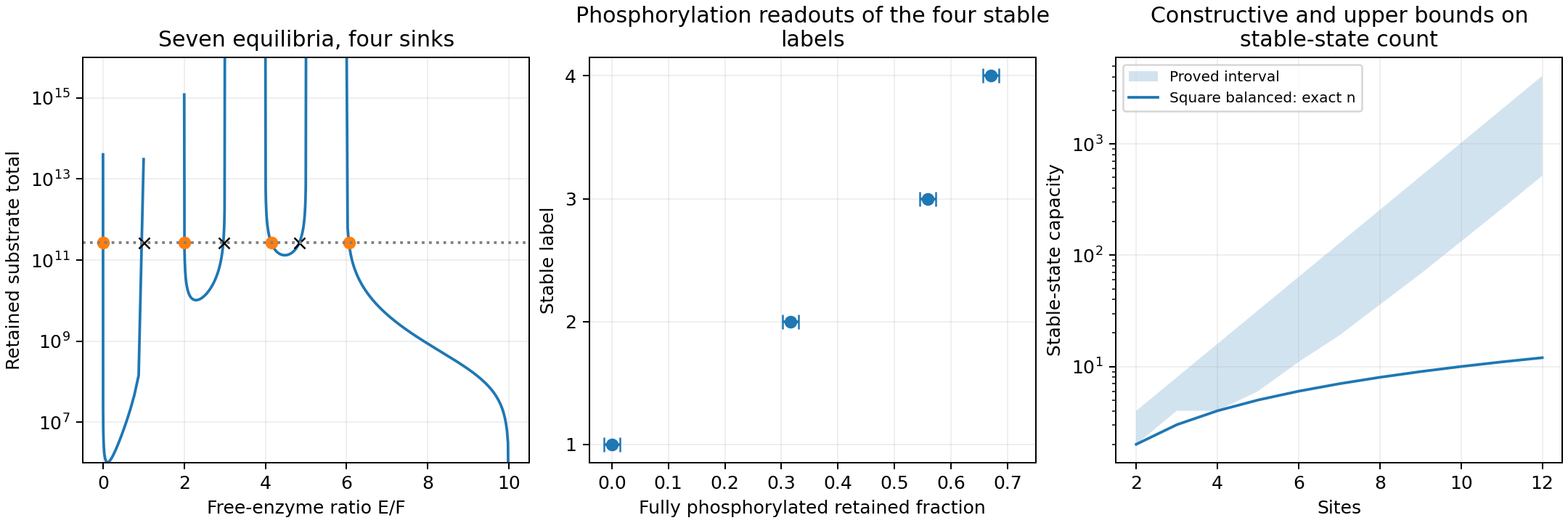
When effective reaction ratios balance around every four-edge phosphorylation cycle, at most n stable states are possible for n sites, as in the sequential model. Unbalanced pathways allow larger constructions, but nonzero affinity alone does not guarantee extra states. The plotted capacity interval records proved bounds rather than an unknown exact capacity.
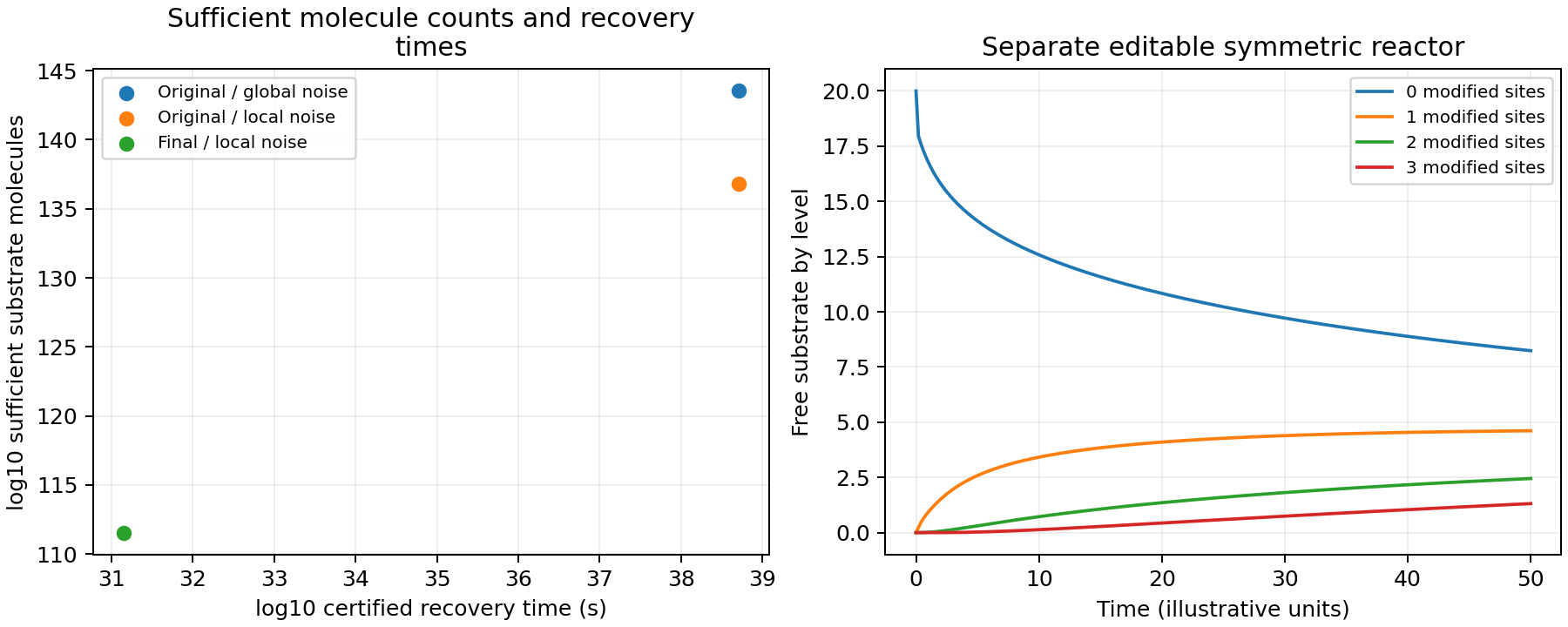
The four labels have well-separated readouts, yet their sufficient operating certificate requires about 3.5 × 10¹¹¹ substrate molecules and 1.4 × 10³¹ seconds for recovery after physical rate scaling. Those figures diagnose this construction and its conservative certificate; they are not universal lower bounds. A common clock change preserves the molecule budget when the protocol's recovery and storage times change together.
Editable inputs drive a separate, moderate-rate symmetric reactor with all complexes retained. Its complete reaction list, trajectories and stochastic path support model development without implying that this illustration has four labels. The exact source's integer preparations, resource bounds and driving thresholds are replayed separately. Prepared labels are not a writing protocol, and finite driving does not automatically inherit the finite-molecule contract. Lean is not rerun.
Python source
"""Four stable labels are not yet an economical memory. Run: python example.py"""
# EDITABLE INPUTS. Exact paper certificates remain separate from the exploratory reactor.
SITES = 3
# One six-rate tuple per sequential level: E binding, release, catalytic; F binding, release, catalytic.
# These moderate, illustrative values define a symmetric cube lift, not the four-sink source.
CHAIN_RATES = [('1','1','1','1','1','1')]*3
TOTAL_KINASE = '2'
TOTAL_PHOSPHATASE = '2'
TOTAL_SUBSTRATE = '20'
INITIAL_PHOSPHOFORM = 0
HORIZON = 50.
REVERSE_ACTIVITY = '0'           # ADP = phosphate activity; zero is irreversible reference
CLOCK_MULTIPLIER = '1'           # applied consistently to all elementary rates
RUN_SSA = True
SYSTEM_SIZE = 20                # count = system size * concentration
SSA_SEED = 72
SSA_EVENT_BUDGET = 200000
# Resource exploration uses the verified four-sink source and its own model clock.
CERTIFIED_SIZE_MULTIPLIER = '1'
CERTIFIED_CLOCK_MULTIPLIER = '1'
LOADING_KERNEL_SHIFT = '0'      # separate family exploration, preserves fixed target/effective rates
OBSERVATION_ERROR_FRACTION = '0.01'

from pathlib import Path
from fractions import Fraction as F
import argparse,csv,hashlib,json,math,platform,sys
import numpy as np
import mpmath as mp
import sympy as sp
from reactor import EdgeKinetics,PhosphorylationNetwork
from geometry import EquilibriumGeometry,capacity_bounds
from certificates import ExactPaperReplay,PublishedSource,PublishedOperatingContract,driving_ratios,load
import paper_checks as cp

MANUSCRIPT_SHA256='7970bdb2f32090091d3a3a5dc2bc73e835db7b7d23165410ff053eb5aa2175ea'


def serialize(value):
    if isinstance(value,F):return str(value)
    if isinstance(value,np.ndarray):return value.tolist()
    if isinstance(value,np.generic):return value.item()
    if isinstance(value,mp.mpf):return mp.nstr(value,60)
    raise TypeError(type(value).__name__)


def main():
    sys.set_int_max_str_digits(0)
    ap=argparse.ArgumentParser(description=__doc__);ap.add_argument('--output',default='outputs');args=ap.parse_args();out=Path(args.output);out.mkdir(exist_ok=True,parents=True)
    def dump(name,value):(out/name).write_text(json.dumps(value,indent=2,default=serialize)+'\n',encoding='utf-8')
    def table(name,headers,rows):
        with (out/name).open('w',newline='',encoding='utf-8') as f:
            w=csv.writer(f);w.writerow(headers);w.writerows(rows)
    print('Replaying the original and final source: roots, full-class stability, operating contracts and integer preparations...',flush=True)
    replay=ExactPaperReplay().run();dump('fresh_exact_replay.json',replay)
    assert replay['admissible_equilibria']==7 and len(replay['final_sinks'])==4
    assert replay['final_worst_retention_bound']<.00105 and replay['final_worst_recovery_bound']<.008987
    source=PublishedSource();net=source.network
    tw=load('tree_weights.json')['weights_descending_coefficients'];u=sp.Symbol('u')
    tau=[sp.Poly.from_list(row,u).as_expr() for row in tw]
    geometry=EquilibriumGeometry(net,tau);roots=geometry.census(source.totals)
    assert len(roots)==8 and sum(r['admissible'] for r in roots)==7
    assert sp.expand(geometry.B-10*geometry.D-sp.prod(u-j for j in range(1,7)))==0
    dump('independent_root_census.json',dict(eliminant_coefficients=[str(x) for x in geometry.eliminant(source.totals).all_coeffs()],roots=roots,scope='All roots isolated exactly; L and M have no roots in each regular isolating interval. u=r is handled separately by the reusable geometry. Simple roots plus four interval-Hurwitz certificates and the paper degree theorem imply the other three have index -1.'))
    states=[];sink_intervals=[list(map(F,c['root_interval'])) for c in load('postproof_candidate_sinks.json')['sink_certificates']]
    with mp.workdps(80):
        for row in roots:
            if not row['admissible']:continue
            ratio=sum(row['interval'])/2;x=geometry.state_on_curve(ratio,source.totals[:2],digits=80)
            idx=len(states);sink=any(max(row['interval'][0],lo)<=min(row['interval'][1],hi) for lo,hi in sink_intervals)
            read=x[7]+sum(x[22+i] for i,(a,b) in enumerate(net.edges) if b==7)
            totals=[sum(mp.mpf(int(v))*x[j] for j,v in enumerate(r)) for r in net.inventory]
            states.append(dict(index=idx,ratio=float(ratio),sink_certified=sink,normalized_readout=float(read/cp.ST),state=[mp.nstr(v,65) for v in x],total_residual=[mp.nstr(t-mp.mpf(str(expected)),10) for t,expected in zip(totals,source.totals)]))
    dump('equilibrium_states.json',dict(states=states,scope='80-digit midpoint reconstructions for reuse and plotting. Stability comes from interval certificates, not floating-point spectra. Bound substrate is retained in the total.'))
    squares=net.square_ratios();assert any(r[-1]!=1 for r in squares)
    dump('cycle_structure.json',dict(squares=[dict(tail=v,sites=[i,j],path_ratio=r,log_effective_affinity=math.log(float(r))) for v,i,j,r in squares],
        detailed_balance_ratios=driving_ratios(net),scope='Effective pathway affinity differs from the common ATP-hydrolysis potential. Nonzero square affinity is necessary, not sufficient, for more than n sinks.'))
    # A fixed-target family direction: compare states at the same free-enzyme ratio, not at the same total.
    shifted=PublishedSource(F(LOADING_KERNEL_SHIFT));sg=EquilibriumGeometry(shifted.network,tau)
    assert sp.expand(sg.B-10*sg.D-(geometry.B-10*geometry.D))==0
    position=F(83,20);x0=geometry.state_on_curve(position,source.totals[:2]);x1=sg.state_on_curve(position,source.totals[:2])
    lower=F(2260898025826008319,15168384)
    assert F(10)/lower<F(68,10**12)
    dump('loading_family_obstruction.json',dict(shift=F(LOADING_KERNEL_SHIFT),ratio=position,free_substrate_reference=str(sum(x0[:8])),free_substrate_shifted=str(sum(x1[:8])),exact_free_substrate_lower_on_4_1_to_4_2=lower,kinase_to_substrate_upper=F(10)/lower,
        scope='Fixed effective rates, target L, enzyme totals and retained ratio interval. A kernel shift preserves free substrate at a fixed ratio but generally changes the compatibility-class total and its equilibrium locations. No stability certificate is transferred to the shifted source.'))
    operating=PublishedOperatingContract().calculate(F(CERTIFIED_SIZE_MULTIPLIER),F(CERTIFIED_CLOCK_MULTIPLIER));dump('configured_operating_contract.json',operating)
    baseline=PublishedOperatingContract().calculate();clockcheck=PublishedOperatingContract().calculate(clock_multiplier=F(1,100))
    assert baseline['required_size']==clockcheck['required_size'] and baseline['rows']==clockcheck['rows']
    dump('common_clock_identity.json',dict(clock_multiplier='1/100',budget_unchanged=True,failure_bounds_unchanged=True,time_multiplier=100,scope='Matched recovery and storage horizons. A fixed absolute horizon is a different contract.'))
    caps=[capacity_bounds(n) for n in range(2,13)];dump('capacity_bounds.json',caps)
    gap=min(states[j+2]['normalized_readout']-states[j]['normalized_readout'] for j in [0,2,4]);obs=F(OBSERVATION_ERROR_FRACTION)
    if obs<=0:raise ValueError('positive observation tolerance required')
    dump('observation_and_crowding.json',dict(normalized_minimum_sink_gap=gap,configured_error=obs,ideal_center_error_boxes_disjoint=2*float(obs)<gap,scalar_packing_upper=1+math.floor(1/(2*obs)),
        source_guaranteed_driving_activity='1/10^102',common_driving_kBT=204*math.log(10),relative_rate_error_certificate='1/10^99',
        scope='Ideal-center separation alone is not an operational guarantee: safe-set variation also belongs in decoder boxes. The fresh paper replay checks the complete source decoder. Driving preserves four deterministic sinks only; its finite-molecule contract is not recomputed. Crowding scaling applies to a different sequential split family and an iterated limit.'))
    crowd=[]
    for delta in [.5,.25,.125,.0625]:crowd.append((delta,delta**6,delta**-4,delta))
    table('crowding_scaling_reference.csv',['separation_delta','relative_barrier_delta6','relative_recovery_delta_minus4','relative_readout_gap_delta'],crowd)
    # A tractable full-network example for editing and simulation; no four-label claim.
    if len(CHAIN_RATES)!=SITES:raise ValueError('one six-rate tuple per site is required')
    chain_rates=[EdgeKinetics(*(F(v) for v in row)).scaled(F(CLOCK_MULTIPLIER)) for row in CHAIN_RATES]
    model=PhosphorylationNetwork.symmetric_lift(chain_rates,F(REVERSE_ACTIVITY));chain=PhosphorylationNetwork.chain(chain_rates,F(REVERSE_ACTIVITY));A=model.cube_aggregation()
    if type(INITIAL_PHOSPHOFORM) is not int or not 0<=INITIAL_PHOSPHOFORM<model.q:raise ValueError('invalid initial phosphoform')
    totals=list(map(F,[TOTAL_KINASE,TOTAL_PHOSPHATASE,TOTAL_SUBSTRATE]))
    if min(totals)<=0:raise ValueError('positive inventories required')
    initial=np.zeros(model.size);initial[model.E]=float(totals[0]);initial[model.F]=float(totals[1]);initial[INITIAL_PHOSPHOFORM]=float(totals[2])
    times=np.linspace(0,HORIZON,251);trajectory=model.simulate(initial,times);[email protected]
    # The paper's exact same-rate chain reduction is for the irreversible lift.
    # Adding the thermodynamic reverse channels changes their aggregation multiplicities.
    reference=chain.simulate(A@initial,times) if not F(REVERSE_ACTIVITY) else None
    residual=float(np.max(abs(aggregated-reference))) if reference is not None else None
    ledger=float(np.max(abs([email protected](totals,float))))
    table('configured_full_trajectory.csv',['time']+model.names,[(t,*x) for t,x in zip(times,trajectory)])
    table('configured_reactions.csv',['reaction','rate','reactants','products'],[(r.name,str(r.rate),'+'.join(model.names[i] for i in r.reactants),'+'.join(model.names[i] for i in r.products)) for r in model.reactions])
    ssa=None
    if RUN_SSA:
        count_totals=[t*SYSTEM_SIZE for t in totals]
        if any(t.denominator!=1 for t in count_totals):raise ValueError('SSA size must make all conserved totals integral')
        counts=[0]*model.size;counts[model.E]=int(count_totals[0]);counts[model.F]=int(count_totals[1]);counts[INITIAL_PHOSPHOFORM]=int(count_totals[2])
        st,sx,events=model.ssa(counts,SYSTEM_SIZE,HORIZON,SSA_SEED,SSA_EVENT_BUDGET)
        for x in sx:assert all(a==b for a,b in zip(model.inventory@x,count_totals))
        stride=max(1,len(st)//1000);selection=sorted(set(range(0,len(st),stride))|{len(st)-1})
        table('configured_ssa_sampled.csv',['time']+model.names,[(st[i],*sx[i]) for i in selection])
        ssa=dict(events=len(events),seed=SSA_SEED,system_size=SYSTEM_SIZE,exact_inventories_preserved=True,completed_horizon=HORIZON);dump('configured_ssa.json',ssa)
    dump('configured_reactor.json',dict(sites=SITES,species=model.size,reactions=len(model.reactions),totals=totals,reverse_activity=F(REVERSE_ACTIVITY),aggregation_max_residual=residual,inventory_max_residual=ledger,
        scope='Moderate illustrative symmetric lift, not the four-label source. Full retained-complex ODE and literal finite-count CTMC. Same-rate chain comparison applies only at zero reverse activity; its residual is null otherwise. One path does not estimate a rare-event retention probability.'))
    curve=[]
    for left,right in [(1e-9,.999999),(2.000001,2.999999),(4.000001,4.999999),(6.000001,9.999999)]:
        grid=np.geomspace(left,right,160) if left<1 else np.linspace(left,right,160)
        for z in grid:
            x=geometry.state_on_curve(str(z),source.totals[:2],digits=50);total=sum(x[:8])+sum(x[10:]);curve.append((left,z,float(total)))
    table('equilibrium_curve.csv',['branch_start','free_enzyme_ratio','retained_substrate_total'],curve)
    plot(out,states,curve,caps,replay,times,trajectory,model)
    print(f'Seven positive equilibria, four exact full-class sinks; minimum normalized readout gap {gap:.6f}.',flush=True)
    print(f'Final sufficient log10(substrate molecules) {replay["physical_final_local"]["log10_substrate"]:.3f}; log10(recovery seconds) {replay["physical_final_local"]["log10_trec_s"]:.3f}.',flush=True)
    print(f'Illustrative full-network aggregation residual {residual}; inventory residual {ledger:.3g}; SSA {ssa}.',flush=True)
    print('Sufficient resources are not minimum requirements. No writing protocol or finite-count reversible guarantee is claimed; Lean not rerun.',flush=True)
    here=Path(__file__).parent;digest=lambda p:hashlib.sha256(p.read_bytes()).hexdigest()
    dump('run_metadata.json',dict(manuscript_sha256=MANUSCRIPT_SHA256,source_sha256=digest(Path(__file__)),python=platform.python_version(),module_sha256={p.name:digest(p) for p in sorted(here.glob('*.py')) if p.name not in ['example.py','test_example.py']},input_sha256={p.name:digest(p) for p in sorted(here.glob('*.json')) if p.name!='release.json'},output_sha256={p.name:digest(p) for p in sorted(out.iterdir()) if p.is_file() and p.name!='run_metadata.json'}))


def plot(out,states,curve,caps,replay,times,trajectory,model):
    import matplotlib
    matplotlib.use('Agg')
    import matplotlib.pyplot as plt
    fig,axs=plt.subplots(1,3,figsize=(12,4),layout='constrained')
    for left in sorted(set(r[0] for r in curve)):
        rows=[r for r in curve if r[0]==left];axs[0].semilogy([r[1] for r in rows],[r[2] for r in rows],color='C0')
    for row in states:axs[0].plot(row['ratio'],cp.ST,'o' if row['sink_certified'] else 'x',color='C1' if row['sink_certified'] else 'black')
    axs[0].axhline(cp.ST,color='gray',ls=':');axs[0].set(xlabel='Free-enzyme ratio E/F',ylabel='Retained substrate total',title='Seven equilibria, four sinks',ylim=(1e6,1e16))
    sinks=[r for r in states if r['sink_certified']]
    axs[1].errorbar([r['normalized_readout'] for r in sinks],range(1,5),xerr=replay['final_min_normalized_gap']/8,fmt='o',capsize=4)
    axs[1].set(xlabel='Fully phosphorylated retained fraction',ylabel='Stable label',title='Phosphorylation readouts of the four stable\nlabels',yticks=[1,2,3,4],xlim=(-.04,.75))
    ns=[r['sites'] for r in caps];axs[2].fill_between(ns,[r['constructive_lower'] for r in caps],[r['universal_upper'] for r in caps],alpha=.2,label='Proved interval')
    axs[2].plot(ns,[r['square_balanced_capacity'] for r in caps],label='Square balanced: exact n');axs[2].set(yscale='log',xlabel='Sites',ylabel='Stable-state capacity',title='Constructive and upper bounds on\nstable-state count');axs[2].legend(fontsize=8)
    for ax in axs:ax.grid(alpha=.2)
    fig.savefig(out/'structure_and_labels.png',dpi=180);fig.savefig(out/'structure_and_labels.svg');plt.close(fig)
    fig,axs=plt.subplots(1,2,figsize=(10,4),layout='constrained')
    for key,label in [('physical_original_global','Original / global noise'),('physical_original_local','Original / local noise'),('physical_final_local','Final / local noise')]:
        r=replay[key];axs[0].scatter(r['log10_trec_s'],r['log10_substrate'],label=label)
    axs[0].set(xlabel='log10 certified recovery time (s)',ylabel='log10 sufficient substrate molecules',title='Sufficient molecule counts and recovery\ntimes');axs[0].legend(fontsize=8)
    for level in range(SITES+1):
        cols=[v for v in range(model.q) if v.bit_count()==level];axs[1].plot(times,trajectory[:,cols].sum(axis=1),label=f'{level} modified sites')
    axs[1].set(xlabel='Time (illustrative units)',ylabel='Free substrate by level',title='Separate editable symmetric reactor');axs[1].legend(fontsize=8)
    for ax in axs:ax.grid(alpha=.2)
    fig.savefig(out/'resources_and_reactor.png',dpi=180);fig.savefig(out/'resources_and_reactor.svg');plt.close(fig)


if __name__=='__main__':main()
Run output
Replaying the original and final source: roots, full-class stability, operating contracts and integer preparations...
{
 "checks_passed": 776,
 "seconds": 48.3,
 "admissible_equilibria": 7,
 "final_log10_Omega": 100.1182378153436,
 "final_worst_recovery_bound": 0.0089868125,
 "final_min_normalized_gap": 0.11168008847494394,
 "free_substrate_lower": 149053322082.6957,
 "final_log10_eps_driving": -101.3973979199173,
 "final_log10_rate_box": -98.37400264507606,
 "original_local_gain": 4997966.209240554
}
ALL CHECKS PASSED
Seven positive equilibria, four exact full-class sinks; minimum normalized readout gap 0.111680.
Final sufficient log10(substrate molecules) 111.541; log10(recovery seconds) 31.152.
Illustrative full-network aggregation residual 1.4139480697394902e-09; inventory residual 3.2e-14; SSA {'events': 12634, 'seed': 72, 'system_size': 20, 'exact_inventories_preserved': True, 'completed_horizon': 50.0}.
Sufficient resources are not minimum requirements. No writing protocol or finite-count reversible guarantee is claimed; Lean not rerun.