Example code
Random polymer networks that contain autocatalytic reaction sets need not resemble those that export substantial product. In this model, the smallest RAF grows among networks selected only for RAF existence, while networks selected for productive output increasingly contain a one-channel RAF, at the stated sufficient volume scale.
The example combines the literal polymer reactor with a sampler that preserves correlations among one molecule's catalytic assignments, candidate enumeration, signed input ledgers and exact kinetic budget checks. Editable inputs specify the named catalytic incidence, background assignments, kinetic marks and exploratory volume. The code keeps numerical illustrations separate from the asymptotic theorem.
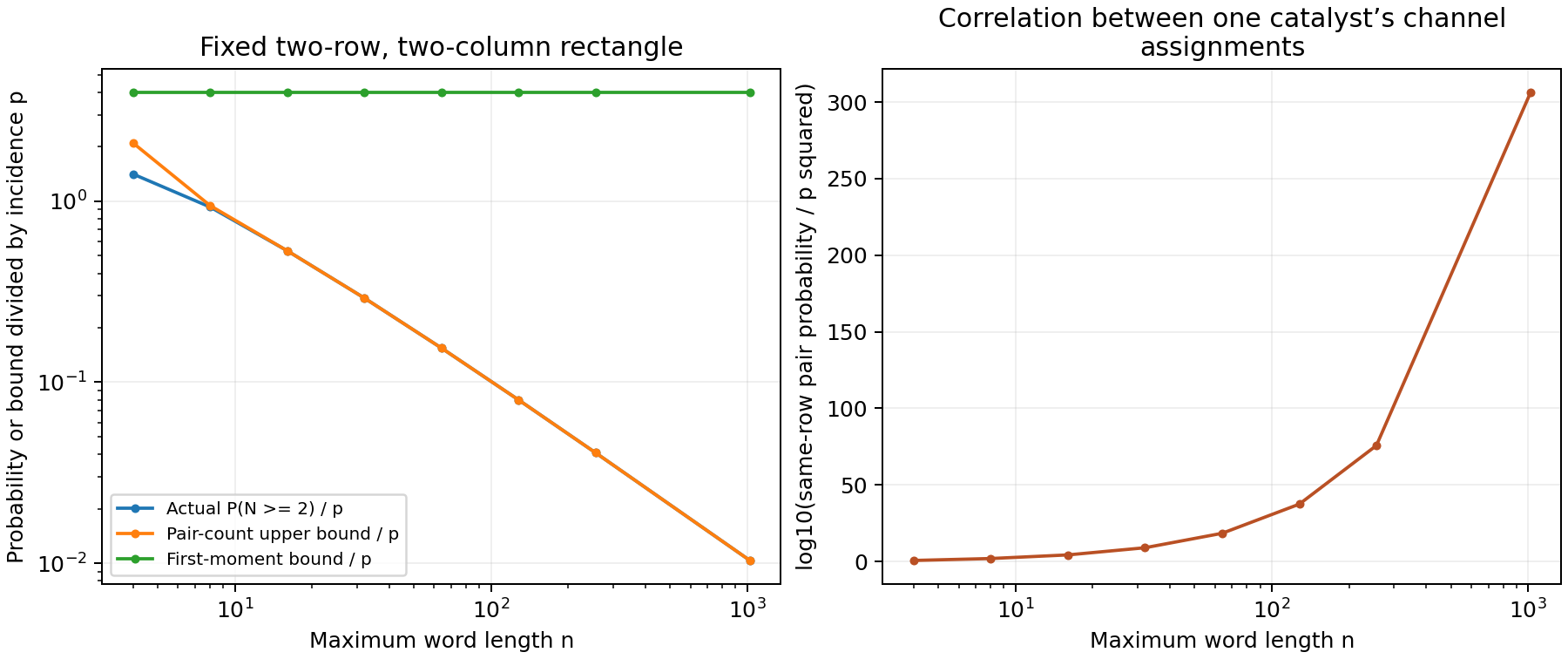
Each catalyst draws a capped power-law-distributed number of catalysed channels and then selects distinct channels without replacement. Requiring one particular catalytic assignment favours molecules with more assignments: the probability of degree becomes , where is its original probability. The source figure preserves this dependence: same-row pair probabilities become negligible relative to one-incidence probability , even while remaining much larger than . Its two-row, two-column rectangle illustrates the source argument; it does not replace the theorem's huge fixed rectangle.
Direct enumeration gives 224 productive candidate incidences, with 192 food catalysts and 32 product catalysts, and 248 singleton-RAF witnesses overall. These counts do not determine the success prefactor or posterior catalyst proportions. Finite candidate probabilities are evaluated using row-miss formulas, retaining the complete Zipf tail at the cap.
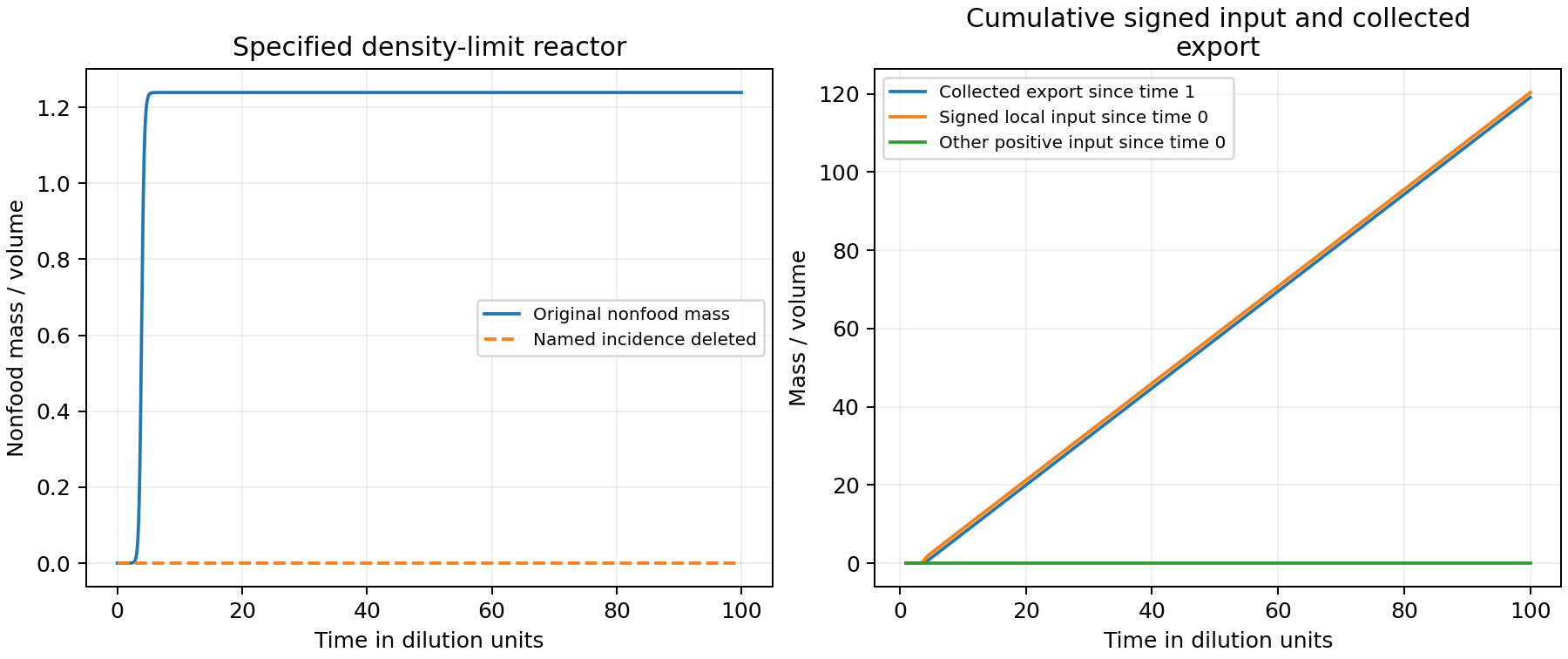
The specified density-limit example uses 0011 to catalyse . Window export is about 119.075, compared with 0.00004956 after deleting only that catalytic incidence. Every basal channel remains active. Signed local input and collected export have separate ledgers, and the model checks their mass balance. This is a numerical illustration, not a sample from the successful-run posterior.
Two observables explain the kinetic exclusion. For a mixed channel, cancels its local contribution exactly. For an outsider catalyst, lets washout cover the material that catalyst could amplify. The code reproduces the paper's rational budgets and handles repeated input molecules with falling-factorial propensities.
The sufficient volume is not a calibrated laboratory threshold. At the displayed finite sizes, the bound for networks selected by productive output is uninformative (above one), and small-volume count simulations do not satisfy the theorem's hypotheses. Optional interrupted simulations report an unresolved outcome.
Seven scientific test groups check the source law, singleton counts, conditioning, reaction kernel, catalytic deletion and attribution. Reusable classes support parameter changes and new environments without treating RAF support as a success probability. The package does not rerun Lean or claim that diffuse productive exceptions are impossible.
Python source
"""Correlated catalytic rows, singleton candidates and productive-input attribution."""
# EDITABLE STUDY INPUTS. Concentrations/time use the paper's dimensionless units.
MAX_WORD_LENGTH = 4
LOCAL_INCIDENCE = ('0011','00','11')  # catalyst, left food, right food
BACKGROUND_INCIDENCES = ()          # changing this can leave local-uniqueness hypotheses
MARK_SEED = 30092026
STOCHASTIC_VOLUME = 20              # exploratory only; not the theorem envelope
STOCHASTIC_SEED = 22092026
MAX_EVENTS = 200000
ANALYTIC_LENGTHS = (4,8,16,32,64,128,256,1024)
FINITE_CANDIDATE_LENGTHS = (4,5,6,7,8)
MAX_DEGREE_TABLE = 10000
WINDOW_START, WINDOW_END = 1.0,100.0
MANUSCRIPT_SHA256 = 'a93db4a9bd559971dc0dcc2654e5c205bbdf684cd53d9b44db7c722db9e5efaf'

import argparse
from dataclasses import dataclass
from fractions import Fraction as Q
from functools import lru_cache
import csv
import hashlib
import itertools
import json
from pathlib import Path
import platform

import mpmath as mp
import numpy as np
from scipy.integrate import solve_ivp
from polymer import PolymerCatalogue, CatalyticEnvironment, KineticParameters, FedReactor

mp.mp.dps=90


def hurwitz_tail(s,R):
    """Numerical Euler--Maclaurin tail for huge R, avoiding a large-prefix scan.

    Twenty corrections are ample at R>1e6 and the exponents used here. This
    evaluator is high-precision numerics, not an outward-rounded certificate.
    """
    if R<=10**6:return mp.zeta(s,R)
    a=mp.mpf(R)
    return a**(1-s)/(s-1)+a**(-s)/2+mp.fsum(
        mp.bernoulli(2*k)/mp.factorial(2*k)*mp.rf(s,2*k-1)*a**(1-s-2*k) for k in range(1,21))


class ZipfLaw:
    """D=min(K,R)-1, retaining the entire Zipf tail at R-1."""
    def __init__(self,n):
        if not isinstance(n,int) or not 4<=n<=10000:raise ValueError('Analytic evaluator supports integer 4<=n<=10000.')
        self.n=n;self.R=(n-2)*2**(n+1)+4;self.X=2**(n+1)-2
        self.a=2-mp.mpf(2)/n;self.zeta=mp.zeta(self.a)
        tail=hurwitz_tail(self.a,self.R)
        H=lambda s:mp.zeta(s)-hurwitz_tail(s,self.R)
        self.mean=(H(self.a-1)-H(self.a)+(self.R-1)*tail)/self.zeta
        self.second=(H(self.a-2)-2*H(self.a-1)+H(self.a)+(self.R-1)**2*tail)/self.zeta
        self.p=self.mean/self.R;self.q2=(self.second-self.mean)/(self.R*(self.R-1));self.q0=1/self.zeta

    @lru_cache(maxsize=None)
    def weights(self,budget=MAX_DEGREE_TABLE):
        if self.R>budget:raise ValueError('Explicit degree table exceeds budget; use moments instead.')
        return tuple([mp.power(d+1,-self.a)/self.zeta for d in range(self.R-1)]+[mp.zeta(self.a,self.R)/self.zeta])

    @lru_cache(maxsize=None)
    def row_hit(self,J):
        if not 0<=J<=self.R:raise ValueError('Invalid channel count.')
        # Stable product for the exact without-replacement row-miss probability.
        result=mp.mpf(0)
        for d,w in enumerate(self.weights()):
            miss=mp.mpf(1)
            if d>self.R-J:miss=mp.mpf(0)
            else:
                for j in range(J):miss*=mp.mpf(self.R-d-j)/(self.R-j)
            result+=w*(1-miss)
        return result

    def candidate_union(self,group_sizes):
        """Exact finite source formula, numerically evaluated; groups are distinct rows."""
        log_miss=mp.fsum(mp.log1p(-self.row_hit(J)) for J in group_sizes)
        return -mp.expm1(log_miss)

    def rectangle_2_by_2(self):
        """Stable exact expressions for two rows and two columns, not the huge K* box."""
        p,q=self.p,self.q2;one=2*p-2*q;hit=2*p-q
        return {'actual_two_or_more':2*q-q*q+one*one,'excess_count_bound':2*q+hit*hit,
            'pair_count_bound':2*q+4*p*p,'first_moment_bound':4*p,
            'wrong_independent_pair_bound':6*p*p}

    def sample(self,catalogue,rng,conditioned_incidence=None,empty_food=False):
        if catalogue.n!=self.n:raise ValueError('Catalogue/source mismatch.')
        weights=np.array([float(w) for w in self.weights()]);weights/=weights.sum()
        degrees=rng.choice(self.R,size=len(catalogue.words),p=weights)
        if empty_food:degrees[list(catalogue.food)]=0
        forced=None
        if conditioned_incidence is not None:
            z,u,v=conditioned_incidence;forced=(catalogue.index[z],catalogue.channel_index[u,v])
            if empty_food and forced[0] in catalogue.food:raise ValueError('Conditioned food row cannot also be empty.')
            biased=np.arange(self.R)*weights;biased/=biased.sum();degrees[forced[0]]=rng.choice(self.R,p=biased)
        rows=[]
        for i,d in enumerate(degrees):
            if forced is not None and i==forced[0]:
                draw=rng.choice(self.R-1,int(d)-1,replace=False)
                row={int(k)+(k>=forced[1]) for k in draw}|{forced[1]}
            else:row=set(rng.choice(self.R,int(d),replace=False).tolist())
            rows.append(frozenset(row))
        return CatalyticEnvironment(catalogue,tuple(rows))


def candidates(catalogue,productive=True):
    result=[]
    for r,c in enumerate(catalogue.channels):
        if c.left in catalogue.food and c.right in catalogue.food and (not productive or catalogue.nonfood[c.product]>0):
            result.extend((z,r) for z in sorted(catalogue.food|{c.product}))
    return tuple(result)


def local_classification(catalogue,z,r):
    c=catalogue.channels[r];m=catalogue.nonfood;gain=int(m[c.product]-m[c.left]-m[c.right])
    if gain==0:kind='neutral'
    elif c.left not in catalogue.food or c.right not in catalogue.food:kind='mixed'
    elif z in catalogue.food or z==c.product:kind='productive'
    else:kind='outsider'
    credit=m.astype(np.int64).copy()
    if kind=='mixed':credit[c.product]-=gain
    if kind=='outsider':credit[z]+=2000
    return kind,gain,credit


def erase_incidence(environment,incidence):
    z,u,v=incidence;c=environment.catalogue;zi=c.index[z];ri=c.channel_index[u,v]
    if ri not in environment.rows[zi]:raise ValueError('Incidence to erase is absent.')
    rows=list(environment.rows);rows[zi]=rows[zi]-{ri}
    return CatalyticEnvironment(c,tuple(rows))


class AttributedReactor(FedReactor):
    """Same chemical kernel; six integrated rewards identify signed local input."""
    ledger=('total_export','signed_local','signed_other','signed_basal','positive_basal','positive_other')

    def __init__(self,environment,parameters,local_incidence):
        super().__init__(environment,parameters)
        c=self.catalogue;z,u,v=local_incidence;key=(c.channel_index[u,v],c.index[z])
        self.local=np.array([e.incidence==key for e in self.events])
        self.other=self.is_catalytic&~self.local

    def rhs(self,time,state):
        c=self.catalogue;x=state[:len(c.words)];rates=self.rates(x);signed=self.nf_changes*rates
        return np.r_[self.feed-x+self.stoich@rates,c.nonfood@x,signed[self.local].sum(),signed[self.other].sum(),
            signed[~self.is_catalytic].sum(),np.maximum(self.nf_changes[~self.is_catalytic],0)@rates[~self.is_catalytic],
            np.maximum(self.nf_changes[self.other],0)@rates[self.other]]

    def deterministic(self,times,method='DOP853'):
        times=np.array(times,float)
        if times[0]!=0 or np.any(np.diff(times)<=0):raise ValueError('Increasing times starting at zero required.')
        solution=solve_ivp(self.rhs,(0,times[-1]),np.r_[self.feed,np.zeros(6)],t_eval=times,method=method,rtol=2e-11,atol=1e-18)
        if not solution.success:raise RuntimeError(solution.message)
        if np.min(solution.y[:len(self.catalogue.words)]) < -1e-11:raise ArithmeticError('Negative concentration; refine numerical solution.')
        return solution.y.T


@dataclass(frozen=True)
class ConditioningLaw:
    """Reweight a supplied finite environment law; reliabilities must be supplied."""
    weights: tuple
    success: tuple

    def __post_init__(self):
        if len(self.weights)!=len(self.success) or sum(self.weights)!=1 or min(self.weights,default=-1)<0:
            raise ValueError('A normalized finite environment law is required.')
        if any(not 0<=p<=1 for p in self.success):raise ValueError('Success probabilities must be in [0,1].')

    def successful_run(self):
        total=sum(w*p for w,p in zip(self.weights,self.success))
        if total==0:return None
        return tuple(w*p/total for w,p in zip(self.weights,self.success))

    def reliable(self,eta):
        if not 0<eta<1:raise ValueError('Fixed reliability threshold must lie in (0,1).')
        selected=tuple(w if p>=eta else 0 for w,p in zip(self.weights,self.success));total=sum(selected)
        return tuple(w/total for w in selected) if total else None

    def structural(self,flags):
        if len(flags)!=len(self.weights):raise ValueError('One structural flag per environment required.')
        selected=tuple(w if flag else 0 for w,flag in zip(self.weights,flags));total=sum(selected)
        return tuple(w/total for w in selected) if total else None


class ProofBudgets:
    """Exact rational kinetic budgets, with explicit theorem-scale applicability."""
    epsilon=Q(1,500000000);K=10**12;k0=4*10**8;d=Q(1,6*10**20);c=Q(1,144*10**47)

    @classmethod
    def algebra(cls):
        b=1936*cls.epsilon;t=Q(85184,cls.K);loss=1012*cls.epsilon+Q(44528,cls.K)
        creation=Q(550,3)*cls.epsilon+Q(29040,cls.K)
        mixed=(b+t+2*loss)/2;outsider=100*(b+t+2000*creation)+Q(1001,100000)
        other=100*(b+t)+Q(2,100)
        assert mixed<Q(1,200000) and outsider<Q(1,10) and other<Q(1,40)
        return {'mixed_half_drift':str(mixed),'mixed_noise_plus_drift':str(Q(21,2000)),
            'mixed_export_contradiction_threshold':str(Q(3,100)),'outsider_export_budget':str(outsider),
            'outsider_export_threshold':str(Q(1,10)),'other_input_budget':str(other),
            'other_input_limit':str(Q(1,40)),'washout_margin':2000-1936}

    @classmethod
    def evaluate(cls,n,V):
        if not isinstance(V,int) or V<=0:raise ValueError('Positive integer volume required.')
        law=ZipfLaw(n)
        if V<2*n/cls.d or Q(n,V)>Q(1,200000):
            return {'applicable':False,'reason':'Requires V>=2n/d and n/V<=1/200000; small simulations do not satisfy these.'}
        exponent=mp.mpf(cls.c.numerator)*V/(cls.c.denominator*n)
        Z=mp.mpf(2)**(min(n,cls.K)+1)-2
        jn=min(n,cls.K+2);J=(jn-2)*mp.mpf(2)**(jn+1)+4
        # Fixed K* rectangle, using actual finite-n row/column counts. Never enumerate it.
        pair=Z*J*(J-1)/2*law.q2+Z*(Z-1)/2*J**2*law.p**2
        multiplicity=min(mp.mpf(1),pair)
        log_lower=6*mp.log(law.q0)+mp.log(law.p)+mp.log1p(-24*mp.exp(-exponent)) if exponent>mp.log(24) else None
        posterior=min(mp.mpf(1),(8*mp.exp(-exponent)+multiplicity)/mp.exp(log_lower)) if log_lower is not None else None
        return {'applicable':True,'at_sufficient_quadratic_envelope':V>=10**60*(n+1)**2,
            'log10_deletion_probability_upper':mp.nstr(min(0,mp.log(4)-exponent)/mp.log(10),30),
            'log10_success_lower':mp.nstr(log_lower/mp.log(10),30) if log_lower is not None else None,
            'fixed_Kstar_multiplicity_upper':mp.nstr(multiplicity,30),
            'posterior_no_productive_candidate_upper':mp.nstr(posterior,30) if posterior is not None else None,
            'scope':'Evaluated theorem inequalities, not interval-rounded probabilities. The huge fixed rectangle makes this finite-n posterior bound vacuous in the displayed range.'}


def main():
    parser=argparse.ArgumentParser(description=__doc__);parser.add_argument('--output',type=Path,default=Path('outputs'));parser.add_argument('--simulate',action='store_true');args=parser.parse_args()
    out=args.output;out.mkdir(parents=True,exist_ok=True);catalogue=PolymerCatalogue(MAX_WORD_LENGTH)
    environment=CatalyticEnvironment.specified(catalogue,(LOCAL_INCIDENCE,*BACKGROUND_INCIDENCES));parameters=KineticParameters.sample(environment,seed=MARK_SEED)
    reactor=AttributedReactor(environment,parameters,LOCAL_INCIDENCE)
    deleted_environment=erase_incidence(environment,LOCAL_INCIDENCE);deleted=AttributedReactor(deleted_environment,parameters,LOCAL_INCIDENCE)
    times=np.unique(np.r_[np.linspace(0,100,1001),1]);enabled=reactor.deterministic(times);off=deleted.deterministic(times);independent=reactor.deterministic(times,method='Radau')
    N=len(catalogue.words);start=int(np.searchsorted(times,1));export=enabled[-1,N]-enabled[start,N]
    result={'specified_environment_not_posterior_sample':True,'productive_candidates':len(candidates(catalogue)),
        'singleton_witness_candidates':len(candidates(catalogue,False)),
        'food_catalyst_candidates':sum(z in catalogue.food for z,r in candidates(catalogue)),
        'product_catalyst_candidates':sum(z==catalogue.channels[r].product for z,r in candidates(catalogue)),
        'deterministic':{'window_export':float(export),'deleted_window_export':float(off[-1,N]-off[start,N]),
            'signed_local_input_0_to_100':float(enabled[-1,N+1]),'local_input_over_window_export':float(enabled[-1,N+1]/export),
            'nonfood_balance_error':float(np.max(np.abs(enabled[:,:N]@catalogue.nonfood+enabled[:,N]-enabled[:,N+1:N+4].sum(axis=1)))),
            'mass_error':float(np.max(np.abs(enabled[:,:N]@catalogue.lengths-10))),
            'independent_solver_max_difference':float(np.max(np.abs(enabled-independent)))},
        'proof_budgets':ProofBudgets.algebra(),'bounds_at_simulation_volume':ProofBudgets.evaluate(MAX_WORD_LENGTH,STOCHASTIC_VOLUME)}
    rows=[]
    for n in ANALYTIC_LENGTHS:
        law=ZipfLaw(n);rectangle=law.rectangle_2_by_2()
        rows.append({'n':n,'X_times_p':mp.nstr(law.X*law.p,35),'q2_over_p':mp.nstr(law.q2/law.p,35),
            'log10_q2_over_p_squared':mp.nstr(mp.log10(law.q2/law.p**2),35),
            'mean_degree':mp.nstr(law.mean,35),'conditional_mean_degree':mp.nstr(law.second/law.mean,35),
            **{k+'_over_p':mp.nstr(v/law.p,35) for k,v in rectangle.items()},
            'theorem_bounds':ProofBudgets.evaluate(n,10**60*(n+1)**2)})
    result['source_moments']=rows;finite=[]
    for n in FINITE_CANDIDATE_LENGTHS:
        law=ZipfLaw(n);cat=PolymerCatalogue(n)
        groups=lambda incidences:[sum(z==i for z,r in incidences) for i in sorted({z for z,r in incidences})]
        probability=law.candidate_union(groups(candidates(cat)));singleton=law.candidate_union(groups(candidates(cat,False)))
        finite.append({'n':n,'p':mp.nstr(law.p,35),'productive_union_over_p':mp.nstr(probability/law.p,35),
            'singleton_union_over_p':mp.nstr(singleton/law.p,35),'cap_atom':mp.nstr(law.weights()[-1],35)})
    result['finite_candidate_probabilities']=finite
    if args.simulate:
        result['exploratory_count_paths']={name:model.stochastic(STOCHASTIC_VOLUME,STOCHASTIC_SEED,max_events=MAX_EVENTS) for name,model in [('original',reactor),('deleted',deleted)]}
        result['count_path_scope']='Small-volume original kernel. Completed=False has productive=None. Catalytic ledger sums all incidences; density ledger isolates the named incidence.'
    (out/'results.json').write_text(json.dumps(result,indent=2)+'\n')
    def csv_file(name,headers,data):
        with (out/name).open('w',newline='') as f:
            w=csv.writer(f);w.writerow(headers);w.writerows(data)
    csv_file('deterministic_original.csv',['time',*catalogue.words,*reactor.ledger],[[t,*values] for t,values in zip(times,enabled)])
    csv_file('deterministic_deleted.csv',['time',*catalogue.words,*reactor.ledger],[[t,*values] for t,values in zip(times,off)])
    keys=[k for k in rows[0] if k!='theorem_bounds'];csv_file('source_moments.csv',keys,[[r[k] for k in keys] for r in rows])
    keys=list(finite[0]);csv_file('candidate_probabilities.csv',keys,[[r[k] for k in keys] for r in finite])
    csv_file('candidate_incidences.csv',['catalyst','left','right','product','productive_type'],
        [[catalogue.words[z],catalogue.words[catalogue.channels[r].left],catalogue.words[catalogue.channels[r].right],catalogue.words[catalogue.channels[r].product],int(catalogue.nonfood[catalogue.channels[r].product]>0)] for z,r in candidates(catalogue,False)])
    lines=[f'Candidate incidences: {result["productive_candidates"]} productive; {result["singleton_witness_candidates"]} singleton witnesses.',
        f'Productive split: {result["food_catalyst_candidates"]} food-catalyzed, {result["product_catalyst_candidates"]} product-catalyzed; not posterior proportions.',
        f'Specified ODE export: {export:.9g}; deleting only the named incidence: {result["deterministic"]["deleted_window_export"]:.9g}.',
        f'Named signed input / window export: {result["deterministic"]["local_input_over_window_export"]:.9g}; numerical illustration, not a conditional limit.',
        'Correlated-row source formulas include the full cap tail and the incidence-conditioned size bias.',
        'The 2x2 rectangle is a small source-law demonstration. The K*=1e12 posterior bound remains vacuous at these finite n.']
    (out/'console.txt').write_text('\n'.join(lines)+'\n');print('\n'.join(lines))
    import matplotlib
    matplotlib.use('Agg')
    import matplotlib.pyplot as plt
    fig,axes=plt.subplots(1,2,figsize=(10,4.2),layout='constrained')
    for key,label in [('actual_two_or_more_over_p','Actual P(N >= 2) / p'),('pair_count_bound_over_p','Pair-count upper bound / p'),('first_moment_bound_over_p','First-moment bound / p')]:
        axes[0].plot(ANALYTIC_LENGTHS,[float(r[key]) for r in rows],'.-',label=label)
    axes[0].set(xscale='log',yscale='log',xlabel='Maximum word length n',ylabel='Probability or bound divided by incidence p',title='Fixed two-row, two-column rectangle');axes[0].legend(fontsize=8)
    axes[1].plot(ANALYTIC_LENGTHS,[float(r['log10_q2_over_p_squared']) for r in rows],'.-',color='#b95024')
    axes[1].set(xscale='log',xlabel='Maximum word length n',ylabel='log10(same-row pair probability / p squared)',title='Correlation between one catalyst’s channel\nassignments')
    for ax in axes:ax.grid(alpha=.2)
    fig.savefig(out/'correlated_rows.png',dpi=180);fig.savefig(out/'correlated_rows.svg');plt.close(fig)
    fig,axes=plt.subplots(1,2,figsize=(10,4.2),layout='constrained')
    axes[0].plot(times,enabled[:,:N]@catalogue.nonfood,label='Original nonfood mass');axes[0].plot(times,off[:,:N]@catalogue.nonfood,'--',label='Named incidence deleted')
    axes[0].set(xlabel='Time in dilution units',ylabel='Nonfood mass / volume',title='Specified density-limit reactor');axes[0].legend(fontsize=8)
    axes[1].plot(times[start:],enabled[start:,N]-enabled[start,N],label='Collected export since time 1')
    axes[1].plot(times[start:],enabled[start:,N+1],label='Signed local input since time 0')
    axes[1].plot(times[start:],enabled[start:,N+4]+enabled[start:,N+5],label='Other positive input since time 0')
    axes[1].set(xlabel='Time in dilution units',ylabel='Mass / volume',title='Cumulative signed input and collected\nexport');axes[1].legend(fontsize=8)
    for ax in axes:ax.grid(alpha=.2)
    fig.savefig(out/'catalytic_deletion.png',dpi=180);fig.savefig(out/'catalytic_deletion.svg');plt.close(fig)
    digest=lambda p:hashlib.sha256(p.read_bytes()).hexdigest();base=Path(__file__).resolve().parent
    (out/'run_metadata.json').write_text(json.dumps({'manuscript_sha256':MANUSCRIPT_SHA256,'source_sha256':digest(Path(__file__)),
        'input_sha256':{'polymer.py':digest(base/'polymer.py')},'python':platform.python_version(),
        'output_sha256':{p.name:digest(p) for p in sorted(out.iterdir()) if p.is_file() and p.name!='run_metadata.json'}},indent=2)+'\n')


if __name__=='__main__':main()
Run output
Candidate incidences: 224 productive; 248 singleton witnesses.
Productive split: 192 food-catalyzed, 32 product-catalyzed; not posterior proportions.
Specified ODE export: 119.074664; deleting only the named incidence: 4.95626353e-05.
Named signed input / window export: 1.01040533; numerical illustration, not a conditional limit.
Correlated-row source formulas include the full cap tail and the incidence-conditioned size bias.
The 2x2 rectangle is a small source-law demonstration. The K*=1e12 posterior bound remains vacuous at these finite n.