Example code
An enzyme assay on pooled cells measures average activity, which may not reveal how many individual cells recover by a deadline. This example connects a literal enzyme rate law to carrier-recovery trajectories, then constructs populations that have identical mean activity but different fractions reaching the target by a deadline.
When cell capacities lie in the paper's two separated ranges, the possible recovery fractions are exactly [20/41, 1]. A calibrated classification readout narrows it to [33/49, 4/5]. The code constructs compatible populations and readout outcomes throughout both intervals, so the endpoints are supported by explicit dynamic witnesses.
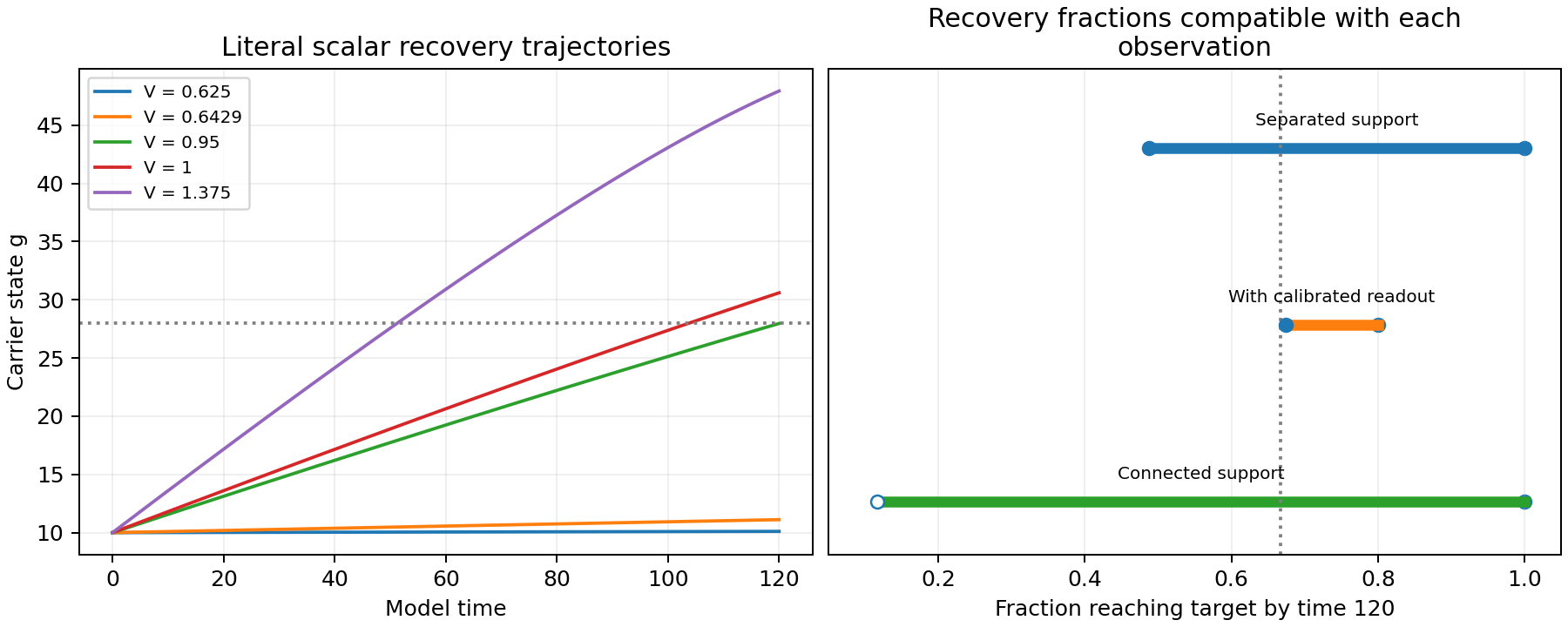
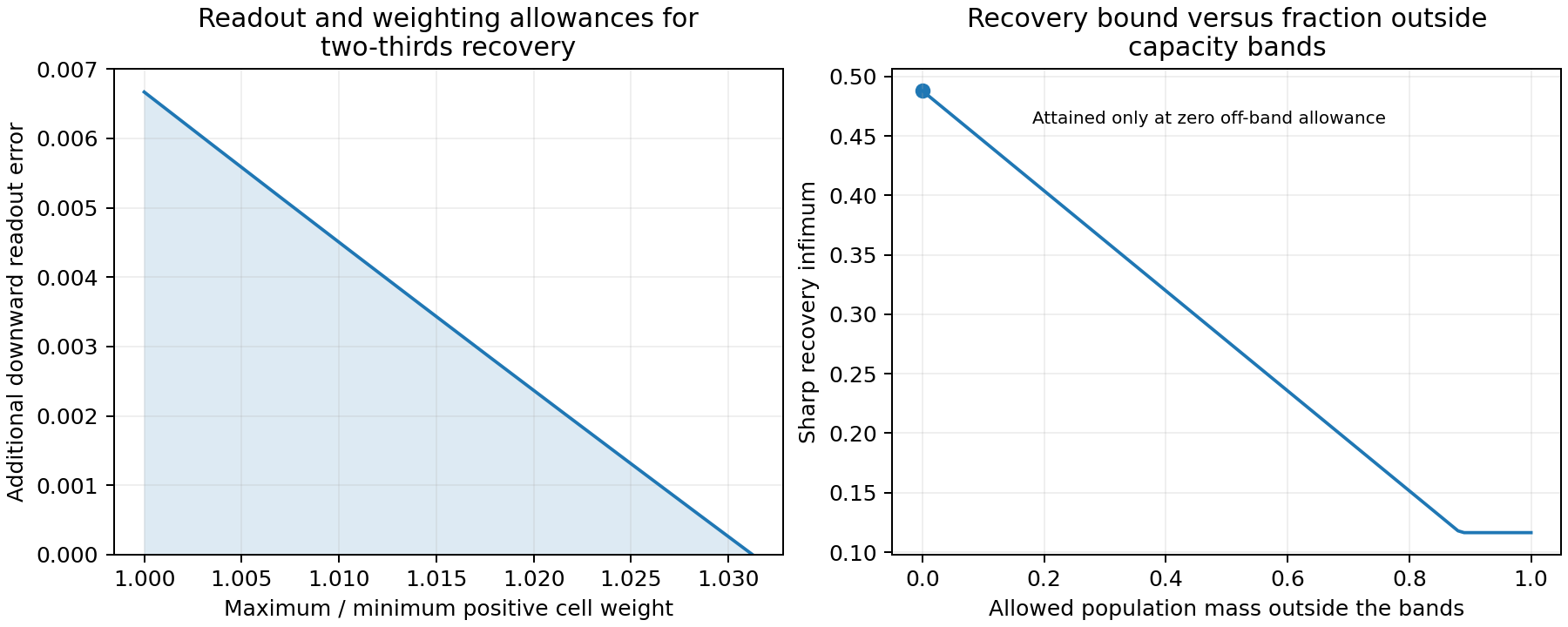
Editable inputs control the kinetic affinities, load, pool, target, deadline, population support and readout bounds. Reusable components implement the original rate, numerical trajectories, exact passage-time bounds, population mixtures and measurement contracts. Individual-cell observation certificates are kept separate from pooled population inference.
The gap between allowed capacity ranges matters: allowing every intermediate capacity lowers the sharp infimum to about 11.64%, and that endpoint is not attained. The example also shows populations with equal mean and variance but recovery fractions of 1/4 and 3/4, and an additional nonlinear assay that leaves the outcome ambiguity unchanged.
Readout error and unequal cell weights consume one shared margin for the illustrated two-thirds requirement. The code reports “not certified from these inputs” when that margin or the kinetic assumptions fail. Download the complete package for exact certificates, composable models, population witnesses, computed outputs and seven scientific test groups.
All values are designed model inputs. Recovery means reaching the specified carrier level, rather than establishing whole-cell viability, numerical roots remain distinct from exact bounds, and Lean is not rerun.
Python source
"""Enzyme activity, actual recovery trajectories, and sharp population bounds.

All inputs are designed model values. The scalar coordinate is not a full-cell
viability endpoint. Run python example.py --output outputs.
"""
from fractions import Fraction as F
from dataclasses import asdict, replace
from pathlib import Path
import argparse
import csv
import hashlib
import json
import math
import platform
import numpy as np
import sympy as sp
import mpmath as mp
from scipy.integrate import solve_ivp
from kinetics import EnzymeParameters, ScalarTask, CapacityFamily, ObservationPolyhedron, features
from population import (Population, TwoBandClass, ReadoutCalibration, minimax,convert_weights,error_normalization_frontier,
                        connected_limits,offband_infimum,offband_witness,resolved_capacity_bounds,row_span_certificate,finite_support_bounds)

# EDITABLE INPUTS ------------------------------------------------------------
POOL = '56'                    # model amount units
INITIAL = '10'
TARGET = '28'
SUBSTRATE = '7'
LOAD = '0.3'                   # amount per model time
DEADLINE = '120'               # model time, not calibrated minutes
AFFINITIES = ('7','3','56','125','520')  # Kg, Kn, Kh, Ka, Kb
INHIBITORS_AB = ('0','0')
LOW_BAND = ('0.625','9/14')
HIGH_BAND = ('1','1.375')
MEAN_CAPACITY = '1'
READOUT_SENSITIVITY = ('0.9','1')
READOUT_FALSE_POSITIVE = ('0','0.02')
READOUT_POSITIVE_FRACTION = ('0.68','0.72')
CELL_WEIGHT_RATIO = '1'
ADDITIONAL_READOUT_ERROR = '0'
DESIRED_FRACTION = '2/3'
OFF_BAND_ALLOWANCE = '0.1'
CAPACITY_MEASUREMENT_ERROR = '0.01'
RECTANGLE_PANELS = 128
TRAJECTORY_CAPACITIES = ('0.625','9/14','0.95','1','1.375')
HORIZONS = (60,120,240,1000)
MANUSCRIPT_SHA256 = '081a2f60534a885288a77debb6655765c7c40ffe21ddc5d1c9d620bf6d4e1884'
# Fixed reference demonstrations below are labeled separately from user inputs.
# ---------------------------------------------------------------------------


def individual_design():
    """a=2,c=3 pinned; designed y(K) in [.24,.26] bounds b=3/K.

    These are coefficient constraints for one realization, not reciprocal
    constraints applied to a pooled mixture.
    """
    avec=(F(1),F(1,7),F(0),F(0),F(0),F(0))
    cvec=(F(0),F(0),F(1,7),F(0),F(0),F(0))
    bvec=(F(0),F(0),F(0),F(1,7),F(0),F(0))
    rows=[avec,tuple(-v for v in avec),cvec,tuple(-v for v in cvec),bvec,tuple(-v for v in bvec)]
    bounds=[F(2),F(-2),F(3),F(-3),F(1,16),-F(33,728)]
    poly=ObservationPolyhedron(rows,bounds);task=ScalarTask();beta=task.parameters.coefficients()
    certificate=poly.verify_dual(task.target_features(),[1,0,F(1,28),0,1,0],beta)
    proposed=poly.propose_dual(task.target_features(),beta)
    deadline=task.uniform_deadline(certificate['reciprocal_upper'])
    # An independent literal rate-band design: target features are the mean of
    # two observed feature vectors at H=14 and H=42, with N=28,S=7 fixed.
    obs=[]
    for H in [14,42]:
        inputs=tuple(map(F,[28,7,H,0,0]));rate=task.parameters.rate(*inputs)
        obs.append((inputs,F(99,100)*rate,F(101,100)*rate))
    literal=ObservationPolyhedron.from_rate_bands(obs)
    literal_cert=literal.verify_dual(task.target_features(),[F(1,2),0,F(1,2),0],beta)
    missing=ObservationPolyhedron(rows[:4],bounds[:4]).propose_dual(task.target_features(),beta)
    # Eventual arrival for K>Kcrit is not a uniform deadline over that class.
    sequence=[]
    for e in [0,1,2,4,6]:
        K=F(252,103)+F(1,10**e);model=replace(task,parameters=replace(task.parameters,inhibition_H=K))
        sequence.append(dict(K=K,target_drift=model.drift(model.target),passage_numeric=model.passage_numeric()))
    return dict(K_interval=(F(48),F(728,11)),dual=certificate,solver_proposal=proposed,deadline=deadline,
                literal_rate_band_dual=literal_cert,literal_rate_band_deadline=task.uniform_deadline(literal_cert['reciprocal_upper']),
                missing_inhibition_observation=missing,compatible_K56_passage_numeric=task.passage_numeric(),near_boundary_sequence=sequence)


def asymptotic_rows():
    """Reference high-precision numerical comparison, separate from certification."""
    rows=[]
    with mp.workdps(65):
        vi=mp.mpf(363)/560;B=mp.mpf(109)/56;q=mp.mpf(3)/10
        def tau(delta):
            V=vi+delta;beta=V-q*B
            return 18*B/beta+6*V/beta**2*mp.log((mp.mpf(81)/70+46*delta)/(28*delta))
        for T in [1000,15000,30000]:
            lo,hi=mp.mpf('1e-50'),mp.mpf(1)
            for _ in range(240):
                mid=(lo+hi)/2
                if tau(mid)>T:lo=mid
                else:hi=mid
            delta=(lo+hi)/2;leading=mp.mpf(81)/1960*mp.exp(-mp.mpf(9)*(T-545)/8470)
            rows.append(dict(deadline=T,delta_numeric=str(delta),leading_delta_numeric=str(leading),relative_error_numeric=float(abs(leading-delta)/delta)))
    return rows


def resource_counterexample():
    rows=[]
    for V in [1.,4.]:
        times=np.linspace(0,1,101)
        def rhs(t,s):y,x=s;return [1-(1+V*V)*y,V*y-x]
        sol=solve_ivp(rhs,(0,1),[1,0],t_eval=times,rtol=1e-11,atol=1e-12,method='Radau')
        if not sol.success:raise ArithmeticError(sol.message)
        exact=V/(1+V*V)*(-np.expm1(-(1+V*V)*times))
        rows.append(dict(capacity=V,x_at_one=float(sol.y[1,-1]),maximum_difference=float(np.max(abs(sol.y[1]-exact))),
                         all_time_ceiling=V/(1+V*V),sampled_success=bool(np.any(sol.y[1]>=.25))))
    return rows


def main():
    parser=argparse.ArgumentParser(description=__doc__);parser.add_argument('--output',type=Path,default=Path('outputs'));out=parser.parse_args().output;out.mkdir(parents=True,exist_ok=True)
    pars=EnzymeParameters(F(1),*map(F,AFFINITIES))
    task=ScalarTask(pars,F(POOL),F(SUBSTRATE),*map(F,INHIBITORS_AB),F(LOAD),F(INITIAL),F(TARGET),F(DEADLINE))
    family=CapacityFamily(task);bands=TwoBandClass(*map(F,LOW_BAND+HIGH_BAND),F(MEAN_CAPACITY))
    bound=bands.bounds(family);eps=F(ADDITIONAL_READOUT_ERROR)
    if eps<0:raise ValueError('Additional readout error must be nonnegative.')
    original_r=tuple(map(F,READOUT_POSITIVE_FRACTION));r=(max(F(0),original_r[0]-eps),min(F(1),original_r[1]+eps))
    readout=ReadoutCalibration(tuple(map(F,READOUT_SENSITIVITY)),tuple(map(F,READOUT_FALSE_POSITIVE)),r)
    repaired=readout.interval(bound['interval']) if bound['interval'] is not None else None
    number=convert_weights(repaired,F(CELL_WEIGHT_RATIO));target=F(DESIRED_FRACTION)
    if not 0<=target<=1:raise ValueError('Desired fraction must be a probability.')
    user=dict(task=asdict(task),bands=asdict(bands),bulk=bound,repaired_interval=repaired,number_interval=number,
              decision='certified' if number is not None and number[0]>=target else 'not certified from these inputs',
              requested_fraction=target,bulk_minimax=minimax(bound['interval']),repaired_minimax=minimax(repaired))
    def table(name,header,rows):
        with (out/name).open('w',newline='',encoding='utf-8') as f:w=csv.writer(f);w.writerow(header);w.writerows(rows)
    trajectories=[];trajectoryrows=[]
    for V in map(F,TRAJECTORY_CAPACITIES):
        model=family.at(V);t,g,hit=model.trajectory();decision=model.classify(RECTANGLE_PANELS)
        trajectories.append(dict(capacity=V,numeric_first_hit=hit,passage_numeric=model.passage_numeric(),classification=decision))
        trajectoryrows.extend(zip([V]*len(t),t,g))
    table('trajectories.csv',['capacity','time','carrier_state'],trajectoryrows)
    # Paper reference witnesses; never claim these for an edited kinetic family.
    ref=CapacityFamily();refbands=TwoBandClass();refreadout=ReadoutCalibration();witnesses=[]
    for p in [F(20,41),F(33,49),F(7,10),F(4,5),F(1)]:
        pop=refbands.witness(p);recovery=pop.recovery_enclosure(ref)
        witnesses.append(dict(requested_fraction=p,population=asdict(pop),counts=pop.count_realization(),mean=pop.mean,recovery=recovery,
                              readout=refreadout.witness(p) if F(33,49)<=p<=F(4,5) else None))
    surface=[]
    for N,S,H,A,B in [(56,7,0,0,0),(28,7,28,0,0),(12,3,40,8,20),(1,100,55,100,500)]:
        inputs=tuple(map(F,[N,S,H,A,B]));rates=[refbands.witness(p).pooled_rate(ref,inputs) for p in [F(20,41),F(1)]]
        assert rates[0]==rates[1];surface.append([*inputs,*rates])
    table('pooled_surface.csv',['N','S','H','A','B','extremal_population_rate','uniform_population_rate'],surface)
    rectangles=[]
    for V in map(F,['19/20','951/1000','7/8','9/8','11/8']):
        row=ref.at(V).passage_rectangles(RECTANGLE_PANELS);row.update(capacity=V,classification=ref.at(V).classify(RECTANGLE_PANELS)['status']);rectangles.append(row)
    assert ref.at(F(19,20)).passage_rectangles(128)['lower']>120
    assert ref.at(F(951,1000)).passage_rectangles(128)['upper']<120
    cutoff=ref.numerical_cutoff();horizons=[]
    for T in HORIZONS:
        c=ref.numerical_cutoff(T);horizons.append(dict(deadline=T,cutoff_numeric=c,**connected_limits(c)))
    offband=[dict(eta=float(e),**offband_infimum(F(str(e)),cutoff)) for e in np.linspace(0,1,101)]
    eta=F(OFF_BAND_ALLOWANCE);approaching=[]
    # Find rational capacities just below the numerical cutoff; exact rectangle
    # lower bounds, not the numerical root alone, certify each failing atom.
    for x in [F(95,100),F(9505,10000),F(95059,100000)]:
        panels=128
        while ref.at(x).classify(panels)['status']=='unresolved' and panels<65536:panels*=2
        classification=ref.at(x).classify(panels)
        if classification['status']!='failure':raise ArithmeticError('Approaching witness is not certified failing.')
        pop=offband_witness(eta,x);approaching.append(dict(failing_capacity=x,population=asdict(pop),mean=pop.mean,offband_mass=pop.weights[1],success_fraction=pop.weights[2],panels=panels))
    equal=[]
    for name,capacities,weights in [('A',(F(7,8),F(11,8)),(F(3,4),F(1,4))),('B',(F(5,8),F(9,8)),(F(1,4),F(3,4)))]:
        pop=Population(capacities,weights);equal.append(dict(name=name,population=asdict(pop),mean=pop.mean,variance=pop.variance,recovery=pop.recovery_enclosure(ref)))
    atoms=list(map(F,['1/20','1/10','1/5','4/5']));second=[2*x/(1+x) for x in atoms];rows=[[F(1)]*4,atoms,second];h=[0,0,1,1]
    null=row_span_certificate(rows,h);lp=finite_support_bounds(rows,[1,F(9,80),F(7,36)],h)
    null['exact_paper_null_vector']=[-98,165,-70,3]
    null['exact_endpoint_weights']=[[0,F(55,56),0,F(1,56)],[F(7,12),0,F(5,12),0]]
    inhibition=[]
    for x in atoms:
        K=56*x/(3*(1-x));model=replace(ScalarTask(),parameters=replace(EnzymeParameters(),inhibition_H=K),deadline=F(300))
        inhibition.append(dict(inhibition_coordinate=x,task_classification=model.classify(),passage_numeric=model.passage_numeric()))
    refpop=refbands.witness(F(7,10));measurement=resolved_capacity_bounds(refpop,refpop.capacities,F(CAPACITY_MEASUREMENT_ERROR),(F(19,20),F(951,1000)))
    eventual=ref.eventual_threshold();eventual_witness=Population((eventual,F(11,8)),(F(210,407),F(197,407)))
    results=dict(user=user,user_trajectories=trajectories,reference_individual=individual_design(),reference_witnesses=witnesses,
                 reference_rectangles=rectangles,reference_cutoff_numeric=cutoff,reference_connected_numeric=connected_limits(cutoff),
                 reference_horizons=horizons,reference_offband_numeric=offband_infimum(eta,cutoff),reference_approaching_witnesses=approaching,
                 reference_equal_variance=equal,reference_second_assay=dict(row_span=null,numerical_bounds=lp,kinetic_classification=inhibition),
                 reference_measurement=measurement,reference_frontier=[dict(weight_ratio=R,**error_normalization_frontier(R)) for R in [F(1),F(51,50),F(33,32),F(6,5)]],
                 reference_eventual=dict(threshold=eventual,lower=F(197,407),attained=True,population=asdict(eventual_witness)),
                 reference_asymptotic=asymptotic_rows(),reference_multidimensional=resource_counterexample(),
                 reference_sample_sizes=dict(one_sided=math.ceil(math.log(20)/(2*(1/150)**2)),two_sided=math.ceil(math.log(40)/(2*(1/150)**2))),
                 evidence='Exact finite certificates and witnesses; numerical ODEs, LPs and roots labeled; general existence/comparison imported from manuscript; Lean not rerun; designed model units only.')
    def serialize(v):
        if isinstance(v,(F,sp.Rational)):return str(v)
        return float(v)
    # JSON represents nonarrival explicitly rather than nonstandard Infinity.
    def clean(x):
        if isinstance(x,float) and not math.isfinite(x):return 'no finite arrival'
        if isinstance(x,dict):return {k:clean(v) for k,v in x.items()}
        if isinstance(x,(tuple,list)):return [clean(v) for v in x]
        return x
    def dump(name,obj):(out/name).write_text(json.dumps(clean(obj),indent=2,default=serialize,allow_nan=False)+'\n',encoding='utf-8')
    dump('results.json',results)
    table('horizons.csv',list(horizons[0]),[list(r.values()) for r in horizons])
    table('offband.csv',['offband_allowance','infimum_numeric'],[[r['eta'],r['infimum']] for r in offband])
    lines=[f'User two-band contract: {bound["status"]}; bulk interval {bound["interval"]}.',
           f'User calibrated interval {repaired}; number interval {number}; requested fraction {target}: {user["decision"]}.',
           f'Reference individual uniform deadline: 43740/391 = {43740/391:.6f}; compatible K=56 arrival {ref.at(1).passage_numeric():.6f}.',
           f'Reference connected-support cutoff: {cutoff:.10f}; infimum {connected_limits(cutoff)["lower"]:.10f}, unattained.',
           'Same mean and variance: recovery fractions 1/4 and 3/4. Entire pooled surface also agrees.',
           'Reference eventual lower bound: 197/407, attained; carrier arrival is not whole-cell viability.']
    (out/'console.txt').write_text('\n'.join(lines)+'\n',encoding='utf-8');print('\n'.join(lines))
    plot(out,trajectoryrows,cutoff,offband)
    digest=lambda p:hashlib.sha256(p.read_bytes()).hexdigest();here=Path(__file__).parent
    dump('run_metadata.json',dict(manuscript_sha256=MANUSCRIPT_SHA256,python=platform.python_version(),source_sha256=digest(Path(__file__)),
         module_sha256={n:digest(here/n) for n in ['kinetics.py','population.py']},output_sha256={p.name:digest(p) for p in sorted(out.iterdir()) if p.is_file() and p.name!='run_metadata.json'}))


def plot(out,trajectoryrows,cutoff,offband):
    import matplotlib
    matplotlib.use('Agg')
    import matplotlib.pyplot as plt
    fig,axs=plt.subplots(1,2,figsize=(10,4),layout='constrained');data=np.array(trajectoryrows,float)
    for V in np.unique(data[:,0]):
        row=data[data[:,0]==V];axs[0].plot(row[:,1],row[:,2],label=f'V = {V:.4g}')
    axs[0].axhline(float(F(TARGET)),color='gray',ls=':');axs[0].set(xlabel='Model time',ylabel='Carrier state g',title='Literal scalar recovery trajectories');axs[0].legend(fontsize=8)
    for y,L,U,label,opened in [(2,20/41,1,'Separated support',False),(1,33/49,.8,'With calibrated readout',False),(0,connected_limits(cutoff)['lower'],1,'Connected support',True)]:
        axs[1].plot([L,U],[y,y],lw=5);axs[1].scatter([L],[y],facecolors='white' if opened else 'tab:blue',edgecolors='tab:blue',zorder=4);axs[1].scatter([U],[y],color='tab:blue')
        axs[1].text((L+U)/2,y+.13,label,ha='center',fontsize=8)
    axs[1].axvline(2/3,color='gray',ls=':');axs[1].set(xlim=(.05,1.05),ylim=(-.3,2.45),yticks=[],xlabel='Fraction reaching target by time 120',title='Recovery fractions compatible with each\nobservation')
    for ax in axs:ax.grid(alpha=.2)
    fig.savefig(out/'recovery.png',dpi=180);fig.savefig(out/'recovery.svg');plt.close(fig)
    fig,axs=plt.subplots(1,2,figsize=(10,4),layout='constrained');R=np.linspace(1,33/32,150);eps=(33-32*R)/(50*(1+2*R))
    axs[0].plot(R,eps);axs[0].fill_between(R,0,eps,alpha=.15);axs[0].set(xlabel='Maximum / minimum positive cell weight',ylabel='Additional downward readout error',title='Readout and weighting allowances for\ntwo-thirds recovery',ylim=(0,.007))
    axs[1].plot([r['eta'] for r in offband],[float(r['infimum']) for r in offband]);axs[1].scatter([0],[20/41],color='tab:blue');axs[1].set(xlabel='Allowed population mass outside the bands',ylabel='Sharp recovery infimum',title='Recovery bound versus fraction outside\ncapacity bands')
    axs[1].text(.18,.46,'Attained only at zero off-band allowance',fontsize=8)
    for ax in axs:ax.grid(alpha=.2)
    fig.savefig(out/'measurement.png',dpi=180);fig.savefig(out/'measurement.svg');plt.close(fig)


if __name__=='__main__':main()
Run output
User two-band contract: exact identified set; bulk interval (Fraction(20, 41), Fraction(1, 1)).
User calibrated interval (Fraction(33, 49), Fraction(4, 5)); number interval (Fraction(33, 49), Fraction(4, 5)); requested fraction 2/3: certified.
Reference individual uniform deadline: 43740/391 = 111.867008; compatible K=56 arrival 103.805763.
Reference connected-support cutoff: 0.9506018463; infimum 0.1163957789, unattained.
Same mean and variance: recovery fractions 1/4 and 3/4. Entire pooled surface also agrees.
Reference eventual lower bound: 197/407, attained; carrier arrival is not whole-cell viability.