Example code
Each two-reaction core can produce both of its internal species, yet several such cores may fail to operate together: a shared species must have one chemical activity (effective concentration) in every reaction. This paper shows how to decide compatibility when cores form paths with private interiors and shared junction endpoints.
The example combines exact lower and upper bounds on activity along each path. Their strict overlap determines which junction states are possible. It then reconstructs rational private-species activities and checks every literal current, production residual and allowed activity range. Editable factors and JSON assembly inputs make the solver reusable.
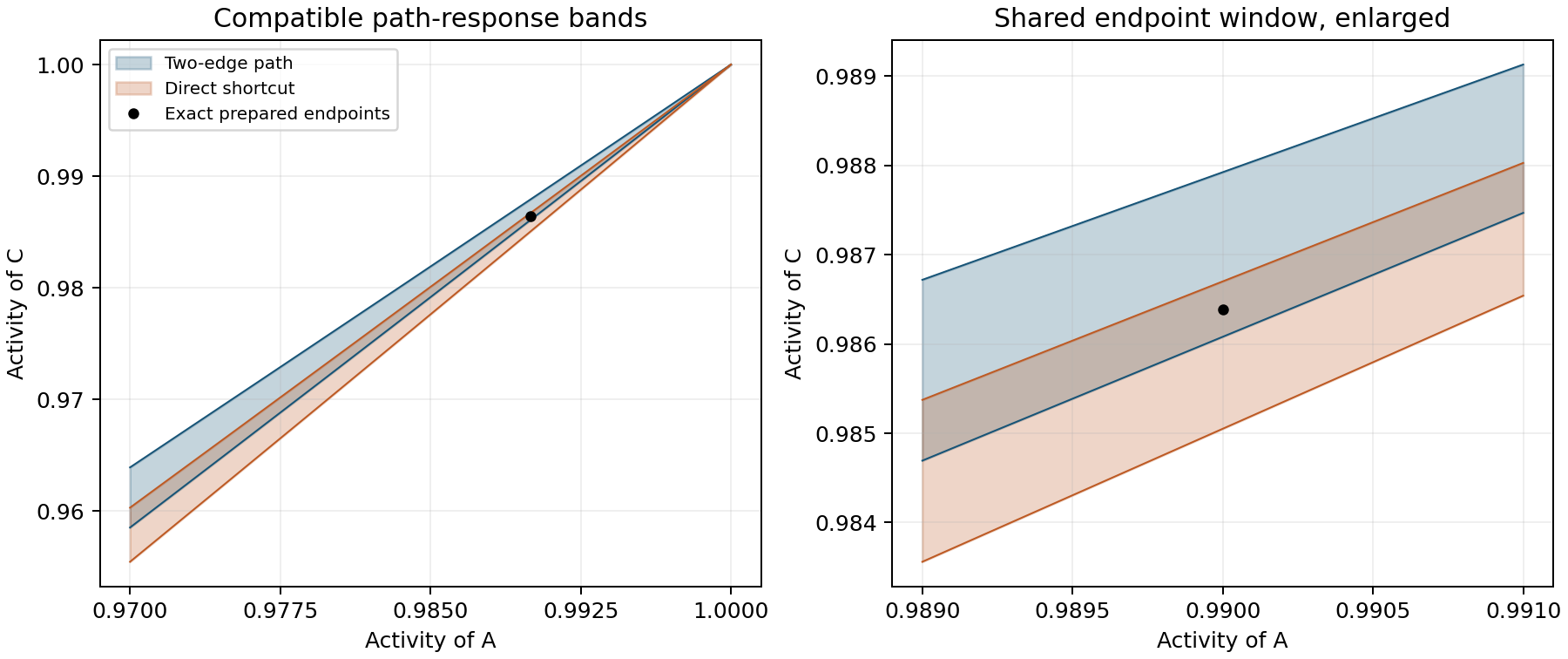
For the graph with shortcut , unit factors are incompatible: the shortcut's lower response lies above the two-edge path's upper response. Factors create a common window. The solver recovers an exact rational state, preserving the same endpoint value on every incident path. Boundary equality remains infeasible, and solver timeouts remain unresolved.
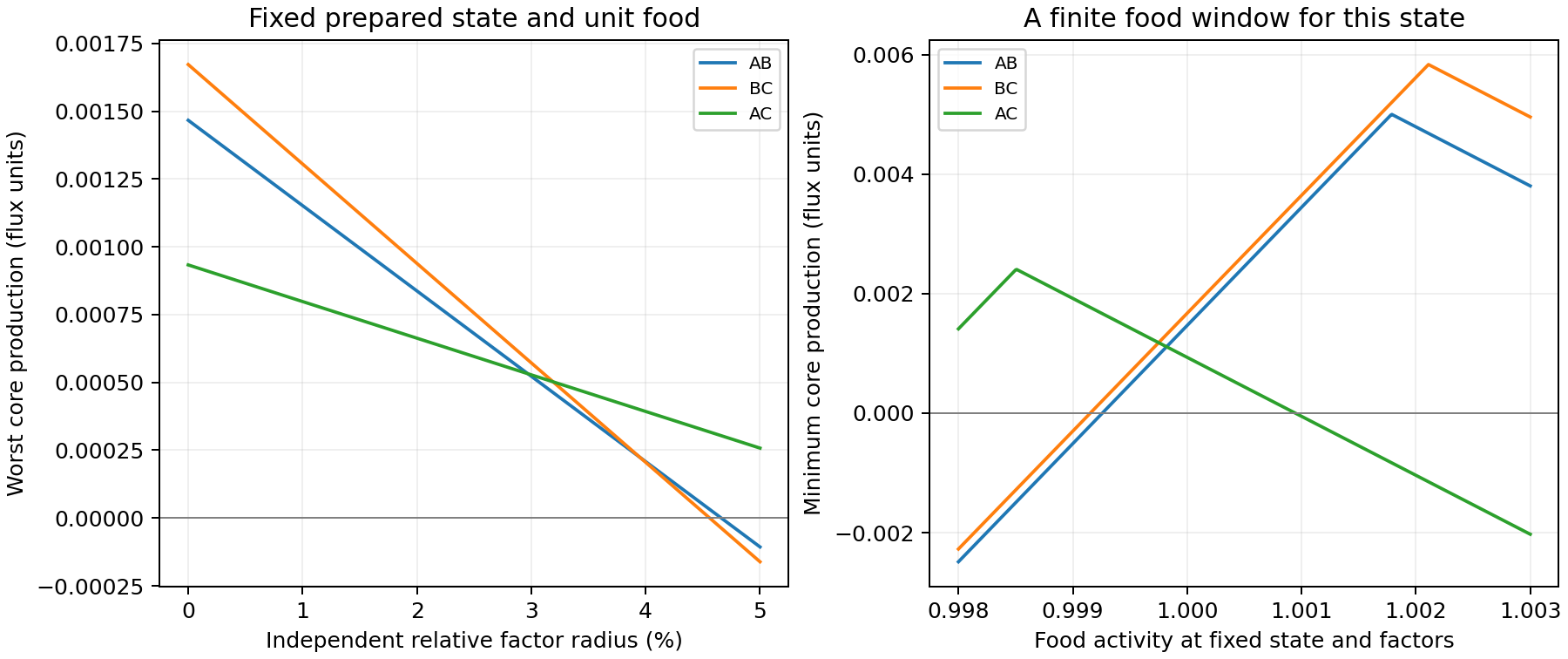
At the paper's separately prepared state , the sharp independent relative-factor tolerance is 43/943, approximately 4.5599%. Strict productivity requires a smaller radius. A simultaneous box with 4% factor variation and activity errors of also passes all 24 exact corner checks, with food fixed at one.
The prepared state has a finite food-activity window, . These are fixed-state limits: changing the state can change what the assembly tolerates. Likewise, its dilution budget describes the instantaneous production-minus-loss derivative, not sustained growth or a steady state.
A second construction uses two unit-factor paths of lengths four and five. It provides a productive nine-species state even though no assignment of integer levels increases by exactly one along every edge. An exact linear sufficient construction and the paper's explicit deficits both yield checked rational states.
Seven scientific test groups cover the reduction, near-boundary reconstruction, negative controls, malformed inputs and operating certificates. The package includes JSON fixtures, exact current tables, setup instructions and reusable solver components. Z3 supplies nonlinear real-arithmetic decisions; every successful state is checked independently with rational arithmetic. The implementation does not claim the paper's external-backend complexity bound or rerun Lean verification.
Python source
"""Exact boundary reduction and rational operating states for junction paths.

python example.py --output outputs
python example.py --input assembly.json --output custom_outputs
Compatibility is static; it does not imply a sustained operating trajectory.
"""
# EDITABLE INPUTS: exact rational model conductances and dimensionless activities.
LOWER_ACTIVITY = '9/10'
PATH_FACTORS = (('9','1'),('9','1'))
SHORTCUT_FACTORS = ('2','1')
REFERENCE_ACTIVITIES = {'A':'99/100','B':'593/600','C':'3551/3600'}
RELATIVE_FACTOR_RADIUS = '1/25'
ACTIVITY_RADIUS = '1/1000000'
FOOD_INTERVAL = ('1','1')
MAX_JUNCTIONS = 6
MAX_PATH_LENGTH = 8
QUERY_TIMEOUT_MS = 3000
MAX_QUERIES = 400

from dataclasses import dataclass
from fractions import Fraction as F
from itertools import product
import argparse
import csv
import hashlib
import json
from pathlib import Path
import platform
import numpy as np
import z3

MANUSCRIPT_SHA256='c71bb73dd23e95817ca599f6a14b3fcb7ca4ec611d6549e411292a3aa23b80c0'


def rational(value):
    if isinstance(value,F):return value
    if type(value) is int or isinstance(value,str):return F(value)
    raise ValueError('Use integer or exact rational strings, not floating-point inputs.')


class Unresolved(RuntimeError):pass


@dataclass(frozen=True)
class Core:
    source:str
    target:str
    a:F
    b:F

    def __post_init__(self):
        object.__setattr__(self,'a',rational(self.a));object.__setattr__(self,'b',rational(self.b))
        if min(self.a,self.b)<=0:raise ValueError('Positive barrier factors required.')
    def response(self,x,c):return (self.a*x+c*self.b*x*x)/(self.a+c*self.b)
    def lower(self,x):return self.response(x,2)
    def upper(self,x):return self.response(x,1)
    def currents(self,x,y,food=F(1)):
        p=self.a*(x-y);q=self.b*(food*y-x*x)
        return p,q,2*q-p,p-q


@dataclass(frozen=True)
class PolynomialResponse:
    """Nonnegative integer coefficients / positive denominator, un-reduced."""
    coefficients:tuple[int,...]=(0,1)
    denominator:int=1

    def append(self,core,c):
        if c not in (1,2):raise ValueError('Response selector must be 1 or 2.')
        a,b=core.a,core.b;alpha=a.numerator*b.denominator;beta=b.numerator*a.denominator
        n=self.coefficients;Q=self.denominator;values=[0]*(2*len(n)-1)
        for i,u in enumerate(n):
            for j,v in enumerate(n):values[i+j]+=c*beta*u*v
        for i,u in enumerate(n):values[i]+=alpha*Q*u
        denominator=(alpha+c*beta)*Q*Q
        if min(values)<0 or sum(values)!=denominator:raise ArithmeticError('Positive representation invariant failed.')
        return PolynomialResponse(tuple(values),denominator)
    def evaluate(self,x):
        value=0
        for c in reversed(self.coefficients):value=value*x+c
        return value/self.denominator
    def z3(self,x):
        value=z3.RealVal(0)
        for c in reversed(self.coefficients):value=value*x+c
        return value/self.denominator


@dataclass(frozen=True)
class DirectedPath:
    cores:tuple[Core,...]

    @property
    def vertices(self):return (self.cores[0].source,)+tuple(e.target for e in self.cores)
    def response(self,x,c):
        for core in self.cores:x=core.response(x,c)
        return x
    def polynomial(self,c):
        value=PolynomialResponse()
        for core in self.cores:value=value.append(core,c)
        return value
    def reconstruct(self,x,y,ell):
        """Keep the final endpoint exact; only the private prefix is interpolated."""
        x,y,ell=map(rational,(x,y,ell));lo,hi=self.response(x,2),self.response(x,1)
        if not 0<ell<=y<x<1 or not lo<y<hi:raise ValueError('Strict response band and common positive box required.')
        if len(self.cores)==1:return (x,y),{'iterations':0,'proved_budget':0}
        r=len(self.cores);C=2**r-1;Cp=2**(r-1)-1;last=self.cores[-1]
        delta=min(y-lo,hi-y);gap=last.a*last.b*ell*(1-x)/((last.a+last.b)*(last.a+2*last.b));radius=delta*gap/(4*C*Cp)
        width=F(1);budget=1
        while width>=radius:width/=2;budget+=1
        left,right=F(0),F(1)
        for iteration in range(1,budget+1):
            lam=(left+right)/2;values=[x]
            for edge in self.cores[:-1]:values.append((1-lam)*edge.lower(values[-1])+lam*edge.upper(values[-1]))
            t=values[-1]
            if last.lower(t)<y<last.upper(t):
                values.append(y)
                if not all(ell<=v<=1 for v in values) or not all(min(edge.currents(u,v)[2:])>0 for edge,u,v in zip(self.cores,values,values[1:])):raise ArithmeticError('Private reconstruction failed exact check.')
                return tuple(values),{'iterations':iteration,'proved_budget':budget,'interpolation_parameter':str(lam),'certified_parameter_radius':str(radius)}
            end=(1-lam)*last.lower(t)+lam*last.upper(t)
            if end<y:left=lam
            else:right=lam
        raise ArithmeticError('Proved rational reconstruction budget exhausted.')


class Assembly:
    """Validates a supplied decomposition; never invents private/junction copies."""
    def __init__(self,data):
        self.species=tuple(data['species']);self.junctions=tuple(data['junctions']);self.ell=rational(data['ell'])
        if any(not isinstance(s,str) or not s for s in self.species) or len(set(self.species))!=len(self.species) or len(set(self.junctions))!=len(self.junctions):raise ValueError('Distinct named species/junctions required.')
        if not set(self.junctions)<=set(self.species) or not 0<self.ell<1:raise ValueError('Invalid junctions or lower activity.')
        raw=data.get('boxes',{})
        if set(raw)-set(self.junctions):raise ValueError('Independent private boxes are outside the two-response reduction; promote those species to junctions.')
        self.boxes={s:tuple(map(rational,raw.get(s,(self.ell,1)))) for s in self.junctions}
        if any(len(b)!=2 or not self.ell<=b[0]<=b[1]<=1 for b in self.boxes.values()):raise ValueError('Invalid closed junction box.')
        self.cores=tuple(Core(e['u'],e['v'],e['a'],e['b']) for e in data['edges']);pairs=set()
        for e in self.cores:
            pair=frozenset((e.source,e.target))
            if e.source not in self.species or e.target not in self.species or e.source==e.target or pair in pairs:raise ValueError('Graph must have no loops, duplicates or antiparallel edges.')
            pairs.add(pair)
        used=[];private=set();paths=[]
        for ids in data['paths']:
            if not ids or any(type(i) is not int or not 0<=i<len(self.cores) for i in ids):raise ValueError('Invalid path indices.')
            path=DirectedPath(tuple(self.cores[i] for i in ids));vs=path.vertices
            if any(a.target!=b.source for a,b in zip(path.cores,path.cores[1:])):raise ValueError('Path orientation/discontinuity.')
            if vs[0] not in self.junctions or vs[-1] not in self.junctions or len(set(vs))!=len(vs):raise ValueError('Path endpoints must be junctions, with no repeated vertices.')
            for s in vs[1:-1]:
                if s in self.junctions or s in private:raise ValueError('Interior species must be private to exactly one path.')
                private.add(s)
            used.extend(ids);paths.append(path)
        if sorted(used)!=list(range(len(self.cores))):raise ValueError('Paths must partition the selected edges exactly.')
        self.paths=tuple(paths)

    def check(self,activities):
        if set(activities)!=set(self.species):raise ValueError('Exactly one activity per global species required.')
        x={s:rational(v) for s,v in activities.items()}
        if any(not self.ell<=v<=1 for v in x.values()) or any(not lo<=x[s]<=hi for s,(lo,hi) in self.boxes.items()):raise ValueError('Activity violates a box.')
        currents=[e.currents(x[e.source],x[e.target]) for e in self.cores]
        if any(min(row[2:])<=0 for row in currents):raise ValueError('Nonpositive literal production residual.')
        return currents


def zq(v):
    v=rational(v);return z3.RealVal(f'{v.numerator}/{v.denominator}')


class BoundarySolver:
    """Z3 is an exact NRA backend, not the paper's complexity-bound routine.

    Every SAT witness is reconstructed and checked with rational arithmetic.
    Timeout/query limits return UNKNOWN, never INCOMPATIBLE.
    """
    def __init__(self,max_junctions=MAX_JUNCTIONS,max_length=MAX_PATH_LENGTH,timeout_ms=QUERY_TIMEOUT_MS,max_queries=MAX_QUERIES):
        self.max_junctions,self.max_length,self.timeout_ms,self.max_queries=max_junctions,max_length,timeout_ms,max_queries
        if timeout_ms<=0 or max_queries<0:raise ValueError('Positive per-query timeout and nonnegative query budget required.')
    def solve(self,assembly):
        self.queries=0
        if len(assembly.junctions)>self.max_junctions or any(len(p.cores)>self.max_length for p in assembly.paths):return {'status':'OUTSIDE_IMPLEMENTATION_LIMITS'}
        if not assembly.cores:
            values={s:(sum(assembly.boxes[s])/2 if s in assembly.boxes else assembly.ell) for s in assembly.species};assembly.check(values)
            return {'status':'SAT','activities':{s:str(v) for s,v in values.items()},'queries':0,'reconstruction':[]}
        solver=z3.SolverFor('QF_NRA');solver.set(timeout=self.timeout_ms);variables={s:z3.Real(f'junction_{i}') for i,s in enumerate(assembly.junctions)}
        for s,(lo,hi) in assembly.boxes.items():solver.add(variables[s]>=zq(lo),variables[s]<=zq(hi))
        residuals=[]
        for p in assembly.paths:
            x,y=variables[p.vertices[0]],variables[p.vertices[-1]]
            residuals.extend((y-p.polynomial(2).z3(x),p.polynomial(1).z3(x)-y))
        def query(constraints):
            if self.queries>=self.max_queries:raise Unresolved('query budget exhausted')
            self.queries+=1;solver.push();solver.add(*constraints);answer=solver.check();reason=solver.reason_unknown();solver.pop()
            if answer==z3.unknown:raise Unresolved(reason)
            return answer==z3.sat
        try:
            if not query([f>0 for f in residuals]):return {'status':'UNSAT','queries':self.queries,'scope':'Exact nonlinear real-arithmetic backend verdict for the validated reduction; no independent UNSAT proof export.'}
            slack=F(1)
            while not query([f>=zq(slack) for f in residuals]):slack/=2
            solver.add(*[f>=zq(slack) for f in residuals]);D=max(2**len(p.cores) for p in assembly.paths);eta=slack/(4*(D+1))
            brackets=dict(assembly.boxes)
            for s in assembly.junctions:
                lo,hi=brackets[s]
                while hi-lo>eta:
                    mid=(lo+hi)/2;constraints=[c for t,(l,u) in brackets.items() for c in (variables[t]>=zq(l),variables[t]<=zq(u))]
                    if query(constraints+[variables[s]<=zq(mid)]):hi=mid
                    else:lo=mid
                    brackets[s]=(lo,hi)
            values={s:assembly.ell for s in assembly.species}
            for s,(lo,hi) in brackets.items():values[s]=(lo+hi)/2
            reconstruction=[]
            for p in assembly.paths:
                local,stats=p.reconstruct(values[p.vertices[0]],values[p.vertices[-1]],assembly.ell)
                for s,v in zip(p.vertices,local):
                    if s in assembly.junctions and values[s]!=v:raise ArithmeticError('Conflicting junction activity.')
                    values[s]=v
                reconstruction.append(stats)
            rows=assembly.check(values)
            return {'status':'SAT','activities':{s:str(v) for s,v in values.items()},'currents_and_residuals':[list(map(str,row)) for row in rows],
                'queries':self.queries,'normalized_response_slack':str(slack),'brackets':{s:list(map(str,b)) for s,b in brackets.items()},'reconstruction':reconstruction,
                'scope':'Exact rational literal-current witness; Z3 QF_NRA used for decisions. No claim of the manuscript backend complexity or rerun Lean verification.'}
        except Unresolved as error:return {'status':'UNKNOWN','queries':self.queries,'reason':str(error)}


class OperatingCertificate:
    def __init__(self,assembly,activities):
        self.assembly=assembly;self.activities={s:rational(v) for s,v in activities.items()};self.rows=assembly.check(self.activities)
    def relative_radius(self):
        if not self.rows:raise ValueError('Nonempty family required for a finite tolerance radius.')
        radii=[min(ru/(2*q+p),rv/(p+q)) for p,q,ru,rv in self.rows]
        return min(radii),radii
    def relative_margin(self,rho):
        rho=rational(rho)
        if not 0<=rho<1:raise ValueError('Relative radius must lie in [0,1).')
        return min(min(ru-rho*(2*q+p),rv-rho*(p+q)) for p,q,ru,rv in self.rows)
    def joint_rectangle(self,activities,factors,food=(F(1),F(1))):
        """Eight checks per core; all bounds are simultaneous and closed."""
        def box(b):
            b=tuple(map(rational,b))
            if len(b)!=2 or not 0<b[0]<=b[1]:raise ValueError('Positive ordered interval required.')
            return b
        activity={s:box(activities[s]) for s in self.assembly.species};food=box(food)
        if len(factors)!=len(self.rows):raise ValueError('One factor rectangle per edge required.')
        checks=[]
        for i,(edge,pair) in enumerate(zip(self.assembly.cores,factors)):
            a_box,b_box=map(box,pair)
            for a,b in product(a_box,b_box):
                for side in (0,1):
                    x=activity[edge.source][1-side];y=activity[edge.target][side];f=food[side]
                    core=Core(edge.source,edge.target,a,b);residual=core.currents(x,y,f)[2+side]
                    checks.append({'edge':i,'side':'source' if side==0 else 'target','a':str(a),'b':str(b),'x':str(x),'y':str(y),'food':str(f),'residual':str(residual)})
        minimum=min(F(row['residual']) for row in checks)
        return {'productive_throughout':minimum>0,'minimum_residual':str(minimum),'corners':checks}
    def food_window(self):
        intervals=[]
        for edge,row in zip(self.assembly.cores,self.rows):
            x,y=self.activities[edge.source],self.activities[edge.target];p=row[0]
            intervals.append(((x*x+p/(2*edge.b))/y,(x*x+p/edge.b)/y))
        return max(b[0] for b in intervals),min(b[1] for b in intervals)
    def instantaneous_budget(self,degradation=None):
        d={s:F(0) for s in self.assembly.species} if degradation is None else {s:rational(degradation[s]) for s in self.assembly.species}
        if min(d.values())<0:raise ValueError('Nonnegative degradation required.')
        production={s:F(0) for s in self.assembly.species}
        for edge,row in zip(self.assembly.cores,self.rows):production[edge.source]+=row[2];production[edge.target]+=row[3]
        return {'production':{s:str(v) for s,v in production.items()},'food_consumption':str(sum(row[1] for row in self.rows)),
            'strict_dilution_upper':str(min(production[s]/self.activities[s]-d[s] for s in production)),
            'scope':'Only the instantaneous field P_s-(D+d_s)*x_s at this prepared state. No persistence, invariant-region or steady-state conclusion.'}


class DeficitConstruction:
    """Linear sufficient construction; failure does not decide compatibility."""
    @staticmethod
    def from_deficits(assembly,deficits,epsilon=None):
        d={s:rational(deficits[s]) for s in assembly.species}
        if min(d.values())<=0:raise ValueError('Positive deficits required.')
        strict_upper=[]
        for e in assembly.cores:
            U=(e.a+4*e.b)*d[e.source]-(e.a+2*e.b)*d[e.target];V=(e.a+e.b)*d[e.target]-(e.a+2*e.b)*d[e.source]
            if min(U,V)<=0:return {'status':'NO_SUFFICIENT_CERTIFICATE','reason':'strict linear deficits fail'}
            strict_upper.append(U/(2*e.b*d[e.source]**2))
        lo=F(0);hi=(1-assembly.ell)/max(d.values())
        for s,(lower,upper) in assembly.boxes.items():lo=max(lo,(1-upper)/d[s]);hi=min(hi,(1-lower)/d[s])
        bound=min(strict_upper,default=hi+1);cap=min(hi,bound)
        if epsilon is None:
            epsilon=(lo+cap)/2 if lo<cap else lo
        else:epsilon=rational(epsilon)
        if not 0<epsilon<bound or not lo<=epsilon<=hi:return {'status':'NO_SUFFICIENT_CERTIFICATE','reason':'epsilon interval empty or supplied epsilon outside it'}
        values={s:1-epsilon*d[s] for s in assembly.species};rows=assembly.check(values)
        return {'status':'SAT','activities':{s:str(v) for s,v in values.items()},'deficits':{s:str(v) for s,v in d.items()},'epsilon':str(epsilon),'minimum_residual':str(min((min(r[2:]) for r in rows),default=F(0)))}
    @staticmethod
    def linear_program(assembly,timeout_ms=QUERY_TIMEOUT_MS):
        solver=z3.Optimize();solver.set(timeout=timeout_ms);d={s:z3.Real(f'deficit_{i}') for i,s in enumerate(assembly.species)};t=z3.Real('margin')
        solver.add(sum(d.values())==1,*[v>=t for v in d.values()])
        for e in assembly.cores:
            alpha=(e.a+2*e.b)/(e.a+e.b);beta=(e.a+4*e.b)/(e.a+2*e.b)
            solver.add(d[e.target]-zq(alpha)*d[e.source]>=t,zq(beta)*d[e.source]-d[e.target]>=t)
        solver.maximize(t);answer=solver.check()
        if answer==z3.unknown:return {'status':'UNKNOWN','reason':solver.reason_unknown()}
        if answer!=z3.sat:return {'status':'NO_SUFFICIENT_CERTIFICATE'}
        model=solver.model()
        def fraction(value):
            value=model.eval(value)
            if not z3.is_rational_value(value):raise Unresolved('Nonrational linear-program output.')
            return F(value.numerator_as_long(),value.denominator_as_long())
        margin=fraction(t)
        if margin<=0:return {'status':'NO_SUFFICIENT_CERTIFICATE','linear_margin':str(margin)}
        result=DeficitConstruction.from_deficits(assembly,{s:fraction(v) for s,v in d.items()});result['linear_margin']=str(margin);return result


def shortcut_data(private=True,unit=False,singleton=False):
    factors=(('1','1'),)*3 if unit else (*PATH_FACTORS,SHORTCUT_FACTORS)
    return {'species':['A','B','C'],'junctions':['A','C'] if private else ['A','B','C'],'ell':LOWER_ACTIVITY,
        'edges':[dict(u=u,v=v,a=a,b=b) for (u,v),(a,b) in zip([('A','B'),('B','C'),('A','C')],factors)],
        'paths':[[0,1],[2]] if private else [[0],[1],[2]],
        'boxes':{s:[REFERENCE_ACTIVITIES[s]]*2 for s in (['A','C'] if private else ['A','B','C'])} if singleton else {}}


def nongraded_data():
    p4=['A','u1','u2','u3','Z'];p5=['A','v1','v2','v3','v4','Z'];edges=[];paths=[]
    for vertices in (p4,p5):
        indices=[]
        for u,v in zip(vertices,vertices[1:]):indices.append(len(edges));edges.append(dict(u=u,v=v,a='1',b='1'))
        paths.append(indices)
    deficits=dict(zip(p4,map(F,['1','83/50','69/25','459/100','191/25'])));deficits.update(zip(p5,map(F,['1','1501/1000','1127/500','3383/1000','1269/250','191/25'])))
    return {'species':list(deficits),'junctions':['A','Z'],'ell':'9/10','edges':edges,'paths':paths},deficits


def main():
    parser=argparse.ArgumentParser(description=__doc__);parser.add_argument('--output',type=Path,default=Path('outputs'));parser.add_argument('--input',type=Path);args=parser.parse_args();out=args.output;out.mkdir(parents=True,exist_ok=True)
    if args.input:
        data=json.loads(args.input.read_text());assembly=Assembly(data);result=BoundarySolver().solve(assembly)
        (out/'custom_result.json').write_text(json.dumps(result,indent=2)+'\n');print(json.dumps(result,indent=2));return
    fixtures={'weighted_private':shortcut_data(),'weighted_junctions':shortcut_data(False),'unit_incompatible':shortcut_data(unit=True),'singleton_junctions':shortcut_data(singleton=True)}
    fixtures['cycle']={'species':['A','B','C'],'junctions':['A','B','C'],'ell':'1/10','edges':[dict(u=u,v=v,a=1,b=1) for u,v in [('A','B'),('B','C'),('C','A')]],'paths':[[0],[1],[2]]}
    decisions={name:BoundarySolver().solve(Assembly(data)) for name,data in fixtures.items()}
    (out/'fixture_inputs.json').write_text(json.dumps(fixtures,indent=2)+'\n')
    a=Assembly(shortcut_data());state={s:F(v) for s,v in REFERENCE_ACTIVITIES.items()};certificate=OperatingCertificate(a,state);radius,radii=certificate.relative_radius();rho=F(RELATIVE_FACTOR_RADIUS);delta=F(ACTIVITY_RADIUS)
    boxes={s:(v-delta,v+delta) for s,v in state.items()};factors=[((e.a*(1-rho),e.a*(1+rho)),(e.b*(1-rho),e.b*(1+rho))) for e in a.cores]
    joint=certificate.joint_rectangle(boxes,factors,tuple(map(F,FOOD_INTERVAL)));food=certificate.food_window();ng,deficits=nongraded_data();nongraded=Assembly(ng)
    fixed_deficits=DeficitConstruction.from_deficits(nongraded,deficits,F(1,10000));lp=DeficitConstruction.linear_program(nongraded)
    (out/'nongraded_input.json').write_text(json.dumps(ng,indent=2)+'\n')
    result={'decisions':decisions,'reference_state':REFERENCE_ACTIVITIES,'relative_radius':str(radius),'edge_relative_radii':list(map(str,radii)),
        'margin_at_configured_relative_radius':str(certificate.relative_margin(rho)),'joint_rectangle':joint,'food_window_open':list(map(str,food)),
        'instantaneous_loss_budget':certificate.instantaneous_budget(),'nongraded_four_five_explicit':fixed_deficits,'nongraded_four_five_linear_program':lp,
        'scope':'Static common-activity compatibility and fixed-state tolerances. No claim of global dynamics, automatic decomposition, or Z3 complexity bound; Lean not rerun.'}
    (out/'results.json').write_text(json.dumps(result,indent=2)+'\n')
    def write(name,header,rows):
        with (out/name).open('w',newline='') as f:w=csv.writer(f);w.writerow(header);w.writerows(rows)
    write('exact_currents.csv',['edge','p','q','source_production','target_production','relative_radius'],[[e.source+'->'+e.target,*map(str,row),str(r)] for e,row,r in zip(a.cores,certificate.rows,radii)])
    path,shortcut=a.paths;xs=np.linspace(.97,1,251);bands=[[x,float(path.response(x,2)),float(path.response(x,1)),float(shortcut.response(x,2)),float(shortcut.response(x,1))] for x in xs]
    write('response_bands.csv',['xA','path_lower','path_upper','shortcut_lower','shortcut_upper'],bands)
    rhos=[F(i,10000) for i in range(501)];tolerances=[[float(r),*[float(min(ru-r*(2*q+p),rv-r*(p+q))) for p,q,ru,rv in certificate.rows]] for r in rhos]
    write('factor_tolerances.csv',['rho','AB_minimum','BC_minimum','AC_minimum'],tolerances)
    foods=[F(998,1000)+F(i,100000) for i in range(501)];foodrows=[[float(f),*[float(min(e.currents(state[e.source],state[e.target],f)[2:])) for e in a.cores]] for f in foods]
    write('food_response.csv',['food','AB_minimum','BC_minimum','AC_minimum'],foodrows)
    representations=[]
    for h in (1,2,4,8):
        p=DirectedPath(tuple(Core(str(i),str(i+1),F(1),F(1)) for i in range(h)));response=p.polynomial(1)
        representations.append({'length':h,'expanded_degree':len(response.coefficients)-1,'denominator_bits':response.denominator.bit_length(),'coefficient_sum_equals_denominator':sum(response.coefficients)==response.denominator})
    (out/'representation_sizes.json').write_text(json.dumps(representations,indent=2)+'\n')
    lines=[f'Weighted private-path decision: {decisions["weighted_private"]["status"]}; unit-factor shortcut: {decisions["unit_incompatible"]["status"]}; directed cycle: {decisions["cycle"]["status"]}.',
        f'Fixed-state sharp relative radius: {radius} = {float(radius):.8g}; strict inequality required.',
        f'Joint preparation/factor/food corner minimum: {joint["minimum_residual"]}.',
        f'Fixed-state food window: ({food[0]}, {food[1]}).',
        f'Nongraded four/five construction minimum production: {fixed_deficits.get("minimum_residual")}; exact LP candidate: {lp["status"]}.',
        'All SAT states are checked against literal currents and boxes. UNKNOWN does not mean incompatible.']
    (out/'console.txt').write_text('\n'.join(lines)+'\n');print('\n'.join(lines))
    import matplotlib
    matplotlib.use('Agg')
    import matplotlib.pyplot as plt
    fig,axs=plt.subplots(1,2,figsize=(10,4.2),layout='constrained')
    for ax,domain in zip(axs,(np.linspace(.97,1,251),np.linspace(.989,.991,251))):
        for p,label,color in [(path,'Two-edge path','#175477'),(shortcut,'Direct shortcut','#bd5a24')]:
            lower=[float(p.response(x,2)) for x in domain];upper=[float(p.response(x,1)) for x in domain]
            ax.fill_between(domain,lower,upper,alpha=.25,color=color,label=label);ax.plot(domain,lower,color=color,lw=.8);ax.plot(domain,upper,color=color,lw=.8)
        ax.plot(float(state['A']),float(state['C']),'ko',ms=4,label='Exact prepared endpoints');ax.set(xlabel='Activity of A',ylabel='Activity of C');ax.set_xticks(np.linspace(domain[0],domain[-1],5));ax.grid(alpha=.2)
    axs[0].set_title('Compatible path-response bands');axs[1].set_title('Shared endpoint window, enlarged');axs[0].legend(fontsize=8)
    fig.savefig(out/'response_bands.png',dpi=180);fig.savefig(out/'response_bands.svg');plt.close(fig)
    fig,axs=plt.subplots(1,2,figsize=(10,4.2),layout='constrained')
    rr=np.array(tolerances);ff=np.array(foodrows)
    for i,label in enumerate(('AB','BC','AC'),1):axs[0].plot(100*rr[:,0],rr[:,i],label=label);axs[1].plot(ff[:,0],ff[:,i],label=label)
    axs[0].set(xlabel='Independent relative factor radius (%)',ylabel='Worst core production (flux units)',title='Fixed prepared state and unit food')
    axs[1].set(xlabel='Food activity at fixed state and factors',ylabel='Minimum core production (flux units)',title='A finite food window for this state')
    for ax in axs:ax.axhline(0,color='gray',lw=.8);ax.legend(fontsize=8);ax.grid(alpha=.2)
    fig.savefig(out/'operating_windows.png',dpi=180);fig.savefig(out/'operating_windows.svg');plt.close(fig)
    digest=lambda p:hashlib.sha256(p.read_bytes()).hexdigest()
    (out/'run_metadata.json').write_text(json.dumps({'manuscript_sha256':MANUSCRIPT_SHA256,'source_sha256':digest(Path(__file__)),'python':platform.python_version(),'z3':z3.get_version_string(),
        'output_sha256':{p.name:digest(p) for p in sorted(out.iterdir()) if p.is_file() and p.name!='run_metadata.json'}},indent=2)+'\n')


if __name__=='__main__':main()
Run output
Weighted private-path decision: SAT; unit-factor shortcut: UNSAT; directed cycle: UNSAT.
Fixed-state sharp relative radius: 43/943 = 0.045599152; strict inequality required.
Joint preparation/factor/food corner minimum: 847959991/4687500000000.
Fixed-state food window: (14814/14825, 88859/88775).
Nongraded four/five construction minimum production: 21/100000000; exact LP candidate: SAT.
All SAT states are checked against literal currents and boxes. UNKNOWN does not mean incompatible.