Example code
When reaction networks share species, their behaviour together depends on what each requires at the shared boundary. This example compares descriptions that retain those constraints with simpler summaries that can miss them. It supplies reusable models for amplification prices, passive reaction chains, degradation stars and finite join-tree messages.
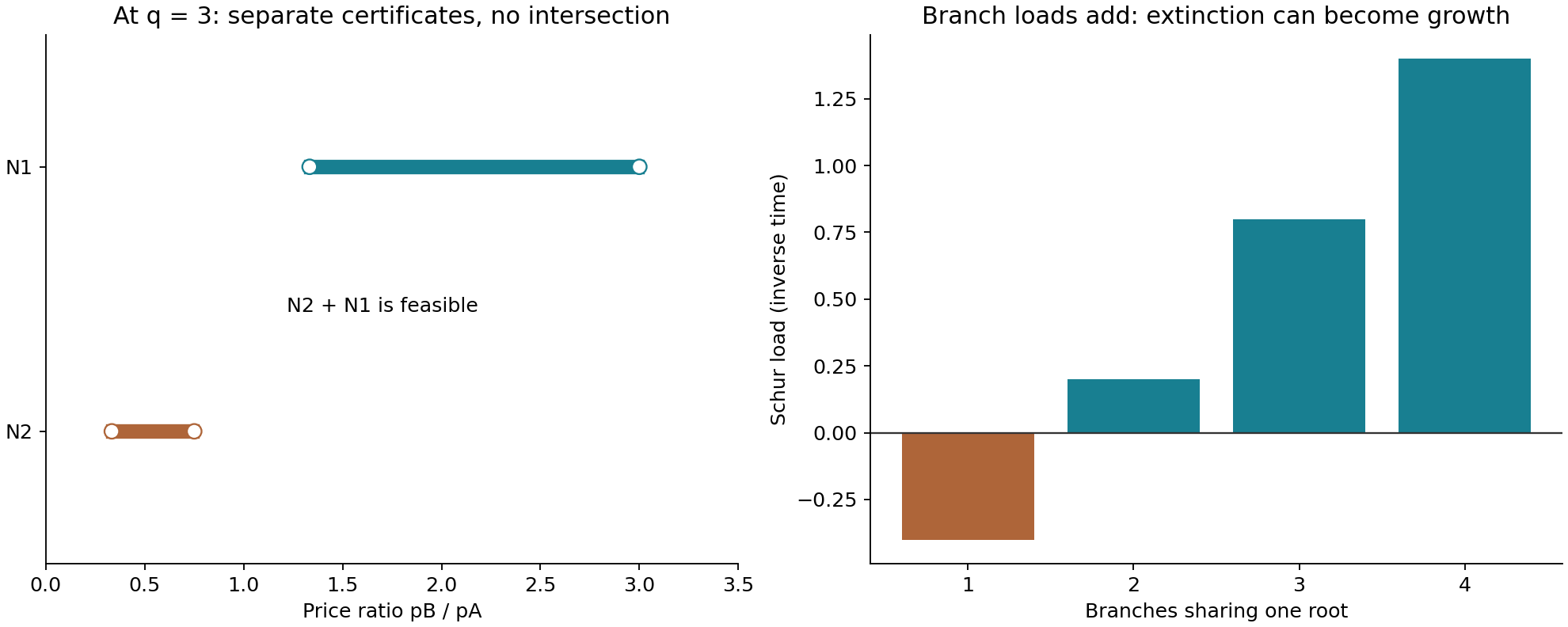
An amplification price profile assigns nonnegative mathematical weights to species. It retains every weighting that rules out a chosen amplification threshold through strict reaction inequalities. Composing networks on the same species intersects those profiles. The two networks and each have maximum amplification 2, but coupling the second to the first reaches 4. Duplicating the first still reaches only 2. At threshold 3, their separate price intervals are disjoint: the scalar score omitted information the partner needed.
The solver returns an exact rational feasible flux or a strict price certificate. It keeps threshold equality on the feasible side; a weak price inequality cannot certify impossibility. Its vertex search is intended for small networks and can be replaced independently of the profile representation.
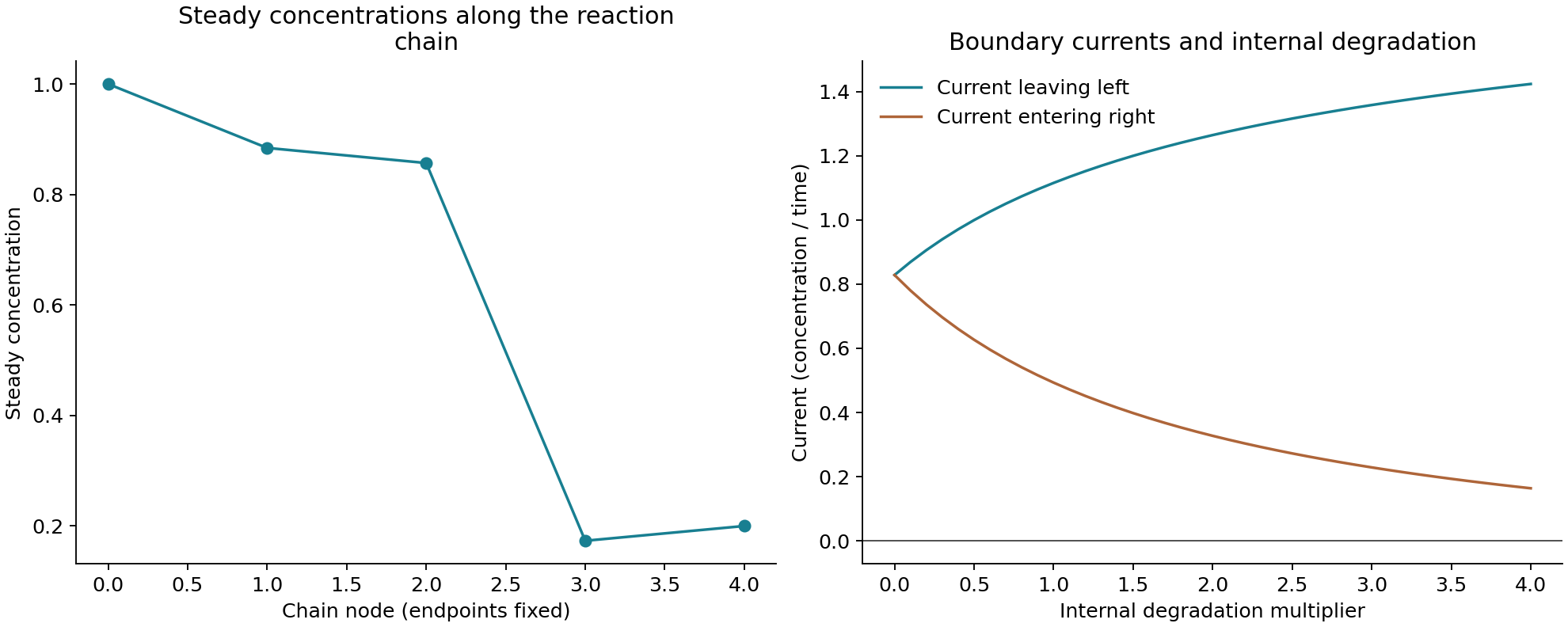
A passive reversible chain can be replaced, at steady state, by a relation between its two endpoint concentrations and currents. Four coefficients determine the current leaving its left endpoint and entering its right endpoint. Internal degradation appears as two endpoint leaks. PassiveTail eliminates the internal species, reconstructs their unique steady concentrations, and checks every original balance. The default four-edge chain has zero residual in each of its three internal balances. The sweep shows that the difference between the two boundary currents is exactly the internal degradation loss.
Substitution is tested inside a larger model: external forcing and endpoint degradation determine both endpoint concentrations. Solving the full chain and its compressed two-species replacement gives identical results. This interface preserves steady-state behaviour; it does not preserve transient relaxation.
A degradation star connects several internal branches to one root. Each branch exposes a load, and those loads add. The paper's example gives per branch against root diagonal : one branch extinguishes, but two grow. DegradationStar returns a positive vector whose matrix product has the required strict sign in every coordinate, or is exactly zero at criticality.
For finite boundary relations—lists of allowed shared-variable values—JoinNode passes those values between modules and checks that their local solutions agree. Children secretly choosing and cannot be glued into one global assignment. The implementation rejects that invalid decomposition; after routing through the separators, it correctly returns an empty trace. FiniteRelation also constructs a separating context whenever two traces differ. Equal trace sizes alone are not sufficient.
Download the package, install requirements.txt, run python example.py --output outputs, then python -m unittest -v. Editable rates, concentrations, thresholds and branch counts appear first. Inputs for the chain are illustrative values in consistent concentration and time units; the amplification and star counterexamples use the manuscript's exact values. Each model can be imported independently.
Seven test groups check analytic amplification thresholds, direct chain solves, replacement inside external environments, strict star certificates, all 256 pairs of binary child relations, and exhaustive contexts on a three-element boundary. The scientific calculations use rational arithmetic or finite sets. These examples demonstrate the central interface mechanisms, not every theorem or the Lean build; finite separator width alone makes no runtime guarantee.
Python source
"""Exact interfaces, usable independently: prices, passive tails, stars, join trees.

Run: python example.py --output outputs. See README.md for units and scope.
Scientific calculations use Fraction; plotting is the only floating conversion.
"""
from __future__ import annotations

# EDITABLE INPUTS -------------------------------------------------------------
# Stoichiometric coefficients and amplification q are dimensionless.
AMPLIFICATION_THRESHOLDS = ("1", "2", "3", "4", "5")
# A reversible unary chain X0 <-> X1 <-> ... <-> X4.
# Rate constants and internal degradation: inverse time, e.g. h^-1.
TAIL_FORWARD = ("2", "3", "1", "4")
TAIL_BACKWARD = ("1", "2", "2", "1")
TAIL_DEGRADATION = ("1/5", "1/2", "1/10")
LEFT_CONCENTRATION = "1"       # arbitrary consistent concentration unit
RIGHT_CONCENTRATION = "1/5"
# Paper's star counterexample; entries have units inverse time.
ROOT_DIAGONAL = "-1"
BRANCH_DIAGONAL = "-15"
ROOT_TO_BRANCH = "3"
BRANCH_TO_ROOT = "3"
BRANCH_COUNTS = (1, 2, 3, 4)
# Finite examples use exact binary relations; no discretization of chemistry.
FINITE_DOMAIN = (0, 1)  # the worked Boolean gluing example requires these values
# ---------------------------------------------------------------------------

import argparse
import csv
from dataclasses import dataclass
from fractions import Fraction as F
import hashlib
from itertools import combinations, product
import json
from pathlib import Path
import platform
from typing import Hashable, Iterable


def rational(value):
    """Decimal strings retain their intended decimal, including supplied floats."""
    return F(str(value))


def dot(a, b):
    return sum((x * y for x, y in zip(a, b, strict=True)), F(0))


def solve(matrix, rhs):
    """Exact square Gaussian elimination; singular systems return None."""
    n = len(rhs)
    if len(matrix) != n or any(len(row) != n for row in matrix):
        raise ValueError("Expected a square system")
    a = [[rational(x) for x in row] + [rational(y)]
         for row, y in zip(matrix, rhs, strict=True)]
    for j in range(n):
        pivot = next((i for i in range(j, n) if a[i][j]), None)
        if pivot is None:
            return None
        a[j], a[pivot] = a[pivot], a[j]
        scale = a[j][j]
        a[j] = [x / scale for x in a[j]]
        for i in range(n):
            if i != j:
                scale = a[i][j]
                a[i] = [x - scale * y for x, y in zip(a[i], a[j])]
    return tuple(row[-1] for row in a)


@dataclass(frozen=True)
class RationalPolytope:
    """Small exact LP: inequalities row*x >= bound plus one normalization.

    Vertex enumeration is deliberately bounded to small models. It is exponential;
    use a larger LP backend with exact certificate verification for large networks.
    """
    normalization: tuple[F, ...]
    inequalities: tuple[tuple[tuple[F, ...], F], ...]

    def vertices(self):
        n = len(self.normalization)
        found = set()
        for active in combinations(self.inequalities, n - 1):
            x = solve([self.normalization] + [r for r, _ in active],
                      [F(1)] + [b for _, b in active])
            if x is not None and all(dot(row, x) >= b for row, b in self.inequalities):
                found.add(x)
        return tuple(sorted(found))


@dataclass(frozen=True)
class PriceProfile:
    """The full threshold-dependent strict halfspaces, not a scalar MAF."""
    inputs: tuple[tuple[F, ...], ...]   # species rows, reaction columns
    outputs: tuple[tuple[F, ...], ...]

    def __post_init__(self):
        for name in ("inputs", "outputs"):
            object.__setattr__(self, name, tuple(tuple(rational(x) for x in row)
                                                for row in getattr(self, name)))
        if (not self.inputs or not self.inputs[0] or len(self.inputs) != len(self.outputs)
                or any(len(row) != len(self.inputs[0]) for row in self.inputs + self.outputs)
                or any(x < 0 for row in self.inputs + self.outputs for x in row)):
            raise ValueError("Nonempty equally shaped nonnegative source matrices required")

    def compose(self, other):
        """Shared-species composition; both profiles use the same species order."""
        if len(self.inputs) != len(other.inputs):
            raise ValueError("Shared species dimensions differ")
        return PriceProfile(tuple(a + b for a, b in zip(self.inputs, other.inputs)),
                            tuple(a + b for a, b in zip(self.outputs, other.outputs)))

    def residual(self, q):
        q = rational(q)
        return tuple(tuple(b - q * a for a, b in zip(ar, br))
                     for ar, br in zip(self.inputs, self.outputs))

    def contains(self, q, prices):
        prices = tuple(map(rational, prices))
        m = self.residual(q)
        return (len(prices) == len(m) and all(p >= 0 for p in prices)
                and all(dot(column, prices) < 0 for column in zip(*m)))

    def decide(self, q):
        """Exactly return either normalized feasible flux or STRICT price witness.

        Weak primal inequalities retain the threshold endpoint. A weak zero price
        residual is never accepted as an impossibility certificate.
        """
        m = self.residual(q)
        ns, nr = len(m), len(m[0])
        positive = tuple((tuple(F(i == j) for i in range(nr)), F(0)) for j in range(nr))
        primal = RationalPolytope((F(1),) * nr, tuple((r, F(0)) for r in m) + positive)
        vertices = primal.vertices()
        if vertices:
            x = vertices[0]
            return {"kind": "feasible", "flux": x, "residual": tuple(dot(r, x) for r in m)}
        # Maximize epsilon with p>=0, sum(p)=1 and -(B-qA)^T p >= epsilon.
        bounds = tuple((tuple(-v for v in col) + (F(-1),), F(0)) for col in zip(*m))
        bounds += tuple((tuple(F(i == j) for i in range(ns + 1)), F(0)) for j in range(ns + 1))
        candidates = RationalPolytope((F(1),) * ns + (F(0),), bounds).vertices()
        best = max(candidates, key=lambda x: x[-1], default=None)
        if best is None or best[-1] <= 0 or not self.contains(q, best[:-1]):
            raise ArithmeticError("No verified alternative; never infer infeasibility from a missing witness")
        return {"kind": "infeasible", "prices": best[:-1], "strict_margin": best[-1]}


@dataclass(frozen=True)
class TwoPort:
    """j_left=(forward+left_leak)*X-backward*Y;
    j_right=forward*X-(backward+right_leak)*Y.
    """
    forward: F
    backward: F
    left_leak: F = F(0)
    right_leak: F = F(0)

    def currents(self, left, right):
        left, right = rational(left), rational(right)
        return ((self.forward + self.left_leak) * left - self.backward * right,
                self.forward * left - (self.backward + self.right_leak) * right)

    def extend(self, forward, backward, degradation):
        forward, backward, degradation = map(rational, (forward, backward, degradation))
        loss = self.backward + self.right_leak + forward + degradation
        return TwoPort(self.forward * forward / loss, self.backward * backward / loss,
                       self.left_leak + self.forward * (self.right_leak + degradation) / loss,
                       backward * (self.right_leak + degradation) / loss)


@dataclass(frozen=True)
class PassiveTail:
    forward: tuple[F, ...]
    backward: tuple[F, ...]
    degradation: tuple[F, ...]

    def __post_init__(self):
        for name in ("forward", "backward", "degradation"):
            object.__setattr__(self, name, tuple(map(rational, getattr(self, name))))
        if (not self.forward or len(self.backward) != len(self.forward)
                or len(self.degradation) != len(self.forward) - 1
                or min(self.forward + self.backward) <= 0
                or any(d < 0 for d in self.degradation)):
            raise ValueError("Positive reversible rates and one nonnegative loss per internal node required")

    def prefixes(self):
        ports = [TwoPort(self.forward[0], self.backward[0])]
        for c, b, d in zip(self.forward[1:], self.backward[1:], self.degradation):
            ports.append(ports[-1].extend(c, b, d))
        return tuple(ports)

    def port(self):
        return self.prefixes()[-1]

    def reconstruct(self, left, right):
        """Unique internal steady concentrations by reversing exact elimination."""
        left, right = rational(left), rational(right)
        if min(left, right) < 0:
            raise ValueError("Concentrations must be nonnegative")
        ports = self.prefixes()
        states = [right]
        for i in range(len(self.forward) - 1, 0, -1):
            p = ports[i - 1]
            loss = p.backward + p.right_leak + self.forward[i] + self.degradation[i - 1]
            states.append((p.forward * left + self.backward[i] * states[-1]) / loss)
        return (left,) + tuple(reversed(states))

    def literal_currents(self, states):
        if len(states) != len(self.forward) + 1:
            raise ValueError("Wrong number of chain states")
        return tuple(c * rational(x) - b * rational(y)
                     for c, b, x, y in zip(self.forward, self.backward, states[:-1], states[1:]))

    def audit(self, left, right):
        states = self.reconstruct(left, right)
        currents = self.literal_currents(states)
        residuals = tuple(currents[i] - currents[i + 1] - d * states[i + 1]
                          for i, d in enumerate(self.degradation))
        boundary = self.port().currents(left, right)
        if any(residuals) or boundary != (currents[0], currents[-1]):
            raise ArithmeticError("Exact two-port audit failed")
        return {"states": states, "edge_currents": currents, "internal_residuals": residuals,
                "boundary_currents": boundary, "internal_loss": sum(d*x for d, x in zip(self.degradation, states[1:-1]))}


@dataclass(frozen=True)
class Branch:
    internal: tuple[tuple[F, ...], ...]
    to_root: tuple[F, ...]
    from_root: tuple[F, ...]

    def __post_init__(self):
        object.__setattr__(self, "internal", tuple(tuple(map(rational, r)) for r in self.internal))
        for name in ("to_root", "from_root"):
            object.__setattr__(self, name, tuple(map(rational, getattr(self, name))))
        n = len(self.internal)
        if (not n or any(len(r) != n for r in self.internal)
                or len(self.to_root) != n or len(self.from_root) != n
                or any(x < 0 for x in self.to_root) or any(x <= 0 for x in self.from_root)
                or any(self.internal[i][j] < 0 for i in range(n) for j in range(n) if i != j)):
            raise ValueError("Metzler branch, nonnegative return and strictly positive source coupling required")
        self.response()

    def response(self):
        u = solve(self.internal, tuple(-c for c in self.from_root))
        if u is None or any(x <= 0 for x in u):
            raise ValueError("Branch lacks a positive solve witness A*u=-c")
        return u

    def load(self):
        return dot(self.to_root, self.response())


@dataclass(frozen=True)
class DegradationStar:
    root_diagonal: F
    branches: tuple[Branch, ...]

    def __post_init__(self):
        object.__setattr__(self, "root_diagonal", rational(self.root_diagonal))
        if not self.branches:
            raise ValueError("Supply at least one branch")

    def matrix(self):
        n = 1 + sum(len(b.internal) for b in self.branches)
        m = [[F(0) for _ in range(n)] for _ in range(n)]
        m[0][0] = self.root_diagonal
        offset = 1
        for b in self.branches:
            for i, row in enumerate(b.internal):
                m[0][offset+i] = b.to_root[i]
                m[offset+i][0] = b.from_root[i]
                m[offset+i][offset:offset+len(row)] = row
            offset += len(b.internal)
        return tuple(map(tuple, m))

    def certificate(self):
        kappa = self.root_diagonal + sum((b.load() for b in self.branches), F(0))
        sign = (kappa > 0) - (kappa < 0)
        delta = sign * min(F(1, 2), abs(kappa) / (2 * (1 + abs(self.root_diagonal))))
        v = (1 + delta,) + tuple(x for b in self.branches for x in b.response())
        residual = tuple(dot(r, v) for r in self.matrix())
        if not all((x > 0) - (x < 0) == sign for x in residual):
            raise ArithmeticError("Failed strict sign certificate")
        return {"state": {1: "growth", 0: "critical", -1: "extinction"}[sign],
                "schur_load": kappa, "positive_vector": v, "matrix_times_vector": residual}


@dataclass(frozen=True)
class FiniteRelation:
    """Extensional relation: out-of-scope inspection is impossible by construction."""
    scope: tuple[str, ...]
    rows: frozenset[tuple[Hashable, ...]]

    def __post_init__(self):
        object.__setattr__(self, "scope", tuple(self.scope))
        object.__setattr__(self, "rows", frozenset(tuple(row) for row in self.rows))
        if len(set(self.scope)) != len(self.scope) or any(len(r) != len(self.scope) for r in self.rows):
            raise ValueError("Unique variables and full rows required")

    def accepts(self, assignment):
        return tuple(assignment[v] for v in self.scope) in self.rows

    def project(self, boundary):
        boundary = tuple(boundary)
        indices = [self.scope.index(v) for v in boundary]
        return FiniteRelation(boundary, frozenset(tuple(row[i] for i in indices) for row in self.rows))

    def compatible(self, context):
        if self.scope != context.scope:
            raise ValueError("Context must use the same ordered boundary")
        return bool(self.rows & context.rows)

    def separating_context(self, other):
        if self.scope != other.scope:
            raise ValueError("Different boundaries")
        difference = self.rows ^ other.rows
        return None if not difference else FiniteRelation(self.scope, frozenset((min(difference),)))


@dataclass(frozen=True)
class JoinNode:
    name: str
    bag: tuple[str, ...]
    separator: tuple[str, ...]
    local: FiniteRelation
    children: tuple[JoinNode, ...] = ()

    def __post_init__(self):
        if not set(self.local.scope) <= set(self.bag) or not set(self.separator) <= set(self.bag):
            raise ValueError("Local scope and separator must lie in the bag")
        if len(set(self.bag)) != len(self.bag) or len(set(self.separator)) != len(self.separator):
            raise ValueError("Duplicate variable")

    def all_variables(self):
        return set(self.bag).union(*(c.all_variables() for c in self.children))

    def validate(self):
        for i, child in enumerate(self.children):
            others = set(self.bag).union(*(c.all_variables() for j, c in enumerate(self.children) if i != j))
            if not child.all_variables() & others <= set(child.separator):
                raise ValueError(f"Running intersection fails at {child.name}")
            if not set(child.separator) <= set(self.bag):
                raise ValueError("This finite implementation requires child separators in the parent bag")
            child.validate()

    def message(self, domain):
        """Exact finite separator relation, refusing invalid decompositions."""
        self.validate()
        return self._message(tuple(domain))

    def _message(self, domain):
        children = [c._message(domain) for c in self.children]
        rows = set()
        for values in product(domain, repeat=len(self.bag)):
            assignment = dict(zip(self.bag, values))
            if self.local.accepts(assignment) and all(c.accepts(assignment) for c in children):
                rows.add(tuple(assignment[v] for v in self.separator))
        return FiniteRelation(self.separator, frozenset(rows))

    def global_trace(self, domain):
        """Independent exhaustive oracle; one assignment for the whole subtree."""
        variables = tuple(sorted(self.all_variables()))
        def holds(node, assignment):
            return node.local.accepts(assignment) and all(holds(c, assignment) for c in node.children)
        rows = set()
        for values in product(domain, repeat=len(variables)):
            assignment = dict(zip(variables, values))
            if holds(self, assignment):
                rows.add(tuple(assignment[v] for v in self.separator))
        return FiniteRelation(self.separator, frozenset(rows))

    def width(self):
        return max([len(self.separator)] + [c.width() for c in self.children])


def paper_profiles():
    return (PriceProfile(((1, 0), (0, 1)), ((0, 4), (1, 0))),
            PriceProfile(((1, 0), (0, 1)), ((0, 1), (4, 0))))


def gluing_examples(domain=FINITE_DOMAIN):
    if set(domain) != {0, 1}:
        raise ValueError("The worked gluing example requires domain {0,1}; JoinNode accepts other finite domains")
    truth = FiniteRelation((), frozenset(((),)))
    left = FiniteRelation(("x", "a"), frozenset((x, x) for x in domain))
    right = FiniteRelation(("x", "b"), frozenset((x, 1-x) for x in domain))
    good = JoinNode("root", ("x",), ("x",), truth,
                    (JoinNode("left", ("x", "a"), ("x",), left),
                     JoinNode("right", ("x", "b"), ("x",), right)))
    bad = JoinNode("root", (), (), truth,
                  (JoinNode("left", ("x",), (), FiniteRelation(("x",), frozenset(((0,),)))),
                   JoinNode("right", ("x",), (), FiniteRelation(("x",), frozenset(((1,),))))))
    # A corrected decomposition routes the conflicting x through both separators.
    repaired = JoinNode("root", ("x",), (), truth,
                       tuple(JoinNode(c.name, c.bag, ("x",), c.local) for c in bad.children))
    return good, bad, repaired


def serialize(value):
    if isinstance(value, F):
        return str(value)
    if isinstance(value, dict):
        return {str(k): serialize(v) for k, v in value.items()}
    if isinstance(value, (tuple, list, set, frozenset)):
        return [serialize(v) for v in value]
    return value


def main():
    parser = argparse.ArgumentParser(description=__doc__)
    parser.add_argument("--output", type=Path, default=Path("outputs"))
    args = parser.parse_args()
    args.output.mkdir(parents=True, exist_ok=True)
    n1, n2 = paper_profiles()
    profiles = {"N1": n1, "N2": n2, "N1+N1": n1.compose(n1), "N2+N1": n2.compose(n1)}
    decisions = {name: {q: model.decide(q) for q in AMPLIFICATION_THRESHOLDS}
                 for name, model in profiles.items()}
    tail = PassiveTail(TAIL_FORWARD, TAIL_BACKWARD, TAIL_DEGRADATION)
    audit = tail.audit(LEFT_CONCENTRATION, RIGHT_CONCENTRATION)
    branch = Branch(((BRANCH_DIAGONAL,),), (BRANCH_TO_ROOT,), (ROOT_TO_BRANCH,))
    stars = {n: DegradationStar(ROOT_DIAGONAL, (branch,) * n).certificate() for n in BRANCH_COUNTS}
    good, bad, repaired = gluing_examples()
    message = good.message(FINITE_DOMAIN)
    assert message == good.global_trace(FINITE_DOMAIN)
    try:
        bad.message(FINITE_DOMAIN)
        raise AssertionError("Invalid tree accepted")
    except ValueError as error:
        rejection = str(error)
    assert not repaired.message(FINITE_DOMAIN).rows and not bad.global_trace(FINITE_DOMAIN).rows
    # Trace cardinality loses information; a singleton context separates these.
    t0 = FiniteRelation(("x",), frozenset(((0,),)))
    t1 = FiniteRelation(("x",), frozenset(((1,),)))
    context = t0.separating_context(t1)
    results = {"amplification": decisions, "tail": {"coefficients": vars(tail.port()), **audit},
               "stars": stars, "finite_traces": {"width": good.width(), "message": sorted(message.rows),
               "invalid_tree_rejection": rejection, "repaired_conflict_trace": [],
               "same_cardinality": len(t0.rows) == len(t1.rows), "separating_context": sorted(context.rows),
               "context_verdicts": [t0.compatible(context), t1.compatible(context)]}}
    (args.output / "results.json").write_text(json.dumps(serialize(results), indent=2) + "\n")
    sweep = []
    for numerator in range(41):
        scale = F(numerator, 10)
        candidate = PassiveTail(tail.forward, tail.backward, tuple(scale*d for d in tail.degradation))
        result = candidate.audit(LEFT_CONCENTRATION, RIGHT_CONCENTRATION)
        sweep.append((scale, *result["boundary_currents"], result["internal_loss"],
                      candidate.port().left_leak, candidate.port().right_leak))
    with (args.output / "tail_sweep.csv").open("w", newline="") as handle:
        writer = csv.writer(handle)
        writer.writerow(("degradation_multiplier", "left_current", "right_current", "internal_loss", "left_leak", "right_leak"))
        writer.writerows(sweep)
    import matplotlib
    matplotlib.use("Agg")
    import matplotlib.pyplot as plt
    plt.rcParams.update({"font.size": 11, "axes.spines.top": False, "axes.spines.right": False,
                         "svg.hashsalt": "exact-interfaces-v1"})
    fig, axes = plt.subplots(1, 2, figsize=(12, 4.8), layout="constrained")
    ratio = [F(i, 100) for i in range(401)]
    q = F(3)
    for label, model, y, color in (("N1", n1, 1, "#187f91"), ("N2", n2, 0, "#ae6539")):
        valid = [r for r in ratio if model.contains(q, (1, r))]
        axes[0].plot([float(r) for r in valid], [y] * len(valid), lw=8, color=color)
    axes[0].scatter([F(4, 3), 3, F(1, 3), F(3, 4)], [1, 1, 0, 0], s=65,
                    facecolors="white", edgecolors=["#187f91"]*2+["#ae6539"]*2, zorder=3)
    axes[0].set(yticks=[0, 1], yticklabels=["N2", "N1"], ylim=(-.5, 1.5), xlim=(0, 3.5),
                xlabel="Price ratio pB / pA", title="At q = 3: separate certificates, no intersection")
    axes[0].text(1.7, .45, "N2 + N1 is feasible", ha="center")
    colors = ["#ae6539" if s["schur_load"] < 0 else "#187f91" for s in stars.values()]
    axes[1].bar(list(stars), [float(s["schur_load"]) for s in stars.values()], color=colors)
    axes[1].axhline(0, color="#333333", lw=1)
    axes[1].set(xlabel="Branches sharing one root", ylabel="Schur load (inverse time)",
                xticks=list(stars), title="Branch loads add: extinction can become growth")
    for extension in ("png", "svg"):
        fig.savefig(args.output / f"interfaces.{extension}", dpi=165)
    plt.close(fig)
    fig, axes = plt.subplots(1, 2, figsize=(12, 4.8), layout="constrained")
    axes[0].plot(range(len(audit["states"])), list(map(float, audit["states"])), "o-", color="#187f91")
    axes[0].set(xlabel="Chain node (endpoints fixed)", ylabel="Steady concentration", title="Steady concentrations along the reaction\nchain")
    axes[1].plot([float(row[0]) for row in sweep], [float(row[1]) for row in sweep], label="Current leaving left", color="#187f91")
    axes[1].plot([float(row[0]) for row in sweep], [float(row[2]) for row in sweep], label="Current entering right", color="#ae6539")
    axes[1].axhline(0, color="#444444", lw=.8)
    axes[1].set(xlabel="Internal degradation multiplier", ylabel="Current (concentration / time)", title="Boundary currents and internal degradation")
    axes[1].legend(frameon=False)
    for extension in ("png", "svg"):
        fig.savefig(args.output / f"passive_tail.{extension}", dpi=165)
    plt.close(fig)
    console = "\n".join([
        "Exact interfaces for modular autocatalytic networks",
        "All certificates, chain balances and finite messages use rational/finite arithmetic.",
        "At q=4: N1+N1 " + profiles["N1+N1"].decide(4)["kind"] + "; N2+N1 " + profiles["N2+N1"].decide(4)["kind"],
        "Two-port coefficients: " + str(serialize(vars(tail.port()))),
        "Internal steady residuals: " + str(audit["internal_residuals"]),
        "Star states: " + str({n: r["state"] for n, r in stars.items()}),
        "Valid finite message: " + str(sorted(message.rows)),
        "Invalid join tree: " + rejection,
        "Cardinality-summary collision, context verdicts: " + str(results["finite_traces"]["context_verdicts"]),
        "Not a re-execution of the Lean proofs; not a nonlinear kinetic model."])
    print(console)
    (args.output / "console.txt").write_text(console + "\n")
    outputs = {p.name: hashlib.sha256(p.read_bytes()).hexdigest() for p in sorted(args.output.iterdir())
               if p.is_file() and p.name != "run_metadata.json"}
    metadata = {"source_sha256": hashlib.sha256(Path(__file__).read_bytes()).hexdigest(),
                "manuscript_sha256": "62106305bc8d8f4652be7989329b13ed300007da7596d596e7e0cdc1ea52ff61",
                "python": platform.python_version(), "matplotlib": matplotlib.__version__,
                "inputs": {"thresholds": AMPLIFICATION_THRESHOLDS, "tail_forward": TAIL_FORWARD,
                           "tail_backward": TAIL_BACKWARD, "tail_degradation": TAIL_DEGRADATION,
                           "left_concentration": LEFT_CONCENTRATION, "right_concentration": RIGHT_CONCENTRATION,
                           "root_diagonal": ROOT_DIAGONAL, "branch_diagonal": BRANCH_DIAGONAL,
                           "root_to_branch": ROOT_TO_BRANCH, "branch_to_root": BRANCH_TO_ROOT,
                           "branch_counts": BRANCH_COUNTS, "finite_domain": FINITE_DOMAIN},
                "output_sha256": outputs, "arithmetic": "exact Fraction / finite sets; float only for plots"}
    (args.output / "run_metadata.json").write_text(json.dumps(metadata, indent=2) + "\n")


if __name__ == "__main__":
    main()
Run output
Exact interfaces for modular autocatalytic networks
All certificates, chain balances and finite messages use rational/finite arithmetic.
At q=4: N1+N1 infeasible; N2+N1 feasible
Two-port coefficients: {'forward': '800/1489', 'backward': '400/4467', 'left_leak': '888/1489', 'right_leak': '587/4467'}
Internal steady residuals: (Fraction(0, 1), Fraction(0, 1), Fraction(0, 1))
Star states: {1: 'extinction', 2: 'growth', 3: 'growth', 4: 'growth'}
Valid finite message: [(0,), (1,)]
Invalid join tree: Running intersection fails at left
Cardinality-summary collision, context verdicts: [True, False]
Not a re-execution of the Lean proofs; not a nonlinear kinetic model.