Example code
Four concentrations, , form two coupled autocatalytic modules. A fork converts into , linking the AB module to the ZH module. Reservoirs maintain the inputs and an output channel removes . Each module has one stationary response when the other's concentrations are held fixed. Coupling them can nevertheless produce two stable compositions that nearby concentrations approach.
The example implements the full reactor and changes the fraction of the fork that feeds dynamic . The remaining fraction feeds a buffered species held at unit activity. Forward and reverse fork capacities each remain one. This gives a concrete intervention: change how much of the fork participates in feedback, then examine the stationary responses.
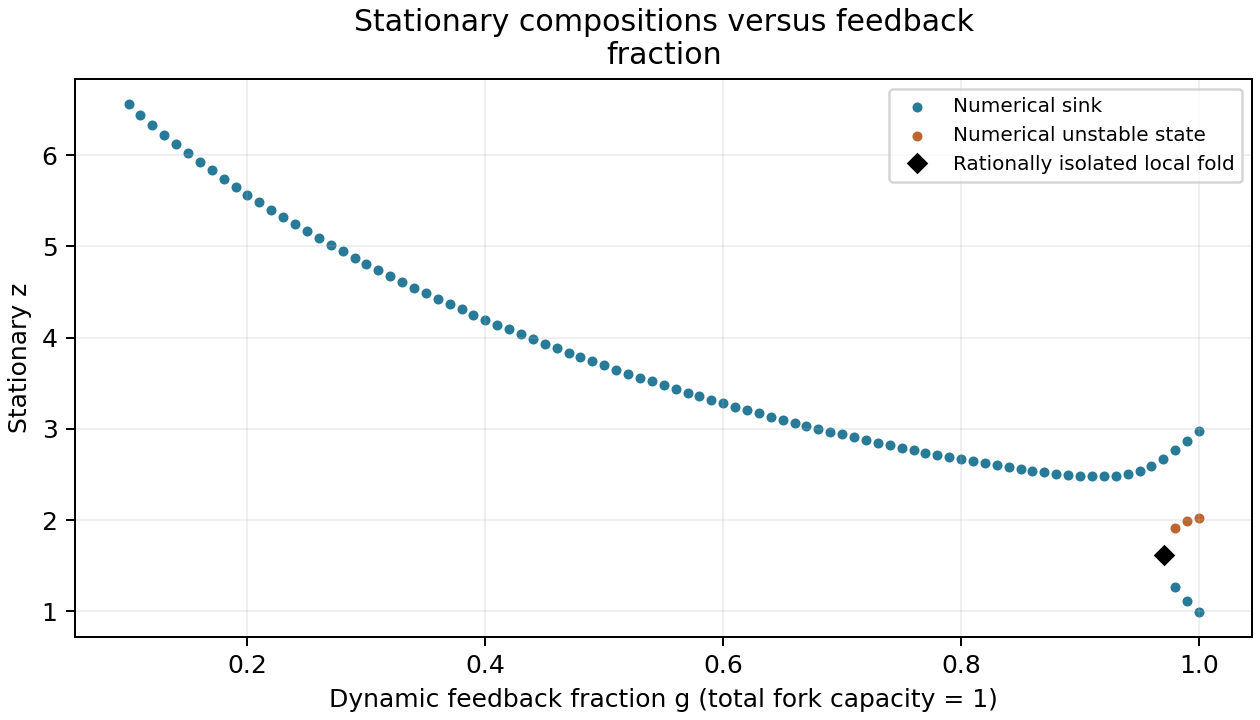
The rational calculation isolates a local saddle-node near , where a stable state (a sink) and an unstable state (a saddle) appear as feedback increases. The broader plotted sweep uses numerical roots and Jacobian eigenvalues. The local certificate checks exact fractions; it does not certify the whole plotted diagram or exclude other folds.
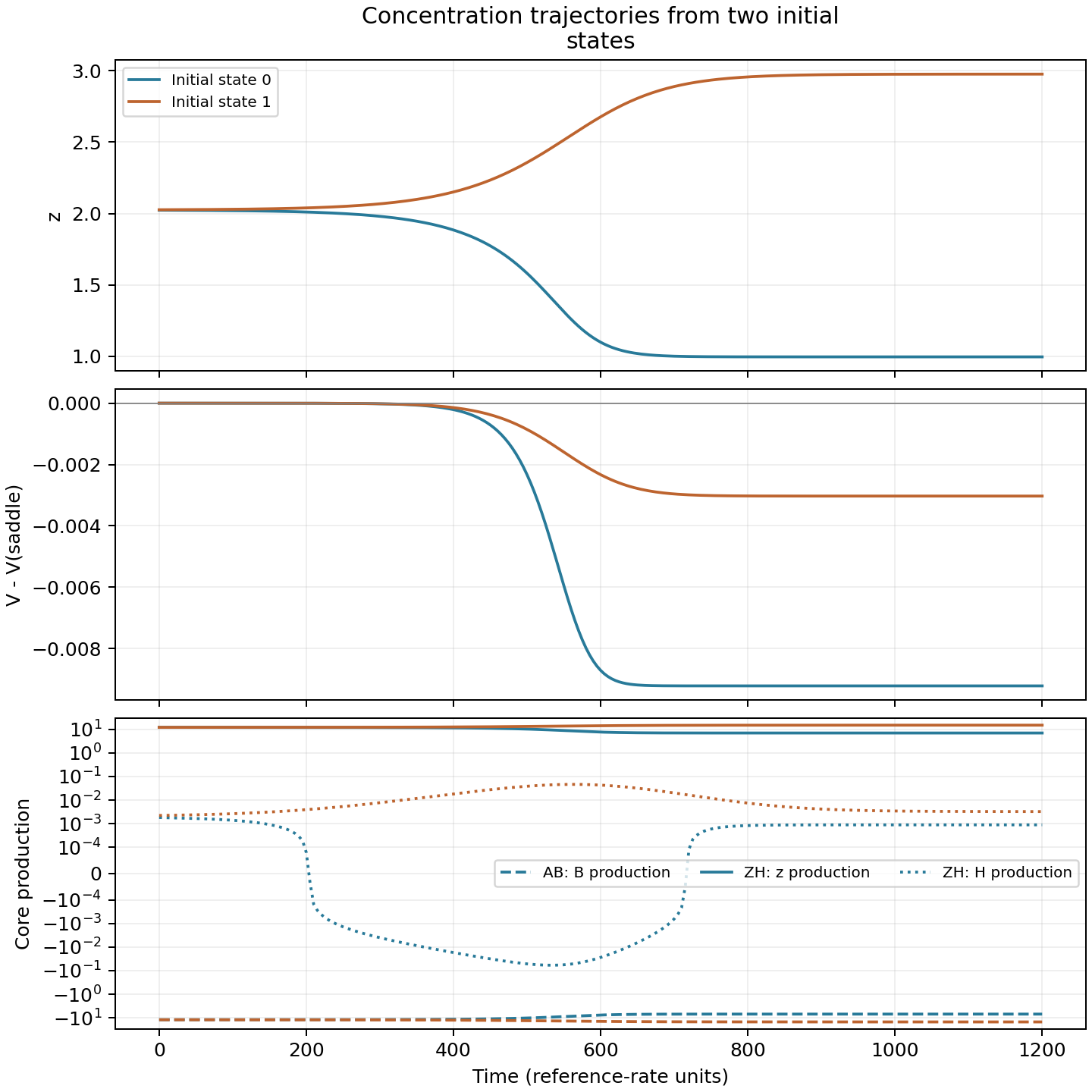
At full feedback, the default reactor has stationary values approximately 0.99579, 2.02484 and 2.97637. The outer states attract nearby trajectories and the middle state is a saddle. The example starts two trajectories on opposite sides of its growing direction. They approach different compositions, yet both end with AB inactive and ZH productive. An activity label therefore loses information that a concentration measurement retains.
The paper's response potential, a scalar function that decreases along the dynamics, supplies a more informative selection test. Once a state enters the stated absorbing region, a potential below the saddle's value and above the saddle's select the low- sink; the same potential test with below selects the high- sink. The reusable observer evaluates this rule and reports unresolved cases. Its trajectories and quadrature are numerical, so its verdicts illustrate the theorem rather than provide validated flow certificates.
The download includes editable manuscript parameters, reaction and reactor classes, clamped-module solvers, exact stationary-root isolation, the response potential, a numerical selection observer, and the exact local fold calculation. Seven scientific test groups check reaction balances, roots, spectra, dissipation, trajectory destinations and theorem-scope boundaries. CSV files expose the trajectories and feedback sweep for further analysis.
The global selection theorem applies to the fully coupled flagship family. Changing the routing, rates or reverse output input supports new experiments but does not automatically extend that theorem. The package keeps those scopes explicit and does not rerun the manuscript's Lean proofs.
Python source
"""Feedback can select different compositions with the same activity signature.

Run: python example.py --output outputs
The reaction model and numerical exploration are reusable. Rational root isolation
and the fixed fold certificate are distinguished from floating-point trajectories.
"""
from __future__ import annotations

# EDITABLE INPUTS: nondimensional maintained activities and rates from Table 1.
from fractions import Fraction as Q
A_FEED = Q(6)
B_FEED = Q(27)
ZH_FORWARD = Q(16)
ZH_REVERSE = Q(2)
REVERSE_CORE_RATE = Q(1, 100000)
OUTPUT_LOSS = Q(1, 10000)
FEEDBACK_FRACTION = Q(1)
REVERSE_OUTPUT_INPUT = Q(0)  # positive values explore the reversible-sink extension
FEEDBACK_SWEEP = tuple(Q(i, 100) for i in range(10, 101))
TRAJECTORY_END = 1200.0
INITIAL_PERTURBATION = 0.02
SAMPLE_COUNT = 241
CUSTOM_INITIAL_STATES = ()  # optional additional (A, B, z, H) positive states
MANUSCRIPT_SHA256 = '83d9a0ecb93ca62c09b473fd55615b34712b44e5d6077598706b156d4d01cb44'

import argparse
import csv
import hashlib
import json
import math
import platform
from dataclasses import dataclass, replace
from functools import cached_property
from pathlib import Path

import numpy as np
import sympy as sp
from scipy.integrate import quad, solve_ivp

SPECIES = ('A', 'B', 'z', 'H')


@dataclass(frozen=True)
class Parameters:
    a: Q = A_FEED
    b: Q = B_FEED
    u: Q = ZH_FORWARD
    v: Q = ZH_REVERSE
    e: Q = REVERSE_CORE_RATE
    d: Q = OUTPUT_LOSS
    g: Q = FEEDBACK_FRACTION
    eta: Q = REVERSE_OUTPUT_INPUT

    def __post_init__(self):
        for name in self.__dataclass_fields__:
            object.__setattr__(self, name, Q(str(getattr(self, name))))
        if min(self.a, self.b, self.u, self.v, self.e, self.d) <= 0:
            raise ValueError('All six reaction rates must be positive.')
        if not 0 <= self.g <= 1 or self.eta < 0:
            raise ValueError('Routing is in [0,1]; reverse output input is nonnegative.')

    @property
    def flagship(self):
        return ((self.a, self.b, self.u, self.v, self.d, self.g, self.eta)
                == (6, 27, 16, 2, Q(1,10000), 1, 0)
                and Q(1,200000) <= self.e <= Q(1,50000))


@dataclass(frozen=True)
class ReversiblePair:
    """Reduced mass action after maintained external activities are substituted."""
    name: str
    reactants: tuple[int, ...]
    products: tuple[int, ...]
    forward: Q
    reverse: Q

    @property
    def change(self):
        return np.subtract(self.products, self.reactants)

    def current(self, state):
        def monomial(powers):
            return math.prod(value**power for value, power in zip(state, powers))
        return self.forward*monomial(self.reactants)-self.reverse*monomial(self.products)


class CoupledReactor:
    """Complete four-species field, with routing and reversible output as parameters."""
    def __init__(self, parameters=Parameters()):
        self.p = parameters
        p = parameters
        self.pairs = (
            ReversiblePair('dynamic fork', (1,0,0,0), (0,1,1,0), p.g, p.g),
            ReversiblePair('buffered fork', (1,0,0,0), (0,1,0,0), 1-p.g, 1-p.g),
            ReversiblePair('z+F / H', (0,0,1,0), (0,0,0,1), p.u, Q(1)),
            ReversiblePair('H / 2z', (0,0,0,1), (0,0,2,0), Q(1), p.v),
            ReversiblePair('A reservoir', (0,0,0,0), (1,0,0,0), p.a, Q(1)),
            ReversiblePair('B reservoir', (0,0,0,0), (0,1,0,0), p.b, Q(1)),
            ReversiblePair('B+G / 2A', (0,1,0,0), (2,0,0,0), p.e, p.e),
            ReversiblePair('H / waste', (0,0,0,1), (0,0,0,0), p.d, p.eta),
        )

    def field(self, time, state):
        # Expanded form is the same sum of reaction changes and currents; tests
        # check that identity exactly. This form makes repeated integration cheap.
        A, B, z, H = state
        a,b,u,v,e,d,g,eta = (float(getattr(self.p,k)) for k in ('a','b','u','v','e','d','g','eta'))
        c = 1-g+g*z
        return np.array([a-2*A+c*B+2*e*(B-A*A),
                         b+A-(1+c)*B-e*(B-A*A),
                         g*(A-B*z)-u*z-2*v*z*z+3*H,
                         u*z+v*z*z-(2+d)*H+eta])

    def jacobian(self, state):
        A,B,z,H = state
        u,v,e,d,g = (float(getattr(self.p,k)) for k in ('u','v','e','d','g'))
        return np.array([[-2-4*e*A,1-g+g*z+2*e,g*B,0],
                         [1+2*e*A,-2+g-g*z-e,-g*B,0],
                         [g,-g*z,-g*B-u-4*v*z,3],
                         [0,0,u+2*v*z,-2-d]])

    def activity(self, state):
        # The paper's two distinguished cores use the dynamic fork. At g != 1
        # no flagship eventual-signature theorem is asserted.
        j = self.pairs[0].current(state)
        k = self.pairs[6].current(state)
        ell = self.pairs[2].current(state)
        m = self.pairs[3].current(state)
        return np.array([-j+2*k, j-k, -ell+2*m, ell-m], dtype=float)

    def integrate(self, initial, end=TRAJECTORY_END, method='Radau', rtol=2e-10):
        initial = np.asarray(initial, dtype=float)
        if initial.shape != (4,) or not np.isfinite(initial).all() or np.min(initial) <= 0 or end <= 0:
            raise ValueError('Use a finite positive four-species state and horizon.')
        sol = solve_ivp(self.field, (0,end), initial, method=method,
                        jac=lambda t,x:self.jacobian(x), rtol=rtol, atol=rtol/100,
                        dense_output=True)
        if not sol.success or np.min(sol.y) <= 0:
            raise RuntimeError('Numerical trajectory failed or lost positivity.')
        return sol


class StationaryResponse:
    """Stationary elimination, never used as a scalar time-evolution equation."""
    def __init__(self, reactor):
        self.reactor = reactor
        self.p = reactor.p

    @cached_property
    def symbolic(self):
        p = self.p
        z = sp.Symbol('z')
        if p.g == 0:
            raise ValueError('Use isolated_state() at zero feedback.')
        B = (p.a+2*p.b)/(3-p.g+p.g*z)
        K = (p.v*(1+2*p.d)*z*z-p.u*(1-p.d)*z-3*p.eta)/(2+p.d)
        A = z*B+K/p.g
        H = (p.u*z+p.v*z*z+p.eta)/(2+p.d)
        residual = p.e*A*A+A+(1-p.e)*B-p.a-p.b
        poly = sp.Poly(sp.cancel(residual).as_numer_denom()[0], z)
        return z, (A,B,z,H), residual, poly

    def reconstruct(self, z):
        p = self.p
        if not p.g:
            raise ValueError('Zero routing uses the independent-module solution.')
        B = (p.a+2*p.b)/(3-p.g+p.g*z)
        K = (p.v*(1+2*p.d)*z*z-p.u*(1-p.d)*z-3*p.eta)/(2+p.d)
        return (z*B+K/p.g, B, z, (p.u*z+p.v*z*z+p.eta)/(2+p.d))

    def isolated_state(self):
        p = self.p
        if p.g != 0:
            raise ValueError('This solution is for g=0 only.')
        B = float((p.a+2*p.b)/3)
        rhs = float(p.a+p.b-(1-p.e)*Q(str(B)))
        A = 2*rhs/(1+math.sqrt(1+4*float(p.e)*rhs))
        c = float(p.u*(1-p.d)); lead=float(p.v*(1+2*p.d))
        z = (c+math.sqrt(c*c+12*lead*float(p.eta)))/(2*lead)
        state=np.array([A,B,z,float((p.u*z+p.v*z*z+p.eta)/(2+p.d))])
        return state if np.min(state)>0 else None

    def exact_roots(self, digits=14):
        """Exact polynomial real-root isolation plus rational positivity enclosure."""
        z, expressions, _, poly = self.symbolic
        result = []
        for (lo,hi), multiplicity in sp.polys.polytools.intervals(poly, eps=sp.Rational(1,10**digits)):
            if hi <= 0:
                continue
            box = Interval(Q(lo),Q(hi))
            state_boxes = [interval_evaluate(f, {z:box}) for f in expressions]
            if any(x.hi <= 0 for x in state_boxes):
                continue
            if any(x.lo <= 0 for x in state_boxes):
                raise ArithmeticError('Positivity unresolved; refine root intervals.')
            result.append({'z_interval':[str(lo),str(hi)], 'multiplicity':multiplicity,
                'state_intervals':[x.as_json() for x in state_boxes],
                'state':list(map(float,self.reconstruct((Q(lo)+Q(hi))/2)))})
        return result

    def numerical_states(self):
        if self.p.g == 0:
            state=self.isolated_state()
            return [] if state is None else [state]
        roots=np.roots([float(c) for c in self.symbolic[3].all_coeffs()])
        states=[]
        for root in sorted(roots,key=lambda v:v.real):
            if abs(root.imag)<1e-8 and root.real>0:
                x=np.array(self.reconstruct(root.real),dtype=float)
                if min(x)>0 and max(abs(self.reactor.field(0,x)))<1e-7:
                    states.append(x)
        return states

    def clamped_ab(self, z):
        if z <= 0:raise ValueError('Clamp must be positive.')
        p=self.p;c=1-p.g+p.g*z
        rhs=float((p.a*(1+c+p.e)+(c+2*p.e)*p.b)/(2+c))
        A=2*rhs/(1+math.sqrt(1+4*float(p.e)*rhs))
        B=float((p.b+A+p.e*A*A)/(1+c+p.e))
        return np.array([A,B])

    def clamped_zh(self, A, B):
        if min(A,B)<=0:raise ValueError('Clamps must be positive.')
        p=self.p
        a=float(p.v*(1+2*p.d));b=float((2+p.d)*p.g*B-p.u*(1-p.d))
        c=float((2+p.d)*p.g*A+3*p.eta)
        disc=math.sqrt(b*b+4*a*c)
        z=2*c/(b+disc) if b>=0 and c else (-b+disc)/(2*a)
        return np.array([z,float((p.u*z+p.v*z*z+p.eta)/(2+p.d))])


class ResponsePotential:
    """Paper equations (29)-(33); valid selection scope is checked explicitly."""
    def __init__(self, reactor):
        if not reactor.p.flagship:
            raise ValueError('Response-potential theorem requires the flagship family.')
        self.reactor=reactor;self.e=float(reactor.p.e);self.d=float(reactor.p.d)

    def response(self,B):
        q=33-B+self.e*B
        a=2*q/(1+math.sqrt(1+4*self.e*q))
        c=self.e*(1+2*a)/(1+2*self.e*a)
        return a+B,c

    @staticmethod
    def inside(state):
        A,B,z,H=state
        return min(state)>=0 and A+B<=34 and z+7*H/4<=384 and z<=12 and B>=2

    @staticmethod
    def L(z):return math.log1p(-1/(z+2))

    def phi(self,H):
        return 2*(2+self.d)*H/(16+math.sqrt(256+8*(2+self.d)*H))

    def residuals(self,state):
        A,B,z,H=state;h,c=self.response(B)
        return np.array([A+B-h,60-(2+z)*B,h-(1+z)*B-16*z-4*z*z+3*H,
                         16*z+2*z*z-(2+self.d)*H])

    def value(self,state):
        if not self.inside(state):raise ValueError('Evaluate this potential inside Omega.')
        A,B,z,H=state;h,c=self.response(B);r=A+B-h
        # U is integrated analytically. R and P use deterministic quadrature.
        U=4*z-12*math.log1p(z)+16*math.log1p(z/2)
        R=quad(lambda v:3*self.L(self.phi(v)),0,H,epsabs=2e-12,epsrel=2e-12)[0]
        P=quad(lambda v:math.log(v/60)+self.response(v)[1]*math.log1p(-v/60),
               20,B,epsabs=2e-12,epsrel=2e-12)[0]
        return B*math.log(z+2)-h*self.L(z)+U-3*H*self.L(z)+P+R+r*r/2

    def dissipation(self,state):
        r,F,Z,K=self.residuals(state)
        return r*r/4+F*F/1000+Z*Z/364+K*K/4000

    def derivative(self,state):
        A,B,z,H=state;h,c=self.response(B);r=A+B-h
        beta=60/B-2;Z=self.residuals(state)[2]
        vB=math.log(B*(z+2)/60)-c*(self.L(z)-self.L(beta))
        vz=-Z/((z+1)*(z+2));vH=3*(self.L(self.phi(H))-self.L(z))
        f=self.reactor.field(0,state)
        return float(vB*f[1]+vz*f[2]+vH*f[3]+r*(f[0]+(1-c)*f[1]))


class NumericalSelector:
    """A numerical energy-and-side test; NOT a validated flow enclosure."""
    def __init__(self,potential,saddle,tolerance=1e-8):
        self.potential=potential;self.saddle=np.array(saddle)
        self.barrier=potential.value(saddle);self.tolerance=tolerance

    def inspect(self,state):
        if not self.potential.inside(state):return 'outside_absorbing_region'
        if self.barrier-self.potential.value(state)<=self.tolerance:return 'unresolved'
        side=state[1]-self.saddle[1]
        if abs(side)<=self.tolerance:return 'unresolved'
        return 'low_z_sink' if side>0 else 'high_z_sink'


@dataclass(frozen=True)
class Interval:
    """Closed rational intervals: no floating-point acceptance tests."""
    lo: Q
    hi: Q | None = None
    def __post_init__(self):
        object.__setattr__(self,'lo',Q(self.lo))
        object.__setattr__(self,'hi',Q(self.lo if self.hi is None else self.hi))
        if self.lo>self.hi:raise ValueError('Inverted interval')
    @staticmethod
    def cast(v):return v if isinstance(v,Interval) else Interval(v)
    def __add__(self,v):
        v=self.cast(v);return Interval(self.lo+v.lo,self.hi+v.hi)
    __radd__=__add__
    def __neg__(self):return Interval(-self.hi,-self.lo)
    def __sub__(self,v):return self+-self.cast(v)
    def __rsub__(self,v):return self.cast(v)+-self
    def __mul__(self,v):
        v=self.cast(v);s=[a*b for a in (self.lo,self.hi) for b in (v.lo,v.hi)]
        return Interval(min(s),max(s))
    __rmul__=__mul__
    def __pow__(self,n):
        if n<0:
            if self.lo<=0<=self.hi:raise ZeroDivisionError('Interval contains zero')
            return Interval(1/self.hi,1/self.lo)**(-n)
        if n==0:return Interval(1)
        if n%2:return Interval(self.lo**n,self.hi**n)
        s=[self.lo**n,self.hi**n]
        return Interval(0 if self.lo<=0<=self.hi else min(s),max(s))
    def size(self):return max(abs(self.lo),abs(self.hi))
    def as_json(self):return [str(self.lo),str(self.hi)]


def interval_evaluate(expr,values):
    expr=sp.sympify(expr)
    if expr.is_Rational:return Interval(Q(expr))
    if expr.is_Symbol:return values[expr]
    if expr.is_Add:return sum((interval_evaluate(v,values) for v in expr.args),Interval(0))
    if expr.is_Mul:
        out=Interval(1)
        for v in expr.args:out=out*interval_evaluate(v,values)
        return out
    if expr.is_Pow and expr.exp.is_Integer:return interval_evaluate(expr.base,values)**int(expr.exp)
    raise ValueError('Only rational expressions are accepted.')


class FoldCertificate:
    """Recompute Appendix B's fixed rational contraction and Hurwitz tests.

    Adapted from the manuscript's certify_fold.py, with no cached acceptance data.
    This certificate is independent of the editable exploration parameters.
    """
    @staticmethod
    def check():
        z,g=sp.symbols('z g');e=sp.Rational(1,100000);h=sp.Rational(20001,10000)
        D=3-g+g*z;B=60/D;K=(20004*z*z-159984*z)/20001
        A=z*B+K/g;H=(16*z+2*z*z)/h
        residual=e*A*A+A+(1-e)*B-33
        f=sp.Matrix([residual,sp.diff(residual,z)])
        derivative=f.jacobian([z,g])
        center=[Q('1.617456101591'),Q('0.970187992295')]
        radius=[Q(1,10**9),Q(1,10**10)]
        point={v:Interval(c) for v,c in zip((z,g),center)}
        box={v:Interval(c-r,c+r) for v,c,r in zip((z,g),center,radius)}
        C=sp.Matrix(2,2,lambda i,j:sp.Rational(interval_evaluate(derivative[i,j],point).lo)).inv()
        M=[[Interval(int(i==j))-sum((Q(C[i,k])*interval_evaluate(derivative[k,j],box)
             for k in range(2)),Interval(0)) for j in range(2)] for i in range(2)]
        error=[-sum((Q(C[i,k])*interval_evaluate(f[k],point) for k in range(2)),Interval(0))
               +sum((M[i][j]*Interval(-radius[j],radius[j]) for j in range(2)),Interval(0)) for i in range(2)]
        norm=max(sum(M[i][j].size()*radius[j]/radius[i] for j in range(2)) for i in range(2))
        assert norm<1 and all(error[i].size()<radius[i] for i in range(2))
        qg=interval_evaluate(sp.diff(residual,g),box)
        qzz=interval_evaluate(sp.diff(residual,z,2),box)
        assert qg.lo>0 and qzz.hi<0
        aa,bb=sp.symbols('aa bb')
        J=sp.Matrix([[-2-4*e*aa,1-g+g*z+2*e,g*bb,0],
                     [1+2*e*aa,-2+g-g*z-e,-g*bb,0],
                     [g,-g*z,-g*bb-16-8*z,3],[0,0,16+4*z,-h]])
        coefficients=J.charpoly().all_coeffs()
        assert sp.cancel(coefficients[-1].subs({aa:A,bb:B})-g*h*D*sp.diff(residual,z))==0
        values={**box,aa:interval_evaluate(A,box),bb:interval_evaluate(B,box)}
        cubic=[interval_evaluate(v,values) for v in coefficients[1:4]]
        gap=cubic[0]*cubic[1]-cubic[2]
        assert min(v.lo for v in cubic)>0 and gap.lo>0
        state=[interval_evaluate(v,box) for v in (A,B,z,H)]
        assert min(v.lo for v in state)>0
        return {'scope':'fixed e=1/100000; local fold only; Lean proofs not rerun',
                'box':{str(k):v.as_json() for k,v in box.items()},
                'contraction_norm':str(norm),'newton_errors':[v.as_json() for v in error],
                'Qg':qg.as_json(),'Qzz':qzz.as_json(),'state':[v.as_json() for v in state],
                'cubic_coefficients':[v.as_json() for v in cubic],'hurwitz_gap':gap.as_json()}


def write_csv(path,headers,rows):
    with path.open('w',newline='') as stream:
        writer=csv.writer(stream);writer.writerow(headers);writer.writerows(rows)


def main():
    parser=argparse.ArgumentParser(description=__doc__)
    parser.add_argument('--output',type=Path,default=Path('outputs'))
    args=parser.parse_args();out=args.output;out.mkdir(parents=True,exist_ok=True)
    model=CoupledReactor();response=StationaryResponse(model)
    roots=response.exact_roots() if model.p.g else []
    states=[np.array(r['state']) for r in roots] if model.p.g else response.numerical_states()
    equilibria=[]
    for x in states:
        eig=np.linalg.eigvals(model.jacobian(x));activity=model.activity(x)
        equilibria.append({'state':x.tolist(),'eigenvalues_real':eig.real.tolist(),
            'eigenvalues_imag':eig.imag.tolist(),'numerical_sink':bool(max(eig.real)<0),
            'activity':activity.tolist(),'signature':[bool(min(activity[:2])>0),bool(min(activity[2:])>0)],
            'field_residual':float(max(abs(model.field(0,x))))})
    sweep=[]
    for g in FEEDBACK_SWEEP:
        trial=CoupledReactor(replace(model.p,g=g))
        for x in StationaryResponse(trial).numerical_states():
            spectral=float(max(np.linalg.eigvals(trial.jacobian(x)).real))
            sweep.append([float(g),*x,spectral])
    write_csv(out/'feedback_sweep.csv',['g',*SPECIES,'largest_eigenvalue_real'],sweep)
    write_csv(out/'equilibria.csv',[*SPECIES,'AB_A','AB_B','ZH_z','ZH_H'],
              [d['state']+d['activity'] for d in equilibria])
    trajectories=[];diagnostics=[]
    initials=list(CUSTOM_INITIAL_STATES)
    potential=selector=None
    if model.p.flagship and len(states)==3:
        potential=ResponsePotential(model);selector=NumericalSelector(potential,states[1])
        eigenvalues,vectors=np.linalg.eig(model.jacobian(states[1]))
        direction=vectors[:,np.argmax(eigenvalues.real)].real
        direction=direction/np.linalg.norm(direction)*np.sign(direction[1])
        initials=[states[1]+sign*INITIAL_PERTURBATION*direction for sign in (1,-1)]+initials
    elif not initials:
        initials=[(1,1,1,1)]
    times=np.linspace(0,TRAJECTORY_END,SAMPLE_COUNT)
    for i,initial in enumerate(initials):
        sol=model.integrate(initial);fine=model.integrate(initial,method='BDF',rtol=2e-12)
        values=sol.sol(times).T;acts=np.array([model.activity(x) for x in values])
        energy=np.array([potential.value(x)-selector.barrier if potential and potential.inside(x) else np.nan for x in values])
        verdicts=[selector.inspect(x) if selector else 'outside_theorem_scope' for x in values]
        selected=next(((t,v) for t,v in zip(times,verdicts) if v.endswith('_sink')),None)
        diagnostics.append({'initial':list(map(float,initial)),'endpoint':values[-1].tolist(),
            'first_sampled_numerical_selection':selected,'last_verdict':verdicts[-1],
            'independent_solver_max_difference':float(np.max(abs(values-fine.sol(times).T))),
            'largest_sampled_energy_increase':float(max(np.diff(energy))) if np.isfinite(energy).all() else None,
            'maximum_dV_plus_D':float(max(potential.derivative(x)+potential.dissipation(x) for x in values)) if potential and all(potential.inside(x) for x in values) else None})
        write_csv(out/f'trajectory_{i}.csv',['time',*SPECIES,'AB_A','AB_B','ZH_z','ZH_H','V_minus_saddle','numerical_verdict'],
                  zip(times,*values.T,*acts.T,energy,verdicts))
        trajectories.append((values,acts,energy))
    fold=FoldCertificate.check()
    result={'parameters':{k:str(getattr(model.p,k)) for k in model.p.__dataclass_fields__},
            'flagship_theorem_scope':model.p.flagship,'exact_stationary_roots':roots,
            'equilibria':equilibria,'trajectories':diagnostics,'fixed_fold_certificate':fold,
            'scope':'exact rational stationary isolation and local fold; numerical flows and selection only'}
    (out/'results.json').write_text(json.dumps(result,indent=2)+'\n')
    lines=[f'Positive stationary states: {len(states)}; flagship theorem scope: {model.p.flagship}.']
    lines += [f'z={d["state"][2]:.10f}; numerical sink={d["numerical_sink"]}; core activity signature={d["signature"]}.' for d in equilibria]
    lines += [f'Trajectory {i}: {d["last_verdict"]}; first sampled test={d["first_sampled_numerical_selection"]}.' for i,d in enumerate(diagnostics)]
    lines += ['Fixed local fold: exact rational contraction and cubic Hurwitz checks pass.',
              'Trajectory verdicts use floating point; they are not validated basin certificates.']
    (out/'console.txt').write_text('\n'.join(lines)+'\n');print('\n'.join(lines))
    import matplotlib
    matplotlib.use('Agg')
    import matplotlib.pyplot as plt
    fig,ax=plt.subplots(figsize=(7,4),layout='constrained')
    data=np.array(sweep)
    for stable,color,label in [(True,'#287a99','Numerical sink'),(False,'#bd642f','Numerical unstable state')]:
        keep=(data[:,-1]<0)==stable
        ax.scatter(data[keep,0],data[keep,3],s=9,color=color,label=label)
    if (model.p.a,model.p.b,model.p.u,model.p.v,model.p.e,model.p.d,model.p.eta)==(6,27,16,2,Q(1,100000),Q(1,10000),0):
        ax.plot(.970187992295,1.617456101591,'kD',ms=5,label='Rationally isolated local fold')
    ax.set(xlabel='Dynamic feedback fraction g (total fork capacity = 1)',ylabel='Stationary z',title='Stationary compositions versus feedback\nfraction')
    ax.legend(fontsize=8);ax.grid(alpha=.2)
    fig.savefig(out/'feedback.png',dpi=180);fig.savefig(out/'feedback.svg');plt.close(fig)
    fig,axes=plt.subplots(3,1,figsize=(8,8),layout='constrained',sharex=True)
    for i,(values,acts,energy) in enumerate(trajectories):
        color=['#287a99','#bd642f'][i%2]
        axes[0].plot(times,values[:,2],color=color,label=f'Initial state {i}')
        axes[1].plot(times,energy,color=color)
        for col,style,label in [(1,'--','AB: B production'),(2,'-','ZH: z production'),(3,':','ZH: H production')]:
            axes[2].plot(times,acts[:,col],style,color=color,label=label if i==0 else None)
    axes[0].set(ylabel='z',title='Concentration trajectories from two initial\nstates');axes[0].legend(fontsize=8)
    axes[1].axhline(0,color='gray',lw=.7);axes[1].set(ylabel='V - V(saddle)')
    if potential is None:axes[1].text(.5,.5,'Potential test outside theorem scope',ha='center',transform=axes[1].transAxes)
    axes[2].set(xlabel='Time (reference-rate units)',ylabel='Core production',ylim=(-30,30))
    axes[2].set_yscale('symlog',linthresh=1e-4)
    axes[2].legend(fontsize=8,ncol=3)
    for ax in axes:ax.grid(alpha=.2)
    fig.savefig(out/'selection.png',dpi=180);fig.savefig(out/'selection.svg');plt.close(fig)
    digest=lambda p:hashlib.sha256(p.read_bytes()).hexdigest()
    (out/'run_metadata.json').write_text(json.dumps({'manuscript_sha256':MANUSCRIPT_SHA256,
        'source_sha256':digest(Path(__file__)),'python':platform.python_version(),
        'output_sha256':{p.name:digest(p) for p in sorted(out.iterdir()) if p.is_file() and p.name!='run_metadata.json'}},indent=2)+'\n')


if __name__=='__main__':main()
Run output
Positive stationary states: 3; flagship theorem scope: True.
z=0.9957940123; numerical sink=True; core activity signature=[False, True].
z=2.0248399792; numerical sink=False; core activity signature=[False, True].
z=2.9763672438; numerical sink=True; core activity signature=[False, True].
Trajectory 0: low_z_sink; first sampled test=(np.float64(0.0), 'low_z_sink').
Trajectory 1: high_z_sink; first sampled test=(np.float64(0.0), 'high_z_sink').
Fixed local fold: exact rational contraction and cubic Hurwitz checks pass.
Trajectory verdicts use floating point; they are not validated basin certificates.