Example code
Food fragments and form a template . The template binds its substrates in complexes and , ligates them into a duplex , then releases two templates. Basal ligation provides startup from food alone; feed and washout keep this an open reactor. The example supplies every reversible count reaction and the corresponding concentration model.
Productive operation requires four things on the same trajectory: controlled resources, reaching a specified catalyst abundance by a deadline, staying above a lower threshold, and collected covalent product during a fixed window. The weighted count includes bound catalyst. That choice makes sequestration part of the growth calculation rather than an unexplained loss of free templates.
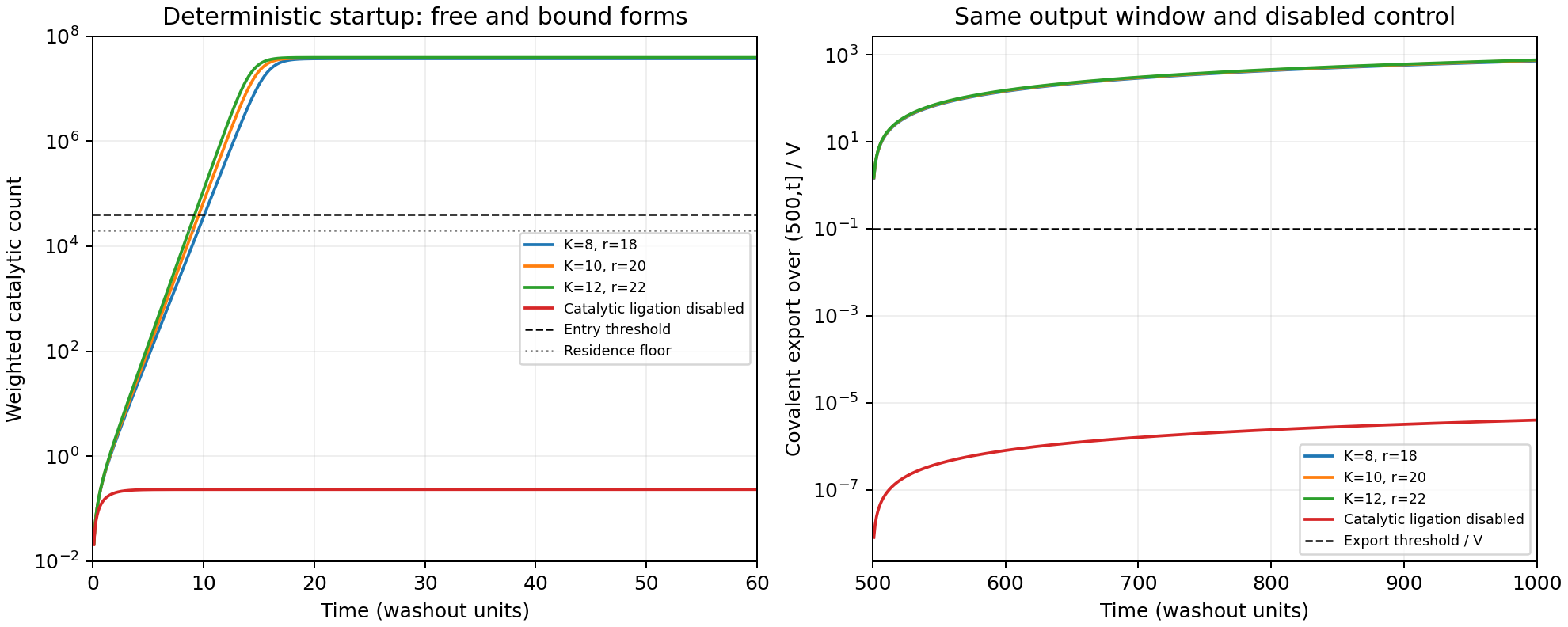
The deterministic sweep reproduces startup near time 9–10 and export of roughly 726–764 per copy scale during . Removing only the two templated-ligation channels reduces that export to about 0.000004 per copy scale. Basal reactions, binding, release, feed and washout stay active in the disabled model. These curves explain the mechanism; they do not establish a stochastic success probability.
The probability calculation uses exact rational upper bounds on the probabilities of resource, entry, residence and output failures, added to bound the chance of any failure. It reproduces an enabled lower bound above 0.9166 and a conservative disabled upper bound below 0.000098, supporting the paper's simpler guarantees of 0.9 and 1/5000. Symbolic checks derive the resource and catalytic drift identities directly from the implemented reactions.
The reusable count monitor preserves the important timing distinctions: residence starts at first entry, export starts after time 500, and reaching the export target does not end resource or residence monitoring. An optional exact stochastic simulator reports unfinished runs honestly when its computational event limit is reached. A full direct simulation at the certified scale is computationally expensive; the default package uses the analytic bounds and deterministic illustration instead.
Download the complete package for editable inputs, reaction and reactor classes, operating-policy and monitor components, seven scientific test groups, parameter-sweep instructions and saved trajectories. The probability budget applies to the manuscript's fixed copy scale, rates, thresholds and window, uniformly over and . Changing the protocol does not automatically transfer that guarantee, and this Python example does not rerun the Lean stochastic proof.
Python source
"""Six-species reversible binding reactor: establish, retain, and export.

Count propensities, phase monitoring, deterministic illustration and exact
algebraic budget checks remain separate. No stochastic theorem is inferred
from the deterministic curves or from a limited number of count trajectories.
"""
from __future__ import annotations

from dataclasses import dataclass
from fractions import Fraction as Q
from pathlib import Path
import argparse
import csv
import hashlib
import json
import math
import platform
import numpy as np
from scipy.integrate import solve_ivp

# EDITABLE REACTOR INPUTS. Nondimensional time uses unit washout; V is the
# bimolecular divisor and each food's feed rate, not a physical vessel volume.
COPY_SCALE = 100_000_000
EQUILIBRIUM_BIAS = Q(10)
DUPLEX_RELEASE = Q(20)
BASAL_RATE = Q(1,500_000_000)
PARAMETER_SWEEP = ((8,18),(10,20),(12,22))
ENTRY_THRESHOLD = 40_000
RESIDENCE_FLOOR = 20_000
ENTRY_DEADLINE = 500.0
END_TIME = 1000.0
EXPORT_THRESHOLD = 10_000_000
RESOURCE_LOWER,RESOURCE_UPPER = Q(9,10),Q(11,10)
ODE_RTOL,ODE_ATOL = 1e-10,1e-16
SSA_EVENT_LIMIT = 20_000       # computation limit; NEVER count unfinished as failure
SSA_SEED = 18092026
SPECIES = ('U','W','X','C1','C2','Z')
RESOURCE_A = (1,0,1,2,2,2)
RESOURCE_B = (0,1,1,1,2,2)
CATALYTIC_WEIGHTS = (Q(0),Q(0),Q(1),Q(9,8),Q(7,5),Q(9,5))
COVALENT_STOCK = (0,0,4,4,4,8)
MANUSCRIPT_SHA256 = '5f10655592fdba876cc0e8fbf37bbd3862c4a8506a4f365128ef6756c48950a2'


@dataclass(frozen=True)
class Reaction:
    name: str
    inputs: tuple[int,...]
    outputs: tuple[int,...]
    coefficient: Q
    export_mark: int=0
    catalytic_ligation: bool=False

    @property
    def jump(self):
        return tuple(self.outputs.count(i)-self.inputs.count(i) for i in range(6))

    def count_rate(self,counts,volume):
        rate=self.coefficient*Q(volume)**(1-len(self.inputs))
        seen={}
        for i in self.inputs:
            rate*=max(0,int(counts[i])-seen.get(i,0));seen[i]=seen.get(i,0)+1
        return rate


@dataclass(frozen=True)
class ReactorParameters:
    K: Q=EQUILIBRIUM_BIAS
    release: Q=DUPLEX_RELEASE
    epsilon: Q=BASAL_RATE

    def __post_init__(self):
        if min(self.K,self.release,self.epsilon) <= 0:
            raise ValueError('All kinetic parameters must be positive.')


class BindingReactor:
    def __init__(self,parameters=ReactorParameters(),enabled=True):
        self.parameters,self.enabled=parameters,enabled
        K,r,e=parameters.K,parameters.release,parameters.epsilon
        pairs=(('basal',(0,1),(2,),e,e/K,False),
               ('first_binding',(2,0),(3,),Q(20),Q(20),False),
               ('second_binding',(3,1),(4,),Q(20),Q(20),False),
               ('templated_ligation',(4,),(5,),Q(20),Q(20)/K,True),
               ('duplex_release',(5,),(2,2),r,r,False))
        channels=[]
        for name,left,right,forward,reverse,catalytic in pairs:
            if enabled or not catalytic:
                channels.extend((Reaction(name+'_forward',left,right,forward,0,catalytic),
                                 Reaction(name+'_reverse',right,left,reverse,0,catalytic)))
        channels += [Reaction('feed_'+SPECIES[i],(),(i,),Q(1)) for i in (0,1)]
        channels += [Reaction('washout_'+SPECIES[i],(i,),(),Q(1),COVALENT_STOCK[i]) for i in range(6)]
        self.channels=tuple(channels)
        self.jumps=np.array([c.jump for c in channels],dtype=np.int64)
        self.marks=np.array([c.export_mark for c in channels],dtype=np.int64)
        self.orders=np.array([len(c.inputs) for c in channels])
        self.coefficients=np.array([float(c.coefficient) for c in channels])
        self.inputs=np.full((len(channels),2),6,dtype=int)
        self.offsets=np.zeros((len(channels),2),dtype=int)
        for j,c in enumerate(channels):
            seen={}
            for k,i in enumerate(c.inputs):
                self.inputs[j,k]=i;self.offsets[j,k]=seen.get(i,0);seen[i]=seen.get(i,0)+1

    def rates(self,values,volume=None):
        factors=np.r_[values,1][self.inputs]
        if volume is not None:
            factors=np.maximum(0,factors-self.offsets)
        answer=self.coefficients*np.prod(factors,axis=1)
        return answer if volume is None else answer*np.power(float(volume),1-self.orders)

    def generator(self,counts,volume,weights):
        rates=[c.count_rate(counts,volume) for c in self.channels]
        deltas=[sum(w*d for w,d in zip(weights,c.jump)) for c in self.channels]
        return sum(a*d for a,d in zip(rates,deltas)),sum(a*d*d for a,d in zip(rates,deltas))

    def rhs(self,time,state):
        rates=self.rates(state[:6])
        return np.r_[[email protected],[email protected]]

    def deterministic(self,policy=None,rtol=ODE_RTOL,method='LSODA'):
        policy=policy or OperatingPolicy()
        def entry(time,state):
            return float(np.array(CATALYTIC_WEIGHTS,dtype=float)@state[:6])-policy.entry/policy.volume
        entry.direction=1
        solution=solve_ivp(self.rhs,(0,policy.end),[1,1,0,0,0,0,0],method=method,
                           rtol=rtol,atol=ODE_ATOL,dense_output=True,max_step=1,events=entry)
        if not solution.success:raise RuntimeError(solution.message)
        return solution

    def stochastic(self,policy=None,seed=SSA_SEED,limit=SSA_EVENT_LIMIT):
        policy=policy or OperatingPolicy()
        if limit < 1 or policy.volume >= 10**12:
            raise ValueError('Positive event budget and V below 10^12 required for this SSA.')
        rng=np.random.default_rng(seed)
        monitor=OperatingMonitor(policy,self.enabled)
        time,events=0.,0
        trace=[(time,*monitor.counts.tolist(),monitor.phase,monitor.counter)]
        while events < limit and monitor.status == 'active' and time < policy.end:
            rates=self.rates(monitor.counts,policy.volume)
            total=rates.sum()
            next_time=time+rng.exponential(1/total)
            boundary=policy.deadline if time < policy.deadline else policy.end
            if next_time > boundary:
                time=boundary
                monitor.advance(time)
                continue  # exponential memorylessness; no state or counter reset
            event=int(np.searchsorted(np.cumsum(rates),rng.random()*total,side='right'))
            time=next_time;events+=1
            monitor.jump(time,monitor.counts+self.jumps[event],int(self.marks[event]))
            if events % 1000 == 0:
                trace.append((time,*monitor.counts.tolist(),monitor.phase,monitor.counter))
        if time >= policy.end:monitor.advance(time)
        trace.append((time,*monitor.counts.tolist(),monitor.phase,monitor.counter))
        result=monitor.report()
        result.update(time=time,events=events,trace=trace)
        if monitor.status == 'active':
            result.update(status='unfinished',event_verdict=None)
        return result


@dataclass(frozen=True)
class OperatingPolicy:
    volume: int=COPY_SCALE
    entry: int=ENTRY_THRESHOLD
    floor: int=RESIDENCE_FLOOR
    deadline: float=ENTRY_DEADLINE
    end: float=END_TIME
    export: int=EXPORT_THRESHOLD
    lower: Q=RESOURCE_LOWER
    upper: Q=RESOURCE_UPPER

    def __post_init__(self):
        if (not isinstance(self.volume,int) or self.volume < 1 or not 0 < self.floor < self.entry
                or not 0 < self.deadline < self.end or self.export < 1 or not 0 < self.lower < 1 < self.upper):
            raise ValueError('Invalid operating thresholds or resource corridor.')


class OperatingMonitor:
    """Stateful monitor for the exact stopped law, including the deadline gate."""
    def __init__(self,policy,enabled=True):
        self.policy,self.enabled=policy,enabled
        self.counts=np.array((policy.volume,policy.volume,0,0,0,0),dtype=np.int64)
        self.phase,self.counter,self.status=0,0,'active'
        self.time,self.entry_time=0.,None

    def corridor(self,counts):
        return all(self.policy.lower*self.policy.volume <= sum(w*int(n) for w,n in zip(weights,counts))
                   <= self.policy.upper*self.policy.volume for weights in (RESOURCE_A,RESOURCE_B))

    def advance(self,time):
        if time < self.time:raise ValueError('Monitor time cannot go backwards.')
        if self.status != 'active':return
        self.time=time
        if self.enabled and time >= self.policy.deadline and self.phase == 0:
            self.status='missed_deadline'
        elif time >= self.policy.end:
            self.status='complete'

    def jump(self,time,new_counts,mark):
        if self.status != 'active':raise ValueError('Stopped law cannot jump.')
        if time < self.time or time > self.policy.end or mark < 0:
            raise ValueError('Invalid event time or export mark.')
        if time > self.policy.deadline and self.time <= self.policy.deadline:
            self.advance(self.policy.deadline)
            if self.status != 'active':return
        self.time=time
        self.counts=np.asarray(new_counts,dtype=np.int64)
        if len(self.counts) != 6 or np.min(self.counts) < 0:raise ValueError('Invalid molecule counts.')
        if time > self.policy.deadline:
            self.counter=min(self.policy.export,self.counter+mark)
        weighted40=sum(w*int(n) for w,n in zip((0,0,40,45,56,72),self.counts))
        if self.enabled:
            if self.phase == 0 and weighted40 >= 40*self.policy.entry:
                self.phase=1;self.entry_time=time
            elif self.phase == 1 and weighted40 < 40*self.policy.floor:
                self.phase=2;self.status='return_failure'
        if not self.corridor(self.counts):self.status='resource_exit'
        # Saturated export does not stop the residence/resource requirements.

    def report(self):
        verdict=None
        if self.status != 'active':
            verdict=(self.status == 'complete' and self.phase == 1 and self.counter == self.policy.export) if self.enabled else (
                self.status == 'resource_exit' or self.counter == self.policy.export)
        return {'status':self.status,'phase':self.phase,'counter':self.counter,'entry_time':self.entry_time,
                'counts':self.counts.tolist(),'enabled':self.enabled,'event_verdict':bool(verdict) if verdict is not None else None}


class ProbabilityBudget:
    """Exact rational envelopes at the fixed theorem scale and thresholds."""
    @staticmethod
    def evaluate():
        inverse_exp=lambda a,m:Q(math.factorial(m))/Q(a)**m
        # exp(1/50) <= 1/(1-1/50); a rational bound replaces floating evaluation.
        resource=4*(inverse_exp(100000,5)+3*10**14*Q(50,49)*inverse_exp(50000,5))
        entry=Q(1,12)+Q(1,600_000_000)
        residence=inverse_exp(1600,2)+3*10**14*inverse_exp(Q(799982,125),6)
        export=Q(27,16_250_000)
        disabled=Q(968,10**7)+resource
        a=Q(8047,3125)
        assert sum(a**j/Q(math.factorial(j)) for j in range(7)) > 12
        assert Q(5,2)**9 > 2000 and inverse_exp(600000,2) < Q(1,600_000_000)
        assert max(resource,residence,export) < Q(1,10000)
        assert disabled < Q(1,5000)
        return {'resource_failure':resource,'missed_entry':entry,'return_failure':residence,
                'insufficient_export':export,'enabled_success_lower':1-resource-entry-residence-export,
                'paper_coarse_success_lower':1-entry-Q(3,10000),
                'disabled_conservative_event_upper':disabled,
                'paper_coarse_disabled_upper':Q(123,625000)}

    @staticmethod
    def applies(parameters,policy):
        return (8 <= parameters.K <= 12 and 18 <= parameters.release <= 22
                and parameters.epsilon == Q(1,500_000_000) and policy == OperatingPolicy(
                    100_000_000,40000,20000,500,1000,10000000,Q(9,10),Q(11,10)))


def symbolic_bookkeeping():
    """Independent symbolic identities and rational coefficient inequalities."""
    import sympy as sp
    u,w,x,c1,c2,z,V,e,k,r=sp.symbols('u w x c1 c2 z V e k r',positive=True)
    rates=(e*u*w/V,e*k*x,20*x*u/V,20*c1,20*c1*w/V,20*c2,20*c2,20*k*z,
           r*z,r*x*(x-1)/V,V,V,u,w,x,c1,c2,z)
    model=BindingReactor()
    def gen(weights,quadratic=False,disabled=False):
        return sp.expand(sum(rate*sum(sp.Rational(weight)*jump for weight,jump in zip(weights,channel.jump))**(2 if quadratic else 1)
                             for rate,channel in zip(rates,model.channels) if not (disabled and channel.catalytic_ligation)))
    A=u+x+2*c1+2*c2+2*z;B=w+x+c1+2*c2+2*z
    assert sp.expand(gen(RESOURCE_A)-(V-A)) == 0
    assert sp.expand(gen(RESOURCE_B)-(V-B)) == 0
    for weights,stock in ((RESOURCE_A,A),(RESOURCE_B,B)):
        residual=sp.Poly(V+2*stock-gen(weights,True),u,w,x,c1,c2,z,V)
        assert all(coefficient >= 0 for coefficient in residual.coeffs())
    expected=(e*u*w/V-e*k*x+(5*u/(2*V)-1)*x+(-sp.Rational(29,8)+11*w/(2*V))*c1
              +sp.Rational(11,10)*c2+(r/5-sp.Rational(9,5)-8*k)*z-r*(x*x-x)/(5*V))
    assert sp.expand(gen(CATALYTIC_WEIGHTS)-expected) == 0
    assert sp.expand(gen(COVALENT_STOCK,disabled=True)+4*x+4*c1+4*c2+8*z-4*(e*u*w/V-e*k*x)) == 0
    # Uniform lower drift: free food >= 4V/5 and x/V <= 1/1000.
    lower=(Q(1)-Q(1,8*10**6)-Q(22,5000),Q(31,40),Q(11,10),Q(4,5))
    assert all(c >= Q(39,100)*weight for c,weight in zip(lower,CATALYTIC_WEIGHTS[2:]))
    # Exact upper QY coefficients after x(x-1)<=x^2, k<=1/8,r<=22,
    # e<=1e-6,u/V,w/V<=5/2 and x/V<=5/4. Basal source kept separate.
    qy=gen(CATALYTIC_WEIGHTS,True)+r*x/(25*V)
    qy=sp.expand(qy.subs({k:sp.Rational(1,8),r:22,e:sp.Rational(1,10**6),u:sp.Rational(5,2)*V,w:sp.Rational(5,2)*V}))
    polynomial=sp.Poly(qy,x,c1,c2,z)
    coefficients=[polynomial.coeff_monomial(x)+sp.Rational(5,4)*V*polynomial.coeff_monomial(x*x)]
    coefficients += [polynomial.coeff_monomial(s) for s in (c1,c2,z)]
    upper=(Q(481,160),Q(343,64),Q(267,40),Q(113,25))
    assert all(c <= sp.Rational(b) <= 5*sp.Rational(weight) for c,b,weight in zip(coefficients,upper,CATALYTIC_WEIGHTS[2:]))
    return {'resource_drift_identities':True,'resource_quadratic_bounds':True,'weighted_drift_identity':True,
            'weighted_drift_lower_coefficients':[str(v) for v in lower],
            'weighted_quadratic_upper_coefficients':[str(v) for v in upper],
            'disabled_covalent_balance':True,'scope':'algebraic checks; not a rerun of the Lean stochastic proof'}


def write_csv(path,headers,rows):
    with path.open('w',newline='') as stream:
        writer=csv.writer(stream);writer.writerow(headers);writer.writerows(rows)


def main():
    parser=argparse.ArgumentParser(description=__doc__)
    parser.add_argument('--output',type=Path,default=Path('outputs'))
    parser.add_argument('--ssa',action='store_true',help='Also attempt a budget-limited exact count path at the configured scale.')
    args=parser.parse_args();out=args.output;out.mkdir(parents=True,exist_ok=True)
    policy=OperatingPolicy()
    diagnostics=[];curves=[]
    times=np.unique(np.r_[np.linspace(0,60,601),np.linspace(60,policy.end,941),policy.deadline])
    settings=[(K,r,True) for K,r in PARAMETER_SWEEP]+[(EQUILIBRIUM_BIAS,DUPLEX_RELEASE,False)]
    for K,r,enabled in settings:
        model=BindingReactor(ReactorParameters(Q(K),Q(r)),enabled)
        solution=model.deterministic(policy)
        check=model.deterministic(policy,rtol=2e-12,method='Radau')
        values=solution.sol(times).T;fine=check.sol(times).T
        window=values[:,6]-solution.sol(policy.deadline)[6]
        name=f'K{K}_r{r}_{"enabled" if enabled else "disabled"}'
        write_csv(out/(name+'.csv'),['time',*SPECIES,'total_export_per_V'],zip(times,*values.T))
        diagnostics.append({'K':str(K),'r':str(r),'enabled':enabled,
            'numerical_entry_time':float(solution.t_events[0][0]) if len(solution.t_events[0]) else None,
            'window_export_per_V':float(values[-1,6]-solution.sol(policy.deadline)[6]),
            'weighted_count_at_end':float(values[-1,:6]@np.array(CATALYTIC_WEIGHTS,dtype=float)*policy.volume),
            'maximum_resource_error_per_V':float(max(np.max(np.abs(values[:,:6]@RESOURCE_A-1)),np.max(np.abs(values[:,:6]@RESOURCE_B-1)))),
            'independent_solver_max_difference':float(np.max(np.abs(values-fine))),
            'theorem_parameters_applicable':ProbabilityBudget.applies(model.parameters,policy)})
        curves.append((name,values,window))
    result={'deterministic':diagnostics,'exact_budgets':{k:str(v) for k,v in ProbabilityBudget.evaluate().items()},
            'symbolic_checks':symbolic_bookkeeping(),'count_trajectory':None}
    if args.ssa:
        path=BindingReactor().stochastic(policy)
        write_csv(out/'count_path.csv',['time',*SPECIES,'phase','counter'],path.pop('trace'))
        result['count_trajectory']=path
    (out/'results.json').write_text(json.dumps(result,indent=2)+'\n')
    lines=[f'K={d["K"]}, r={d["r"]}, enabled={d["enabled"]}: numerical entry={d["numerical_entry_time"]}; window export/V={d["window_export_per_V"]:.9g}.' for d in diagnostics]
    budget=ProbabilityBudget.evaluate()
    lines += [f'Exact rational enabled lower bound: {float(budget["enabled_success_lower"]):.9f}.',
              f'Exact rational disabled conservative-event upper bound: {float(budget["disabled_conservative_event_upper"]):.9g}.',
              'The deterministic curves illustrate the mechanism; probability bounds use the manuscript generator argument.']
    (out/'console.txt').write_text('\n'.join(lines)+'\n');print('\n'.join(lines))
    import matplotlib
    matplotlib.use('Agg')
    import matplotlib.pyplot as plt
    fig,axes=plt.subplots(1,2,figsize=(11,4.4),layout='constrained')
    for (name,values,window),diagnostic in zip(curves,diagnostics):
        label=f'K={diagnostic["K"]}, r={diagnostic["r"]}' if diagnostic['enabled'] else 'Catalytic ligation disabled'
        ys=values[:,:6]@np.array(CATALYTIC_WEIGHTS,dtype=float)*policy.volume
        axes[0].plot(times[ys>0],ys[ys>0],label=label)
        keep=(times>policy.deadline)&(window>0)
        axes[1].plot(times[keep],window[keep],label=label)
    axes[0].axhline(policy.entry,color='black',ls='--',lw=1,label='Entry threshold')
    axes[0].axhline(policy.floor,color='gray',ls=':',lw=1,label='Residence floor')
    axes[0].set(xlim=(0,60),yscale='log',ylim=(.01,1e8),xlabel='Time (washout units)',
                ylabel='Weighted catalytic count',title='Deterministic startup: free and bound forms')
    axes[1].axhline(policy.export/policy.volume,color='black',ls='--',lw=1,label='Export threshold / V')
    axes[1].set(xlim=(policy.deadline,policy.end),yscale='log',xlabel='Time (washout units)',
                ylabel='Covalent export over (500,t] / V',title='Same output window and disabled control')
    for ax in axes:ax.legend(fontsize=7);ax.grid(alpha=.2)
    fig.savefig(out/'operation.png',dpi=180);fig.savefig(out/'operation.svg');plt.close(fig)
    digest=lambda p:hashlib.sha256(p.read_bytes()).hexdigest()
    (out/'run_metadata.json').write_text(json.dumps({'manuscript_sha256':MANUSCRIPT_SHA256,
        'source_sha256':digest(Path(__file__)),'python':platform.python_version(),
        'output_sha256':{p.name:digest(p) for p in sorted(out.iterdir()) if p.is_file() and p.name != 'run_metadata.json'}},indent=2)+'\n')


if __name__ == '__main__':main()
Run output
K=8, r=18, enabled=True: numerical entry=10.089904394348057; window export/V=726.175452.
K=10, r=20, enabled=True: numerical entry=9.5792625359099; window export/V=748.421292.
K=12, r=22, enabled=True: numerical entry=9.212524546179198; window export/V=764.031711.
K=10, r=20, enabled=False: numerical entry=None; window export/V=3.99999998e-06.
Exact rational enabled lower bound: 0.916660608.
Exact rational disabled conservative-event upper bound: 9.72702041e-05.
The deterministic curves illustrate the mechanism; probability bounds use the manuscript generator argument.