Example code
Two mass-action networks can have identical net molecule changes and the same species participating as reactants, yet differ in equilibrium stability. The missing information is reactant multiplicity: how many copies occur in each reaction. This example builds both networks, evaluates their full dynamics, and checks the paper's instability certificates exactly.
The reactant matrix gives the exponents in mass-action rates; the product matrix is , and the net stoichiometric matrix is . Adding the same integer padding to both sides of a reaction keeps unchanged. When padding uses existing reactants, it also preserves every reactant incidence and every child selection: a pairing of species with distinct reactions that consume them, used in D-core stability tests.
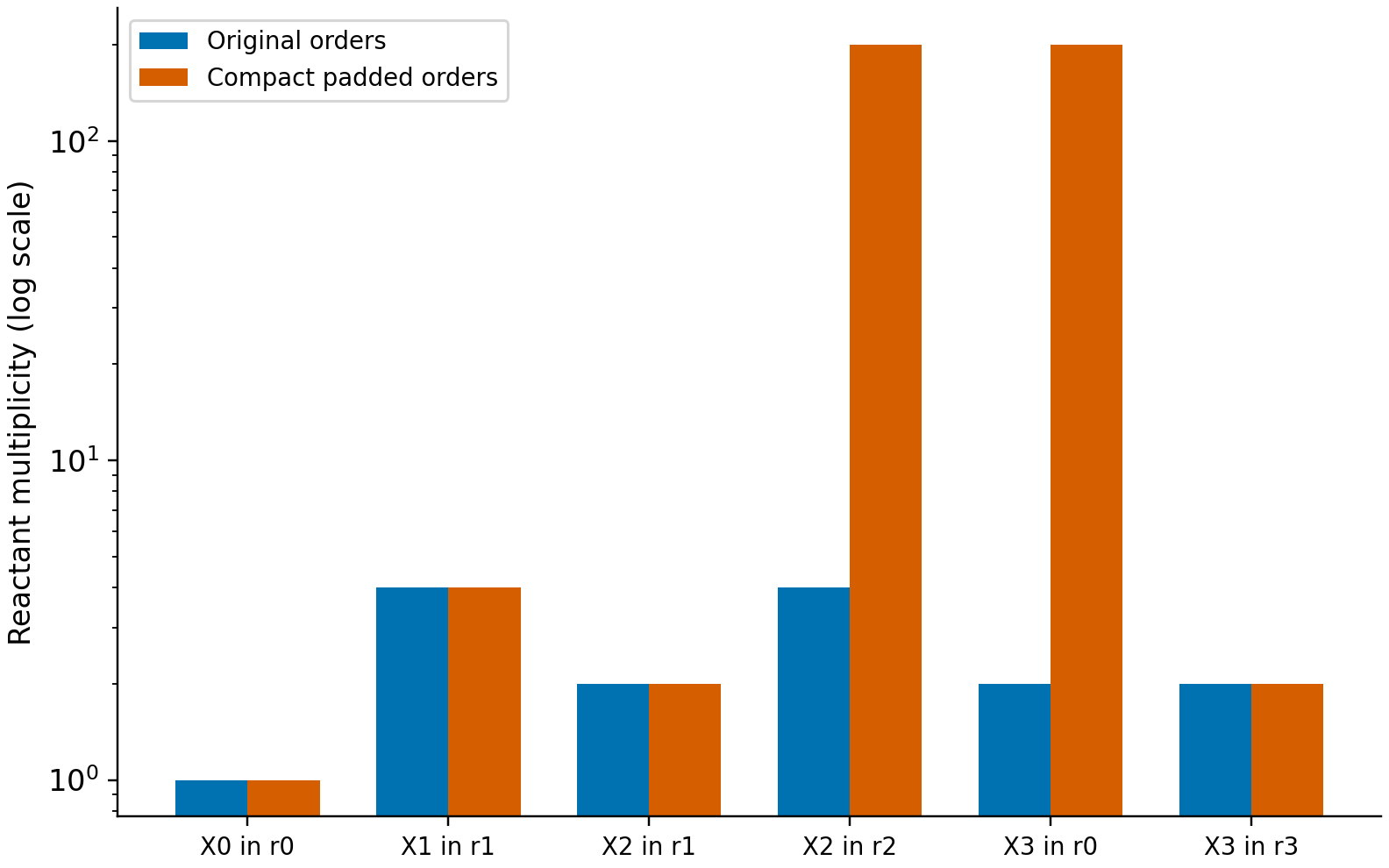
At a positive equilibrium with concentrations and stationary flux , the rate sensitivity is . The Jacobian describes the growth or decay of small concentration disturbances. The values of therefore matter even when its pattern of nonzero entries does not change. The first figure compares the original orders with the paper's compact witness, which raises two orders to 200.
The original network is stable at every positive equilibrium. The code checks its all-positive-scaling certificate by expanding a cubic Hurwitz expression into seven positive monomials. The compact padded network instead has an unstable complex pair, approximately . Its negative third Hurwitz determinant is checked using exact rational arithmetic. The larger principal witness also reproduces the exact eigenpair .
All networks retain 24 child selections. Exact dissipativity certificates and a separate singular-case factorization show that none becomes unstable when its matrix columns are multiplied by positive factors (D-instability). The singular child retains a zero eigenvalue, so its certificate permits the stability boundary. The instability belongs to the full Jacobian even though these structural tests cannot distinguish the padded and original networks.
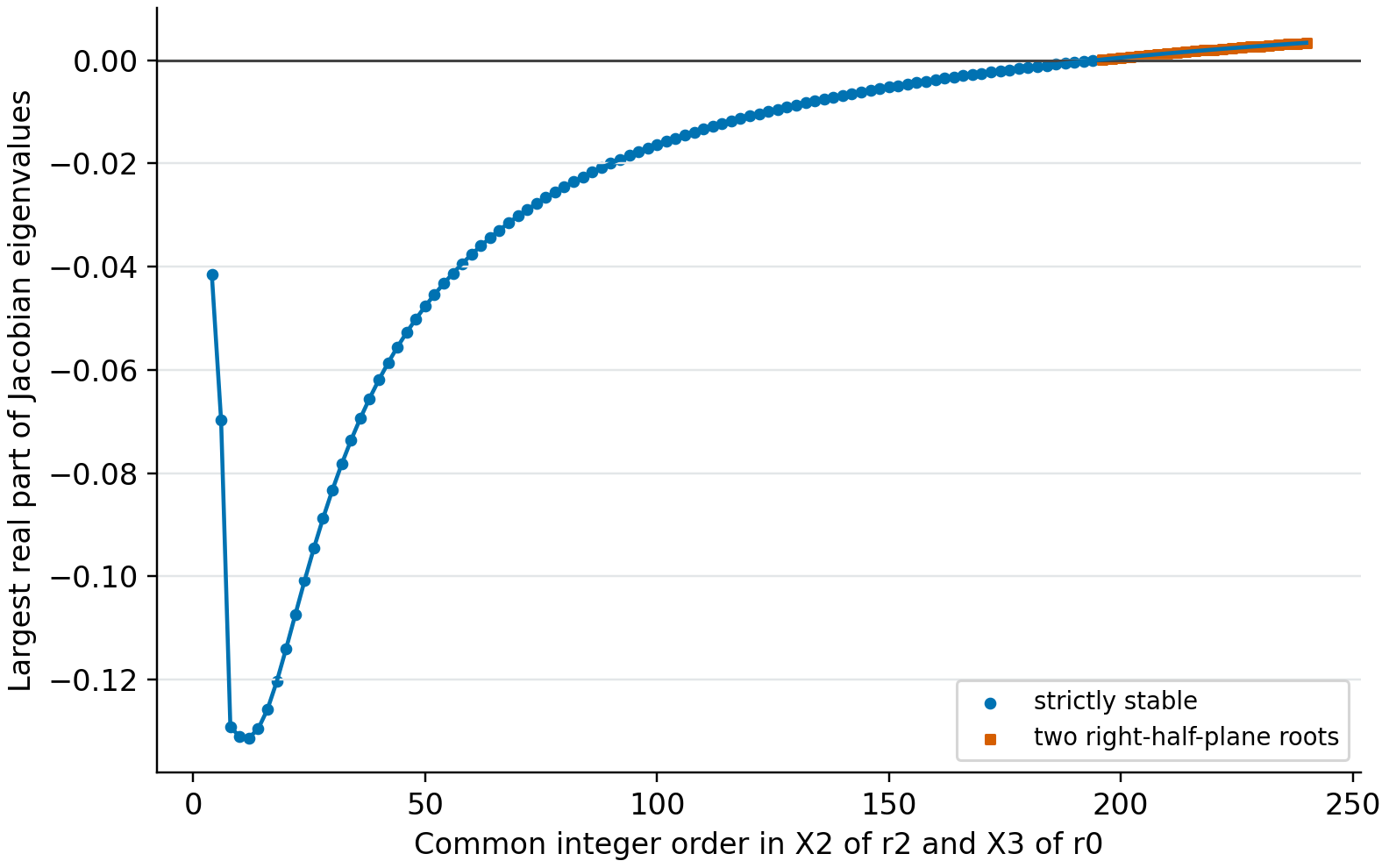
The second figure varies the two compact-family orders together at even integers, keeping the equilibrium state and flux fixed and reconstructing the rate constants at each point. The first sampled unstable value is 196. This is an exploratory result for this chosen family, not a minimum-order theorem or a Hopf-bifurcation claim. The marker classifications use exact Hurwitz signs; the vertical coordinates are numerical eigenvalues.
Download the package, install requirements.txt, run python example.py --output outputs, and check it with python -m unittest -v. The source begins with editable matrices, states, fluxes and sweep inputs. Network handles reaction complexes and padding, EquilibriumModel provides rates, Jacobians and optional nonlinear simulation, and RationalLift constructs padding for another admissible rational reactivity. Model JSON exports the full reaction and equilibrium data.
Rate constants are retained as reconstruction formulas and logarithms. Rates are evaluated relative to the equilibrium, avoiding expansion of enormous powers. These high-order reactions are mathematical witnesses, not calibrated physical mechanisms. The tests include exact certificates, independent derivative checks and a nonlinear solver comparison with an analytical reversible-pair solution. No periodic orbit, low-molecularity counterexample, or new Lean verification is claimed.
Python source
"""Classical mass action with identical stoichiometry/support, opposite stability.

Exact certificates plus reusable equilibrium-centred rate and Jacobian models.
"""
from __future__ import annotations
import argparse
import csv
from dataclasses import dataclass
from fractions import Fraction as F
from itertools import combinations,permutations,product
import hashlib
import json
from math import lcm,log
from pathlib import Path
import platform
import time
import numpy as np

# USER INPUTS ---------------------------------------------------------------
# Rows are species, columns are reactions. Abstract nondimensional model.
BASE_REACTANTS = ((1,0,0,0,0),(0,4,0,0,0),(0,2,4,0,0),(2,0,0,2,0))
BASE_PRODUCTS = ((0,0,0,1,0),(0,0,0,6,0),(4,0,0,1,2),(0,0,2,0,2))
EQUILIBRIUM_FLUX = (2,3,2,2,2)
COMPACT_EXPONENT = 200
COMPACT_STATE = ('1','235','585','1/257')
EXACT_STATE = ('2','600','33000','93316000000')
EXACT_PADDED_ORDERS = (11,7500,5187522222797,28200219703)
EXPONENT_SWEEP = tuple(range(4,241,2)) # integer exponents; each point reconstructs k
PAPER_SHA256 = '46399af83f2c5ce5870601ab84cb955d314a12a57dfb4b01bb6ca4fa8ff37f62'
# These high-order reactions are mathematical witnesses, not calibrated chemistry.
# --------------------------------------------------------------------------


def rational_matrix(values): return np.array([[F(v) for v in row] for row in values],dtype=object)
def strings(a): return np.vectorize(str)(a).tolist()


def determinant(a):
    a=np.asarray(a,dtype=object);n=len(a)
    if a.shape!=(n,n): raise ValueError('Determinant needs a square matrix.')
    result=F(0)
    for order in permutations(range(n)):
        term=F((-1)**sum(order[i]>order[j] for i in range(n) for j in range(i+1,n)))
        for i,j in enumerate(order): term*=a[i,j]
        result+=term
    return result


def characteristic(a):
    """Descending coefficients of det(zI-A), by exact principal minors."""
    a=np.asarray(a,dtype=object);n=len(a)
    return [F(1)]+[(-1)**k*sum((determinant(a[np.ix_(s,s)]) for s in combinations(range(n),k)),F(0)) for k in range(1,n+1)]


def quartic_certificate(a):
    coefficients=characteristic(a)
    if len(coefficients)!=5: raise ValueError('Quartic certificate needs four species.')
    _,a1,a2,a3,a4=coefficients;d2=a1*a2-a3;d3=d2*a3-a1*a1*a4
    # Strict signs suffice here; boundary or other sign patterns remain unclassified.
    stable=all(v>0 for v in (a1,a2,a3,a4,d2,d3))
    pair=all(v>0 for v in (a1,a2,a3,a4,d2)) and d3<0
    return dict(coefficients=list(map(str,coefficients)),delta2=str(d2),delta3=str(d3),
                classification='strictly stable' if stable else 'two right-half-plane roots' if pair else 'unclassified boundary/sign pattern')


@dataclass(frozen=True)
class Network:
    reactants: np.ndarray
    products: np.ndarray

    def __post_init__(self):
        y=rational_matrix(self.reactants);p=rational_matrix(self.products)
        if y.shape!=p.shape or y.ndim!=2 or min(y.shape)<1: raise ValueError('Nonempty equally shaped complex matrices required.')
        if any(v<0 or v.denominator!=1 for v in (*y.flat,*p.flat)): raise ValueError('Complexes require nonnegative integers.')
        y.setflags(write=False);p.setflags(write=False)
        object.__setattr__(self,'reactants',y);object.__setattr__(self,'products',p)

    @property
    def stoichiometry(self): return self.products-self.reactants

    def pad_to(self,orders):
        orders=rational_matrix(orders)
        if orders.shape!=self.reactants.shape: raise ValueError('Padding shape mismatch.')
        pad=orders-self.reactants
        if any(v<0 for v in pad.flat) or np.any((orders>0)!=(self.reactants>0)):
            raise ValueError('Padding must increase existing incidences without adding new ones.')
        return Network(orders,self.products+pad)

    def same_skeleton(self,other):
        return np.array_equal(self.stoichiometry,other.stoichiometry) and np.array_equal(self.reactants>0,other.reactants>0)

    def children(self):
        n,m=self.reactants.shape;children=[]
        for size in range(1,n+1):
            for species in combinations(range(n),size):
                choices=[tuple(j for j in range(m) if self.reactants[i,j]>0) for i in species]
                for reactions in product(*choices):
                    if len(set(reactions))==size:
                        children.append((species,reactions,self.stoichiometry[np.ix_(species,reactions)]))
        return children


class EquilibriumModel:
    """Mass action represented by a network, positive stationary flux, and state.

    r(x) = v * exp(Y.T @ log(x/xbar)); avoids expanding enormous k monomials.
    """
    def __init__(self,network:Network,state,flux):
        self.network=network;self.state=np.array([F(x) for x in state],dtype=object);self.flux=np.array([F(v) for v in flux],dtype=object)
        n,m=network.reactants.shape
        if self.state.shape!=(n,) or self.flux.shape!=(m,) or any(x<=0 for x in (*self.state,*self.flux)):
            raise ValueError('Positive state and flux of the correct sizes required.')
        if any(v!=0 for v in [email protected]): raise ValueError('Flux must lie exactly in the stoichiometric kernel.')
        self.y=np.array(network.reactants,dtype=float);self.s=np.array(network.stoichiometry,dtype=float)
        self.x=np.array(self.state,dtype=float);self.v=np.array(self.flux,dtype=float)

    def reactivity(self): return self.flux[:,None]*self.network.reactants.T/self.state[None,:]
    def jacobian(self): return [email protected]()

    def log_rate_constants(self):
        # Logarithms of exact rational factors; no attempt to expand powers.
        return np.array([log(v.numerator)-log(v.denominator) for v in self.flux])[email protected]([log(x.numerator)-log(x.denominator) for x in self.state])

    def rates(self,state):
        state=np.asarray(state)
        if state.shape!=self.x.shape or np.any(np.real(state)<=0): raise ValueError('Rate evaluation requires positive concentrations.')
        with np.errstate(over='raise',invalid='raise'):
            return self.v*np.exp([email protected](state/self.x))

    def rhs(self,t,state): return [email protected](state)

    def numerical_jacobian(self,state):
        state=np.asarray(state)
        return self.s@(self.rates(state)[:,None]*self.y.T/state[None,:])

    def simulate(self,initial,times,rtol=1e-8,atol=1e-10):
        """Optional nonlinear positive-state simulation in log coordinates.

        Highly stiff witnesses need care; this is not a periodic-orbit detector.
        """
        from scipy.integrate import solve_ivp
        initial=np.asarray(initial,dtype=float);times=np.asarray(times,dtype=float)
        if initial.shape!=self.x.shape or np.any(initial<=0) or len(times)<2 or np.any(np.diff(times)<=0):
            raise ValueError('Positive initial state and increasing output times required.')
        def rhs(t,q):
            with np.errstate(over='raise',invalid='raise'):
                state=self.x*np.exp(q);return self.s@(self.v*np.exp(self.y.T@q))/state
        def jac(t,q):
            state=self.x*np.exp(q);drift=rhs(t,q)
            return (self.numerical_jacobian(state)*state[None,:])/state[:,None]-np.diag(drift)
        result=solve_ivp(rhs,(times[0],times[-1]),np.log(initial/self.x),t_eval=times,method='Radau',jac=jac,rtol=rtol,atol=atol)
        if not result.success: raise RuntimeError(result.message)
        return self.x[:,None]*np.exp(result.y)


class RationalLift:
    """Construct the theorem's uniform-state integer-exponent padding exactly."""
    @staticmethod
    def build(network,flux,target):
        flux=np.array([F(v) for v in flux],dtype=object);target=rational_matrix(target)
        n,m=network.reactants.shape
        if flux.shape!=(m,) or any(v<=0 for v in flux) or target.shape!=(m,n): raise ValueError('Invalid flux or reactivity shape.')
        if any(v<0 for v in target.flat) or np.any((target>0)!=(network.reactants.T>0)):
            raise ValueError('Target must be positive exactly on the existing reactant incidences.')
        q=target.T/flux[None,:];denominator=lcm(*(v.denominator for v in q.flat))
        scale=1+sum(network.reactants.flat);state=int(scale*denominator)
        model=EquilibriumModel(network.pad_to(q*state),[state]*n,flux)
        if not np.array_equal(model.reactivity(),target): raise ArithmeticError('Lift failed to reconstruct target reactivity.')
        return model


def poly_product(a,b):
    result={}
    for u,x in a.items():
        for v,y in b.items():
            w=tuple(i+j for i,j in zip(u,v));result[w]=result.get(w,F(0))+x*y
    return {w:x for w,x in result.items() if x}


def scaled_coefficients(a):
    """Coefficient polynomials of det(zI-A diag(d)), as sparse exact monomials."""
    n=len(a);result=[]
    for k in range(1,n+1):
        terms={}
        for s in combinations(range(n),k):
            value=(-1)**k*determinant(a[np.ix_(s,s)])
            if value: terms[tuple(int(i in s) for i in range(n))]=value
        result.append(terms)
    return result


def base_stability_certificate(base,flux):
    [email protected]([F(v) for v in flux])@base.reactants.T
    if any(b[0,j]!=0 for j in range(1,4)) or b[0,0]>=0: raise ValueError('Base block certificate does not apply.')
    a1,a2,a3=scaled_coefficients(b[1:,1:]);delta=poly_product(a1,a2)
    for powers,value in a3.items(): delta[powers]=delta.get(powers,F(0))-value
    delta={p:c for p,c in delta.items() if c}
    if not all(terms and all(c>0 for c in terms.values()) for terms in (a1,a2,a3,delta)):
        raise ArithmeticError('Strict all-positive-scaling certificate failed.')
    return dict(template=strings(b),isolated_eigenvalue_coefficient=str(b[0,0]),
        cubic_coefficients=[{','.join(map(str,p)):str(c) for p,c in terms.items()} for terms in (a1,a2,a3)],
        cubic_hurwitz_gap={','.join(map(str,p)):str(c) for p,c in delta.items()})


def child_certificates(network):
    children=network.children();lookup={(s,r):a for s,r,a in children}
    specifications=[((0,1,2,3),(0,1,2,3),(100,35,40,140)),
                    ((0,2,3),(0,1,3),(10,2,7)),((2,3),(1,0),(1,2)),
                    ((1,3),(1,0),(1,2)),((2,3),(2,0),(1,2))]
    certificates=[];covered=set()
    for species,reactions,weight in specifications:
        a=lookup[(species,reactions)];p=np.diag(weight);m=-(p@a+a.T@p)
        minors=[determinant(m[np.ix_(s,s)]) for k in range(1,len(m)+1) for s in combinations(range(len(m)),k)]
        if any(v<0 for v in minors): raise ArithmeticError('Weighted symmetrization is not positive semidefinite.')
        certificates.append(dict(species=species,reactions=reactions,weights=weight,symmetrization=strings(m),principal_minors=list(map(str,minors))))
        mapping=dict(zip(species,reactions))
        covered.update((s,r) for s,r,a in children if all(mapping.get(i)==j for i,j in zip(s,r)))
    # Remaining maximal child: exact scaled characteristic z(z+4d0)(z+4d1+2d2).
    singular=((1,2,3),(1,2,0));a=lookup[singular];actual=scaled_coefficients(a)
    expected=[{(1,0,0):F(4),(0,1,0):F(4),(0,0,1):F(2)},
              {(1,1,0):F(16),(1,0,1):F(8)},{}]
    if actual!=expected: raise ArithmeticError('Singular child factorization failed.')
    covered.add(singular)
    if covered!=set(lookup): raise ArithmeticError('Certificate coverage misses a child selection.')
    return dict(child_count=len(children),covered_count=len(covered),dissipativity=certificates,
        singular_child=dict(species=singular[0],reactions=singular[1],factorization='z (z+4d0) (z+4d1+2d2)'),
        conclusion='Every child is D-nonunstable; the singular child has a permanent zero eigenvalue.')


def exact_eigenpair(jacobian):
    real=np.array([-152886431705,23331004034,7890610882,1399740000],dtype=object)
    imag=np.array([15563289455,-30699360512,34396287629,0],dtype=object)
    a,b=F(1,500),F(51,500)
    residual_real=jacobian@real-a*real+b*imag;residual_imag=jacobian@imag-b*real-a*imag
    if any(v!=0 for v in (*residual_real,*residual_imag)): raise ArithmeticError('Exact unstable eigenpair failed.')
    return dict(real_part=str(a),imaginary_part=str(b),real_vector=list(map(str,real)),imaginary_vector=list(map(str,imag)),residual='exactly zero')


def compact_network(base,exponent):
    if not isinstance(exponent,int) or exponent<4: raise ValueError('Compact family exponent must be an integer at least four.')
    orders=base.reactants.copy();orders[2,2]=exponent;orders[3,0]=exponent
    return base.pad_to(orders)


def write_csv(path,rows):
    with path.open('w',newline='',encoding='utf-8') as f:
        writer=csv.DictWriter(f,fieldnames=list(rows[0]));writer.writeheader();writer.writerows(rows)


def plot(base,compact,sweep,output):
    import matplotlib
    matplotlib.use('Agg')
    import matplotlib.pyplot as plt
    with plt.rc_context({'font.size':11,'figure.facecolor':'white','savefig.facecolor':'white','svg.fonttype':'none'}):
        incidences=list(zip(*np.nonzero(base.reactants>0)));x=np.arange(len(incidences))
        fig,ax=plt.subplots(figsize=(7.2,4.5),layout='constrained')
        ax.bar(x-.18,[float(base.reactants[i,j]) for i,j in incidences],width=.36,color='#0072B2',label='Original orders')
        ax.bar(x+.18,[float(compact.reactants[i,j]) for i,j in incidences],width=.36,color='#D55E00',label='Compact padded orders')
        ax.set_xticks(x,[f'X{i} in r{j}' for i,j in incidences]);ax.tick_params(axis='x',labelsize=9)
        ax.set(yscale='log',ylabel='Reactant multiplicity (log scale)');ax.legend(fontsize=9)
        ax.spines[['top','right']].set_visible(False)
        fig.savefig(output/'orders.png',dpi=220);fig.savefig(output/'orders.svg');plt.close(fig)
        fig,ax=plt.subplots(figsize=(7.2,4.5),layout='constrained')
        ax.axhline(0,color='#444444',linewidth=1)
        ax.plot([r['exponent'] for r in sweep],[r['max_real_eigenvalue'] for r in sweep],color='#0072B2',linewidth=1.5)
        for classification,color,marker in [('strictly stable','#0072B2','o'),('two right-half-plane roots','#D55E00','s')]:
            rows=[r for r in sweep if r['classification']==classification]
            ax.scatter([r['exponent'] for r in rows],[r['max_real_eigenvalue'] for r in rows],s=12,c=color,marker=marker,label=classification)
        ax.set(xlabel='Common integer order in X2 of r2 and X3 of r0',ylabel='Largest real part of Jacobian eigenvalues')
        ax.legend(fontsize=9);ax.spines[['top','right']].set_visible(False);ax.grid(axis='y',color='#e3e6e8')
        fig.savefig(output/'stability.png',dpi=220);fig.savefig(output/'stability.svg');plt.close(fig)


def main():
    parser=argparse.ArgumentParser(description=__doc__);parser.add_argument('--output',type=Path,default=Path('outputs'))
    args=parser.parse_args();args.output.mkdir(parents=True,exist_ok=True);start=time.perf_counter()
    inputs=dict(base_reactants=BASE_REACTANTS,base_products=BASE_PRODUCTS,flux=EQUILIBRIUM_FLUX,compact_exponent=COMPACT_EXPONENT,
        compact_state=COMPACT_STATE,exact_state=EXACT_STATE,exact_padded_orders=EXACT_PADDED_ORDERS,exponent_sweep=EXPONENT_SWEEP)
    intro='Resolved inputs: '+json.dumps(inputs);print(intro,flush=True)
    base=Network(BASE_REACTANTS,BASE_PRODUCTS);orders=base.reactants.copy()
    for (i,j),value in zip(((2,1),(2,2),(3,0),(3,3)),EXACT_PADDED_ORDERS): orders[i,j]=value
    exact=EquilibriumModel(base.pad_to(orders),EXACT_STATE,EQUILIBRIUM_FLUX)
    compact=EquilibriumModel(compact_network(base,COMPACT_EXPONENT),COMPACT_STATE,EQUILIBRIUM_FLUX)
    stable=EquilibriumModel(base,COMPACT_STATE,EQUILIBRIUM_FLUX)
    lift=RationalLift.build(base,EQUILIBRIUM_FLUX,exact.reactivity())
    eigenpair=exact_eigenpair(exact.jacobian());children=child_certificates(base)
    if any(not base.same_skeleton(m.network) for m in (exact,compact,lift)): raise ArithmeticError('Changed skeleton.')
    base_certificate=base_stability_certificate(base,EQUILIBRIUM_FLUX)
    models={'base':stable,'compact':compact,'exact':exact,'uniform_lift':lift};records={};spectra=[]
    for name,model in models.items():
        eigenvalues=np.linalg.eigvals(np.array(model.jacobian(),dtype=float))
        spectra.extend(dict(model=name,real=float(v.real),imaginary=float(v.imag)) for v in eigenvalues)
        records[name]=dict(reactants=strings(model.network.reactants),products=strings(model.network.products),
            state=list(map(str,model.state)),flux=list(map(str,model.flux)),reactivity=strings(model.reactivity()),
            jacobian=strings(model.jacobian()),log_rate_constants=model.log_rate_constants().tolist(),
            rate_constant_definition='k[j] = flux[j] / product(state[i] ** reactants[i,j])',certificate=quartic_certificate(model.jacobian()))
    sweep=[]
    for exponent in EXPONENT_SWEEP:
        model=EquilibriumModel(compact_network(base,exponent),COMPACT_STATE,EQUILIBRIUM_FLUX);jac=model.jacobian()
        certificate=quartic_certificate(jac)
        sweep.append(dict(exponent=exponent,max_real_eigenvalue=float(max(np.linalg.eigvals(np.array(jac,dtype=float)).real)),
            delta2=certificate['delta2'],delta3=certificate['delta3'],classification=certificate['classification']))
    write_csv(args.output/'sweep.csv',sweep);write_csv(args.output/'spectra.csv',spectra)
    write_csv(args.output/'children.csv',[dict(species=' '.join(map(str,s)),reactions=' '.join(map(str,r)),matrix=json.dumps(strings(a))) for s,r,a in base.children()])
    (args.output/'models.json').write_text(json.dumps(records,indent=2)+'\n',encoding='utf-8')
    certificates=dict(base_stability=base_certificate,children=children,eigenpair=eigenpair)
    (args.output/'certificates.json').write_text(json.dumps(certificates,indent=2)+'\n',encoding='utf-8')
    plot(base,compact.network,sweep,args.output)
    summary=dict(inputs=inputs,same_skeleton=True,child_count=children['child_count'],exact_eigenpair=eigenpair,
        compact_certificate=records['compact']['certificate'],base_certificate=records['base']['certificate'],
        uniform_lift_state=str(lift.state[0]),uniform_lift_max_exponent=str(max(lift.network.reactants.flat)),
        first_sampled_unstable_exponent=next((r['exponent'] for r in sweep if r['classification']=='two right-half-plane roots'),None),
        evidence='Rational certificates for flux, lifting, eigenpair, child coverage and Hurwitz signs. Spectral coordinates are floating-point visualizations. No Hopf or periodic-orbit claim; no Lean compilation.')
    transcript=json.dumps(summary,indent=2)
    (args.output/'summary.json').write_text(transcript+'\n',encoding='utf-8')
    (args.output/'console.txt').write_text(intro+'\n'+transcript+'\n',encoding='utf-8')
    import scipy,matplotlib
    metadata=dict(paper_sha256=PAPER_SHA256,source_sha256=hashlib.sha256(Path(__file__).read_bytes()).hexdigest(),
        python=platform.python_version(),numpy=np.__version__,scipy=scipy.__version__,matplotlib=matplotlib.__version__,platform=platform.platform(),
        elapsed_seconds=time.perf_counter()-start,command='python example.py --output outputs',seed_policy='No random sampling.',
        output_sha256={p.name:hashlib.sha256(p.read_bytes()).hexdigest() for p in sorted(args.output.iterdir()) if p.is_file() and p.name!='run_metadata.json'})
    (args.output/'run_metadata.json').write_text(json.dumps(metadata,indent=2)+'\n',encoding='utf-8');print(transcript)


if __name__=='__main__': main()
Run output
Resolved inputs: {"base_reactants": [[1, 0, 0, 0, 0], [0, 4, 0, 0, 0], [0, 2, 4, 0, 0], [2, 0, 0, 2, 0]], "base_products": [[0, 0, 0, 1, 0], [0, 0, 0, 6, 0], [4, 0, 0, 1, 2], [0, 0, 2, 0, 2]], "flux": [2, 3, 2, 2, 2], "compact_exponent": 200, "compact_state": ["1", "235", "585", "1/257"], "exact_state": ["2", "600", "33000", "93316000000"], "exact_padded_orders": [11, 7500, 5187522222797, 28200219703], "exponent_sweep": [4, 6, 8, 10, 12, 14, 16, 18, 20, 22, 24, 26, 28, 30, 32, 34, 36, 38, 40, 42, 44, 46, 48, 50, 52, 54, 56, 58, 60, 62, 64, 66, 68, 70, 72, 74, 76, 78, 80, 82, 84, 86, 88, 90, 92, 94, 96, 98, 100, 102, 104, 106, 108, 110, 112, 114, 116, 118, 120, 122, 124, 126, 128, 130, 132, 134, 136, 138, 140, 142, 144, 146, 148, 150, 152, 154, 156, 158, 160, 162, 164, 166, 168, 170, 172, 174, 176, 178, 180, 182, 184, 186, 188, 190, 192, 194, 196, 198, 200, 202, 204, 206, 208, 210, 212, 214, 216, 218, 220, 222, 224, 226, 228, 230, 232, 234, 236, 238, 240]}
{
  "inputs": {
    "base_reactants": [
      [
        1,
        0,
        0,
        0,
        0
      ],
      [
        0,
        4,
        0,
        0,
        0
      ],
      [
        0,
        2,
        4,
        0,
        0
      ],
      [
        2,
        0,
        0,
        2,
        0
      ]
    ],
    "base_products": [
      [
        0,
        0,
        0,
        1,
        0
      ],
      [
        0,
        0,
        0,
        6,
        0
      ],
      [
        4,
        0,
        0,
        1,
        2
      ],
      [
        0,
        0,
        2,
        0,
        2
      ]
    ],
    "flux": [
      2,
      3,
      2,
      2,
      2
    ],
    "compact_exponent": 200,
    "compact_state": [
      "1",
      "235",
      "585",
      "1/257"
    ],
    "exact_state": [
      "2",
      "600",
      "33000",
      "93316000000"
    ],
    "exact_padded_orders": [
      11,
      7500,
      5187522222797,
      28200219703
    ],
    "exponent_sweep": [
      4,
      6,
      8,
      10,
      12,
      14,
      16,
      18,
      20,
      22,
      24,
      26,
      28,
      30,
      32,
      34,
      36,
      38,
      40,
      42,
      44,
      46,
      48,
      50,
      52,
      54,
      56,
      58,
      60,
      62,
      64,
      66,
      68,
      70,
      72,
      74,
      76,
      78,
      80,
      82,
      84,
      86,
      88,
      90,
      92,
      94,
      96,
      98,
      100,
      102,
      104,
      106,
      108,
      110,
      112,
      114,
      116,
      118,
      120,
      122,
      124,
      126,
      128,
      130,
      132,
      134,
      136,
      138,
      140,
      142,
      144,
      146,
      148,
      150,
      152,
      154,
      156,
      158,
      160,
      162,
      164,
      166,
      168,
      170,
      172,
      174,
      176,
      178,
      180,
      182,
      184,
      186,
      188,
      190,
      192,
      194,
      196,
      198,
      200,
      202,
      204,
      206,
      208,
      210,
      212,
      214,
      216,
      218,
      220,
      222,
      224,
      226,
      228,
      230,
      232,
      234,
      236,
      238,
      240
    ]
  },
  "same_skeleton": true,
  "child_count": 24,
  "exact_eigenpair": {
    "real_part": "1/500",
    "imaginary_part": "51/500",
    "real_vector": [
      "-152886431705",
      "23331004034",
      "7890610882",
      "1399740000"
    ],
    "imaginary_vector": [
      "15563289455",
      "-30699360512",
      "34396287629",
      "0"
    ],
    "residual": "exactly zero"
  },
  "compact_certificate": {
    "coefficients": [
      "1",
      "87840586/423",
      "325113896/5499",
      "22009472/1833",
      "2105344/611"
    ],
    "delta2": "2196782093181776/178929",
    "delta3": "-384290295376441702400/327976857",
    "classification": "two right-half-plane roots"
  },
  "base_certificate": {
    "coefficients": [
      "1",
      "113122114/27495",
      "1269329416/137475",
      "31339264/15275",
      "1052672/15275"
    ],
    "delta2": "143581471842732304/3779875125",
    "delta3": "1477461490764834283999232/19245864178125",
    "classification": "strictly stable"
  },
  "uniform_lift_state": "49270848000000",
  "uniform_lift_max_exponent": "2739011733636816",
  "first_sampled_unstable_exponent": 196,
  "evidence": "Rational certificates for flux, lifting, eigenpair, child coverage and Hurwitz signs. Spectral coordinates are floating-point visualizations. No Hopf or periodic-orbit claim; no Lean compilation."
}