Example code
An interacting network of four species produces resource . Consumers use that resource to copy themselves, while each consumer also limits its own growth through a loss proportional to the square of its concentration. The paper proves lasting coexistence from every strictly positive initial state in its specified regime, even when copying consumes a separately supplied precursor .
The example implements both the maintained-precursor reactor and the full dynamic-reservoir reactor. Editable inputs control directed reaction rates, initial concentrations, supply and desired consumer proportions. The saved trajectories start with one rare consumer and a depleted reservoir.
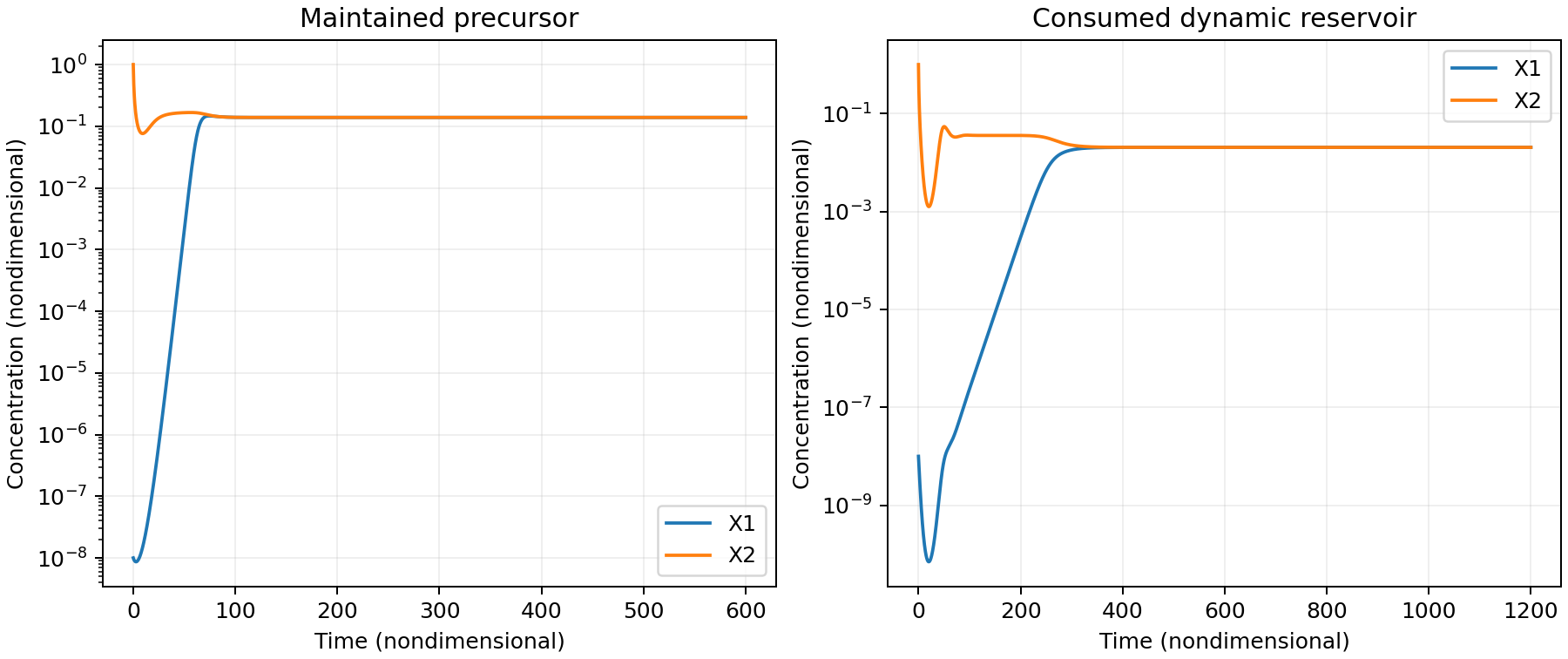
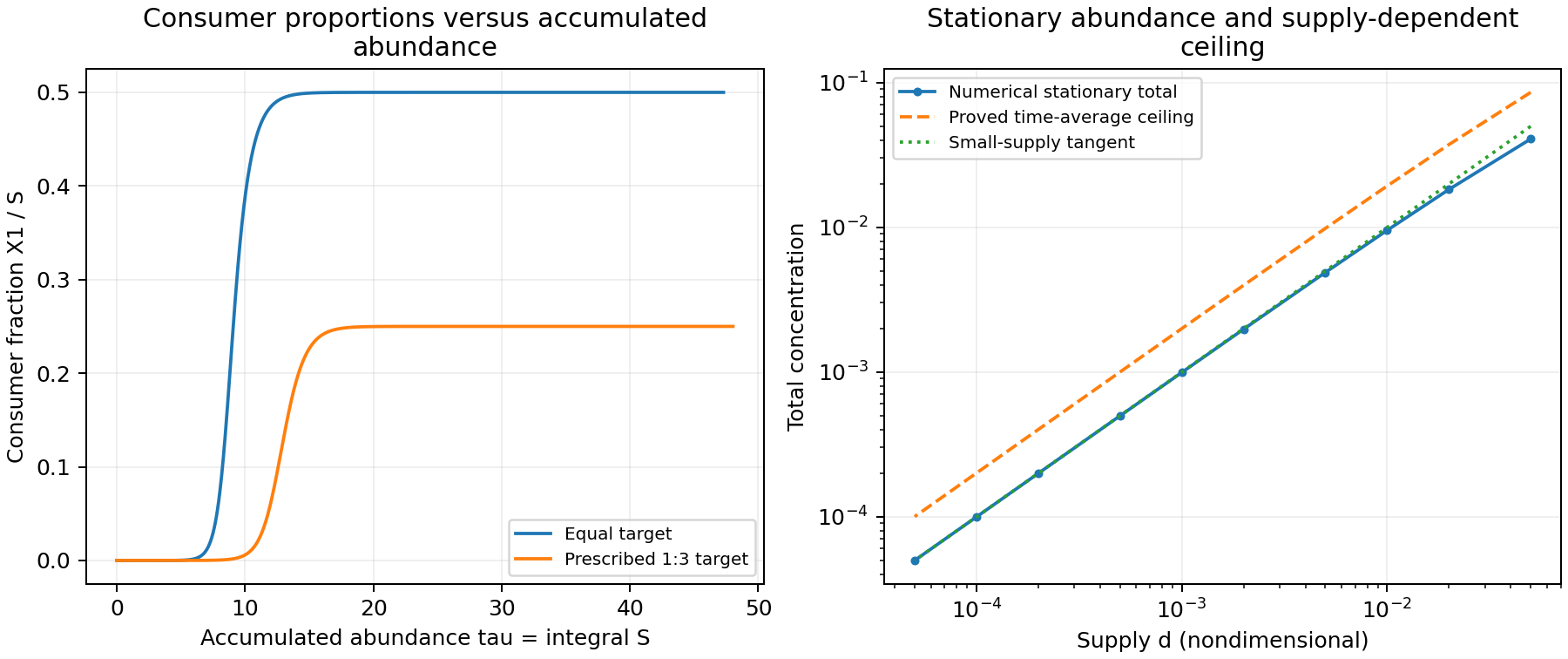
Self-limitation also provides a composition control. If consumer has quadratic-loss coefficient , its eventual fraction is proportional to . Choosing prescribes positive target shares . Keeping fixed preserves the reduced equation for total abundance on the target composition. Transients can differ because an uneven composition adds extra loss proportional to the square of its concentration.
With supply , the numerical reservoir equilibrium has total consumer concentration 0.0406741. Equal self-limitation gives equal shares; coefficients give a 1:3 ratio at the same total operating state. Composition change depends on accumulated total abundance , where is total consumer concentration; scarcity therefore slows recovery of the target proportions.
The precursor balance makes the cost visible: approximately 43.98% of its inflow enters copying, while the remainder leaves as unused precursor washout. The proved asymptotic time-average abundance ceiling is 0.0854102 at this supply. It is a necessary operating bound, not an instantaneous cap or sufficient design rule. At zero supply, finite initial inventory is exhausted and consumers tend to zero.
The package retains the paper's extremely small global permanence bounds as exact prefactors times exponentials, avoiding numerical underflow. Separately, it recomputes the exact rational local certificate for a specified ellipsoid around one operating point. Inside that ellipsoid, all 21 directed rates can vary independently by at most and each consumer remains above 0.0203270509477. This local result does not establish global equilibrium convergence or certify a trajectory's entry time.
Seven scientific test groups check the literal reaction equations, composition identities, resource balances, exact certificates and numerical controls. Reusable reaction, consumer, reservoir and analysis classes support new parameter studies. The README explains their interfaces and theorem conditions. Concentrations and times are nondimensional source conventions; optional unit scales are illustrative, and the effective network is not a fully atom-balanced apparatus.
Python source
"""Self-limited consumers coupled to the paper's loaded resident network.

Run: python example.py --output outputs
Concentrations/time are nondimensional; numerical trajectories are not proofs.
"""
from __future__ import annotations

# EDITABLE STUDY INPUTS: paper illustrations, not measured kinetic parameters.
RESIDENT_E = 1e-5
SUPPLY = 0.05
INITIAL_RESIDENT = (3., 10., 0.05, 3.)  # A, B, z, H
INITIAL_RESERVOIR = 0.001
INITIAL_CONSUMERS = (1e-8, 1.)
TARGET_SHARES = (0.25, 0.75)
TARGET_KAPPA = 1.
HORIZON_A = 600.
HORIZON_B = 1200.
SUPPLY_SWEEP = tuple(float(x) for x in (0.05, 0.02, 0.01, 0.005, 0.002, 0.001, 0.0005, 0.0002, 0.0001, 0.00005))
CONCENTRATION_SCALE_MICROMOLAR = 1.  # illustrative dimensionalization only
TIME_SCALE_HOURS = 1.

import argparse
import csv
from dataclasses import dataclass, replace
from fractions import Fraction as F
import hashlib
import json
from pathlib import Path
import platform
import numpy as np
from scipy.integrate import solve_ivp
from scipy.optimize import least_squares

MANUSCRIPT_SHA256 = '8f00f7290e3e9a3f9a9d437d54ae386a3755ec295b37a4ef171d3ea3d449a835'


@dataclass(frozen=True)
class Reaction:
    """Directed monomial mass action: 2X uses x*x, no factorial divisor."""
    name: str
    inputs: tuple[int, ...]
    outputs: tuple[int, ...]
    rate: object

    def flux(self, x):
        value = self.rate
        for i, power in enumerate(self.inputs):
            if power: value = value * x[i]**power
        return value

    def derivative(self, x, j):
        if not self.inputs[j]: return 0
        value = self.rate * self.inputs[j]
        for i, power in enumerate(self.inputs):
            exponent = power - (i == j)
            if exponent > 0: value = value * x[i]**exponent
        return value


@dataclass(frozen=True)
class Resident:
    # Each directed rate can vary independently, including both reverse pairs.
    rates: tuple = (6, 27, 1, 1, 1, 1, F(1,100000), F(1,100000), 16, 2, 1, 1, F(1,10000))

    @classmethod
    def reference(cls, e=RESIDENT_E):
        rates=list(cls().rates); rates[6:8]=[e,e]; return cls(tuple(rates))


@dataclass(frozen=True)
class Consumers:
    copying: tuple
    loss: tuple
    limitation: tuple

    def __post_init__(self):
        n=len(self.copying)
        if n<2 or len(self.loss)!=n or len(self.limitation)!=n: raise ValueError('Need matching vectors for at least two consumers.')
        if any(float(v)<0 or not np.isfinite(float(v)) for vs in (self.copying,self.loss,self.limitation) for v in vs): raise ValueError('Rates must be finite and nonnegative.')

    @classmethod
    def equal(cls, n): return cls((1,)*n,(F(1,2),)*n,(n,)*n)

    @classmethod
    def target(cls, shares, kappa=1):
        q=tuple(F(str(v)) for v in shares); k=F(str(kappa))
        if k<=0 or any(v<=0 for v in q) or sum(q)!=1: raise ValueError('Positive shares must sum exactly to one, with positive kappa.')
        n=len(q); return cls((1,)*n,(F(1,2),)*n,tuple(k/v for v in q))

    def target_data(self):
        if len(set(self.copying))!=1 or len(set(self.loss))!=1 or min(self.limitation)<=0:
            raise ValueError('Composition theorem requires common growth and positive self-limitation.')
        k=1/sum(1/F(v) for v in self.limitation)
        return k, tuple(k/F(v) for v in self.limitation)


@dataclass(frozen=True)
class Reservoir:
    feed: object
    washout: object

    @classmethod
    def reference(cls, d): return cls(d,d)


class Reactor:
    """Composable literal reaction list; reservoir=None selects maintained A.

    Arbitrary rates define a model but do not inherit the paper's theorems.
    """
    def __init__(self, resident, consumers, reservoir=None):
        self.resident,self.consumers,self.reservoir=resident,consumers,reservoir
        self.offset=4+(reservoir is not None)
        self.names=('A','B','z','H')+(('R',) if reservoir else ())+tuple(f'X{i+1}' for i in range(len(consumers.copying)))
        self.reactions=self._build()
        if any(not np.isfinite(float(r.rate)) or float(r.rate)<0 for r in self.reactions): raise ValueError('Invalid directed rate.')
        self.matrix=np.array([[b-a for a,b in zip(r.inputs,r.outputs)] for r in self.reactions],dtype=float).T
        self.powers=np.array([r.inputs for r in self.reactions]);self.rates=np.array([r.rate for r in self.reactions],dtype=float)

    def _build(self):
        n=len(self.names); reactions=[]
        def add(name, inputs, outputs, rate):
            def vector(d): return tuple(d.get(i,0) for i in range(n))
            reactions.append(Reaction(name,vector(inputs),vector(outputs),rate))
        specs=[({}, {0:1}),({}, {1:1}),({0:1},{1:1,2:1}),({1:1,2:1},{0:1}),({0:1},{}),({1:1},{}),({1:1},{0:2}),({0:2},{1:1}),({2:1},{3:1}),({2:2},{3:1}),({3:1},{2:1}),({3:1},{2:2}),({3:1},{})]
        if len(self.resident.rates)!=13: raise ValueError('Exactly thirteen resident rates required.')
        for j,((a,b),k) in enumerate(zip(specs,self.resident.rates)): add(f'resident_{j+1}',a,b,k)
        for j,(k,mu,rho) in enumerate(zip(self.consumers.copying,self.consumers.loss,self.consumers.limitation)):
            i=self.offset+j; inputs={2:1,i:1}
            if self.reservoir: inputs[4]=1
            add(f'copy_{j+1}',inputs,{i:2},k);add(f'loss_{j+1}',{i:1},{},mu);add(f'limit_{j+1}',{i:2},{i:1},rho)
        if self.reservoir:
            add('reservoir_feed',{}, {4:1},self.reservoir.feed);add('reservoir_washout',{4:1},{},self.reservoir.washout)
        return tuple(reactions)

    def field(self, x):
        """Supports exact Fractions and SymPy as well as ordinary numbers."""
        values=[0]*len(x)
        for r in self.reactions:
            v=r.flux(x)
            for i,(a,b) in enumerate(zip(r.inputs,r.outputs)):
                if b!=a: values[i]=values[i]+(b-a)*v
        return values

    def jacobian(self,x):
        n=len(x); J=[[0]*n for _ in range(n)]
        for r in self.reactions:
            for j in range(n):
                v=r.derivative(x,j)
                for i,(a,b) in enumerate(zip(r.inputs,r.outputs)):
                    if b!=a:J[i][j]=J[i][j]+(b-a)*v
        return J

    def numerical_field(self,x): return self.matrix @ (self.rates*np.prod(np.asarray(x)[None,:]**self.powers,axis=1))

    def with_rates(self,rates):
        """Order: 13 resident, (copy,loss,limit) per consumer, then feed/washout."""
        if len(rates)!=len(self.reactions):raise ValueError('Incorrect rate vector length.')
        n=len(self.consumers.copying); c=rates[13:13+3*n]
        return Reactor(Resident(tuple(rates[:13])),Consumers(tuple(c[::3]),tuple(c[1::3]),tuple(c[2::3])),Reservoir(*rates[-2:]) if self.reservoir else None)

    def initial(self, resident=INITIAL_RESIDENT, consumers=INITIAL_CONSUMERS, reservoir=INITIAL_RESERVOIR):
        x=np.array([*resident,*([reservoir] if self.reservoir else []),*consumers],float)
        if len(x)!=len(self.names) or not np.all(np.isfinite(x)) or min(x)<=0:raise ValueError('Strictly positive initial state of matching size required.')
        return x


@dataclass
class Trajectory:
    time: np.ndarray
    state: np.ndarray
    ledgers: np.ndarray
    model: Reactor
    ledger_names=('tau','uptake','reservoir_washout','linear_loss','quadratic_loss','variance_loss')

    @property
    def consumers(self):return self.state[:,self.model.offset:]
    @property
    def total(self):return self.consumers.sum(axis=1)

    def balance_error(self):
        if not self.model.reservoir: return None
        inventory=self.state[:,4]+self.total
        return float(np.max(np.abs(inventory-inventory[0]-float(self.model.reservoir.feed)*self.time+self.ledgers[:,2:5].sum(axis=1))))

    def save(self,path):
        np.savetxt(path,np.column_stack([self.time,self.state,self.ledgers]),delimiter=',',header=','.join(('time',*self.model.names,*self.ledger_names)),comments='')


class Simulator:
    """Log consumers preserve rare positive species without artificial immigration.

    Integrated rewards make reservoir balances independent of sampling quadrature.
    Negative resident outputs or log underflow fail visibly; nothing is clipped.
    """
    def __init__(self,model):self.model=model

    def run(self, initial, times, method='Radau'):
        m=self.model; o=m.offset; initial=np.asarray(initial,float); times=np.asarray(times,float)
        if len(initial)!=len(m.names) or min(initial)<=0 or times[0]!=0 or np.any(np.diff(times)<=0):raise ValueError('Positive state and strictly increasing times starting at zero required.')
        try: kappa,q=m.consumers.target_data();q=np.array(q,float)
        except ValueError:kappa,q=None,None
        mu=np.array(m.consumers.loss,float);rho=np.array(m.consumers.limitation,float);copy=np.array(m.consumers.copying,float)
        def rhs(t,y):
            x=np.exp(y[o:len(initial)]); state=np.r_[y[:o],x];R=state[4] if m.reservoir else 1.;z=state[2];S=sum(x)
            field=m.numerical_field(state);growth=copy*R*z-mu-rho*x
            uptake=R*z*(copy@x);wash=float(m.reservoir.washout)*R if m.reservoir else 0.
            variance=float(rho@((x-q*S)**2)) if q is not None else 0.
            return np.r_[field[:o],growth,S,uptake,wash,mu@x,rho@(x*x),variance]
        y0=np.r_[initial[:o],np.log(initial[o:]),np.zeros(6)]
        sol=solve_ivp(rhs,(0,times[-1]),y0,t_eval=times,method=method,rtol=2e-10,atol=2e-12)
        if not sol.success:raise RuntimeError(sol.message)
        state=sol.y[:len(initial)].T.copy();state[:,o:]=np.exp(state[:,o:])
        if not np.all(np.isfinite(state)) or np.any(state<=0):raise RuntimeError('Nonpositive output or log underflow; reduce horizon or rescale.')
        return Trajectory(times,state,sol.y[len(initial):].T,m)


class OperatingAnalysis:
    @staticmethod
    def ceiling(d,kappa=1):
        if d<0 or kappa<=0:raise ValueError('Nonnegative supply and positive self-limitation required.')
        return 4*d/(np.sqrt(1+16*kappa*d)+1) # stable equivalent of (sqrt-1)/(4 kappa)

    @staticmethod
    def equilibrium(model,guess):
        """Positive numerical root; per-capita residual excludes zero-consumer roots."""
        o=model.offset
        def residual(logx):
            x=np.exp(logx);f=model.numerical_field(x);f[o:]/=x[o:];return f
        fit=least_squares(residual,np.log(guess),bounds=(-40,12),xtol=1e-13,ftol=1e-13,gtol=1e-13,max_nfev=2000)
        error=float(np.max(np.abs(residual(fit.x))))
        if not fit.success or error>2e-9:raise RuntimeError(f'Unresolved positive equilibrium: {error:g}')
        return np.exp(fit.x),error

    @staticmethod
    def spectral_split(model,state):
        k,q=model.consumers.target_data();q=np.array(q,float);o=model.offset;n=len(q);S=sum(state[o:])
        if not np.allclose(state[o:]/S,q,atol=1e-8):raise ValueError('State is not on the target manifold.')
        # Columns map (environment, total, n-1 composition perturbations) to x.
        T=np.zeros((o+n,o+n));T[:o,:o]=np.eye(o);T[o:,o]=q
        for j in range(n-1):T[o+j,o+1+j]=S;T[-1,o+1+j]=-S
        J=np.array(model.jacobian(state),float);transformed=np.linalg.solve(T,J@T)
        expected=-float(k)*S*np.eye(n-1)
        return {'composition_eigenvalue':-float(k)*S,'multiplicity':n-1,
            'composition_block_error':float(np.max(np.abs(transformed[o+1:,o+1:]-expected))),
            'coupling_error':float(max(np.max(np.abs(transformed[:o+1,o+1:])),np.max(np.abs(transformed[o+1:,:o+1])))),
            'reduced_eigenvalues':[[float(v.real),float(v.imag)] for v in np.linalg.eigvals(transformed[:o+1,:o+1])]}


@dataclass(frozen=True)
class UnitScales:
    concentration:float=CONCENTRATION_SCALE_MICROMOLAR
    time:float=TIME_SCALE_HOURS

    def __post_init__(self):
        if self.concentration<=0 or self.time<=0:raise ValueError('Positive unit scales required.')
    def concentration_value(self,x):return self.concentration*x
    def time_value(self,t):return self.time*t
    def rate_constant(self,k,order):return k/(self.concentration**(order-1)*self.time)
    def flux(self,j):return self.concentration*j/self.time


@dataclass(frozen=True)
class ExponentialFloor:
    """Exact positive prefactor * exp(-exponent); never coerce floor to float."""
    prefactor:F
    exponent:F

    def divided(self,n):return ExponentialFloor(self.prefactor/F(n),self.exponent)
    def record(self):return {'prefactor':str(self.prefactor),'negative_exponent':str(self.exponent),'expression':f'({self.prefactor}) * exp(-({self.exponent}))','scope':'Paper theorem evaluated symbolically; not a numerical abundance estimate or independently rerun global proof.'}


class PermanenceBounds:
    @staticmethod
    def aggregate(n,system='B',dmin=F(1,20),robust=False):
        if n<2 or system not in ('A','B') or (system=='B' and dmin<=0):raise ValueError('Outside theorem parameter domain.')
        b=F(288)/F(dmin) if system=='B' else F(0)
        gamma=F(1,16 if robust else 8) if system=='B' else F(1,8 if robust else 4)
        beta=n+(120000002+6*b if robust else 120000000+3*b) if system=='B' else n+(60000001 if robust else 60000000)
        return ExponentialFloor(gamma/(2*beta),F(300000000000)+b/2)

    @staticmethod
    def report(n,dmin=F(1,20),dmax=F(1,20)):
        if dmax<dmin:raise ValueError('Invalid supply interval.')
        result={}
        for system in ('A','B'):
            for robust in (False,True):
                floor=PermanenceBounds.aggregate(n,system,dmin,robust)
                label=system+('2' if robust else '1')
                recovery=floor.divided(8*(n+1) if robust else 2*n)
                result[label]={'aggregate':floor.record(),'consumer_recovery':recovery.record()}
                if robust:
                    result[label]['allowed_rate_radius']=f'min(1/10^18, {"dmin/4, 1/[1000(1+288/dmin)], " if system=="B" else ""}aggregate_floor/1000)'
        result['warning']='The full robust radius includes the exponentially tiny floor/1000. Using 1e-18 alone is NOT sufficient. Floors require strictly positive initial states; zero consumer faces stay invariant.'
        return result


def main():
    parser=argparse.ArgumentParser(description=__doc__);parser.add_argument('--output',type=Path,default=Path('outputs'));args=parser.parse_args();out=args.output;out.mkdir(parents=True,exist_ok=True)
    resident=Resident.reference();n=len(INITIAL_CONSUMERS);equal=Consumers.equal(n)
    models={'maintained':Reactor(resident,equal),'reservoir':Reactor(resident,equal,Reservoir.reference(SUPPLY)),
        'target':Reactor(resident,Consumers.target(TARGET_SHARES,TARGET_KAPPA),Reservoir.reference(SUPPLY)),
        'zero_supply':Reactor(resident,equal,Reservoir.reference(0)),
        'no_limitation':Reactor(resident,Consumers((1,1),(F(1,2),F(3,4)),(0,0)))}
    trajectories={}
    for name,model in models.items():
        end=HORIZON_A if name in ('maintained','no_limitation') else HORIZON_B
        times=np.unique(np.r_[np.linspace(0,80,321),np.linspace(80,end,901)])
        initial=model.initial(consumers=(1e-8,1.)) if name=='no_limitation' else model.initial()
        trajectories[name]=Simulator(model).run(initial,times);trajectories[name].save(out/(name+'.csv'))
    main_run=trajectories['reservoir'];independent=Simulator(models['reservoir']).run(models['reservoir'].initial(),main_run.time,method='BDF')
    equilibrium,error=OperatingAnalysis.equilibrium(models['reservoir'],main_run.state[-1]);guess=equilibrium
    branch=[]
    for d in SUPPLY_SWEEP:
        model=Reactor(resident,equal,Reservoir.reference(d));guess,err=OperatingAnalysis.equilibrium(model,guess)
        branch.append([d,*guess,sum(guess[model.offset:]),OperatingAnalysis.ceiling(d),err])
    np.savetxt(out/'stationary_branch.csv',branch,delimiter=',',header=','.join(['supply',*models['reservoir'].names,'total','average_ceiling','per_capita_residual']),comments='')
    from certificates import local_certificate, donor_certificate
    local=local_certificate();donor=donor_certificate()
    (out/'local_certificate.json').write_text(json.dumps(local,indent=2)+'\n');(out/'donor_certificate.json').write_text(json.dumps(donor,indent=2)+'\n')
    result={'trajectories':{name:{'final_consumers':run.consumers[-1].tolist(),'final_total':float(run.total[-1]),'balance_max_error':run.balance_error(),
        'minimum_consumer':float(np.min(run.consumers)),'integrated_uptake':float(run.ledgers[-1,1]),'integrated_abundance':float(run.ledgers[-1,0]),'variance_loss':float(run.ledgers[-1,5])} for name,run in trajectories.items()},
        'equilibrium':equilibrium.tolist(),'per_capita_residual':error,'spectral_split':OperatingAnalysis.spectral_split(models['reservoir'],equilibrium),
        'independent_solver_max_difference':float(np.max(np.abs(main_run.state-independent.state))),
        'reservoir_copying_fraction':float(1-equilibrium[4]),'copying_flux':float(SUPPLY*(1-equilibrium[4])),
        'illustrative_units':{'concentration_scale_micromolar':CONCENTRATION_SCALE_MICROMOLAR,'time_scale_hours':TIME_SCALE_HOURS,
            'copying_flux_micromolar_per_hour':float(UnitScales().flux(SUPPLY*(1-equilibrium[4]))),'calibrated':False},
        'asymptotic_average_ceiling':OperatingAnalysis.ceiling(SUPPLY),'floors':PermanenceBounds.report(n,F(str(SUPPLY)),F(str(SUPPLY))),
        'scope':'Numerical trajectories do not prove permanence or global convergence. Exact local rational certificate applies only to its fixed reference center/rates and ellipsoid. Lean not rerun.'}
    (out/'results.json').write_text(json.dumps(result,indent=2)+'\n')
    lines=[f'Reference reservoir equilibrium total: {sum(equilibrium[5:]):.10g}; average ceiling: {OperatingAnalysis.ceiling(SUPPLY):.10g}.',
        f'Copying uses {100*(1-equilibrium[4]):.6g}% of reservoir inflow; unused reservoir washout uses the remainder.',
        f'Target consumers: {trajectories["target"].consumers[-1]}; proportions are prescribed by inverse self-limitation.',
        f'Reservoir balance error: {main_run.balance_error():.3g}; independent BDF comparison: {result["independent_solver_max_difference"]:.3g}.',
        f'Exact local certificate passes: {local["accepted"]}; consumer floor {local["consumer_floor"]} within its ellipsoid.',
        'Global floors are retained as exact prefactor times exp(-exponent), not rounded to zero.']
    (out/'console.txt').write_text('\n'.join(lines)+'\n');print('\n'.join(lines))
    import matplotlib
    matplotlib.use('Agg')
    import matplotlib.pyplot as plt
    fig,axs=plt.subplots(1,2,figsize=(10,4.2),layout='constrained')
    for ax,key,title in zip(axs,['maintained','reservoir'],['Maintained precursor','Consumed dynamic reservoir']):
        run=trajectories[key]
        for i in range(n):ax.semilogy(run.time,run.consumers[:,i],label=f'X{i+1}')
        ax.set(xlabel='Time (nondimensional)',ylabel='Concentration (nondimensional)',title=title);ax.legend();ax.grid(alpha=.2)
    fig.savefig(out/'consumer_recovery.png',dpi=180);fig.savefig(out/'consumer_recovery.svg');plt.close(fig)
    fig,axs=plt.subplots(1,2,figsize=(10,4.2),layout='constrained')
    for key,label in [('reservoir','Equal target'),('target','Prescribed 1:3 target')]:
        run=trajectories[key];axs[0].plot(run.ledgers[:,0],run.consumers[:,0]/run.total,label=label)
    axs[0].set(xlabel='Accumulated abundance tau = integral S',ylabel='Consumer fraction X1 / S',title='Consumer proportions versus accumulated\nabundance');axs[0].legend(fontsize=8)
    ar=np.array(branch);ds=ar[:,0];z0=float(F(donor['z_interval'][0])+F(donor['z_interval'][1]))/2
    axs[1].loglog(ds,ar[:,-3],'.-',label='Numerical stationary total');axs[1].loglog(ds,ar[:,-2],'--',label='Proved time-average ceiling');axs[1].loglog(ds,2*(1-1/(2*z0))*ds,':',label='Small-supply tangent')
    axs[1].set(xlabel='Supply d (nondimensional)',ylabel='Total concentration',title='Stationary abundance and supply-dependent\nceiling');axs[1].legend(fontsize=8)
    for ax in axs:ax.grid(alpha=.2)
    fig.savefig(out/'composition_supply.png',dpi=180);fig.savefig(out/'composition_supply.svg');plt.close(fig)
    digest=lambda p:hashlib.sha256(p.read_bytes()).hexdigest();base=Path(__file__).resolve().parent
    (out/'run_metadata.json').write_text(json.dumps({'manuscript_sha256':MANUSCRIPT_SHA256,'source_sha256':digest(Path(__file__)),
        'input_sha256':{f:digest(base/f) for f in ('certificates.py','local_certificate_inputs.json')},'python':platform.python_version(),
        'output_sha256':{p.name:digest(p) for p in sorted(out.iterdir()) if p.is_file() and p.name!='run_metadata.json'}},indent=2)+'\n')


if __name__=='__main__':main()
Run output
Reference reservoir equilibrium total: 0.0406741019; average ceiling: 0.08541019662.
Copying uses 43.9829% of reservoir inflow; unused reservoir washout uses the remainder.
Target consumers: [0.01016853 0.03050558]; proportions are prescribed by inverse self-limitation.
Reservoir balance error: 2.29e-11; independent BDF comparison: 1.61e-08.
Exact local certificate passes: True; consumer floor 203270509477/10000000000000 within its ellipsoid.
Global floors are retained as exact prefactor times exp(-exponent), not rounded to zero.