Example code
A cell population can expand through different combinations of initial states, state switching, division and death. This example shows how an independently randomized stopping time, calibrated markers and joint daughter records separate initial composition, switching, division, death and correlated inheritance.
The package supplies reusable finite-state branching sources, marker channels, stopped-record laws, exact immediate-read inverses, monitored delayed-read models and finite-sample switching inference. Editable inputs use the paper's synthetic rates; the inference routine itself receives only counts, calibration and the deadline rate.
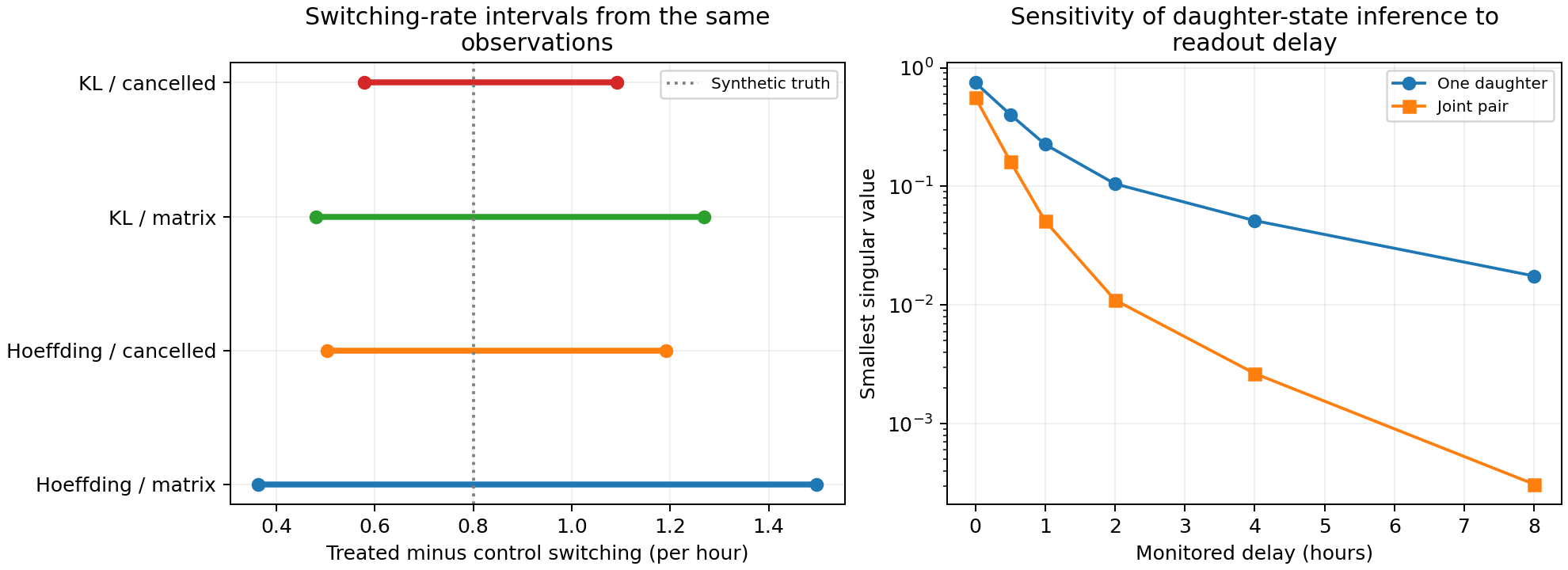
The retained dataset reproduces the interval for treatment-induced change in switching rate [0.578, 1.092] per hour, compared with [0.362, 1.498] from the original evaluation route. The improvement uses the same observations and confidence event: it cancels repeated calibration factors and uses narrower, rigorously enclosed feature sets. Insufficient data return an unresolved interval.
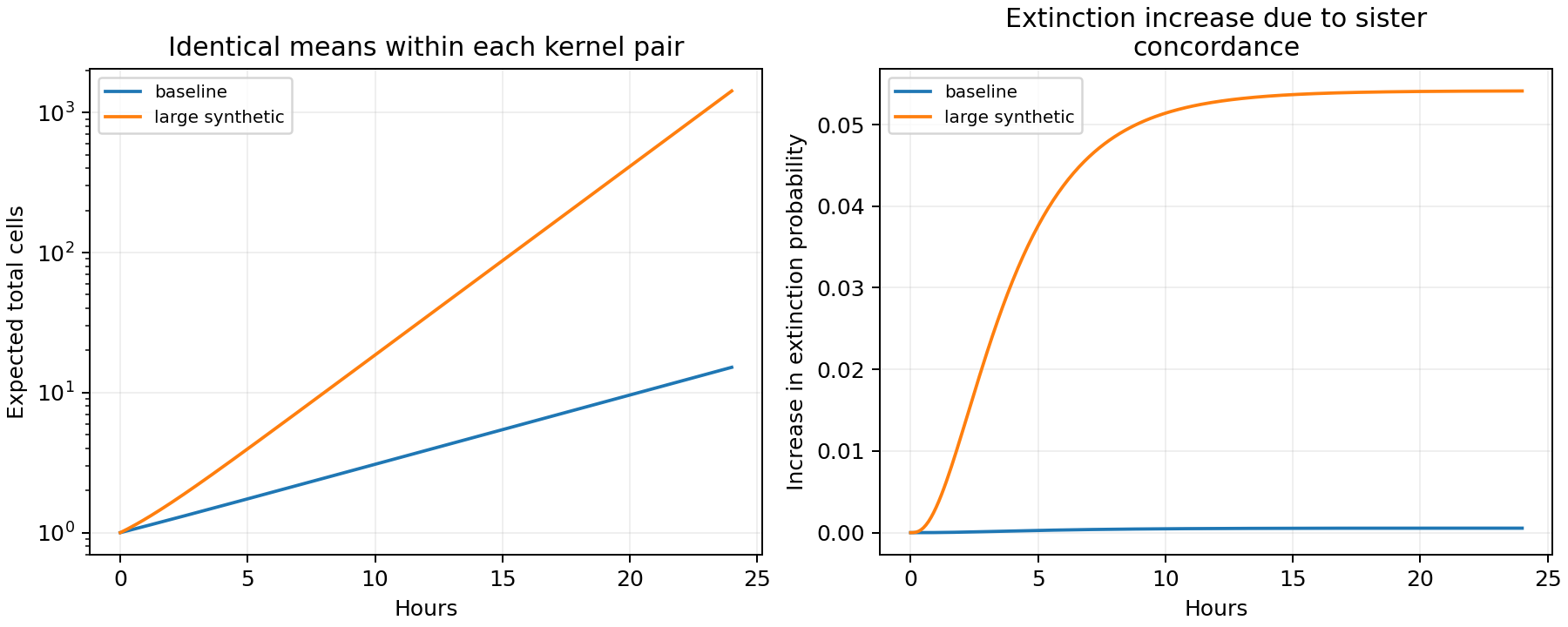
The full source inverse also works with more than two states, marker readouts with more categories than cell states and singular transition matrices for the stopped process. Delayed daughter observations retain interruption flags; longer delays preserve theoretical identification while making inferred rates more sensitive to measurement error. A separate prediction demonstrates why joint daughters matter: greater sister concordance leaves mean growth unchanged but can increase extinction.
Every KL endpoint is checked against the correct rational exclusion threshold. The prospective calculation encloses the entire control-parameter range, slightly widening the paper's printed bounds while retaining its 150,000-founders-per-arm sufficient result. All parameters are synthetic, numerical extinction magnitudes are distinguished from exact arithmetic, and Lean is not rerun.
Python source
"""Randomized stopping identifies mechanisms; uncertainty still costs samples.

Edit synthetic inputs below or pass your own six-category counts to inference.py.
No experimental rates or reporter calibrations are claimed by these defaults.
"""
PREPARATION = ['0.65','0.35']
SWITCHING_CONTROL = '0.05'             # S -> T, per hour
SWITCHING_TREATED = '0.85'
SWITCHING_REVERSE = '0.07'
DIVISION_RATES = ['0.22','0.16']
DEATH_RATES = ['0.12','0.04']
SISTER_KERNEL = [['0.62','0.12','0.12','0.14'],['0.10','0.10','0.10','0.70']]
MARKER = [['0.9','0.15'],['0.1','0.85']] # columns S,T; rows marker 0,1
DEADLINE_RATE = '1'                    # per hour, randomized independently per founder
DAUGHTER_DELAYS = [0,0.5,1,2,4,8]      # retain interruption flags
FOUNDERS_PER_ARM = 50_000
CALIBRATION_PER_STATE = 100_000
RANDOM_SEED = 20260922
FEATURE_BIAS_RESERVE = '0'             # only use independently justified bounds
MOVIE_CAP_CLOCK_UNITS = 14             # cap L0 = 14 / deadline rate
PROSPECTIVE_BUDGETS = [140_000,150_000,1_000_000]
EXTINCTION_HOURS = 24
CONCORDANCE_SHIFT = ['0.05','0.05']
MANUSCRIPT_SHA256 = 'a7b2582bd9ee8a5baac720ca0cbb02720cca9660490dc7c9ac944b2cd9ad22fe'

import argparse,csv,hashlib,json,platform
from pathlib import Path
from fractions import Fraction as Q
import numpy as np
import scipy,sympy as sp
from scipy.linalg import expm
from lineage import BranchingSource,MarkerChannel,RandomDeadline,known_mixture_calibration,matrix
from inference import FounderCounts,CalibrationCounts,InductionInference
from certkit import I,log_bounds,kl_lower
from prospective_boxes import decide
from model import strong_source


def source(a):return BranchingSource(PREPARATION,[['0',a],[SWITCHING_REVERSE,'0']],DIVISION_RATES,DEATH_RATES,SISTER_KERNEL)


def serial(x):
    if isinstance(x,sp.MatrixBase):return [[str(v) for v in row] for row in x.tolist()]
    if isinstance(x,(sp.Basic,Q)):return str(x)
    if isinstance(x,np.ndarray):return x.tolist()
    if isinstance(x,np.generic):return x.item()
    if isinstance(x,I):return dict(lower=str(x.a),upper=str(x.b),display=x.pair())
    raise TypeError(type(x))


def main():
    parser=argparse.ArgumentParser(description=__doc__);parser.add_argument('--output',type=Path,default=Path('outputs'));out=parser.parse_args().output;out.mkdir(parents=True,exist_ok=True)
    def dump(name,value):(out/name).write_text(json.dumps(value,indent=2,default=serial)+'\n')
    def table(name,rows):
        with (out/name).open('w',newline='') as f:
            w=csv.DictWriter(f,fieldnames=list(rows[0]));w.writeheader();w.writerows(rows)
    marker=MarkerChannel(MARKER);design=RandomDeadline(DEADLINE_RATE);models=[source(SWITCHING_CONTROL),source(SWITCHING_TREATED)]
    laws=[];recoveries=[]
    for m in models:
        law=design.law(m,marker);recovered=design.recover(law['law'],marker)
        assert recovered['killed']==m.killed and recovered['exit_mass']==m.exits and recovered['preparation']==m.preparation
        laws.append(law);recoveries.append(recovered)
    dump('exact_stopped_laws.json',laws);dump('exact_source_recovery.json',recoveries)
    # Independent founder preparations and independent labelled calibration.
    rng=np.random.default_rng(RANDOM_SEED);cal=tuple(int(x) for x in rng.binomial(CALIBRATION_PER_STATE,[float(marker.emissions[1,j]) for j in range(2)]))
    full=[rng.multinomial(FOUNDERS_PER_ARM,np.array(v['law'],float).ravel()).reshape(2,7) for v in laws]
    counts=[FounderCounts.from_full(c) for c in full];calibration=CalibrationCounts(cal,CALIBRATION_PER_STATE)
    dump('retained_data.json',dict(calibration_successes=cal,calibration_per_state=CALIBRATION_PER_STATE,founders_per_arm=FOUNDERS_PER_ARM,full_counts=full,six_category_counts=[c.deadline+c.exits for c in counts],seed=RANDOM_SEED,scope='Synthetic independent roots, all event outcomes retained; coarsening D means death OR division.'))
    routes={}
    for scheme in ['hoeffding','kl']:
        for evaluator in ['matrix','cancelled']:
            r=InductionInference(Q(DEADLINE_RATE),scheme,evaluator,Q(FEATURE_BIAS_RESERVE)).contrast(*counts,calibration);routes[scheme+'_'+evaluator]=r
            print(scheme,evaluator,r.get('display',r['status']),flush=True)
    dump('induction_intervals.json',routes)
    endpoint_audit=[]
    engine=InductionInference()
    for c in counts:
        for k in c.features():
            n=c.total;L=Q(25,4);s=engine.feature(k,n,L)
            endpoint_audit.append(dict(k=k,n=n,L=str(L),lower=str(s.a),upper=str(s.b),lower_exclusion_margin=str(n*kl_lower(Q(k,n),s.a)-L) if s.a else 'boundary',upper_exclusion_margin=str(n*kl_lower(Q(k,n),s.b)-L) if s.b<1 else 'boundary'))
    for k in cal:
        n=CALIBRATION_PER_STATE;L=Q(6);s=engine.feature(k,n,L)
        endpoint_audit.append(dict(k=k,n=n,L=str(L),lower=str(s.a),upper=str(s.b),lower_exclusion_margin=str(n*kl_lower(Q(k,n),s.a)-L),upper_exclusion_margin=str(n*kl_lower(Q(k,n),s.b)-L)))
    dump('rational_endpoint_audit.json',endpoint_audit)
    small=FounderCounts((12,1,1,3),(1,2));dump('unresolved_small_sample.json',{s+'_'+e:InductionInference(Q(DEADLINE_RATE),s,e).contrast(small,small,calibration) for s in ['hoeffding','kl'] for e in ['matrix','cancelled']})
    prospective={}
    for n in PROSPECTIVE_BUDGETS:
        for scheme,method in [('hoeffding','matrix'),('kl','cancelled')]:
            prospective[f'{scheme}_{method}_{n}']=decide(Q(1),n,n,scheme,method)
    dump('prospective_continuous_boxes.json',dict(results=prospective,scope='Fixed paper class in prospective_boxes.py, independent of edited synthetic source inputs; full control interval enclosed. Sufficient budgets, not necessary sample sizes.'))
    delay=[];delayed=[]
    for tau in DAUGHTER_DELAYS:
        protocol=RandomDeadline(DEADLINE_RATE,tau);law=protocol.law(models[1],marker);r=protocol.recover(law['law'],marker)
        F=np.array(law['channel'],float);s=float(np.linalg.svd(F,compute_uv=False)[-1]);error=float(np.max(np.abs(np.array(r['killed'],float)-np.array(models[1].killed,float))))
        delay.append(dict(delay_hours=tau,one_daughter_min_singular=s,pair_min_singular=s*s,founder_hours=float(law['founder_hours']),extra_daughter_hours_upper=2*tau*float(law['division_yield']),recovered_generator_error=error))
        delayed.append(dict(delay=tau,recovered=r,law=law['law'],channel=law['channel']))
    table('delayed_channel_conditioning.csv',delay);dump('delayed_source_recovery.json',delayed)
    P=matrix([['4/5','1/4'],['1/5','3/4']]);mixed=known_mixture_calibration(marker.emissions*P,P);assert mixed.emissions==marker.emissions
    dump('known_mixture_calibration.json',dict(compositions=P,marker_distributions=marker.emissions*P,recovered=mixed.emissions,scope='Compositions independently established at readout; not gates defined by the same uncalibrated marker.'))
    # Exact tests beyond two states: rectangular channel, complex spectrum,
    # reducibility, zero division, and a singular killed generator.
    exact_cases=[]
    for name,q,b,d in [('cycle',[[0,2,0],[0,0,2],[2,0,0]],['1/2']*3,['1/2']*3),('singular_reducible',[[0,0,0],[0,0,1],[0,0,0]],[0,0,0],[0,1,1])]:
        K=sp.zeros(3,9)
        for i in range(3):K[i,4*i]=1
        m=BranchingSource(['1/3']*3,q,b,d,K)
        E=MarkerChannel([['3/4',0,0],[0,'3/4',0],[0,0,'3/4'],['1/4']*3]);p=RandomDeadline('3/2');law=p.law(m,E);r=p.recover(law['law'],E)
        assert r['killed']==m.killed and r['exit_mass']==m.exits
        exact_cases.append(dict(name=name,source_killed=m.killed,recovery=r))
    dump('finite_state_exact_examples.json',exact_cases)
    m=source('0.18');shifted=m.concordance_shift(CONCORDANCE_SHIFT)
    assert m.mean_generator()==shifted.mean_generator()
    strong=strong_source();big=BranchingSource(strong['pi'],strong['q'],strong['b'],strong['d'],strong['K']);bigshift=big.concordance_shift(['.18','.18'])
    curves=[];t=np.linspace(0,EXTINCTION_HOURS,241)
    for label,base,more in [('baseline',m,shifted),('large_synthetic',big,bigshift)]:
        f,p,mean=base.population(t);g,p2,mean2=more.population(t)
        assert np.max(np.abs(mean-mean2))<1e-10 and np.min(g-f)>-1e-10
        curves.extend(dict(source=label,hours=float(x),extinction=float(a),greater_concordance_extinction=float(b),identical_mean=float(c)) for x,a,b,c in zip(t,p,p2,mean))
    table('extinction_and_means.csv',curves)
    eps=matrix(CONCORDANCE_SHIFT);d=m.death
    dump('concordance_identity.json',dict(mean_generator=m.mean_generator(),shifted_mean_generator=shifted.mean_generator(),cubic_coefficients=[m.division[i]*eps[i]*(d[0]-d[1])**2/3 for i in range(2)],offspring_difference='epsilon_i * (x_S - x_T)^2',scope='Polynomial identity and mean equality exact; finite-time effect magnitudes numerical. Equality can hold with state-independent demographic rates.'))
    lam=sp.Rational(DEADLINE_RATE);mu=2*lam;H=models[1].killed;R=(lam*sp.eye(2)-H).inv();S=(mu*sp.eye(2)-H).inv();assert R-S==(mu-lam)*R*S
    cap=Q(MOVIE_CAP_CLOCK_UNITS)/Q(DEADLINE_RATE)
    dump('deadline_design_checks.json',dict(resolvent_identity_residual=R-S-(mu-lam)*R*S,erlang_two_apparent_birth_rates=['1/3','1/4'],erlang_deadline_rates=[1,2],movie_cap_hours=str(cap),movie_cap_TV_reserve_display=float(np.exp(-float(lam)*float(cap))),scope='Capped record law is not a resolvent. A justified reserve can widen features; no survivor filtering or repeated-trace pseudoreplication.'))
    plot(out,routes,delay,curves)
    print('Exact immediate population inverse works for all retained states; delayed inversion retains interruptions.',flush=True)
    print('Prospective full-box 150000:',prospective.get('kl_cancelled_150000'),flush=True)
    print('All inputs are synthetic. Exact interval endpoints are audited at n*KL >= L. Numerical extinction is not an interval certificate; Lean not rerun.',flush=True)
    here=Path(__file__).parent;digest=lambda p:hashlib.sha256(p.read_bytes()).hexdigest()
    dump('run_metadata.json',dict(manuscript_sha256=MANUSCRIPT_SHA256,source_sha256=digest(Path(__file__)),python=platform.python_version(),numpy=np.__version__,scipy=scipy.__version__,sympy=sp.__version__,module_sha256={p.name:digest(p) for p in sorted(here.glob('*.py')) if p.name not in ['example.py','test_example.py']},input_sha256={p.name:digest(p) for p in sorted(here.glob('*.json')) if p.name!='release.json'},output_sha256={p.name:digest(p) for p in sorted(out.iterdir()) if p.is_file() and p.name!='run_metadata.json'}))


def plot(out,routes,delay,curves):
    import matplotlib
    matplotlib.use('Agg')
    import matplotlib.pyplot as plt
    fig,axs=plt.subplots(1,2,figsize=(11,4),layout='constrained')
    for i,(name,r) in enumerate(routes.items()):
        if r['status']=='resolved':axs[0].plot(r['display'],[i,i],'o-',lw=3)
    axs[0].set(yticks=range(4),yticklabels=['Hoeffding / matrix','Hoeffding / cancelled','KL / matrix','KL / cancelled'],xlabel='Treated minus control switching (per hour)',title='Switching-rate intervals from the same\nobservations');axs[0].axvline(float(Q(SWITCHING_TREATED)-Q(SWITCHING_CONTROL)),color='gray',ls=':',label='Synthetic truth');axs[0].legend(fontsize=8)
    axs[1].semilogy([r['delay_hours'] for r in delay],[r['one_daughter_min_singular'] for r in delay],'o-',label='One daughter');axs[1].semilogy([r['delay_hours'] for r in delay],[r['pair_min_singular'] for r in delay],'s-',label='Joint pair');axs[1].set(xlabel='Monitored delay (hours)',ylabel='Smallest singular value',title='Sensitivity of daughter-state inference to\nreadout delay');axs[1].legend(fontsize=8)
    for a in axs:a.grid(alpha=.2)
    fig.savefig(out/'inference_and_delay.png',dpi=180);fig.savefig(out/'inference_and_delay.svg');plt.close(fig)
    fig,axs=plt.subplots(1,2,figsize=(10,4),layout='constrained')
    for label in ['baseline','large_synthetic']:
        rows=[r for r in curves if r['source']==label];t=[r['hours'] for r in rows]
        axs[0].semilogy(t,[r['identical_mean'] for r in rows],label=label.replace('_',' '))
        axs[1].plot(t,[r['greater_concordance_extinction']-r['extinction'] for r in rows],label=label.replace('_',' '))
    axs[0].set(xlabel='Hours',ylabel='Expected total cells',title='Identical means within each kernel pair');axs[1].set(xlabel='Hours',ylabel='Increase in extinction probability',title='Extinction increase due to sister\nconcordance')
    for a in axs:a.grid(alpha=.2);a.legend(fontsize=8)
    fig.savefig(out/'inheritance_extinction.png',dpi=180);fig.savefig(out/'inheritance_extinction.svg');plt.close(fig)


if __name__=='__main__':main()
Run output
hoeffding matrix [0.3623756968764834, 1.497817961637643]
hoeffding cancelled [0.5034354334731796, 1.1907747008204304]
kl matrix [0.48094996966966147, 1.2691659349780189]
kl cancelled [0.5782587403550983, 1.0915852750775206]
Exact immediate population inverse works for all retained states; delayed inversion retains interruptions.
Prospective full-box 150000: {'null': [-0.144828694934, 0.144828694934], 'alt': [0.407270308787, 1.31356799607], 'ok': True}
All inputs are synthetic. Exact interval endpoints are audited at n*KL >= L. Numerical extinction is not an interval certificate; Lean not rerun.