Example code
A sandwich immunoassay detects analyte bound by two reagents; too much analyte can keep them from binding the same molecule and reduce the signal. This example builds that ambiguity from finite reagent supplies, then shows what a matched dilution can establish across an uncertain calibration range.
Reusable binding-site components form the simultaneous assay, its four-species kinetic model, and a sequential assay with washing. Editable inputs specify capacities, affinities, dilution, availability, timing and measurement error. All worked values are synthetic.
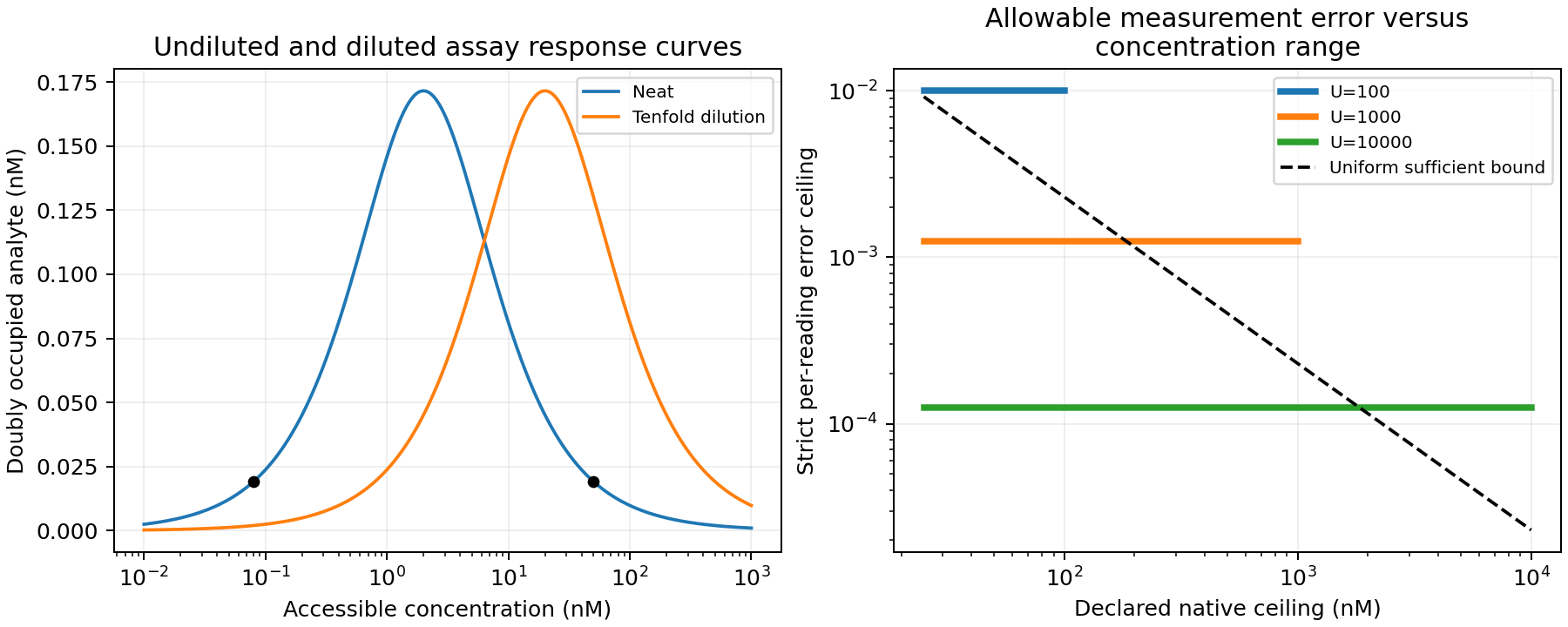
For the near-unit calibration box, the code freshly verifies a 0.04 minimum difference between undiluted and diluted model signals on accessible concentrations 20–100. Eight exact rational coefficients establish the entire rectangle, rather than a grid of sampled points. The package reproduces ten certificates covering wider ranges, unequal capacities, gain and availability drift, and incomplete equilibration. A failed sufficient certificate remains inconclusive.
The inference component retains the shared instrument gain and returns conservative concentration sets. A blank pair with an independently justified native ceiling of 100 gives the outer interval [0, 0.00763]; without a ceiling, the same readings remain unresolved. Hypothetical results are kept separate from the configured record, whose calibration has not been established.
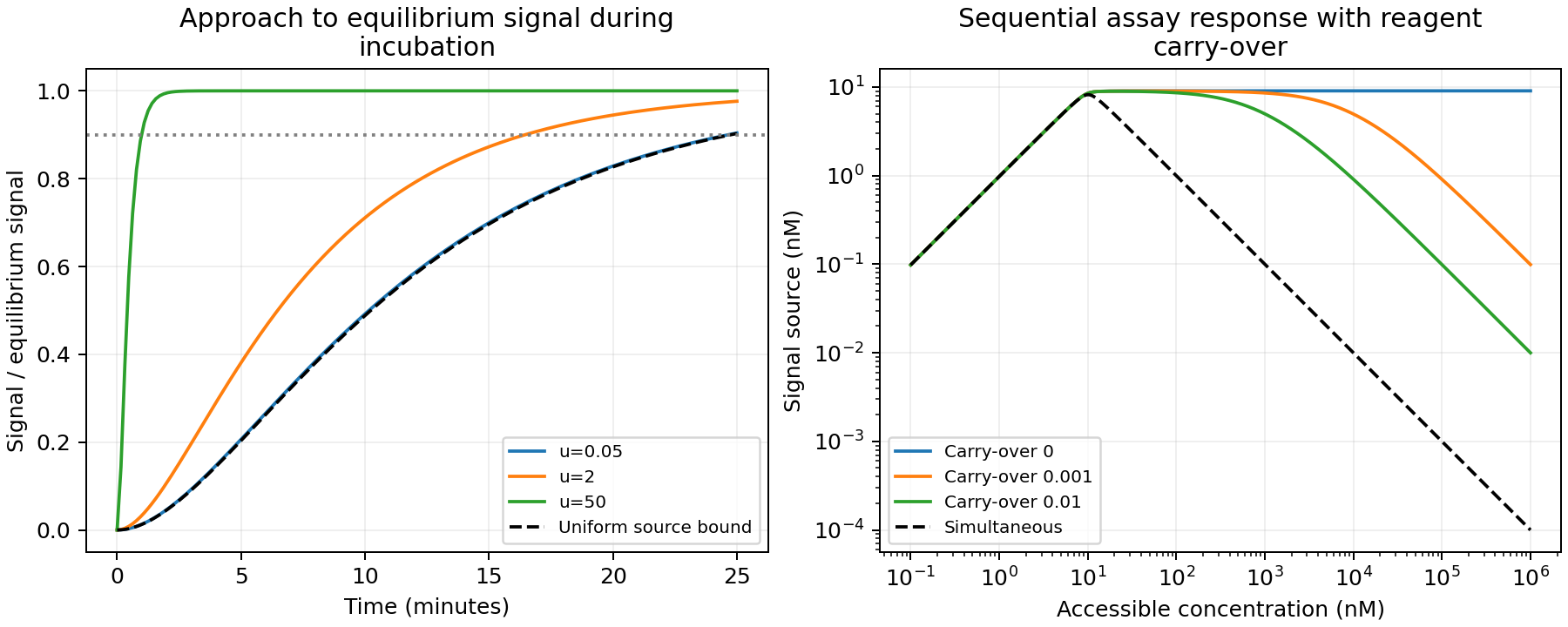
The kinetic model explains why equilibrium calibration alone cannot establish an incubation time. The sequential model shows why perfect washing removes the high-dose signal decline (the hook effect), while any fixed carry-over restores the high-concentration tail. Exact masking examples show why fully accessible spikes cannot identify invisible native analyte.
Download the complete package for the source models, exact certificate builder, conservative inference engine, scientific checks and generated tables. The bounds are conditional on the stated source and calibration assumptions; these are not clinical performance claims. Lean is not rerun.
Python source
"""Finite-reagent sandwich assays: source models, exact margins, outer inference.

Run: python example.py --output outputs
Synthetic paper inputs; no assay calibration or clinical interpretation is inferred.
"""
from __future__ import annotations
from dataclasses import dataclass, replace, asdict
from fractions import Fraction as F
from pathlib import Path
import argparse
import csv
import hashlib
import json
import math
import platform
import numpy as np
from scipy.integrate import solve_ivp
from scipy.optimize import brentq
from scipy.stats import norm

# EDITABLE INPUTS: final reaction concentrations in nM; raw signal in separate units.
C, D, K, J = 1., 1., 1., 1.
DILUTION = 10.
NATIVE_AVAILABILITY = 1.
ON_RATES = (0.001, 0.001)  # nM^-1 s^-1 = 10^6 M^-1 s^-1
NATIVE_CEILING = F(100)  # External operating-domain assumption, never inferred.
READING_ERROR = F(1, 10000)  # Simultaneous absolute allowance, NOT a CV.
ENCLOSURE_DEPTH = 14
CELL_BUDGET = 40000
CALIBRATION_ESTABLISHED = False
CARRY_OVER = 0.001
MANUSCRIPT_SHA256 = '9d7e87368f1db8e2548ecfc878dab2b4d56b42faef68d1734bc9262526c8116a'


@dataclass(frozen=True)
class BindingSite:
    capacity: float
    dissociation: float

    def __post_init__(self):
        if not all(math.isfinite(v) and v > 0 for v in (self.capacity, self.dissociation)):
            raise ValueError('Positive finite capacity and dissociation constant required')

    def occupancy(self, u):
        u = np.asarray(u, dtype=float)
        if np.any(~np.isfinite(u)) or np.any(u < 0):
            raise ValueError('Nonnegative finite accessible concentration required')
        c, k = self.capacity, self.dissociation
        # Positive terms avoid subtracting the two almost equal quadratic roots.
        return 2*c / (u+c+k+np.sqrt((u-c)**2+2*k*(u+c)+k*k))

    def captured(self, u):
        return np.asarray(u)*self.occupancy(u)

    def elasticity(self, u):
        p = self.occupancy(u)
        return np.asarray(u)*(1-p)**2/(np.asarray(u)*(1-p)**2+self.dissociation)


@dataclass(frozen=True)
class SandwichSource:
    capture: BindingSite
    detector: BindingSite

    def signal(self, u):
        return np.asarray(u)*self.capture.occupancy(u)*self.detector.occupancy(u)

    def species(self, u):
        p, q = self.capture.occupancy(u), self.detector.occupancy(u)
        return np.array([u*(1-p)*(1-q), u*p*(1-q), u*(1-p)*q, u*p*q])

    def log_slope(self, u):
        return 1-self.capture.elasticity(u)-self.detector.elasticity(u)

    def peak(self):
        scale = max(self.capture.capacity+self.capture.dissociation,
                    self.detector.capacity+self.detector.dissociation)
        return brentq(self.log_slope, scale*1e-10, scale*1e10)

    def paired(self, x, rho=1., dilution=10., gain=1., drift=1.):
        if not 0 < rho <= 1 or min(dilution, gain, drift) <= 0:
            raise ValueError('Invalid preparation or gains')
        u = rho*x
        return gain*self.signal(u), gain*drift*self.signal(u/dilution)


@dataclass(frozen=True)
class SequentialSource:
    source: SandwichSource
    carry_over: float = 0.

    def __post_init__(self):
        if not math.isfinite(self.carry_over) or not 0 <= self.carry_over <= 1:
            raise ValueError('Carry-over fraction must lie in [0,1]')

    def signal(self, u):
        w = self.source.capture.captured(u)
        return w*self.source.detector.occupancy(w+self.carry_over*(np.asarray(u)-w))

    @property
    def plateau(self):
        return self.source.detector.captured(self.source.capture.capacity)

    @staticmethod
    def wash_limit(detector_min: F, upper: F, retained_fraction: F):
        if detector_min <= 0 or upper <= 0 or not 0 < retained_fraction <= 1:
            raise ValueError('Invalid wash specification')
        return detector_min*(1/retained_fraction-1)/upper


@dataclass(frozen=True)
class BindingKinetics:
    source: SandwichSource
    on_capture: float
    on_detector: float

    def __post_init__(self):
        if not all(math.isfinite(v) and v > 0 for v in (self.on_capture, self.on_detector)):
            raise ValueError('Positive finite association rates required')

    def rates(self, u):
        return [on*math.sqrt((u-s.capacity)**2+2*s.dissociation*(u+s.capacity)+s.dissociation**2)
                for s, on in [(self.source.capture, self.on_capture), (self.source.detector, self.on_detector)]]

    def attenuation(self, u, t):
        a, b = self.rates(u)
        return -np.expm1(-a*np.asarray(t)) * -np.expm1(-b*np.asarray(t))

    def uniform_rate(self):
        return min(on*max(s.dissociation, 2*math.sqrt(s.capacity*s.dissociation))
                   for s, on in [(self.source.capture, self.on_capture), (self.source.detector, self.on_detector)])

    def trajectory(self, u, times, full=True):
        """Independent full four-species mass action or reduced site equations; unbound start."""
        if u < 0 or not np.all(np.diff(times) > 0) or times[0] != 0:
            raise ValueError('Nonnegative u and increasing times starting at zero required')
        c, k = self.source.capture.capacity, self.source.capture.dissociation
        d, j = self.source.detector.capacity, self.source.detector.dissociation
        kc, kd = self.on_capture, self.on_detector
        def rhs(t, y):
            if not full:
                p, q = y
                return [kc*((c-u*p)*(1-p)-k*p), kd*((d-u*q)*(1-q)-j*q)]
            a00, a10, a01, a11 = y
            cf, df = c-a10-a11, d-a01-a11
            f0, f1 = kc*(cf*a00-k*a10), kc*(cf*a01-k*a11)
            g0, g1 = kd*(df*a00-j*a01), kd*(df*a10-j*a11)
            return [-f0-g0, f0-g1, g0-f1, f1+g1]
        y0 = [u, 0, 0, 0] if full else [0, 0]
        sol = solve_ivp(rhs, (0, times[-1]), y0, t_eval=times, method='Radau', rtol=2e-10, atol=1e-13)
        if not sol.success:
            raise RuntimeError(sol.message)
        if full:
            return sol.y.T
        p, q = sol.y
        return np.array([u*(1-p)*(1-q), u*p*(1-q), u*(1-p)*q, u*p*q]).T


@dataclass(frozen=True)
class Interval:
    lo: F
    hi: F

    def __post_init__(self):
        object.__setattr__(self, 'lo', F(self.lo)); object.__setattr__(self, 'hi', F(self.hi))
        if self.lo > self.hi:
            raise ValueError('Reversed interval')

    @classmethod
    def point(cls, v):
        return cls(F(str(v)), F(str(v)))


@dataclass(frozen=True)
class CalibrationBox:
    capture: Interval = Interval(F(9,10), F(11,10))
    detector: Interval = Interval(F(9,10), F(11,10))
    K: Interval = Interval(F(9,10), F(11,10))
    J: Interval = Interval(F(9,10), F(11,10))
    dilution: Interval = Interval(F(9), F(11))
    drift: Interval = Interval(F(19,20), F(21,20))
    rho: Interval = Interval(F(4,5), F(1))
    attenuation: F = F(1)

    def __post_init__(self):
        if min(getattr(self, n).lo for n in ['capture','detector','K','J','dilution','drift','rho']) <= 0:
            raise ValueError('Positive calibration bounds required')
        if self.rho.hi > 1 or not 0 < self.attenuation <= 1:
            raise ValueError('Invalid availability or attenuation')

    @property
    def A(self): return self.capture.hi+self.K.hi
    @property
    def H(self): return self.detector.hi+self.J.hi
    @property
    def product_min(self): return self.capture.lo*self.detector.lo

    def relative_error(self, eta):
        if not 0 <= eta < 1: raise ValueError('Relative envelope must lie in [0,1)')
        return replace(self, drift=Interval(self.drift.lo*(1-eta)/(1+eta), self.drift.hi*(1+eta)/(1-eta)))

    def availability_drift(self, ratio: Interval):
        if ratio.lo <= 0: raise ValueError('Positive availability ratio required')
        return replace(self, dilution=Interval(self.dilution.lo/ratio.hi, self.dilution.hi/ratio.lo))

    def response_bounds(self, lo, hi):
        lower = self.attenuation*self.product_min*lo/((hi+self.A)*(hi+self.H))
        upper = min(hi, self.capture.hi*self.detector.hi*hi/((lo+self.K.lo)*(lo+self.J.lo)))
        return lower, upper


@dataclass(frozen=True)
class MarginCertificate:
    box: CalibrationBox
    low: F
    high: Interval
    margin: F

    def __post_init__(self):
        if self.low < 0 or self.high.lo <= 0 or self.margin < 0:
            raise ValueError('Invalid certificate range or margin')

    def polynomial(self, u, d):
        b = self.box; c = b.product_min
        return c*b.drift.lo*b.attenuation*d*u*u-(c+self.margin*u)*(u+b.A*d)*(u+b.H*d)

    def coefficients(self, d):
        b = self.box; c = b.product_min; m = self.margin
        a = [-c*b.A*b.H*d*d, -c*(b.A+b.H)*d-m*b.A*b.H*d*d,
             c*b.drift.lo*b.attenuation*d-c-m*(b.A+b.H)*d, -m]
        derivative = lambda u: a[1]+2*a[2]*u+3*a[3]*u*u
        l, h = self.high.lo, self.high.hi; width = h-l
        return [self.polynomial(l,d), self.polynomial(l,d)+width*derivative(l)/3,
                self.polynomial(h,d)-width*derivative(h)/3, self.polynomial(h,d)]

    def check(self):
        b = self.box
        coeffs = {str(d): self.coefficients(d) for d in (b.dilution.lo, b.dilution.hi)}
        low_ok = b.drift.hi*(self.low+b.A)*(self.low+b.H) <= b.attenuation*b.product_min*b.dilution.lo
        return dict(low_sign=low_ok, high_margin=all(v >= 0 for row in coeffs.values() for v in row),
                    coefficients=coeffs, meaning='Sufficient exact certificate; a failed coefficient is inconclusive')


@dataclass(frozen=True)
class ObservationBudget:
    neat_error: F = READING_ERROR
    diluted_error: F = READING_ERROR
    gain_min: F = F(1)

    def __post_init__(self):
        if min(self.neat_error, self.diluted_error) < 0 or self.gain_min <= 0:
            raise ValueError('Nonnegative errors and positive gain required')

    def bounds(self, margin):
        e = self.neat_error+self.diluted_error
        return e, self.gain_min*margin-e

    def report(self, z: F, certificate: MarginCertificate, promised=False, calibrated=False):
        check = certificate.check(); a, b = self.bounds(certificate.margin)
        if not calibrated:
            return dict(status='UNRESOLVED', reason='Calibration premises have not been established')
        if not check['low_sign'] or not check['high_margin']:
            return dict(status='UNRESOLVED', reason='Sufficient source certificate failed')
        exclusions = dict(excludes_low=z>a, excludes_high=z<b)
        # Both exclusions may hold in the guard band. A caller's binary promise then contradicts the record.
        if promised and all(exclusions.values()):
            status = 'MODEL_OR_PROMISE_INCOMPATIBLE'
        elif promised and a < b:
            status = 'HIGH_UNDER_PROMISE' if z > a else 'LOW_UNDER_PROMISE'
        else:
            status = 'ONE_SIDED_EXCLUSIONS_ONLY'
        return dict(status=status, **exclusions, contrast_bounds=(a,b))

    @staticmethod
    def gaussian_allowance(bias, sigma, alpha):
        if min(bias,sigma) < 0 or not 0 < alpha < 1: raise ValueError('Invalid precision contract')
        return bias+norm.ppf(1-alpha/4)*sigma  # Two readings, four tails, no independence needed.


@dataclass(frozen=True)
class OuterInference:
    box: CalibrationBox
    budget: ObservationBudget
    certificate: MarginCertificate | None = None
    low_label: F = F(1,10)
    high_label: F = F(25)

    def feasible(self, lo, hi, readings):
        # Independent interval envelopes relax reagent sharing. Intersect the SAME gain for both readings.
        b = self.box
        bounds = [b.response_bounds(lo,hi), b.response_bounds(lo/b.dilution.hi,hi/b.dilution.lo)]
        bounds[1] = (bounds[1][0]*b.drift.lo, bounds[1][1]*b.drift.hi)
        gl, gu = self.budget.gain_min, None
        for obs, (sl,sh), eps in zip(readings,bounds,[self.budget.neat_error,self.budget.diluted_error]):
            if obs is None: continue
            yl, yh = obs.lo-eps, obs.hi+eps
            if yh < 0 or (sh == 0 and yl > 0): return False
            if sh > 0: gl = max(gl,yl/sh)
            if sl > 0: gu = yh/sl if gu is None else min(gu,yh/sl)
            if gu is not None and gl > gu: return False
        cert = self.certificate
        if cert is not None and all(v is not None for v in readings):
            zlo, zhi = readings[1].lo-readings[0].hi, readings[1].hi-readings[0].lo
            a, c = self.budget.bounds(cert.margin)
            if hi <= cert.low and zlo > a: return False
            if lo >= cert.high.lo and hi <= cert.high.hi and zhi < c: return False
        return True

    def enclose(self, readings, ceiling=NATIVE_CEILING, depth=ENCLOSURE_DEPTH,
                calibrated=False, cell_budget=CELL_BUDGET):
        if len(readings) != 2: raise ValueError('Exactly two reading intervals, or None for missing')
        if not isinstance(depth,int) or depth < 0 or cell_budget < 1: raise ValueError('Invalid work budget')
        if ceiling is None or not calibrated:
            return dict(status='UNRESOLVED', intervals=[['0','unbounded']], reason='Finite ceiling and established calibration required')
        if ceiling < 0: raise ValueError('Nonnegative ceiling required')
        if self.certificate is not None:
            if self.certificate.box != self.box or not all(self.certificate.check()[v] for v in ['low_sign','high_margin']):
                raise ValueError('Contrast cuts require a matching verified certificate')
        cells = [(F(0), F(ceiling)*self.box.rho.hi)]; completed = 0
        # If the budget is reached, retain the complete previous covering. Never return a partial search as complete.
        for _ in range(depth):
            if 2*len(cells) > cell_budget: break
            cells = [(a,b) for lo,hi in cells for a,b in [(lo,(lo+hi)/2),((lo+hi)/2,hi)] if self.feasible(a,b,readings)]
            completed += 1
        merged = []
        for lo,hi in cells:
            a,b = lo/self.box.rho.hi, min(F(ceiling),hi/self.box.rho.lo)
            if merged and a <= merged[-1][1]: merged[-1] = (merged[-1][0],max(b,merged[-1][1]))
            else: merged.append((a,b))
        status = ('MODEL_OR_MEASUREMENT_INCOMPATIBLE' if not merged else
                  'LOW_CONDITIONAL' if merged[-1][1] <= self.low_label else
                  'HIGH_CONDITIONAL' if merged[0][0] >= self.high_label else 'UNRESOLVED')
        return dict(status=status,intervals=merged,depth=completed,requested_depth=depth,
                    ceiling=ceiling,meaning='Outer relaxation; retained states need not be feasible')


def paper_certificates():
    unit = CalibrationBox()
    cap = replace(unit,capture=Interval(9,11),detector=Interval(9,11),K=Interval(F(9,100),F(11,100)),J=Interval(F(9,100),F(11,100)))
    unequal = replace(cap,detector=Interval(18,22),J=Interval(F(18,100),F(22,100)))
    specs = [('main',unit,F(2,5),20,100,F(1,25)), ('smaller_guard',unit,F(2,5),12,100,F(1,100)),
             ('range_1000',unit,F(2,5),20,1000,F(1,200)), ('range_10000',unit,F(2,5),20,10000,F(1,2000)),
             ('availability_drift',unit.availability_drift(Interval(F(19,20),F(21,20))),F(1,10),20,100,F(3,100)),
             ('transient',replace(unit,attenuation=F(9,10)),F(1,10),20,100,F(3,100)),
             ('relative_error',unit.relative_error(F(3,100)),F(1,10),20,100,F(3,100)),
             ('high_capacity',cap,F(15),100,1000,F(2,5)), ('capacity_guard',cap,F(15),60,1000,F(3,20)),
             ('unequal_capacity',unequal,F(20),200,1000,F(4,5))]
    return {name:MarginCertificate(box,low,Interval(l,h),m) for name,box,low,l,h,m in specs}


def main():
    parser = argparse.ArgumentParser(); parser.add_argument('--output',default='outputs'); args=parser.parse_args()
    out=Path(args.output); out.mkdir(parents=True,exist_ok=True)
    source=SandwichSource(BindingSite(C,K),BindingSite(D,J)); certificates=paper_certificates()
    checks={name:cert.check() for name,cert in certificates.items()}
    assert all(v['low_sign'] and v['high_margin'] for v in checks.values())
    budget=ObservationBudget(); inference=OuterInference(certificates['main'].box,budget,certificates['main'])
    pt=Interval.point
    scenarios={'blank':[pt(0),pt(0)],'high_50':list(map(pt,source.paired(50,NATIVE_AVAILABILITY,DILUTION))),
               'guard_1':list(map(pt,source.paired(1))), 'collision_low':list(map(pt,source.paired(200/2499))),
               'collision_high':list(map(pt,source.paired(2499/50))), 'neat_only':[pt(F(49,2550)),None],
               'negative':[pt(-1),pt(0)], 'censored_dilution':[pt(0),Interval(F(-1,10000),F(1,10000))]}
    enclosures={name:inference.enclose(v,calibrated=True) for name,v in scenarios.items()}
    enclosures['blank_without_ceiling']=inference.enclose(scenarios['blank'],ceiling=None,calibrated=True)
    observed_status=inference.enclose(scenarios['high_50'],calibrated=CALIBRATION_ESTABLISHED)
    kinetics=BindingKinetics(source,*ON_RATES); times=np.linspace(0,3/kinetics.uniform_rate(),161)
    kinetic_rows=[]; maxgap=0.
    for u in [.05,2,50]:
        full=kinetics.trajectory(u,times); reduced=kinetics.trajectory(u,times,full=False)
        maxgap=max(maxgap,float(np.max(np.abs(full-reduced))))
        kinetic_rows.extend(zip([u]*len(times),times,full[:,3],kinetics.attenuation(u,times)*source.signal(u),[float(source.signal(u))]*len(times)))
    highsource=SandwichSource(BindingSite(10,.1),BindingSite(10,.1))
    sequential=SequentialSource(highsource,CARRY_OVER)
    seqrows=[[u,float(SequentialSource(highsource).signal(u)),float(sequential.signal(u))] for u in [1,10,100,1000,1e6]]
    u=np.geomspace(.01,1e6,601)
    sourcerows=list(zip(u,source.signal(u),source.signal(u/DILUTION),source.signal(u/DILUTION)/source.signal(u)))
    results=dict(inputs=dict(C=C,D=D,K=K,J=J,dilution=DILUTION,rho=NATIVE_AVAILABILITY,ceiling=NATIVE_CEILING,error=READING_ERROR),
                 certificates=checks,conditional_enclosures=enclosures,configured_record=observed_status,
                 peak=float(source.peak()),collision=dict(neat=F(49,2550),accessible_low=F(200,2499),accessible_high=F(2499,50)),
                 kinetic_max_full_reduced_gap=maxgap,near_unit_box_sufficient_seconds=3/(.001*1.8),
                 precision_allowance=budget.gaussian_allowance(.001,.002,.01),
                 wash_limit=SequentialSource.wash_limit(F(10),F(1000),F(9,10)),
                 blank_tail_from=F(121,100)*11/READING_ERROR,
                 uniform_tail_margin_constant=F(7371,8000),
                 masking_worlds=[dict(x=F(1,10),rho=F(1)),dict(x=F(100),rho=F(1,1000))],
                 scope='Fresh exact rational certificates and conservative inference; numerical source/ODE; Lean not rerun')
    def dump(name,data): (out/name).write_text(json.dumps(data,indent=2,default=lambda v:str(v) if isinstance(v,F) else float(v))+'\n',encoding='utf-8')
    def table(name,header,rows):
        with (out/name).open('w',newline='') as f:
            w=csv.writer(f);w.writerow(header);w.writerows(rows)
    dump('results.json',results)
    table('source.csv',['accessible','neat','diluted','ratio'],sourcerows)
    table('kinetics.csv',['accessible','seconds','full_A11','attenuation_lower','equilibrium'],kinetic_rows)
    table('sequential.csv',['accessible_nM','ideal_wash','carry_over'],seqrows)
    table('certificates.csv',['case','dilution','b0','b1','b2','b3'],[[name,d,*v] for name,check in checks.items() for d,v in check['coefficients'].items()])
    lines=[f'{len(checks)} exact continuum certificates passed (80 Bernstein coefficients).',
           'Blank with external ceiling 100: '+str(enclosures['blank']['intervals'])+'; without ceiling: unresolved.',
           f'Full/reduced kinetic discrepancy: {maxgap:.3g}; box-wide sufficient incubation: {results["near_unit_box_sufficient_seconds"] / 60:.3f} minutes.',
           f'Configured record: {observed_status["status"]}. All numerical inputs are synthetic.']
    (out/'console.txt').write_text('\n'.join(lines)+'\n');print('\n'.join(lines))
    plot(out,source,certificates,kinetic_rows,highsource)
    digest=lambda p:hashlib.sha256(p.read_bytes()).hexdigest()
    dump('run_metadata.json',dict(manuscript_sha256=MANUSCRIPT_SHA256,python=platform.python_version(),source_sha256=digest(Path(__file__)),
                               output_sha256={p.name:digest(p) for p in sorted(out.iterdir()) if p.is_file() and p.name!='run_metadata.json'}))


def plot(out,source,certs,kinetic_rows,highsource):
    import matplotlib
    matplotlib.use('Agg')
    import matplotlib.pyplot as plt
    fig,axs=plt.subplots(1,2,figsize=(10,4),layout='constrained')
    u=np.geomspace(.01,1000,501)
    axs[0].semilogx(u,source.signal(u),label='Neat');axs[0].semilogx(u,source.signal(u/10),label='Tenfold dilution')
    for x in [200/2499,2499/50]:axs[0].scatter(x,source.signal(x),color='k',s=20,zorder=4)
    axs[0].set(title='Undiluted and diluted assay response curves',xlabel='Accessible concentration (nM)',ylabel='Doubly occupied analyte (nM)');axs[0].legend(fontsize=8)
    for name in ['main','range_1000','range_10000']:
        c=certs[name];axs[1].loglog([25,float(c.high.hi)],[float(c.margin/4)]*2,lw=3,label=f'U={c.high.hi}')
    ceilings=np.geomspace(25,10000,200);axs[1].loglog(ceilings,7371/(32000*ceilings),'k--',label='Uniform sufficient bound')
    axs[1].set(title='Allowable measurement error versus\nconcentration range',xlabel='Declared native ceiling (nM)',ylabel='Strict per-reading error ceiling');axs[1].legend(fontsize=8)
    for ax in axs:ax.grid(alpha=.2)
    fig.savefig(out/'dilution.png',dpi=180);fig.savefig(out/'dilution.svg');plt.close(fig)
    fig,axs=plt.subplots(1,2,figsize=(10,4),layout='constrained')
    for u in [.05,2,50]:
        rows=np.array([r for r in kinetic_rows if r[0]==u]);axs[0].plot(rows[:,1]/60,rows[:,2]/rows[:,4],label=f'u={u:g}')
    t=np.linspace(0,max(r[1] for r in kinetic_rows),200)
    rate=BindingKinetics(source,*ON_RATES).uniform_rate();axs[0].plot(t/60,(-np.expm1(-rate*t))**2,'k--',label='Uniform source bound')
    axs[0].axhline(.9,color='gray',ls=':');axs[0].set(title='Approach to equilibrium signal during\nincubation',xlabel='Time (minutes)',ylabel='Signal / equilibrium signal');axs[0].legend(fontsize=8)
    u=np.geomspace(.1,1e6,501)
    for lam in [0,.001,.01]:axs[1].loglog(u,SequentialSource(highsource,lam).signal(u),label=f'Carry-over {lam:g}')
    axs[1].loglog(u,highsource.signal(u),'k--',label='Simultaneous')
    axs[1].set(title='Sequential assay response with reagent\ncarry-over',xlabel='Accessible concentration (nM)',ylabel='Signal source (nM)');axs[1].legend(fontsize=8)
    for ax in axs:ax.grid(alpha=.2)
    fig.savefig(out/'protocol.png',dpi=180);fig.savefig(out/'protocol.svg');plt.close(fig)


if __name__ == '__main__': main()
Run output
10 exact continuum certificates passed (80 Bernstein coefficients).
Blank with external ceiling 100: [(Fraction(0, 1), Fraction(125, 16384))]; without ceiling: unresolved.
Full/reduced kinetic discrepancy: 3.9e-11; box-wide sufficient incubation: 27.778 minutes.
Configured record: UNRESOLVED. All numerical inputs are synthetic.