Example code
This example designs a phosphorylation reactor to have specified steady states. A kinase adds phosphate groups to a multisite substrate, while a phosphatase removes them. Their bound complexes matter: shared enzyme inventories couple the steps and can produce several steady states at the same rates and conserved totals.
The example turns the paper's construction into reusable components: prescribe the free-enzyme ratios, generate positive reaction rates, check every physical equilibrium, and integrate the full mass-action model. The default three-site system has five exact equilibria. Separate exact stability calculations identify three locally attracting states and two unstable saddle states.
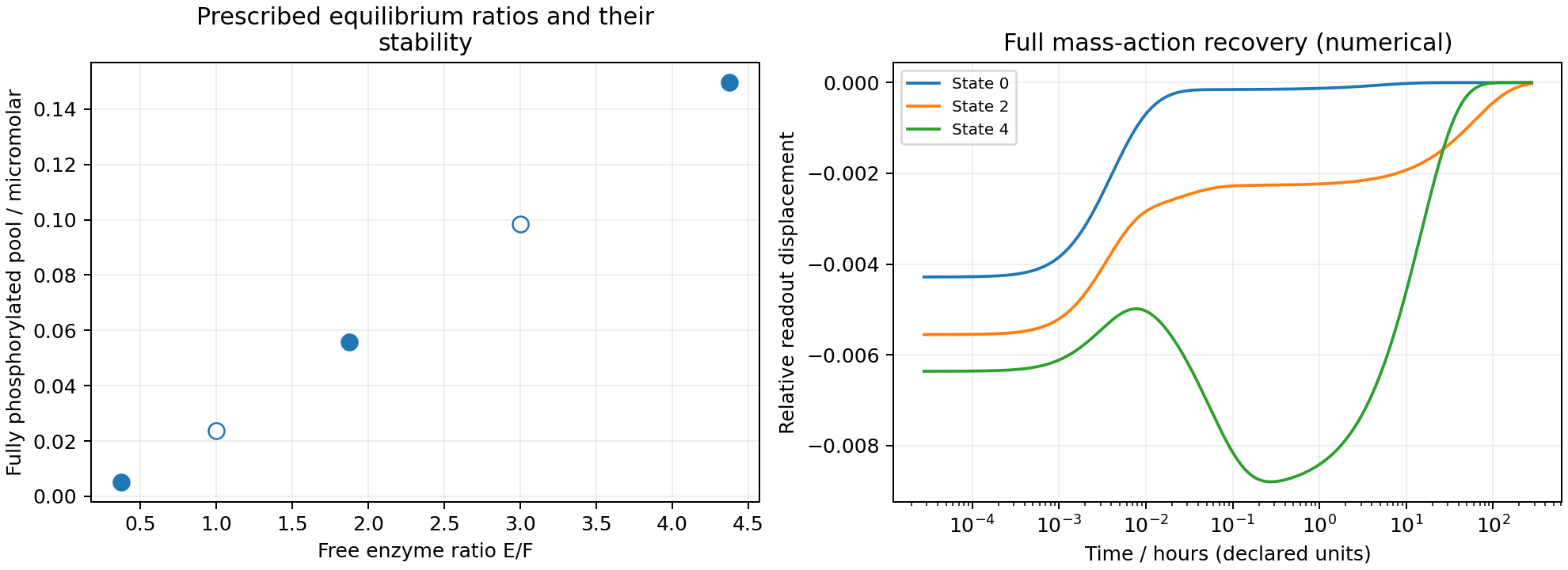
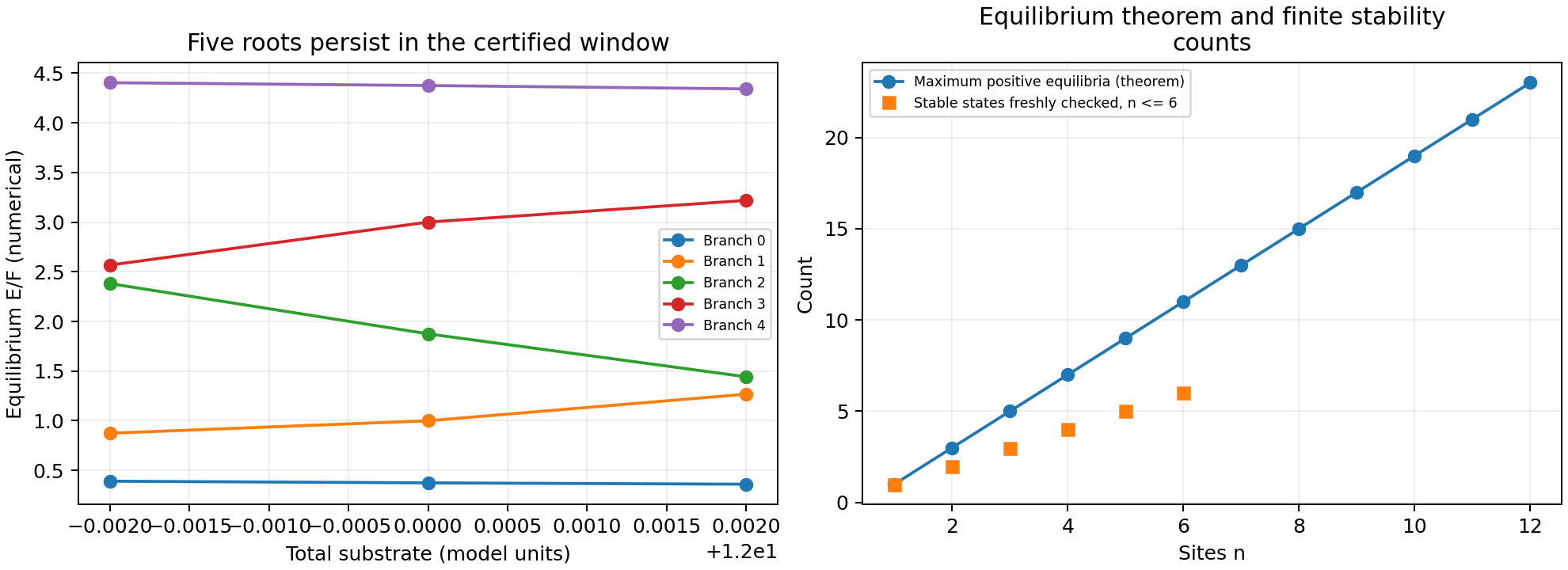
The package reproduces the narrow substrate-total window in which all five roots persist. It also shows why polynomial roots need physical filtering, handles the exceptional enzyme-ratio case, and lets users change kinetic speeds without moving the equilibria. Editable inputs and declared physical units sit at the top of the driver.
The general equilibrium count is a mathematical result. Stability is freshly checked through six sites by default; the source's slower ten-site census is optional. The paper's all-site stability conjecture is not assumed. Return trajectories are numerical, the unit conversion is illustrative, and Lean is not rerun.
Python source
"""Design prescribed phosphorylation equilibria, then test their physical dynamics."""
# EDIT THESE INPUTS. x>1 gives the prescribed free-enzyme ratio u=(x*x-1)/8.
AUXILIARY_ROOTS=('2','3','4','5','6')
ENZYME_TOTAL_RATIO='5'
CONCENTRATION_UNIT_MICROMOLAR='0.1'   # illustration, not a fitted biochemical system
TIME_UNIT_SECONDS='10'
SUBSTRATE_TOTAL_OFFSETS=('-1/500','0','1/500')
KINETIC_SPEED_FACTORS=('1/10','1','10')
TRAJECTORY_DURATION=100000.0
FREE_SUBSTRATE_PERTURBATION=0.01
FULL_SOURCE_CENSUS=False             # True extends exact Routh census from n<=6 to n<=10; slow

import argparse,csv,hashlib,json,platform
from pathlib import Path
from fractions import Fraction as Q
import numpy as np
import scipy
import sympy as sp
from scipy.optimize import brentq
import phos_sharp as ps
from construction import PrescribedStates,KineticFreedom,EquilibriumChart,stability,substrate_window
from reactor import Reactor
import paper_checks
MANUSCRIPT_SHA256='84259d8ba8da08bb2db4d3b1950eb2cb032902be1e42970ff64d6f7c1411d805'

def main():
    parser=argparse.ArgumentParser(description=__doc__);parser.add_argument('--output',type=Path,default=Path('outputs'));out=parser.parse_args().output;out.mkdir(parents=True,exist_ok=True)
    def dump(name,x):(out/name).write_text(json.dumps(x,indent=2,default=lambda v:v.tolist() if isinstance(v,np.ndarray) else str(v))+'\n')
    def table(name,rows):
        with (out/name).open('w',newline='') as f:w=csv.DictWriter(f,fieldnames=list(rows[0]));w.writeheader();w.writerows(rows)
    print('Replaying source construction, interlacing, coefficient positivity, determinant and Routh checks.',flush=True)
    replay=paper_checks.replay(FULL_SOURCE_CENSUS);dump('source_arithmetic_replay.json',replay)
    rec=PrescribedStates(AUXILIARY_ROOTS,Q(ENZYME_TOTAL_RATIO)).construct();rates=rec['rates'];n=len(rates)
    dump('configured_design.json',rec);audit=EquilibriumChart(rates,rec['totals']).audit();dump('physical_root_audit.json',audit)
    if audit['positive_count']!=2*n-1:raise ArithmeticError('Independent physical root audit disagrees with construction.')
    rows=[]
    for j,s in enumerate(rec['states']):
        z=s['z'];H,dH,*_=ps.chart(rec['A'],rec['B'],rec['D'],rec['r'],Q(2),s['u']);exact=stability(rates,z)
        if any(ps.vector_field(rates,z)) or ps.totals(z)!=rec['totals']:raise ArithmeticError('Exact equilibrium validation failed.')
        J=ps.reduced_jacobian(rates,z);lead=float(max(np.linalg.eigvals(np.array(J,float)).real));flux=sum(row[2]*z[n+3+i] for i,row in enumerate(rates))
        rows.append(dict(index=j,x=str(s['x']),enzyme_ratio=str(s['u']),free_readout=float(z[n]),total_readout=float(z[n]+z[-1]),phosphorylation_flux=str(flux),relative_substrate_sensitivity=float(rec['totals'][2]/(s['u']*abs(dH))),slope=str(dH),leading_real_numerical=lead,**exact))
    dump('equilibrium_classification.json',rows)
    # Keep the paper's certified benchmark separate from configurable geometry.
    benchmark=PrescribedStates(('2','3','4','5','6'),Q(5)).construct();probes=list(map(Q,['1/20','69/128','4327/3200','7917/3200','6373/1600','399/80']))
    window=substrate_window(benchmark,probes,Q(1,500));dump('certified_substrate_window.json',window)
    wide=substrate_window(benchmark,probes,Q(1,100));dump('wider_window_attempt.json',wide)
    continuation=[]
    for offset in SUBSTRATE_TOTAL_OFFSETS:
        st=Q(12)+Q(offset);chart=EquilibriumChart(benchmark['rates'],(Q(10),Q(2),st));aa=chart.audit();dump('substrate_offset_'+str(Q(offset)).replace('/','_')+'.json',aa)
        for k,(lo,hi) in enumerate(zip(probes,probes[1:])):
            try:u=brentq(lambda v:float(ps.chart(benchmark['A'],benchmark['B'],benchmark['D'],Q(5),Q(2),v)[0])-float(st),float(lo),float(hi),xtol=1e-13)
            except ValueError:continue
            _,_,s,f,*_=ps.chart(benchmark['A'],benchmark['B'],benchmark['D'],Q(5),Q(2),u);z=ps.state_from(benchmark['A'],benchmark['B'],benchmark['D'],u,s,f)
            continuation.append(dict(substrate_total=str(st),branch=k,ratio_numerical=u,readout_numerical=float(z[3]+z[-1]),physical_root_count_exact=aa['positive_count']))
    table('substrate_total_continuation.csv',continuation)
    # A symmetric one-site system has u=r and would be lost by the regular chart.
    exceptional=EquilibriumChart([(2,1,1,2,1,1)],(1,1,2)).audit();dump('exceptional_ratio_example.json',exceptional)
    bad=list(map(Q,['1059/1000','1098/1000','1003/1000','1029/1000','1038/1000']));threshold=[]
    for r in map(Q,['64/100','66/100','675/1000']):
        b=ps.build(bad,r);threshold.append(dict(r=str(r),r_exceeds_every_requested_ratio=r>max(map(ps.ratio,bad)),all_coefficients_positive=b['positive'],leading_B_raw=str(b['Braw'][-1])))
    dump('coefficient_positivity_counterexample.json',threshold)
    sweep=[]
    for fac in map(Q,KINETIC_SPEED_FACTORS):
        freedom=KineticFreedom(tuple(row[1]*fac for row in rates),tuple(row[4]*fac for row in rates),tuple(row[5]*fac for row in rates));rr=freedom.realize(rec)
        for j,s in enumerate(rec['states']):
            if any(ps.vector_field(rr,s['z'])):raise ArithmeticError('Kinetic freedom moved a prescribed equilibrium.')
            lead=float(max(np.linalg.eigvals(np.array(ps.reduced_jacobian(rr,s['z']),float)).real));sweep.append(dict(speed_factor=str(fac),state=j,unstable=stability(rr,s['z']).get('unstable'),leading_real_numerical=lead))
    table('same_equilibria_different_speeds.csv',sweep)
    reactor=Reactor(rates,rec['totals']);curves=[];diagnostics=[]
    if not 0<FREE_SUBSTRATE_PERTURBATION<.1:raise ValueError('Use a small positive fraction below 0.1.')
    for row,state in zip(rows,rec['states']):
        if row.get('unstable')!=0:continue
        z=np.array(state['z'],float);q=z[reactor.indices].copy();q[n-1]*=1-FREE_SUBSTRATE_PERTURBATION;initial=reactor.species(q);run=reactor.integrate(initial,TRAJECTORY_DURATION);other=reactor.integrate(initial,TRAJECTORY_DURATION,samples=101,method='Radau');curves.append((row['index'],run,float(z[n]+z[-1])))
        diagnostics.append(dict(state=row['index'],initial_distance=float(np.linalg.norm(initial-z)),final_distance=float(np.linalg.norm(run['endpoint']-z)),solver_difference=float(max(abs(run['endpoint']-other['endpoint']))),conservation_drift=run['conservation_drift'],minimum_concentration=run['minimum_concentration']))
        table(f'full_reactor_sink_{row["index"]}.csv',[dict(time_model=t,**{label:float(run['species'][l,k]) for l,label in enumerate(reactor.labels)}) for k,t in enumerate(run['time'])])
    dump('numerical_recovery_checks.json',diagnostics)
    table('physical_rate_constants.csv',[dict(site=i+1,**{label:float(value/(Q(TIME_UNIT_SECONDS)*(Q(CONCENTRATION_UNIT_MICROMOLAR) if j in [0,3] else 1))) for j,(label,value) in enumerate(zip(['a_per_uM_s','b_per_s','c_per_s','alpha_per_uM_s','beta_per_s','gamma_per_s'],row))}) for i,row in enumerate(rates)])
    plot(out,rec,rows,curves,continuation)
    print('Positive physical equilibria:',audit['positive_count'],'; Routh unstable counts:',[r.get('unstable') for r in rows],flush=True)
    print('Paper substrate window:',window['status'],'; wider attempted window:',wide['status'],flush=True)
    print('Source checks:',replay['checks_passed'],'; exact Routh census n <=',replay['routh_census_nmax'],flush=True)
    print('The all-n equilibrium count is a paper theorem. Even-index stability beyond the finite census is not proved here. Numerical trajectories are not basin or robustness certificates; Lean not rerun.',flush=True)
    here=Path(__file__).parent;digest=lambda p:hashlib.sha256(p.read_bytes()).hexdigest()
    dump('run_metadata.json',dict(manuscript_sha256=MANUSCRIPT_SHA256,source_sha256=digest(Path(__file__)),python=platform.python_version(),numpy=np.__version__,scipy=scipy.__version__,sympy=sp.__version__,module_sha256={p.name:digest(p) for p in sorted(here.glob('*.py')) if p.name not in ['example.py','test_example.py']},output_sha256={p.name:digest(p) for p in sorted(out.iterdir()) if p.is_file() and p.name!='run_metadata.json'}))

def plot(out,rec,rows,curves,continuation):
    import matplotlib
    matplotlib.use('Agg')
    import matplotlib.pyplot as plt
    fig,axs=plt.subplots(1,2,figsize=(11,4),layout='constrained')
    for row in rows:
        stable=row.get('unstable')==0;axs[0].plot(float(Q(row['enzyme_ratio'])),row['total_readout']*float(Q(CONCENTRATION_UNIT_MICROMOLAR)),'o',mfc='C0' if stable else 'white',mec='C0',ms=8)
    axs[0].set(xlabel='Free enzyme ratio E/F',ylabel='Fully phosphorylated pool / micromolar',title='Prescribed equilibrium ratios and their\nstability')
    for j,run,base in curves:axs[1].semilogx(run['time'][1:]*float(Q(TIME_UNIT_SECONDS))/3600,((run['species'][len(rec['rates'])]+run['species'][-1])/base-1)[1:],label=f'State {j}')
    axs[1].set(xlabel='Time / hours (declared units)',ylabel='Relative readout displacement',title='Full mass-action recovery (numerical)');axs[1].legend(fontsize=8)
    for ax in axs:ax.grid(alpha=.2)
    fig.savefig(out/'prescribed_states_recovery.png',dpi=180);fig.savefig(out/'prescribed_states_recovery.svg');plt.close(fig)
    fig,axs=plt.subplots(1,2,figsize=(11,4),layout='constrained')
    for k in range(5):
        points=[r for r in continuation if r['branch']==k];axs[0].plot([float(Q(r['substrate_total'])) for r in points],[r['ratio_numerical'] for r in points],'o-',label=f'Branch {k}')
    axs[0].set(xlabel='Total substrate (model units)',ylabel='Equilibrium E/F (numerical)',title='Five roots persist in the certified window');axs[0].legend(fontsize=7)
    xs=np.arange(1,13);axs[1].plot(xs,2*xs-1,'o-',label='Maximum positive equilibria (theorem)');axs[1].plot(np.arange(1,7),np.arange(1,7),'s',label='Stable states freshly checked, n <= 6');axs[1].set(xlabel='Sites n',ylabel='Count',title='Equilibrium theorem and finite stability\ncounts');axs[1].legend(fontsize=7)
    for ax in axs:ax.grid(alpha=.2)
    fig.savefig(out/'window_and_count.png',dpi=180);fig.savefig(out/'window_and_count.svg');plt.close(fig)

if __name__=='__main__':main()
Run output
Replaying source construction, interlacing, coefficient positivity, determinant and Routh checks.
Positive physical equilibria: 5 ; Routh unstable counts: [0, 1, 0, 1, 0]
Paper substrate window: certified_at_least_5 ; wider attempted window: not_certified
Source checks: 3239 ; exact Routh census n <= 6
The all-n equilibrium count is a paper theorem. Even-index stability beyond the finite census is not proved here. Numerical trajectories are not basin or robustness certificates; Lean not rerun.