Example code
Following one daughter after each division records a single cell lineage, but omits how sister cells vary together. That missing dependence can change which treatment order best extinguishes the whole family. The two sources in this example have identical life-event rates and retained-daughter marginals. Their sister states have different dependence, which reverses the preferred order of the same two treatment phases.
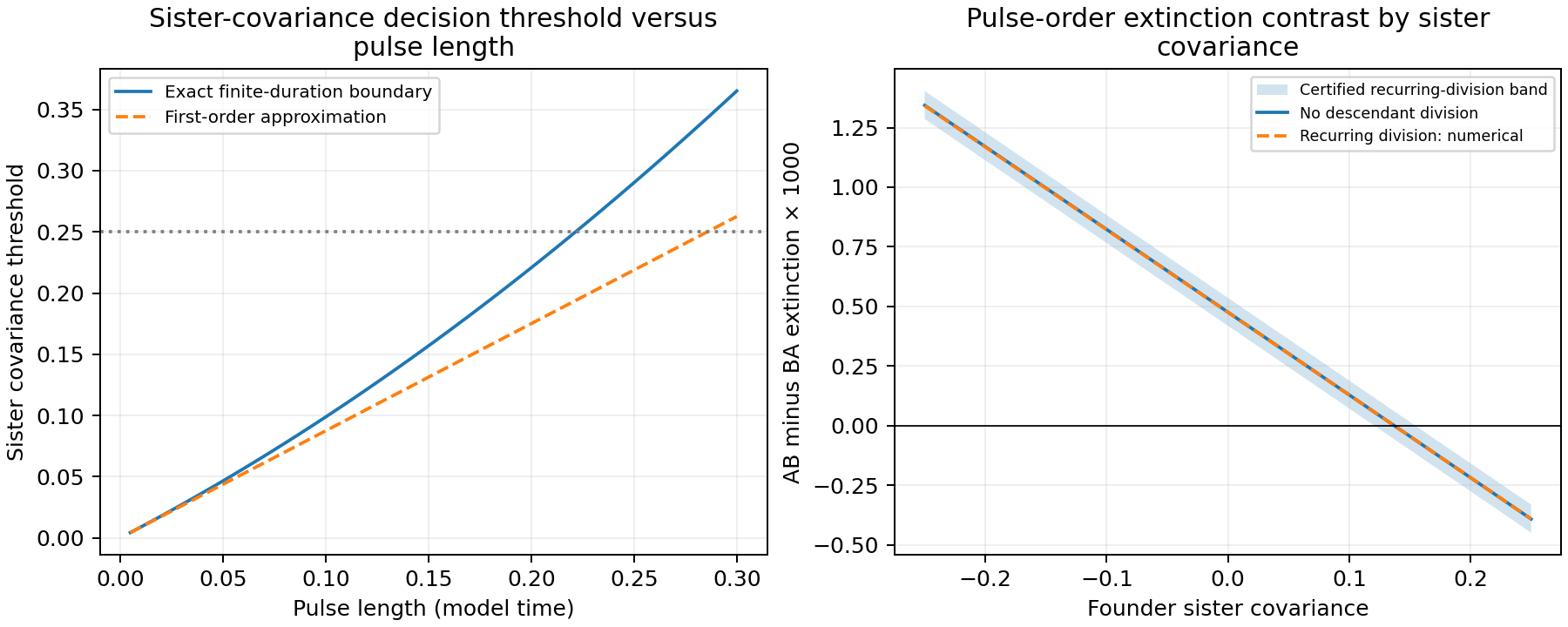
The reusable three-type branching model computes full-family extinction, while a separate observation component records only the specified retained branch. Exact finite-duration formulas locate the decision boundary above zero covariance. Fresh sensitivity-reserve calculations certify that the reversal survives recurring descendant division, including descendants dividing as fast as the founder at the shorter pulse length.
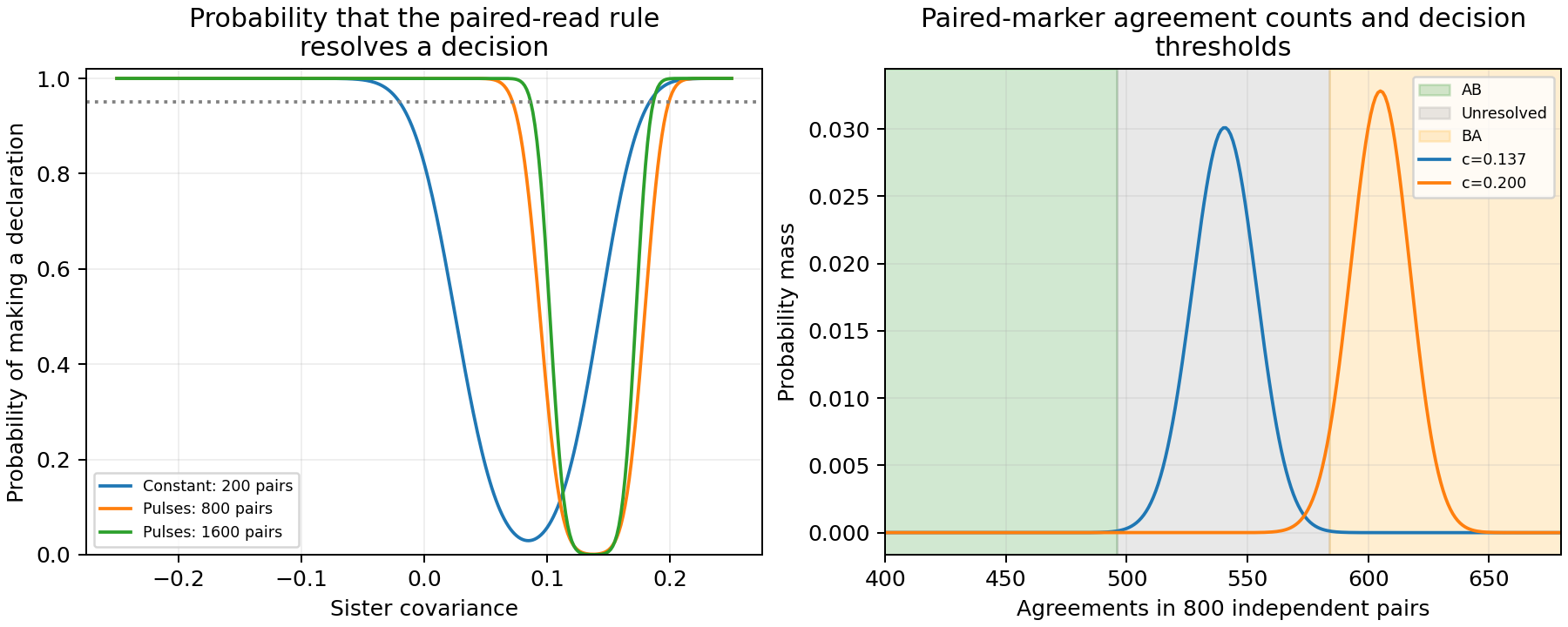
A paired-sister measurement supplies the missing coordinate. Exact binomial rules reproduce the separate constant-action and pulse-order decisions, with “unresolved” returned when the evidence does not cross the appropriate boundary. Editable inputs include pulse length, sister covariance, descendant division, persistent phenotype marginals, marker noise and observed agreement counts.
The example accounts for calibration uncertainty and correlated read errors, distinguishes resolution from correctness, and reports residual ambiguity in survival-risk units. The forty-division classification assumes a separated source class; it is not a general confidence rule.
The source is synthetic and the effect is a ranking mechanism: both reference pulse orders leave one-founder survival near 97%. The retained-history obstruction does not apply to full family trees, sister observations or molecular partitioning that determines the omitted sister by conservation. Numerical flow plots are distinguished from exact certificates; the stochastic comparison theorems are used from the paper.
Python source
"""Treatment order is a family decision; a retained branch omits sister coupling."""
from fractions import Fraction as F

# EDITABLE INPUTS. Synthetic paper rates, scaled to founder division hazard one.
EXP_MINUS_PULSE=F(7,8)       # exact x=exp(-h); use 49/50 for the short-pulse case
FOUNDER_COVARIANCE=F(1,5)
DESCENDANT_DIVISION=F(1,100)
USE_PERSISTENT_MARGINALS=False
DESCENDANT_COVARIANCES=(F(-1,10),F(1,10))
INITIAL_COUNTS=(1,0,0)       # P,S,T; independent founders conditional on this source
MARKER_FLIP_PROBABILITY=F(1,10)
ACCEPTED_DIVISIONS=800
OBSERVED_AGREEMENTS=600      # illustrative supplied data, not an experimental claim
ERROR_PROBABILITY=F(1,20)
FOUNDER_MEAN_WAIT_HOURS=24   # illustrative scaling only
SEED=6801
MANUSCRIPT_SHA256='fdce95c103c6e2c3f7570d8993029d8e24e331f8a011a269ab6512db853bada3'

import argparse,csv,hashlib,json,platform
from pathlib import Path
from math import log,ceil
import numpy as np
from branching import SisterKernel,FamilySource,RetainedBranchExperiment,Phase,A,B
from certificates import ReferenceCertificate,boundary,pulse_extinction,constant_extinction
from assay import SymmetricReadout,PairedDecisionRule,tail,binomial_confidence_interval,project_covariance,calibrated_free_pulse_choice,covariance_sign,minimax_regret


def enclosure(value,grid=10**15):
    v=F(value);return (F(v.numerator*grid//v.denominator,grid),F(ceil(v*grid),grid))


def symbolic_checks():
    import sympy as s
    x,c=s.symbols('x c');aa=(x**4+x**3+x*x+x+1)*(3*x**5+6*x**4+9*x**3+12*x*x+8*x+4)
    qq=3*x**8+12*x**7+30*x**6+60*x**5+98*x**4+137*x**3+170*x*x+159*x+66
    def bb(r,t):return (x**(t+1)-x**(r+t))/(r-1)+(x*x-x**(t+1))/(t-1)
    def ext(r,t):return 1-x*x-bb(r[0],t[0])-bb(r[1],t[1])+(s.Rational(1,4)+c)*(bb(2*r[0],2*t[0])+bb(2*r[1],2*t[1]))+(s.Rational(1,2)-2*c)*bb(sum(r),sum(t))
    factor=x*x*(x-1)**3*(4*c*aa+(x-1)*qq)/210
    assert s.cancel(ext((2,4),(3,3))-ext((3,3),(2,4))-factor)==0
    cp=(1-x)*qq/(4*aa);P=s.Poly(s.cancel(-s.diff(cp,x)*4*aa**2),x)
    assert all(a>0 for a in P.all_coeffs())
    assert boundary(F(80120,100000))[0]>F(1,4)>boundary(F(80121,100000))[0]
    assert aa.subs(x,1)==210 and qq.subs(x,1)==735
    return dict(factorization=str(factor),positive_derivative_numerator=[int(a) for a in P.all_coeffs()],unique_boundary_x=(F(80120,100000),F(80121,100000)),
        interpretation='cp decreases with x and increases with h=-log(x). For LONGER pulses beyond the crossing AB wins for all feasible c; for shorter pulses both preferences exist.',
        source_note='The manuscript Figure 2 caption reverses its below/above-h0 description. This example follows Proposition 3 and the directly checked monotonicity.')


def main():
    parser=argparse.ArgumentParser();parser.add_argument('--output',type=Path,default=Path('outputs'));args=parser.parse_args();out=args.output;out.mkdir(parents=True,exist_ok=True)
    def default(v):
        if isinstance(v,F):return str(v)
        if isinstance(v,np.ndarray):return v.tolist()
        if isinstance(v,np.generic):return v.item()
        raise TypeError(type(v).__name__)
    def dump(name,value):(out/name).write_text(json.dumps(value,default=default,indent=2)+'\n',encoding='utf-8')
    def table(name,header,rows):
        with (out/name).open('w',newline='',encoding='utf-8') as f:w=csv.writer(f);w.writerow(header);w.writerows(rows)
    ref=ReferenceCertificate(EXP_MINUS_PULSE,DESCENDANT_DIVISION,arbitrary_descendants=USE_PERSISTENT_MARGINALS)
    h=-log(float(EXP_MINUS_PULSE));kernel=SisterKernel(F(1,2),FOUNDER_COVARIANCE)
    descendants=(SisterKernel(F(3,5),DESCENDANT_COVARIANCES[0]),SisterKernel(F(2,5),DESCENDANT_COVARIANCES[1])) if USE_PERSISTENT_MARGINALS else None
    model=FamilySource(kernel,DESCENDANT_DIVISION,descendants);phases={'AB':[Phase(A,h),Phase(B,h)],'BA':[Phase(B,h),Phase(A,h)]}
    configured={name:dict(extinction_vector=model.extinction(seq),configuration_extinction=model.founder_configuration_extinction(seq,INITIAL_COUNTS)) for name,seq in phases.items()}
    band=ref.band('pulses');gap=band.low_minus_high_extinction_interval(FOUNDER_COVARIANCE)
    dump('configured_source.json',dict(x=EXP_MINUS_PULSE,pulse=h,epsilon=DESCENDANT_DIVISION,founder_kernel=kernel.entries,descendant_kernels=[k.entries for k in model.descendants],initial_counts=INITIAL_COUNTS,
        results=configured,certified_single_P_gap=gap,certified_choice=band.decide(FOUNDER_COVARIANCE),pulse_hours=h*FOUNDER_MEAN_WAIT_HOURS,
        scope='Exact reserve certifies one P founder under the fixed A/B response law. Configuration products and ODE values are numerical diagnostics. Independent P replication preserves the rank but changes its magnitude.'))
    dump('symbolic_checks.json',symbolic_checks())
    reference=[];reserve_outputs={}
    for x,cw,e in [(F(7,8),F(1,5),F(1,30)),(F(7,8),F(1,4),F(1,16)),(F(49,50),F(1,4),F(1))]:
        r=ReferenceCertificate(x,e,arbitrary_descendants=True);bb=r.band('pulses');left=bb.low_minus_high_extinction_interval(-cw);right=bb.low_minus_high_extinction_interval(cw)
        assert left[0]>0>right[1]
        reference.append(dict(x=x,covariance_magnitude=cw,epsilon_max=e,negative_covariance_gap=left,positive_covariance_gap=right,minimum_gap=min(left[0],-right[1]),certified_epsilon_supremum=r.reversal_range(cw)))
        reserve_outputs[str(x)]=dict(log_interval=r.h,polynomials=r.polynomials,sensitivity_intervals=r.W,occupation=r.V)
    dump('recurring_division_certificates.json',dict(cases=reference,reserves=reserve_outputs,scope='Fresh rational/log enclosures plus the manuscript comparison theorem. Arbitrary type-dependent descendant kernels satisfy the checked supersolution criterion at these pulse lengths.'))
    # Exact record-law signatures are the evidence; matched sample paths illustrate.
    low=FamilySource(SisterKernel(F(1,2),F(-1,5)),F(1,30));high=FamilySource(SisterKernel(F(1,2),F(1,5)),F(1,30))
    sig=low.observation_signature([A,B]);assert sig==high.observation_signature([A,B])
    means={a.label:low.mean_operator(a) for a in [A,B]};assert all(low.mean_operator(a)==high.mean_operator(a) for a in [A,B])
    longphases=[Phase(A,1),Phase(B,1)];records=[]
    for seed in range(SEED,SEED+40):
        a=RetainedBranchExperiment(low).sample(longphases,seed);b=RetainedBranchExperiment(high).sample(longphases,seed);assert a==b;records.append(a)
    dump('observation_equivalence.json',dict(signature=sig,mean_operators=means,scope='Common life-event clocks and retained-state kernels give exact equality of complete pruned history laws, including under shared retained-history policies. Equality of forty coupled numerical records is an illustration, not the proof. Hidden sister/family observations, survivor selection and molecular-conservation constraints are excluded.'))
    dump('retained_records.json',records)
    # Fixed finite-sample rules: distinct tasks have distinct thresholds/orientations.
    assayref=ReferenceCertificate(F(7,8),F(1,100));rules={};resolution=[]
    for name,task,n,expected in [('constant200','constant',200,(106,137)),('pulse800','pulses',800,(496,584)),('pulse1600','pulses',1600,(1009,1153))]:
        rule=PairedDecisionRule(assayref.assay_band(task),n);assert (rule.low_cut,rule.high_cut)==expected
        probabilities={str(c):{key:enclosure(v) for key,v in rule.probabilities(c).items()} for c in [F(-1,5),F(1,5)]}
        assert rule.probabilities(F(1,5))['resolution']>F(19,20)
        rules[name]=dict(n=n,low_action=rule.band.low_action,high_action=rule.band.high_action,low_cut=rule.low_cut,high_cut=rule.high_cut,p_minus=rule.p_minus,p_plus=rule.p_plus,probability_enclosures=probabilities,
            boundary_error_enclosures=(enclosure(tail(n,rule.p_minus,rule.low_cut)),enclosure(tail(n,rule.p_plus,rule.high_cut,upper=True))))
    constant=ReferenceCertificate(F(7,8),F(1,4)).band('constant');slope=constant.slope;t=constant.threshold;read=SymmetricReadout()
    separated=(tail(40,read.agreement(t-F(1,10)),25,upper=True),tail(40,read.agreement(t+F(1,10)),24))
    assert max(separated)<F(1,20) and constant.decide(t-F(1,10))=='B' and constant.decide(t+F(1,10))=='A'
    dump('paired_rules.json',dict(full_class=rules,separated40=dict(choose_A_at_least=25,error_intervals=[enclosure(v) for v in separated],epsilon_max=F(1,4),assumed_covariance_separation=F(1,10)),
        scope='Independent accepted founder divisions; known symmetric conditionally independent read errors. Full-class error is unconditional and permits unresolved output. The forty-division rule assumes separation; it cannot certify separation from the data.'))
    current=PairedDecisionRule(ref.assay_band('pulses'),ACCEPTED_DIVISIONS,SymmetricReadout(MARKER_FLIP_PROBABILITY),ERROR_PROBABILITY)
    bitinterval=binomial_confidence_interval(ACCEPTED_DIVISIONS,OBSERVED_AGREEMENTS,ERROR_PROBABILITY,bits=28)
    k=current.readout.attenuation;covinterval=project_covariance(bitinterval,(k,k));Dinterval=band.low_minus_high_extinction_interval(*covinterval);Rinterval=(-Dinterval[1],-Dinterval[0])
    dump('configured_assay.json',dict(accepted_divisions=ACCEPTED_DIVISIONS,observed_agreements=OBSERVED_AGREEMENTS,decision=current.decide(OBSERVED_AGREEMENTS),cutoffs=(current.low_cut,current.high_cut),
        bit_confidence_interval=bitinterval,covariance_interval=covinterval,confidence_set_choice=band.decide(*covinterval),extinction_gap_interval=Dinterval,survival_risk_difference_interval=Rinterval,minimax=minimax_regret(Rinterval),
        scope='Illustrative input counts. Direct tail rule uses a conservatively rounded reserve; the confidence-set route uses outward bisection. Their cutoffs need not coincide at machine-close boundaries.'))
    aliases=[(F(1,20),F(0)),(F(1,5),F(1,4))];assert all(SymmetricReadout(eta).agreement(c)==F(3,5) for c,eta in aliases)
    dump('calibration_and_cost.json',dict(same_bit_law_different_decisions=[dict(c=c,eta=eta,agreement=F(3,5),constant_choice=assayref.band('constant').decide(c)) for c,eta in aliases],
        uncertain_calibration_projection=project_covariance((F(59,100),F(61,100)),(F(1,4),F(1))),
        calibration_free_examples={str(I):calibrated_free_pulse_choice(assayref.band('pulses'),I) for I in [(F(3,10),F(49,100)),(F(81,100),F(82,100)),(F(59,100),F(61,100))]},
        correlated_error_examples=dict(positive=covariance_sign((F(2,100),F(3,100)),F(1,100)),unresolved=covariance_sign((F(2,100),F(3,100)),F(3,100))),
        paired_effort=dict(deadline_rate=1,expected_roots=2*ACCEPTED_DIVISIONS,expected_founder_time=ACCEPTED_DIVISIONS,no_timeout_roots=ACCEPTED_DIVISIONS,calibration_and_read_cost='additional'),
        scope='Calibration coverage must be charged jointly; the examples are supplied parameter sets, not estimated calibration. Correlated-error signs require a bound on mean conditional error covariance and the stated conditional-mean model. Expected collection cost is not a fixed-budget guarantee.'))
    # Matched sufficient direct-endpoint benchmark, not an optimality claim.
    g=slope/10-assayref.epsilon*assayref.W['A'][1];n=ceil(6*(F(12,1000)+2*g/3)/g**2)
    assert n==2688960
    fab=pulse_extinction(F(7,8),F(1,5),'AB');fba=pulse_extinction(F(7,8),F(1,5),'BA')
    dump('effect_and_effort.json',dict(direct_roots=2*n,per_arm=n,gap_lower=g,founders={str(n):dict(AB=fab**n,BA=fba**n,absolute_gap=fba**n-fab**n) for n in [1,2,10]},
        retained_only_worst_case_choice_error_lower=F(1,2),scope='Direct endpoint budget is a sufficient Bernstein bound for the same separated constant-action task at epsilon<=0.01. It does not establish an optimal sample-complexity advantage. One-founder survival stays near 97%; this is a ranking mechanism, not effective eradication.'))
    curve=[]
    for c in np.linspace(-.25,.25,41):
        source=FamilySource(SisterKernel(F(1,2),F(str(c))),DESCENDANT_DIVISION)
        d=source.extinction(phases['AB'])[0]-source.extinction(phases['BA'])[0];lo,hi=band.low_minus_high_extinction_interval(F(str(c)))
        curve.append((c,float(ref.reference_gap(F(str(c)))),d,float(lo),float(hi)))
    table('decision_curve.csv',['covariance','reference_gap','numerical_recurring_gap','certified_lower','certified_upper'],curve)
    scaling=[]
    for x in [F(7,8),F(49,50),F(99,100),F(999,1000),F(9999,10000)]:
        rr=ReferenceCertificate(x);cp,s=boundary(x);scaling.append((str(x),float(rr.h[1]),float(cp),float(rr.reversal_range(F(1,4))),float(rr.W['BA'][1]/s/rr.h[1])))
    table('short_pulse_scaling.csv',['x','pulse','threshold','certified_epsilon_supremum','band_halfwidth_per_epsilon_per_pulse'],scaling)
    plot(out,curve,rules,assayref)
    print(f'Configured single-P pulse choice: {band.decide(FOUNDER_COVARIANCE)}; paired-read decision: {current.decide(OBSERVED_AGREEMENTS)}.',flush=True)
    print('Exact recurring-division reversals, three full-class assay rules and the separate forty-division classification checked. Identical retained records omit the required sister dependence.',flush=True)
    here=Path(__file__).parent;digest=lambda p:hashlib.sha256(p.read_bytes()).hexdigest()
    dump('run_metadata.json',dict(manuscript_sha256=MANUSCRIPT_SHA256,source_sha256=digest(Path(__file__)),python=platform.python_version(),module_sha256={p.name:digest(p) for p in sorted(here.glob('*.py')) if p.name not in ['example.py','test_example.py']},output_sha256={p.name:digest(p) for p in sorted(out.iterdir()) if p.is_file() and p.name!='run_metadata.json'}))


def plot(out,curve,rules,reference):
    import matplotlib
    matplotlib.use('Agg')
    import matplotlib.pyplot as plt
    from scipy.stats import binom
    fig,axs=plt.subplots(1,2,figsize=(10,4),layout='constrained')
    hs=np.linspace(.005,.3,120);cp=[float(boundary(F(str(np.exp(-h))))[0]) for h in hs]
    axs[0].plot(hs,cp,label='Exact finite-duration boundary');axs[0].plot(hs,7*hs/8,ls='--',label='First-order approximation');axs[0].axhline(.25,color='gray',ls=':');axs[0].set(xlabel='Pulse length (model time)',ylabel='Sister covariance threshold',title='Sister-covariance decision threshold versus\npulse length');axs[0].legend(fontsize=8)
    data=np.array(curve);axs[1].fill_between(data[:,0],1e3*data[:,3],1e3*data[:,4],alpha=.2,label='Certified recurring-division band');axs[1].plot(data[:,0],1e3*data[:,1],label='No descendant division');axs[1].plot(data[:,0],1e3*data[:,2],ls='--',label='Recurring division: numerical');axs[1].axhline(0,color='black',lw=.7);axs[1].set(xlabel='Founder sister covariance',ylabel='AB minus BA extinction × 1000',title='Pulse-order extinction contrast by sister\ncovariance');axs[1].legend(fontsize=7)
    for ax in axs:ax.grid(alpha=.2)
    fig.savefig(out/'family_decision.png',dpi=180);fig.savefig(out/'family_decision.svg');plt.close(fig)
    fig,axs=plt.subplots(1,2,figsize=(10,4),layout='constrained')
    c=np.linspace(-.25,.25,301);p=.5+1.28*c
    for name,label in [('constant200','Constant: 200 pairs'),('pulse800','Pulses: 800 pairs'),('pulse1600','Pulses: 1600 pairs')]:
        r=rules[name];resolution=binom.cdf(r['low_cut'],r['n'],p)+binom.sf(r['high_cut']-1,r['n'],p);axs[0].plot(c,resolution,label=label)
    axs[0].axhline(.95,color='gray',ls=':');axs[0].set(xlabel='Sister covariance',ylabel='Probability of making a declaration',title='Probability that the paired-read rule\nresolves a decision',ylim=(0,1.02));axs[0].legend(fontsize=7)
    r=rules['pulse800'];axs[1].axvspan(0,r['low_cut'],color='green',alpha=.18,label='AB');axs[1].axvspan(r['low_cut'],r['high_cut'],color='gray',alpha=.18,label='Unresolved');axs[1].axvspan(r['high_cut'],800,color='orange',alpha=.18,label='BA');counts=np.arange(801)
    for cc in [.137064,.2]:axs[1].plot(counts,binom.pmf(counts,800,.5+1.28*cc),label=f'c={cc:.3f}')
    axs[1].set(xlabel='Agreements in 800 independent pairs',ylabel='Probability mass',xlim=(400,680),title='Paired-marker agreement counts and decision\nthresholds');axs[1].legend(fontsize=7)
    for ax in axs:ax.grid(alpha=.2)
    fig.savefig(out/'paired_assay.png',dpi=180);fig.savefig(out/'paired_assay.svg');plt.close(fig)


if __name__=='__main__':main()
Run output
Configured single-P pulse choice: BA; paired-read decision: BA.
Exact recurring-division reversals, three full-class assay rules and the separate forty-division classification checked. Identical retained records omit the required sister dependence.