Example code
Two antioxidant branches can each meet their target turnover rate alone, yet fall short when sharing the NADPH that supplies their reducing power. This example implements the paper's maintained glutathione-peroxidase (GPx)/glutathione and peroxiredoxin (Prx)/thioredoxin system, retaining private enzyme and carrier inventories—including enzyme-bound glutathione—and one shared regeneration balance.
The source must meet actual kinetic demand. A branch can consume more NADPH than its minimum quota, so adding the quotas alone underestimates the required capacity. Removing a branch, relaxing its requirement, and changing its enzyme inventory have different effects.
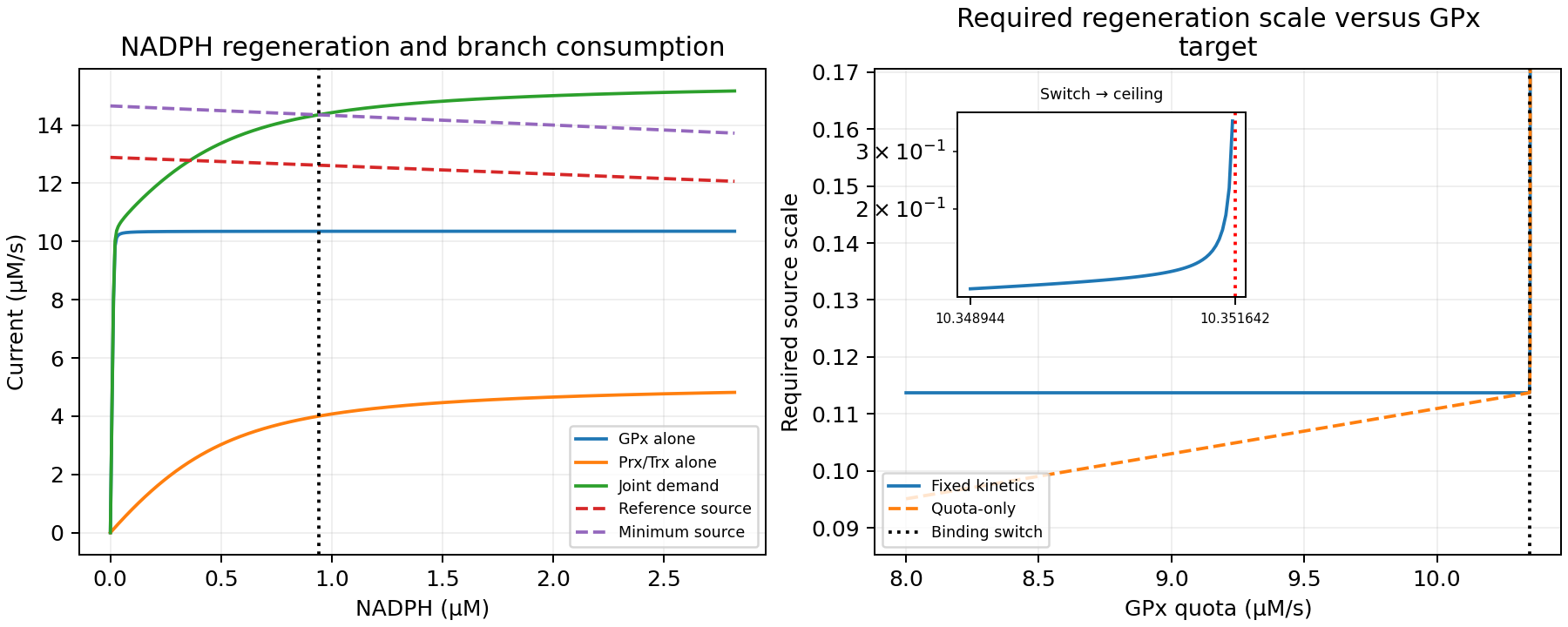
At the nominal source setting, separate preparations deliver about 10.35 and 5.13 μM/s, exceeding their quotas of 10 and 4. Coupling them gives 10.34 and 2.44, so the thioredoxin requirement fails. The attained minimum regeneration scale is 0.113712668, a 13.71% increase. Fresh rational arithmetic checks the paper's narrow enclosure; the full model independently reconstructs every steady species and verifies its balances.
The quota-only estimate misses glutathione-branch overdelivery. Reducing the declared GPx pool by about 3.37% removes that overhead and attains the quota-only lower bound. The code checks both algebraic redesign candidates and identifies the one using less enzyme. Lowering the GPx quota alone does not change its kinetic consumption. Quotas at or above finite-pool ceiling currents cannot be repaired by any finite regeneration capacity.
Editable inputs sit at the top of the runnable model. Separate components handle carrier responses, biochemical branches, regeneration, service decisions, species reconstruction, the full eight-variable kinetics, and enzyme redesign. Outputs include quota sweeps, all-state transient trajectories, maintained-input accounting, and a conservative exact parameter-box bound.
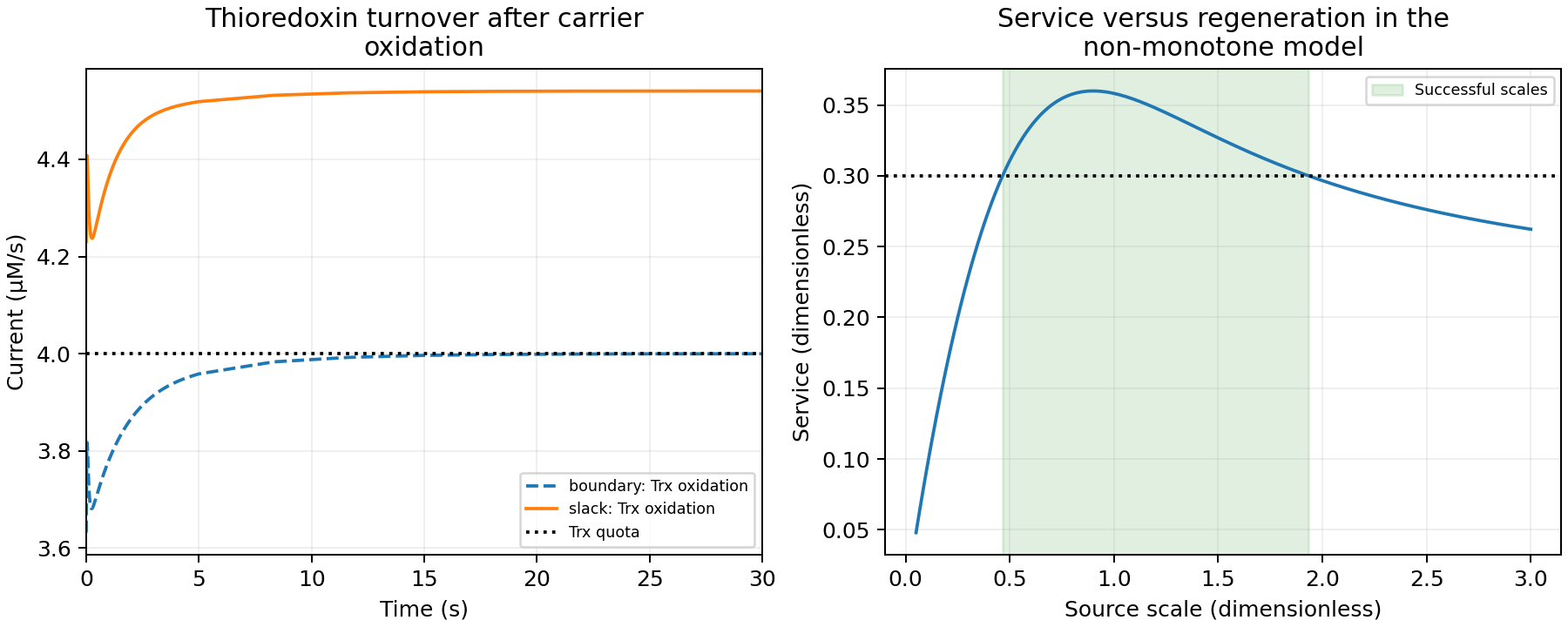
The steady-state theorem does not guarantee transient service. Perturbations at the boundary can temporarily break the thioredoxin quota, while a setting with slack performs better in the sampled runs. A separate analytic example shows that non-monotone service can have an upper regeneration limit even with a unique stable equilibrium.
The nominal rates are source-derived effective parameters for a declared maintained preparation; the quotas are design requirements. Peroxide supply, regeneration drive, and Prx repair remain external inputs. Numerical trajectories do not establish global convergence or continuous-time quota guarantees. Lean is not rerun, and the example makes no whole-cell or clinical claim.
Python source
"""Shared NADPH: retained-state kinetics, exact thresholds, and a usable design model.

Run: python example.py --output outputs. Concentrations uM; time seconds.
The main inputs are immediately below. The exact paper audit stays fixed and is
reported separately from any edited preparation. See README for evidence scope.
"""
from __future__ import annotations
import argparse
import csv
from dataclasses import dataclass, replace, asdict
from fractions import Fraction as F
import hashlib
import json
import math
from pathlib import Path
import platform
from typing import Protocol
import numpy as np
from scipy.integrate import solve_ivp
from scipy.optimize import brentq

# EDITABLE PREPARATION: paper Table 1, source-derived effective kinetics.
# a_G, a_T, b_T already incorporate a maintained peroxide concentration 0.01 uM.
# Editing that challenge requires changing the peroxide-dependent rates too.
GPX = dict(G=371.56, z0=1.78, E=50., a=.21, b=.04, c=10., k=3.2)
TRX = dict(T=.505, z0=.075, E=19.096, a=.4, b=.00072, c=.003, d=15., e=2.1, k=20.)
SOURCE = dict(P=30.3, P0=.3, K=57., V=375.)
QUOTAS = (10., 4.)  # design requirements, uM/s; not health thresholds
REFERENCE_SCALE = .1
SLACK_SCALE = .12
SOURCE_TOLERANCE = .05  # family of constant multiplicative settings
HORIZON = 2000.
CARRIER_PERTURBATION = (1., .02)  # increases to z and zT, uM
ENZYME_PERTURBATION = (.2, .05)  # increases to e1 and h, uM
MANUSCRIPT_SHA256 = 'b1f97e45d58820881a8f2d779660a9f6e27270fadf9df8596477b2a7c787becd'


def positive(**values):
    if any(not math.isfinite(float(v)) or v <= 0 for v in values.values()):
        raise ValueError('Finite positive values required: '+', '.join(values))


@dataclass(frozen=True)
class QuadraticResponse:
    """Au²+(B+C/x)u-Gamma=0; j=pu/(vu+w). B may be negative."""
    A: float
    B: float
    C: float
    Gamma: float
    p: float
    v: float
    w: float

    def __post_init__(self):
        positive(A=self.A, C=self.C, Gamma=self.Gamma, p=self.p, w=self.w)
        if not math.isfinite(float(self.B)) or not math.isfinite(float(self.v)) or self.v < 0:
            raise ValueError('B finite; v finite and nonnegative')

    def polynomial(self, x, u):
        return self.A*u*u+(self.B+self.C/x)*u-self.Gamma

    def carrier(self, x):
        if x == 0: return 0.
        positive(x=x)
        beta=float(self.B+self.C/x)
        disc=math.hypot(beta, 2*math.sqrt(float(self.A*self.Gamma)))
        # Avoid cancellation and also avoid overflow in beta+disc.
        return float(self.Gamma)/(beta/2+disc/2) if beta >= 0 else (-beta/2+disc/2)/float(self.A)

    def current_from_carrier(self, u):
        return self.p*u/(self.v*u+self.w)

    def current(self, x):
        return self.current_from_carrier(self.carrier(x))

    def invert(self, quota):
        positive(quota=quota)
        den=self.p-quota*self.v
        if den <= 0: raise ValueError('Quota reaches the kinetic asymptote')
        Y=quota*self.w/den
        delta=self.Gamma-self.A*Y*Y-self.B*Y
        if delta <= 0: raise ValueError('No finite positive NADPH floor')
        return Y, self.C*Y/delta

    def derivative(self, x):
        u=self.carrier(x); beta=self.B+self.C/x
        du=self.C*u/(x*x*(2*self.A*u+beta))
        return self.p*self.w*du/(self.v*u+self.w)**2

    def enclose(self, x, steps=100):
        """Fresh rational bisection, with no floating root used as evidence."""
        if not isinstance(x, F) or x <= 0: raise ValueError('Positive Fraction x required')
        lo,hi=F(0),F(1)
        while self.polynomial(x,hi) < 0: hi *= 2
        for _ in range(steps):
            mid=(lo+hi)/2
            if self.polynomial(x,mid) <= 0: lo=mid
            else: hi=mid
        return lo,hi


@dataclass(frozen=True)
class GlutathioneBranch:
    G: float; z0: float; E: float; a: float; b: float; c: float; k: float

    def __post_init__(self):
        positive(G=self.G,E=self.E,a=self.a,b=self.b,c=self.c,k=self.k)
        if not math.isfinite(float(self.z0)) or self.z0 < 0: raise ValueError('Invalid GSSG baseline')
        self.response  # enforce positive-pool condition at construction

    @property
    def rho(self): return self.a*(1/self.b+1/self.c)
    @property
    def S(self): return self.G-2*self.z0
    @property
    def response(self):
        return QuadraticResponse(1,self.rho-self.S,2*self.E*self.a/self.k,
            self.S*self.rho-self.E*self.a/self.c,self.E*self.a,1,self.rho)

    def reconstruct(self,x):
        positive(x=x); g=self.response.carrier(x); j=self.response.current_from_carrier(g)
        return dict(g=g,z=self.z0+j/(self.k*x),e0=j/self.a,e1=j/(self.b*g),e2=j/(self.c*g),jG=j)

    def redesign(self,x,quota):
        """Both algebraic candidates, with admissibility checked independently."""
        positive(x=x,quota=quota)
        B=self.S-2*quota/(self.k*x); C=quota/self.c; disc=B*B-4*C
        if B <= 0 or disc < 0: return []
        large=(B+math.sqrt(disc))/2
        roots=[large] if disc == 0 else [large,C/large]
        result=[]
        for g in roots:
            E=quota*(g+self.rho)/(self.a*g)
            try:
                branch=replace(self,E=E); state=branch.reconstruct(x)
                admissible=min(state.values()) > 0 and abs(state['jG']-quota) < 1e-8*quota
            except ValueError: admissible=False
            result.append(dict(g=g,E=E,admissible=admissible))
        return result


@dataclass(frozen=True)
class ThioredoxinBranch:
    T: float; z0: float; E: float; a: float; b: float; c: float; d: float; e: float; k: float

    def __post_init__(self):
        positive(T=self.T,E=self.E,a=self.a,c=self.c,d=self.d,e=self.e,k=self.k)
        if any(not math.isfinite(float(v)) or v < 0 for v in [self.z0,self.b]): raise ValueError('Invalid baseline/hyperoxidation rate')
        self.response

    @property
    def rho(self): return 1/self.a+1/self.d+self.b/(self.c*self.d)
    @property
    def S(self): return self.T-self.z0
    @property
    def response(self):
        v=self.rho*self.e
        return QuadraticResponse(v,1-self.S*v,self.E*self.e/self.k,self.S,self.E*self.e,v,1)

    def reconstruct(self,x):
        positive(x=x); y=self.response.carrier(x); j=self.response.current_from_carrier(y)
        return dict(y=y,zT=self.z0+j/(self.k*x),r=j/self.a,h=j/self.d,
            w=self.b*j/(self.c*self.d),v=j/(self.e*y),jT=j)


class DecreasingSource(Protocol):
    """Contract: strictly decreasing, positive below N, zero at N."""
    N: float
    def unit_current(self,x): ...


@dataclass(frozen=True)
class Regeneration:
    P: float; P0: float; K: float; V: float
    def __post_init__(self):
        positive(P=self.P,K=self.K,V=self.V)
        if not math.isfinite(float(self.P0)) or not 0 <= self.P0 < self.P: raise ValueError('Require 0 <= P0 < P')
    @property
    def N(self): return self.P-self.P0
    @property
    def D(self): return self.K+self.P
    def unit_current(self,x): return self.V*(self.N-x)/(self.D-x)
    def derivative(self,x): return -self.V*(self.D-self.N)/(self.D-x)**2


@dataclass(frozen=True)
class InhibitedSource:
    """Illustrative product inhibition of source; not inhibition of a branch."""
    base: Regeneration
    KI: float
    def __post_init__(self): positive(KI=self.KI)
    @property
    def N(self): return self.base.N
    def unit_current(self,x): return self.base.unit_current(x)/(1+x/self.KI)


@dataclass(frozen=True)
class ServiceDesign:
    responses: tuple[QuadraticResponse,...]
    source: DecreasingSource

    def __post_init__(self):
        if not self.responses: raise ValueError('At least one branch required')

    def demand(self,x): return sum(r.current(x) for r in self.responses)

    def equilibrium(self,scale):
        positive(scale=scale)
        return brentq(lambda x:scale*self.source.unit_current(x)-self.demand(x),0,float(self.source.N),xtol=1e-14)

    def decision(self,quotas):
        if len(quotas) != len(self.responses): raise ValueError('One positive quota per branch')
        for q in quotas: positive(quota=q)
        ceilings=[r.current(self.source.N) for r in self.responses]
        if any(q >= c for q,c in zip(quotas,ceilings)):
            return dict(repairable=False,ceilings=ceilings,reason='A quota reaches a finite-pool ceiling')
        inv=[r.invert(q) for r,q in zip(self.responses,quotas)]; L=max(x for _,x in inv)
        currents=[r.current(L) for r in self.responses]; R=self.source.unit_current(L)
        return dict(repairable=True,ceilings=ceilings,carrier_floors=[y for y,_ in inv],
            nadph_floors=[x for _,x in inv],L=L,currents=currents,
            minimum=sum(currents)/R,quota_only=sum(quotas)/R,
            overdelivery=[j-q for j,q in zip(currents,quotas)],
            isolated=[q/self.source.unit_current(x) for q,(_,x) in zip(quotas,inv)])

    @staticmethod
    def robust_command(scale,tolerance):
        if not 0 <= tolerance < 1: raise ValueError('Tolerance in [0,1) required')
        return scale/(1-tolerance)


@dataclass(frozen=True)
class MaintainedKinetics:
    """Literal eight-state ODE. Equilibrium response curves are NOT a transient closure."""
    gpx: GlutathioneBranch
    trx: ThioredoxinBranch
    source: Regeneration
    coordinates=('x','z','e1','e2','zT','h','w','v')

    @property
    def design(self): return ServiceDesign((self.gpx.response,self.trx.response),self.source)

    def full(self,u):
        x,z,e1,e2,zT,h,w,v=u
        return dict(zip(self.coordinates,u),g=self.gpx.G-2*z-e2,e0=self.gpx.E-e1-e2,
            y=self.trx.T-zT,r=self.trx.E-h-w-v,nadp=self.source.P-x)

    def state(self,x):
        s=dict(x=x,**self.gpx.reconstruct(x),**self.trx.reconstruct(x))
        return np.array([s[k] for k in self.coordinates])

    def currents(self,u,scale):
        s=self.full(u); G,T=self.gpx,self.trx
        return dict(source=scale*self.source.unit_current(s['x']),phi0=G.a*s['e0'],
            phi1=G.b*s['g']*s['e1'],phi2=G.c*s['g']*s['e2'],psiG=G.k*s['x']*(s['z']-G.z0),
            thetaR=T.a*s['r'],thetaW=T.b*s['h'],thetaH=T.c*s['w'],thetaV=T.d*s['h'],
            thetaY=T.e*s['y']*s['v'],psiT=T.k*s['x']*(s['zT']-T.z0))

    def rhs(self,t,u,scale):
        c=self.currents(u,scale)
        return np.array([c['source']-c['psiG']-c['psiT'],c['phi2']-c['psiG'],
            c['phi0']-c['phi1'],c['phi1']-c['phi2'],c['thetaY']-c['psiT'],
            c['thetaR']+c['thetaH']-c['thetaW']-c['thetaV'],c['thetaW']-c['thetaH'],c['thetaV']-c['thetaY']])

    def margins(self,u):
        s=self.full(u)
        return np.array([s[k] for k in self.coordinates]+[s[k] for k in ['g','e0','y','r']]+
            [self.source.N-s['x'],s['z']-self.gpx.z0,s['zT']-self.trx.z0])

    def jacobian(self,u,scale):
        return np.column_stack([self.rhs(0,np.asarray(u,dtype=complex)+1e-20j*np.eye(8)[i],scale).imag/1e-20 for i in range(8)])

    def integrate(self,initial,scale,times):
        positive(scale=scale)
        if self.margins(initial).min() < -1e-12: raise ValueError('Initial state outside conserved physical domain')
        times=np.asarray(times)
        if len(times)<2 or times[0]!=0 or not np.all(np.diff(times)>0): raise ValueError('Increasing times starting at zero required')
        sol=solve_ivp(lambda t,u:self.rhs(t,u,scale),(0,times[-1]),initial,t_eval=times,
            method='Radau',rtol=2e-9,atol=2e-11,jac=lambda t,u:self.jacobian(u,scale))
        if not sol.success: raise RuntimeError(sol.message)
        if min(self.margins(u).min() for u in sol.y.T) < -1e-7: raise RuntimeError('Numerical physical-domain violation')
        return sol.y.T


def nominal(exact=False):
    conv=lambda d:{k:F(str(v)) for k,v in d.items()} if exact else d.copy()
    # Literal paper parameters: deliberately independent of the editable block.
    G=GlutathioneBranch(**conv(dict(G=371.56,z0=1.78,E=50,a=.21,b=.04,c=10,k=3.2)))
    T=ThioredoxinBranch(**conv(dict(T=.505,z0=.075,E=19.096,a=.4,b=.00072,c=.003,d=15,e=2.1,k=20)))
    R=Regeneration(**conv(dict(P=30.3,P0=.3,K=57,V=375)))
    return MaintainedKinetics(G,T,R)


def exact_paper_audit():
    M=nominal(True); G,T,R=M.gpx,M.trx,M.source
    yg,xg=G.response.invert(F(10)); yt,xt=T.response.invert(F(4)); L=max(xg,xt)
    assert xg==F(3294375,138400918) and xt==F(460180,489387) and yt==F(5000,23009)
    assert T.response.polynomial(L,yt)==0 and T.response.current_from_carrier(yt)==4
    glo,ghi=F('361.1185'),F('361.1186')
    assert G.response.polynomial(L,glo)<0<G.response.polynomial(L,ghi)
    slo=(G.response.current_from_carrier(glo)+4)/R.unit_current(L)
    shi=(G.response.current_from_carrier(ghi)+4)/R.unit_current(L)
    assert F('.11371266')<slo<shi<F('.11371268')
    tight=G.response.enclose(L)
    sq=F(14)/R.unit_current(L)
    # Isolation succeeds at s=.1; joint failure is already forced at the floor.
    assert F(10)/R.unit_current(xg)<F('.1') and F(4)/R.unit_current(xt)<F('.1')<slo
    # Ceiling tests use the inverted polynomial, without rounded ceiling currents.
    assert G.response.polynomial(R.N,yg)<0 and T.response.polynomial(R.N,yt)<0
    # Larger redesign root in (361,362) uses less enzyme; check its pool condition.
    B=G.S-20/(G.k*L); C=F(10)/G.c
    poly=lambda u:u*u-B*u+C
    assert poly(F(361))<0<poly(F(362))
    emax=10*(361+G.rho)/(G.a*361)
    assert 0<emax<G.E and G.S*G.rho>emax*G.a/G.c
    assert sq>F('.1')  # no admitted GPx-only redesign can avoid this lower bound
    # Exact enclosure gives e0<=50<g, hence opposite Jacobian off-diagonal signs.
    assert glo>G.E
    return dict(XG=xg,XT=xt,carrier_T=yt,carrier_G_bracket=[glo,ghi],scale_bracket=[slo,shi],
        tighter_scale_bracket=[(G.response.current_from_carrier(u)+4)/R.unit_current(L) for u in tight],
        quota_only=sq,redesign_GSH_bracket=[361,362],redesign_enzyme_upper=emax,
        separate_success_joint_failure=True,ceiling_tests=True,opposite_sign_pair=True,
        evidence='Fresh rational checks under the paper equations; Lean is not rerun')


def declared_parameter_box():
    """Appendix B: rational enclosure of a continuum, not a corner optimization."""
    M=nominal(True); G,T,R=M.gpx,M.trx,M.source
    emax=G.E*F(101,100); emin=G.E*F(99,100)
    tmax=T.E*F(101,100); tmin=T.E*F(99,100)
    yglo=10*G.rho/(emax*G.a-10); yghi=10*G.rho/(emin*G.a-10)
    ytlo=4/(tmax*T.e-4*T.rho*T.e); ythi=4/(tmin*T.e-4*T.rho*T.e)
    dg=G.S*G.rho-emax*G.a/G.c-yghi*yghi-(G.rho-G.S)*yglo
    dt=T.S-T.rho*T.e*ythi**2-(1-T.S*T.rho*T.e)*ytlo
    assert dg>0 and dt>0 and G.rho-G.S<0 and 1-T.S*T.rho*T.e<0
    xg=(2*emax*G.a/(G.k*F(19,20)))*yghi/dg
    xt=(tmax*T.e/(T.k*F(19,20)))*ythi/dt
    target=F(3,2)
    assert max(xg,xt)<target<R.N
    upper=emax*G.a*G.S/(G.S+G.rho)+tmax*T.e*T.S/(1+T.rho*T.e*T.S)
    scale=upper/R.unit_current(target)
    assert scale==F(11621793767394811,92312851976765625)
    return dict(threshold_upper=[xg,xt],target=target,demand_upper=upper,scale=scale,
        command_with_5pct_tolerance=scale/F('.95'),scope='Fixed nominal box: E +/-1%, reductase k +/-5%; sufficient, not optimal')


class NonmonotoneExample:
    """Dimensionless analytic counterexample, kept outside ServiceDesign's contract."""
    @staticmethod
    def current(x): return x*(1.2-x)
    @staticmethod
    def equilibrium(scale):
        positive(scale=scale)
        return 2*scale/(1.2+scale+math.sqrt((1.2+scale)**2-4*scale))
    @staticmethod
    def scale_interval(): return ((12-3*math.sqrt(6))/10,(12+3*math.sqrt(6))/10)


def write_table(path,header,rows):
    with path.open('w',newline='',encoding='utf-8') as f:
        w=csv.writer(f);w.writerow(header);w.writerows(rows)


def main():
    parser=argparse.ArgumentParser(description=__doc__);parser.add_argument('--output',default='outputs');args=parser.parse_args()
    out=Path(args.output);out.mkdir(parents=True,exist_ok=True)
    model=MaintainedKinetics(GlutathioneBranch(**GPX),ThioredoxinBranch(**TRX),Regeneration(**SOURCE))
    design=model.design;decision=design.decision(QUOTAS)
    result=dict(inputs=dict(GPX=GPX,TRX=TRX,SOURCE=SOURCE,quotas=QUOTAS),configured=decision,
        fixed_paper_exact=exact_paper_audit(),fixed_parameter_box=declared_parameter_box())
    # An edited impossible quota is a result, not a failed root solve.
    dump=lambda name,obj:(out/name).write_text(json.dumps(obj,indent=2,default=lambda v:str(v) if isinstance(v,F) else float(v))+'\n',encoding='utf-8')
    if not decision['repairable']:
        dump('results.json',result);print('No finite regeneration repair: a quota reaches its branch ceiling.');return
    L=decision['L'];sm=decision['minimum'];eq=model.state(L)
    result['boundary_state']=model.full(eq)
    result['boundary_residual']=float(np.max(np.abs(model.rhs(0,eq,sm))))
    result['source_capacity']=sm*model.source.V
    result['boundary_accounting']=dict(NADPH=sum(decision['currents']),
        peroxide=decision['currents'][0]+decision['currents'][1]*(1+model.trx.b/model.trx.d),
        external_Prx_repair=model.trx.b/model.trx.d*decision['currents'][1])
    result['constant_tolerance_command']=design.robust_command(sm,SOURCE_TOLERANCE)
    result['inhibited_source_example']=ServiceDesign(design.responses,InhibitedSource(model.source,5.)).decision(QUOTAS)
    isolated=[]
    for response in design.responses:
        x=ServiceDesign((response,),model.source).equilibrium(REFERENCE_SCALE)
        isolated.append(dict(x=x,current=response.current(x)))
    xjoint=design.equilibrium(REFERENCE_SCALE)
    result['reference_comparison']=dict(isolated=isolated,joint_x=xjoint,
        joint_currents=[r.current(xjoint) for r in design.responses])
    redesign=[]
    if decision['nadph_floors'][0] <= decision['nadph_floors'][1]:
        for candidate in model.gpx.redesign(L,QUOTAS[0]):
            if candidate['admissible']:
                other=replace(model,gpx=replace(model.gpx,E=candidate['E']))
                candidate['decision']=other.design.decision(QUOTAS)
                candidate['full_residual']=float(np.max(np.abs(other.rhs(0,other.state(L),decision['quota_only']))))
            redesign.append(candidate)
    result['redesign_candidates']=redesign
    traces=[];dynamics=[]
    times=np.unique(np.r_[np.linspace(0,min(5.,HORIZON),251),np.linspace(min(5.,HORIZON),HORIZON,601)])
    for scale,label in [(REFERENCE_SCALE,'reference'),(sm,'boundary'),(SLACK_SCALE,'slack')]:
        equilibrium=model.state(design.equilibrium(scale));jac=model.jacobian(equilibrium,scale)
        eigen=np.linalg.eigvals(jac)
        for kind in ['carrier oxidation','enzyme allocation']:
            initial=equilibrium.copy()
            if kind=='carrier oxidation': initial[[1,4]]+=CARRIER_PERTURBATION
            else: initial[[2,5]]+=ENZYME_PERTURBATION
            states=model.integrate(initial,scale,times);services=[];dist=[]
            for t,u in zip(times,states):
                c=model.currents(u,scale);err=float(max(abs(u-equilibrium)));dist.append(err)
                services.append([c['phi0'],c['thetaY']])
                traces.append([label,kind,t,*u,c['phi0'],c['thetaY'],c['psiG']+c['psiT'],
                    c['phi0']+c['thetaR']+c['thetaW'],c['thetaH'],err])
            services=np.array(services)
            dynamics.append(dict(setting=label,scale=scale,perturbation=kind,
                largest_eigen_real=float(max(eigen.real)),sampled_service_min=services.min(axis=0).tolist(),
                sampled_domain_min=float(min(model.margins(u).min() for u in states)),
                final_distance=dist[-1],equilibrium_residual=float(max(abs(model.rhs(0,equilibrium,scale))))))
    result['numerical_dynamics']=dynamics
    J=model.jacobian(eq,sm);result['orthant_obstruction_pair']=[J[2,3],J[3,2]]
    # Sweep from a low quota to near its finite-source ceiling, resolving the narrow GPx binding interval.
    sweep=[]
    for branch in [0,1]:
        switch=decision['currents'][branch];ceil=decision['ceilings'][branch]
        grid=np.unique(np.r_[np.linspace(.8*QUOTAS[branch],min(switch,ceil*.999999),90),
            np.linspace(switch,ceil-(ceil-switch)*.01,80)])
        for q in grid:
            qs=list(QUOTAS);qs[branch]=q;d=design.decision(qs)
            if d['repairable']: sweep.append([branch,q,d['L'],d['minimum'],d['quota_only']])
    nonmono=[[s,NonmonotoneExample.equilibrium(s),NonmonotoneExample.current(NonmonotoneExample.equilibrium(s))] for s in np.linspace(.05,3,180)]
    result['nonmonotone_dimensionless']=dict(success_scale_interval=NonmonotoneExample.scale_interval(),unique_equilibrium=True,
        explanation='h derivative = ((1-x)^2+1/5)/(1-x)^2 >0; more source eventually breaks the quota')
    write_table(out/'transients.csv',['setting','perturbation','time_s',*model.coordinates,'GPx_peroxide','Trx_oxidation','NADPH_demand','total_peroxide','Prx_repair','state_distance'],traces)
    write_table(out/'quota_sweep.csv',['branch','quota_uM_per_s','NADPH_floor_uM','minimum_scale','quota_only_scale'],sweep)
    write_table(out/'nonmonotone.csv',['scale','x','current'],nonmono)
    write_table(out/'boundary_species.csv',['species','uM'],result['boundary_state'].items())
    dump('results.json',result)
    lines=[f'Both separate currents at s={REFERENCE_SCALE}: '+', '.join(format(v['current'],'.9f') for v in isolated),
        f'Joint currents: '+', '.join(f'{r.current(xjoint):.9f}' for r in design.responses),
        f'Minimum scale {sm:.12f}; quota-only {decision["quota_only"]:.12f}; capacity {sm*model.source.V:.9f} uM/s.',
        f'Boundary NADPH demand {sum(decision["currents"]):.9f} uM/s; full ODE residual {result["boundary_residual"]:.3g}.',
        'Exact paper audit and parameter-box bounds passed. Dynamic stability and transient service are numerical only.']
    (out/'console.txt').write_text('\n'.join(lines)+'\n');print('\n'.join(lines))
    plot(out,model,decision,traces,sweep,nonmono)
    digest=lambda p:hashlib.sha256(p.read_bytes()).hexdigest()
    dump('run_metadata.json',dict(manuscript_sha256=MANUSCRIPT_SHA256,source_sha256=digest(Path(__file__)),
        python=platform.python_version(),output_sha256={p.name:digest(p) for p in sorted(out.iterdir()) if p.is_file() and p.name!='run_metadata.json'}))


def plot(out,model,d,traces,sweep,nonmono):
    import matplotlib
    matplotlib.use('Agg')
    import matplotlib.pyplot as plt
    fig,axs=plt.subplots(1,2,figsize=(10,4),layout='constrained')
    xs=np.linspace(0,min(model.source.N,3*d['L']),400)
    for i,label in enumerate(['GPx alone','Prx/Trx alone']):axs[0].plot(xs,[model.design.responses[i].current(x) for x in xs],label=label)
    axs[0].plot(xs,[model.design.demand(x) for x in xs],label='Joint demand')
    for s,label in [(REFERENCE_SCALE,'Reference source'),(d['minimum'],'Minimum source')]:axs[0].plot(xs,[s*model.source.unit_current(x) for x in xs],'--',label=label)
    axs[0].axvline(d['L'],color='k',ls=':');axs[0].set(xlabel='NADPH (μM)',ylabel='Current (μM/s)',title='NADPH regeneration and branch consumption');axs[0].legend(fontsize=7)
    data=np.array(sweep);a=data[data[:,0]==0]
    # Use NADPH floor to expose the tiny quota interval without collapsing the switch and ceiling.
    axs[1].plot(a[:,1],a[:,3],label='Fixed kinetics');axs[1].plot(a[:,1],a[:,4],'--',label='Quota-only');axs[1].axvline(d['currents'][0],ls=':',color='k',label='Binding switch')
    axs[1].set(xlabel='GPx quota (μM/s)',ylabel='Required source scale',ylim=(.75*d['minimum'],1.5*d['minimum']),title='Required regeneration scale versus GPx\ntarget');axs[1].legend(fontsize=7,loc='lower left')
    inset=axs[1].inset_axes([.12,.53,.42,.38]);tail=a[a[:,1]>=d['currents'][0]];inset.plot(tail[:,1],tail[:,3]);inset.axvline(d['ceilings'][0],ls=':',color='r');inset.tick_params(labelsize=6);inset.set_xticks([d['currents'][0],d['ceilings'][0]],[format(d['currents'][0],'.6f'),format(d['ceilings'][0],'.6f')]);inset.set_yscale('log');inset.set_title('Switch → ceiling',fontsize=7)
    for ax in axs:ax.grid(alpha=.2)
    fig.savefig(out/'shared_source.png',dpi=180);fig.savefig(out/'shared_source.svg');plt.close(fig)
    fig,axs=plt.subplots(1,2,figsize=(10,4),layout='constrained')
    for setting,style in [('boundary','--'),('slack','-')]:
        a=np.array([row[2:] for row in traces if row[0]==setting and row[1]=='carrier oxidation'],float)
        axs[0].plot(a[:,0],a[:,10],style,label=f'{setting}: Trx oxidation')
    axs[0].axhline(QUOTAS[1],color='k',ls=':',label='Trx quota');axs[0].set(xlim=(0,min(30,HORIZON)),xlabel='Time (s)',ylabel='Current (μM/s)',title='Thioredoxin turnover after carrier\noxidation');axs[0].legend(fontsize=7)
    a=np.array(nonmono);lo,hi=NonmonotoneExample.scale_interval();axs[1].plot(a[:,0],a[:,2]);axs[1].axhline(.3,color='k',ls=':');axs[1].axvspan(lo,hi,color='green',alpha=.12,label='Successful scales');axs[1].set(xlabel='Source scale (dimensionless)',ylabel='Service (dimensionless)',title='Service versus regeneration in the\nnon-monotone model');axs[1].legend(fontsize=7)
    for ax in axs:ax.grid(alpha=.2)
    fig.savefig(out/'operating_limits.png',dpi=180);fig.savefig(out/'operating_limits.svg');plt.close(fig)


if __name__=='__main__': main()
Run output
Both separate currents at s=0.1: 10.351411336, 5.129762887
Joint currents: 10.344228315, 2.440510390
Minimum scale 0.113712667752; quota-only 0.110947356002; capacity 42.642250407 uM/s.
Boundary NADPH demand 14.348943552 uM/s; full ODE residual 3.55e-15.
Exact paper audit and parameter-box bounds passed. Dynamic stability and transient service are numerical only.