Example code
A phosphorylation network may have several steady concentration states, but only the stable ones recover from small disturbances. In a sequential phosphorylation cycle, a kinase adds phosphate groups and a phosphatase removes them. Shared enzyme pools couple the sites. The paper shows that one n-site system can attain 2n−1 positive equilibria, of which n are stable, at the same reaction rates and conserved totals.
The example separates the two design steps: construct equilibrium geometry with positive polynomials, then choose kinetics without moving those equilibria. Reusable components provide the full mass-action reactor, exact stability counts, a bounded design search and a local recovery certificate. The default three-site benchmark has five equilibria with the alternating pattern stable, unstable, stable, unstable, stable.
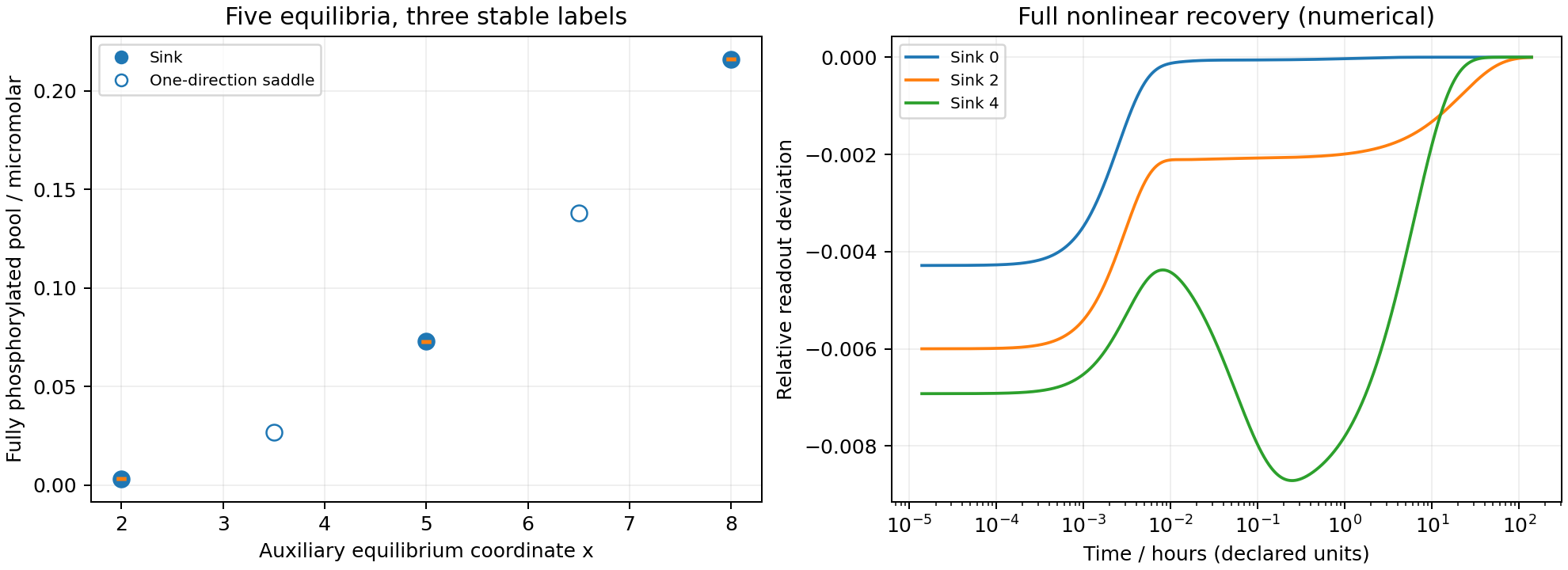
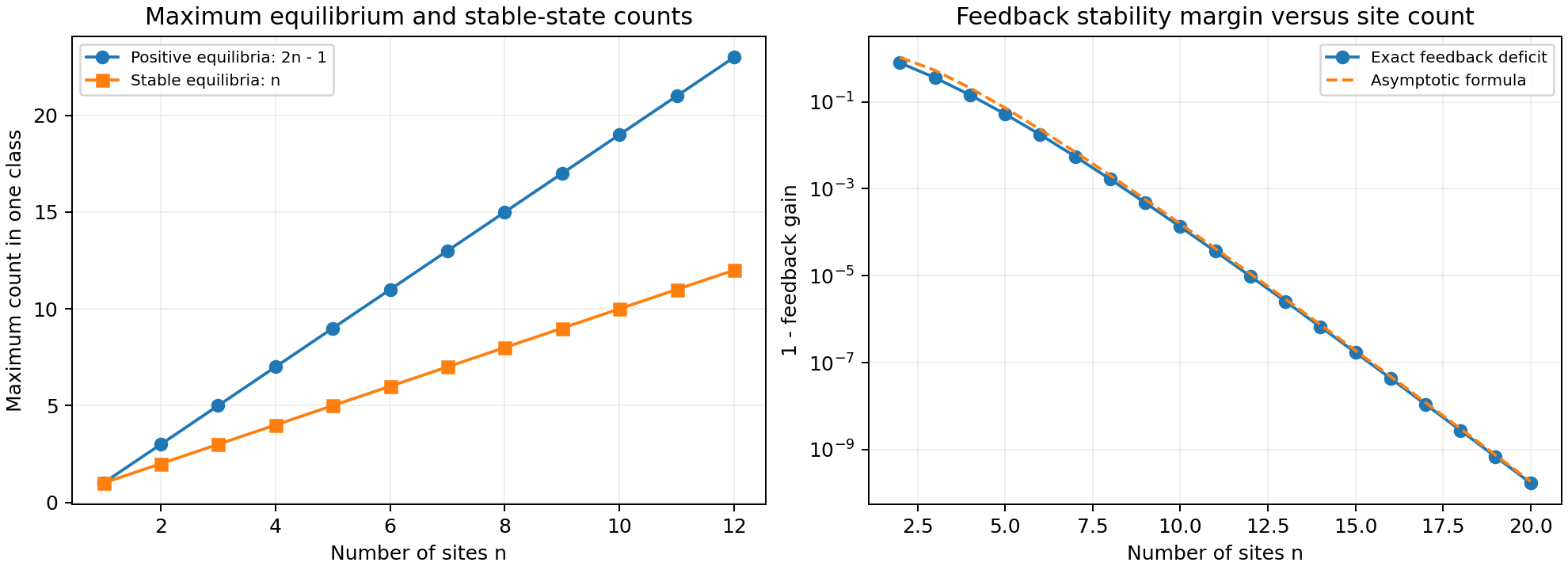
All 48 rational states in the paper's two-through-seven-site witnesses are freshly checked. The benchmark's independent rate-and-total uncertainty bounds and local Lyapunov calculations are also replayed. Full nonlinear recovery traces use larger preparations and are explicitly numerical; they do not enlarge the tiny certified preparation region.
The example exposes the cost of this construction: tightly packed states recover slowly, and its stability margin shrinks with site count. The capacities count deterministic equilibria, not all attractors, information rates or stochastic memory lifetimes. Physical units are declared examples, and Lean is not rerun.
Python source
"""Construct equilibrium geometry, choose kinetics, and verify stable-state capacity."""
# EDITABLE INPUTS: an exact designed family and the separate published benchmark.
DESIGN_SITES = 3
DESIGN_STAGE_BUDGET = 24
CUSTOM_ROOTS = ('2','7/2','5','13/2','8')
ENZYME_TOTAL_RATIO = '9'
CATALYTIC_SCALES = ('1','1','1')
KINASE_DISSOCIATION = ('1','1','1')
PHOSPHATASE_DISSOCIATION = ('1','1','1')
BINDING_SCALE = '1'
INDEPENDENT_PARAMETER_RADIUS = '1/671088640000'
READOUT_ERROR_MICROMOLAR = '1/1000'
CONCENTRATION_UNIT_MICROMOLAR = '1/10'
TIME_UNIT_SECONDS = '10'
TRAJECTORY_DURATION = 50000.
TRAJECTORY_RELATIVE_PERTURBATION = .01 # Exploration outside the tiny certified initial balls.
FULL_PAPER_REPLAY = True             # Includes all 48 rational states for n=2,...,7.

from pathlib import Path
from fractions import Fraction as Q
from dataclasses import asdict
import argparse,csv,hashlib,json,math,platform
import numpy as np
import scipy
from mpmath import mp
import phos_sharp as ps
import phos_capacity as pc
import paper_checks
from model import Geometry,Kinetics,Reactor,stability,ordered_design
from recovery import LocalRecovery

MANUSCRIPT_SHA256='2cda97c29c4bf2773242ede84a0c57667a8aba2e1e90466844a6b5cdce51242f'

def main():
    parser=argparse.ArgumentParser(description=__doc__);parser.add_argument('--output',type=Path,default=Path('outputs'));out=parser.parse_args().output;out.mkdir(parents=True,exist_ok=True)
    def dump(name,value):(out/name).write_text(json.dumps(value,indent=2,default=lambda v:v.tolist() if isinstance(v,np.ndarray) else asdict(v) if hasattr(v,'__dataclass_fields__') else str(v))+'\n')
    def table(name,rows):
        with (out/name).open('w',newline='') as f:w=csv.DictWriter(f,fieldnames=list(rows[0]));w.writeheader();w.writerows(rows)
    print('Replaying exact construction, all rational witnesses, and local interval bounds.',flush=True)
    replay=paper_checks.replay(FULL_PAPER_REPLAY);dump('source_arithmetic_replay.json',replay)
    design=ordered_design(DESIGN_SITES,DESIGN_STAGE_BUDGET);dump('ordered_design.json',design)
    geometry=Geometry(CUSTOM_ROOTS,Q(ENZYME_TOTAL_RATIO));rec=geometry.construct();kinetics=Kinetics(CATALYTIC_SCALES,KINASE_DISSOCIATION,PHOSPHATASE_DISSOCIATION,Q(BINDING_SCALE));rates=kinetics.rates(geometry)
    dump('configured_geometry.json',dict(polynomials={k:list(map(str,rec[k])) for k in ['N','J','A','B','D']},roots=rec['xs'],rates=rates,totals=rec['totals'],states=[dict(state=s['z'],**stability(rates,s['z'])) for s in rec['states']],scope='Distinct roots give distinct equilibria. Geometry is preserved by admitted kinetic retuning; their stability is checked separately, not inferred from count.'))
    here=Path(__file__).parent;benchmark=json.loads((here/'worked_example.json').read_text());certificate=json.loads((here/'operational_certificate.json').read_text());rates=paper_checks.rate_tuple_list(benchmark['record']['rates']);states=[list(map(Q,p['state'])) for p in benchmark['record']['profiles']];totals=tuple(map(Q,certificate['totals']));n=3
    geometry=Geometry(tuple(benchmark['selection']['xs']),Q(benchmark['selection']['r']));rec=geometry.construct();reactor=Reactor(rates,totals)
    profiles=[]
    for j,z in enumerate(states):
        exact=stability(rates,z);matrix=ps.reduced_jacobian(rates,z);eig=np.linalg.eigvals(np.array(matrix,float));u=z[4]/z[5];phi,slope,*_=ps.chart(rec['A'],rec['B'],rec['D'],Q(9),Q(2),u)
        if any(ps.vector_field(rates,z)) or ps.totals(z)!=totals:raise ArithmeticError('Exact benchmark equilibrium failed.')
        profiles.append(dict(index=j,x=str(rec['xs'][j]),u=str(u),state=list(map(str,z)),readout_exact=str(z[3]+z[11]),readout_micromolar=float((z[3]+z[11])*Q(CONCENTRATION_UNIT_MICROMOLAR)),slope=str(slope),leading_real_numerical=float(max(eig.real)),**exact))
    dump('benchmark_equilibria.json',profiles)
    recovery=LocalRecovery(certificate,states).evaluate(INDEPENDENT_PARAMETER_RADIUS,READOUT_ERROR_MICROMOLAR,CONCENTRATION_UNIT_MICROMOLAR,TIME_UNIT_SECONDS);dump('local_recovery_certificate.json',recovery)
    wider=LocalRecovery(certificate,states).evaluate('1/1000',READOUT_ERROR_MICROMOLAR,CONCENTRATION_UNIT_MICROMOLAR,TIME_UNIT_SECONDS);dump('larger_tolerance_attempt.json',wider)
    # The unbound-only mass matrix is intentionally compared with the correct
    # loaded matrix. It is not silently used as the dynamics of this reactor.
    co=pc.coalesced(3,Q(4));state=co['states'][0]['z'];M,h,K=pc.loaded(3,state,Q(8),Q(2));R=pc.incidence(3);wrong=pc.matmul(pc.matmul([[-R[i][j]+h[j] for j in range(4)] for i in range(3)],[[Q(int(i==j))/state[i] for j in range(4)] for i in range(4)]),pc.transpose(R))
    dump('loaded_inventory_comparison.json',dict(mass_matrix=M,loaded_K=K,unbound_only_K=wrong,entrywise_difference=max(abs(K[i][j]-wrong[i][j]) for i in range(3) for j in range(3)),scope='The loaded mass matrix retains enzyme-bound substrate. Replacing it by free-substrate diagonal changes the slow model.'))
    limiting=[]
    for nn in range(2,21):
        v=(3*nn-2)*Q(2,9)**(nn-1);gap=v*(50*nn-45)/(9*(14-8*v));limiting.append(dict(sites=nn,feedback_deficit_exact=str(gap),feedback_deficit=float(gap),asymptote=float(Q(25,21)*nn*nn*Q(2,9)**(nn-1))))
    table('limiting_feedback_margin.csv',limiting)
    kinetic=[]
    for scale in [Q(1),Q(1,10),Q(1,100)]:
        recg=Geometry(tuple(Q(3)+Q(1,2)*(j-2) for j in range(5)),Q(4));kin=Kinetics.from_coalesced_currents(3,Q(4),binding_scale=scale);rr=kin.rates(recg)
        for j,s in enumerate(recg.construct()['states']):
            assert all(v==0 for v in ps.vector_field(rr,s['z']));e=np.linalg.eigvals(np.array(ps.reduced_jacobian(rr,s['z']),float));kinetic.append(dict(binding_scale=str(scale),state=j,unstable=stability(rr,s['z']).get('unstable'),leading_real=float(max(e.real))))
    table('same_geometry_kinetic_sweep.csv',kinetic)
    splitting=split_law();dump('splitting_law.json',splitting)
    curves=[];summaries=[]
    if not 0<TRAJECTORY_RELATIVE_PERTURBATION<.05:raise ValueError('Use a small positive exploratory perturbation below five percent.')
    for j in [0,2,4]:
        z=np.array(states[j],float);q=z[reactor.indices].copy();q[2]*=1-TRAJECTORY_RELATIVE_PERTURBATION;initial=reactor.species(q)
        run=reactor.integrate(initial,TRAJECTORY_DURATION);other=reactor.integrate(initial,TRAJECTORY_DURATION,method='Radau',samples=101);rd=run['species'][3]+run['species'][11];curves.append((j,run))
        summaries.append(dict(sink=j,relative_perturbation=-TRAJECTORY_RELATIVE_PERTURBATION,final_distance=float(np.linalg.norm(run['endpoint']-z)),solver_difference=float(max(abs(run['endpoint']-other['endpoint']))),conservation_drift=run['conservation_drift'],minimum=run['minimum_concentration'],scope='Free S3 is decreased and free S0 increased by the same amount. Numerical recovery outside the very small certified initial neighbourhood.'))
        table(f'recovery_sink_{j}.csv',[dict(time_model=t,readout_micromolar=rd[k]*float(Q(CONCENTRATION_UNIT_MICROMOLAR)),**{label:run['species'][l,k] for l,label in enumerate(reactor.labels)}) for k,t in enumerate(run['time'])])
    dump('nonlinear_recovery_diagnostics.json',summaries)
    table('benchmark_rates_physical.csv',[dict(site=i+1,association_kinase=float(row[0]/(Q(CONCENTRATION_UNIT_MICROMOLAR)*Q(TIME_UNIT_SECONDS))),dissociation_kinase=float(row[1]/Q(TIME_UNIT_SECONDS)),catalysis_kinase=float(row[2]/Q(TIME_UNIT_SECONDS)),association_phosphatase=float(row[3]/(Q(CONCENTRATION_UNIT_MICROMOLAR)*Q(TIME_UNIT_SECONDS))),dissociation_phosphatase=float(row[4]/Q(TIME_UNIT_SECONDS)),catalysis_phosphatase=float(row[5]/Q(TIME_UNIT_SECONDS))) for i,row in enumerate(rates)])
    plot(out,profiles,recovery,curves,limiting)
    print('Exact benchmark unstable counts:',[p['unstable'] for p in profiles],flush=True)
    print('Fresh independent-parameter certificate:',recovery['all_certified'],'; tenfold envelope seconds:',[s.get('tenfold_seconds_upper') for s in recovery['sinks']],flush=True)
    print('Source checks:',replay['checks'],'; equilibrium capacity is 2n-1, stable-equilibrium capacity n. Neither theorem bounds periodic attractors or stochastic memory retention. Lean not rerun.',flush=True)
    digest=lambda p:hashlib.sha256(p.read_bytes()).hexdigest()
    dump('run_metadata.json',dict(manuscript_sha256=MANUSCRIPT_SHA256,source_sha256=digest(Path(__file__)),python=platform.python_version(),numpy=np.__version__,scipy=scipy.__version__,module_sha256={p.name:digest(p) for p in sorted(here.glob('*.py')) if p.name not in ['example.py','test_example.py']},input_sha256={p.name:digest(p) for p in sorted(here.glob('*.json')) if p.name!='release.json'},output_sha256={p.name:digest(p) for p in sorted(out.iterdir()) if p.is_file() and p.name!='run_metadata.json'}))

def split_law():
    mp.dps=60;n=3;r=Q(4);co=pc.coalesced(n,r);kin=Kinetics.from_coalesced_currents(n,r);rates=kin.rates(Geometry((Q(3),)*5,r));cp=ps.charpoly(ps.reduced_jacobian(rates,co['states'][0]['z']));theta=abs(cp[-2]);M=ps.val(co['B'],Q(1))-ps.val(co['D'],Q(1));pref=math.prod((b+c)*al*ga for a,b,c,al,be,ga in rates)
    a=4*(2*r*ps.val(co['N'],r)+ps.val(co['J'],r))*M/((r-1)*ps.val(co['Draw'],Q(1))*theta)*pref;rows=[]
    for delta in [Q(1,2),Q(1,4),Q(1,8),Q(1,16)]:
        geo=Geometry(tuple(Q(3)+delta*(j-2) for j in range(5)),r);rr=kin.rates(geo)
        for j,st in enumerate(geo.construct()['states']):
            matrix=ps.reduced_jacobian(rr,st['z']);J=mp.matrix([[mp.mpf(v.numerator)/v.denominator for v in row] for row in matrix]);e=mp.eig(J,left=False,right=False);slow=min(e,key=abs);leading=-a*delta**4*math.prod(j-k for k in range(5) if k!=j);prediction=mp.mpf(leading.numerator)/leading.denominator
            rows.append(dict(delta=str(delta),state=j,slow_eigenvalue=mp.nstr(slow,30),leading_prediction=str(leading),ratio=mp.nstr(slow/prediction,25)))
    return dict(a_exact=str(a),rows=rows,scope='Exact positive splitting coefficient and high-precision numerical eigenvalue comparison. The delta^-4 recovery tradeoff belongs to this three-site coalescing family, not a universal speed limit.')

def plot(out,profiles,recovery,curves,limiting):
    import matplotlib
    matplotlib.use('Agg')
    import matplotlib.pyplot as plt
    fig,axs=plt.subplots(1,2,figsize=(11,4),layout='constrained')
    for p in profiles:axs[0].plot(float(Q(p['x'])),p['readout_micromolar'],'o',mfc='C0' if p['unstable']==0 else 'white',mec='C0',ms=8)
    if recovery['all_certified']:
        for s in recovery['sinks']:
            a,b=map(lambda x:float(Q(x)),s['readout_interval_micromolar']);x=float(Q(profiles[s['index']]['x']));axs[0].vlines(x,a,b,color='C1',lw=5)
    axs[0].set(xlabel='Auxiliary equilibrium coordinate x',ylabel='Fully phosphorylated pool / micromolar',title='Five equilibria, three stable labels');axs[0].plot([],[],'o',mfc='C0',mec='C0',label='Sink');axs[0].plot([],[],'o',mfc='white',mec='C0',label='One-direction saddle');axs[0].legend(fontsize=8)
    for j,run in curves:
        nominal=profiles[j]['readout_micromolar'];rd=(run['species'][3]+run['species'][11])*float(Q(CONCENTRATION_UNIT_MICROMOLAR));axs[1].semilogx(run['time'][1:]*float(Q(TIME_UNIT_SECONDS))/3600,(rd[1:]-nominal)/nominal,label=f'Sink {j}')
    axs[1].set(xlabel='Time / hours (declared units)',ylabel='Relative readout deviation',title='Full nonlinear recovery (numerical)');axs[1].legend(fontsize=8)
    for ax in axs:ax.grid(alpha=.2)
    fig.savefig(out/'stable_labels_recovery.png',dpi=180);fig.savefig(out/'stable_labels_recovery.svg');plt.close(fig)
    fig,axs=plt.subplots(1,2,figsize=(11,4),layout='constrained')
    ns=np.arange(1,13);axs[0].plot(ns,2*ns-1,'o-',label='Positive equilibria: 2n - 1');axs[0].plot(ns,ns,'s-',label='Stable equilibria: n');axs[0].set(xlabel='Number of sites n',ylabel='Maximum count in one class',title='Maximum equilibrium and stable-state counts');axs[0].legend(fontsize=8)
    axs[1].semilogy([r['sites'] for r in limiting],[r['feedback_deficit'] for r in limiting],'o-',label='Exact feedback deficit');axs[1].semilogy([r['sites'] for r in limiting],[r['asymptote'] for r in limiting],'--',label='Asymptotic formula');axs[1].set(xlabel='Number of sites n',ylabel='1 - feedback gain',title='Feedback stability margin versus site count');axs[1].legend(fontsize=8)
    for ax in axs:ax.grid(alpha=.2)
    fig.savefig(out/'capacity_and_margin.png',dpi=180);fig.savefig(out/'capacity_and_margin.svg');plt.close(fig)

if __name__=='__main__':main()
Run output
Replaying exact construction, all rational witnesses, and local interval bounds.
Exact benchmark unstable counts: [0, 1, 0, 1, 0]
Fresh independent-parameter certificate: True ; tenfold envelope seconds: [356051, 32917295, 23432516]
Source checks: 2365 ; equilibrium capacity is 2n-1, stable-equilibrium capacity n. Neither theorem bounds periodic attractors or stochastic memory retention. Lean not rerun.